Sanctuary of Truth: A Wooden Masterpiece That Has Spent 45 Years Exploring the Meaning of Life
In a photograph of a long hall, the eye travels between intricately carved pillars. Faces, deities, animals and tiny ornaments flow into one another; even the ceiling seems to have been shaped into a single, immense narrative. At the far…
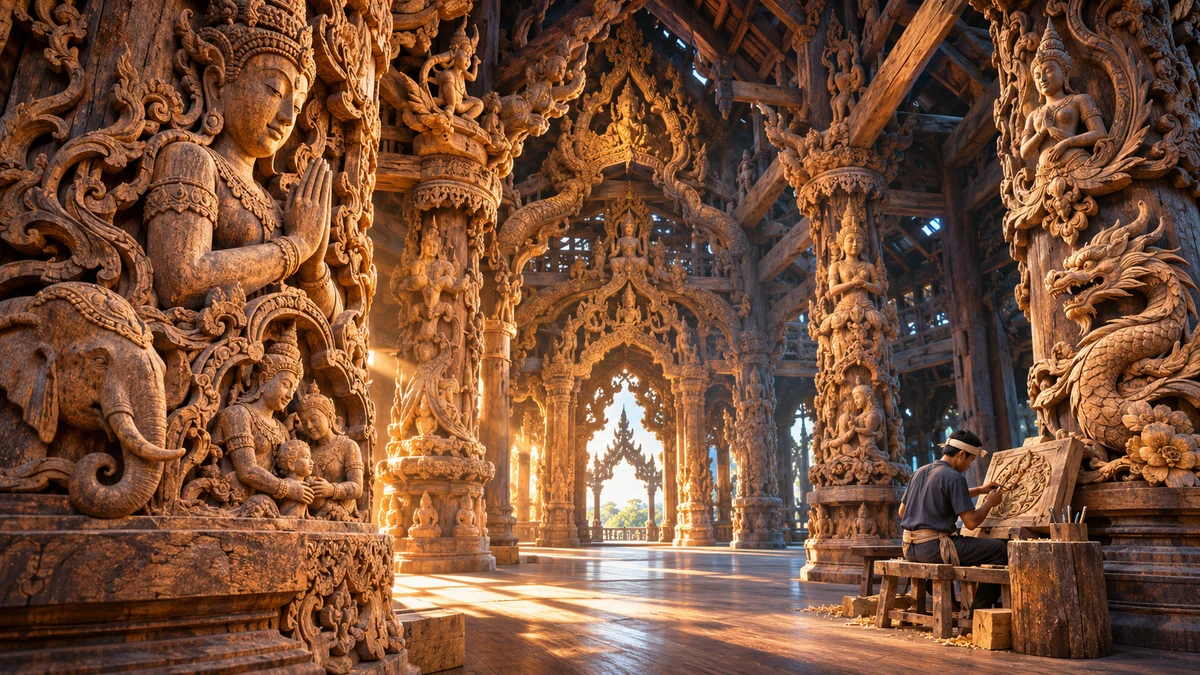
Artistic interpretation of the Sanctuary of Truth interior, not a documentary photograph of a specific hall.
In a photograph of a long hall, the eye travels between intricately carved pillars. Faces, deities, animals and tiny ornaments flow into one another; even the ceiling seems to have been shaped into a single, immense narrative. At the far end of the corridor, daylight streams through an opening. The dark wood glows in its light, and the space seems as though it must have taken centuries to create.
Yet that impression is misleading. The Sanctuary of Truth, on the northern edge of Pattaya in Thailand, is not an ancient temple. Construction began in 1981. By 2026, its story has unfolded over roughly forty-five years, and the building remains a place where carpentry and woodcarving are still actively practised. While the world around it has changed at the pace of the computer age, people here have continued to shape wood and revive demanding techniques for joining it together. [1][2]
Online, the story is often reduced to a “105-metre-high temple built without a single nail.” But there is more to this place than any record-breaking claim. Why would two people envision a building they could never finish in their own lifetimes? And why did they want thousands of carved figures to speak about life, death, family, morality and truth?
A Vision That Outlived Its Founders
The project was conceived by the Thai cultural patrons and entrepreneurs Lek Viriyaphan and his wife, Praphai Viriyaphan. Their story extends beyond Pattaya. Their names are also associated with Ancient City, or Muang Boran, and the Erawan Museum in the Bangkok area. These projects return to a similar idea: art and architecture can preserve the memory of cultural heritage and invite people to consider questions that daily obligations often push aside. [3][4]
Lek was also critical of a world that measures progress primarily in material comfort. According to the institution's account of its founder's vision, he believed that science and technology bring considerable benefits but do not, by themselves, guarantee moral development. This was his philosophical position, not a finding that scientific progress and moral responsibility are inherently opposed. Rather than merely writing about it, he wanted to make a place in which visitors could also think with their eyes, surrounded by stories carved into wood. [3]
The Sanctuary is therefore not a reconstruction of a lost building. It is a modern artistic and philosophical project that draws images from older Asian traditions to address the concerns of people living today. Praphai died in 1992 and Lek in 2000. Work continued after both founders had died, without either seeing the project completed. [4]
This may be the Sanctuary's first lesson, even though it is not inscribed on a sign: some human ambitions demand more patience than a single lifetime can offer. Yet perseverance on a grand scale does not establish that every underlying idea is right. It is worth understanding what the founders hoped to preserve—and how that purpose is being pursued today.
How Can Wood Become an Entire World?

Seen from the coast, the structure resembles an elaborate wooden castle, with tiered roofs and soaring spires. As one approaches, sheer scale gives way to detail. Carved figures emerge from the columns, animals and deities appear along the passages, and richly decorated wooden surfaces continue overhead. The carvings are not merely decorations added after construction: they help determine how the building and its spaces are understood.
The museum emphasises traditional Thai timber joints, in which components interlock through grooves, wedges and carefully worked connections. The associated Muang Boran museum also describes joints resembling dovetails. Such craftsmanship demands precision and an understanding of wood, which moves with changes in humidity and temperature. The carved faces matter, but so do the often unseen components that bear loads and hold the structure together. [2][5]
This is the origin of the celebrated claim that the Sanctuary of Truth was built “without nails.” The operator and tourism institutions explicitly promote this principle. But there is a difference between describing traditional construction using wooden joints instead of ordinary nails and claiming, without exception, that not a single metal fastener has ever been used anywhere in the building, in any repair or in auxiliary equipment. The latter would require a detailed, independent technical inspection. That qualification does nothing to diminish the genuine achievement of its craftspeople. [1][2][5]
Nor is the material simply one exotic species of wood. Muang Boran lists several hardwoods, including mai daeng, mai takien, mai panchart and teak. Keeping the local names is important: calling all of them “mahogany” or “golden teak” would obscure real differences, and we do not have a comprehensive independent botanical inventory of the wood used in each part of the building. [5]
Imagine a workshop in which a piece of timber is slowly transformed into a face or a structural element. In the end, it must satisfy both the artistic design and the place it will occupy in the larger whole. This kind of work is not the opposite of modern technology. It is a reminder that even the most technologically advanced society needs people who understand their materials, master their tools and take responsibility for what they make.
How Tall Is the Sanctuary of Truth?
Descriptions of the building's monumental scale frequently give a height of 105 metres. That figure appears on the website of the associated Muang Boran museum, which also gives dimensions of around one hundred metres along both horizontal axes and an interior floor area of 2,115 square metres. The Tourism Authority of Thailand has likewise reported a height of approximately 105 metres, while another institutional presentation uses a figure of about one hundred metres. [5][8][9]
Yet Connecting to Spiritual Thailand, a publication hosted by a Thai government office, describes a 30-metre-high sanctuary on page 44. As published, these figures clearly conflict. Perhaps they refer to different parts of the building or use different reference points; perhaps one is simply mistaken. Without technical drawings or a reliable survey, guessing cannot settle the discrepancy. [7]
The responsible conclusion is therefore this: 105 metres is a widely circulated height, including in institutional sources, but it is not consistent across every source reviewed. This article does not present it as an independently verified measurement. The unresolved technical detail does not make the building any less remarkable as an example of wooden architecture.
Seven Truths Told Through Carvings
The real reason for the name Sanctuary of Truth is not its height. The institution presents visitors with a philosophical programme of seven truths, intended to link an artistic experience with questions about human life. This is a contemporary museum interpretation drawing on several traditions, not proof that all Asian civilisations historically shared a single doctrine of seven truths. [6]
The first concerns human origins, the shared nature of human beings and the four elements—earth, water, wind and fire. The second concerns the cycle of life: birth, ageing and suffering. The third asks about death, reminding us that material wealth cannot be taken with us. The fourth reflects on civilisations, whose achievements and ideas can outlive the people who created them. [6]
The fifth truth considers the purpose of life and the direction of our actions. The sixth examines society, in which good and evil coexist and the choice of how to act is therefore consequential. The seventh turns to family: parents, children, relationships and the values people first encounter among those closest to them. [6]
These themes raise questions that can matter even to someone who belongs to none of the religious traditions represented. What do we leave behind? Whom do our choices affect? What is worth passing on to the next generation? The carvings do not answer through scientific experiments or legal proofs. They offer images that encourage visitors to look more slowly and think more deeply.
For THY-REALITY, another distinction matters. Similar concerns about dignity, responsibility and truth do not mean that the museum's philosophical programme can simply be equated with the universal moral Natural Law advocated by the website. The two can be compared, their shared questions recognised and their differences explained. Such a comparison is more valuable than automatically appropriating someone else's spiritual heritage.
Four Cultural Worlds Under One Roof
The wooden surfaces bring together motifs from Thai, Khmer, Indian and Chinese art. They include images associated with Buddhist, Hindu and other Asian philosophical and mythological traditions. That does not amount to archaeological evidence for a once-unified world religion. It reflects a deliberate modern choice by the project's artists and patrons to allow several cultural languages to speak within one building. [10][11]
The museum's interpretation also assigns particular themes to different sections. It associates the eastern hall with parents and gratitude, and the western hall with the four elements and the relationship between heaven and earth. The northern hall explores social and spiritual growth through Chinese philosophical and Mahayana Buddhist motifs. The southern hall uses images of the sun, moon and planets, while the central space evokes Buddhist ideas of liberation and freedom from attachment. These are interpretations within this particular project, not universal definitions of all the traditions represented. [5]
Hindu deities have their own historical meanings, Buddhist teachings their own doctrines, and Chinese philosophy its own development. Artistic synthesis can bring them closer to visitors, but it cannot erase their differences. That tension is itself illuminating: under one roof, a dialogue emerges that should not be confused with historical identity.
Some visitors will primarily see exceptional woodcarving. Others will recognise religious symbols; still others will reflect on the meaning of life. All these experiences are possible, but they are not the same. A thoughtful account of the Sanctuary need not force them into a single interpretation.
A Monument Still in the Making
At many historic monuments, we admire the handiwork of craftspeople who died centuries ago. In Pattaya, the woodcarvers and carpenters belong to the story of the present. The Sanctuary is simultaneously an exhibition space, a workshop and a construction site. Thai tourism information confirms that building and carving continue, while the museum's visitor rules provide for safety helmets inside the structure. [2][12]
This is more than an attractive scene to photograph. A traditional skill survives only when people continue to practise it and pass it on. The knowledge involved is not just how to carve an attractive figure, but how a material behaves, how load-bearing components fit together and how to correct a mistake before it becomes dangerous. It would be irresponsible to make claims about the working conditions of today's craftspeople without appropriate testimony and records; it is nonetheless important to recognise their labour as an essential part of this heritage.
Wood ages. On the coast, it is exposed to moisture, sun, wind and other environmental stresses. Some components will require maintenance or perhaps replacement, regardless of when the construction is formally declared finished. This offers an almost irresistible symbolic parallel with the project's reflections on impermanence. But it is our interpretation, not a verified quotation from its founders.
The material dimension of the project also raises questions. Using hardwood on such a monumental scale reasonably invites scrutiny of raw-material origins, traceability and sustainable forest management. The sources reviewed do not provide complete independent evidence of procurement and certification. We therefore have grounds neither to accuse the project of illegally sourced timber nor to claim that every material has demonstrably met a particular environmental standard. Taking truth seriously also means admitting when the necessary information is absent.
When a Philosophical Sanctuary Becomes a Tourist Attraction
Official Sanctuary of Truth Museum gallery
Today the Sanctuary of Truth is not an isolated space where people contemplate life in silence, untouched by the modern world. It sells admission tickets and offers guided tours, souvenirs and other tourist activities. Its official pages list elephant riding and a small zoo among the attractions. This raises questions about the place of animals in tourist entertainment, although a service listing alone tells us nothing definitive about the health or care of any individual animal. [1][2]
The tension between spiritual content and tourist spectacle is thus more than a rhetorical flourish. In Architects of Buddhist Leisure, scholar Justin Thomas McDaniel examines cultural projects associated with the Viriyaphans as places where religious images, art, public culture and leisure intersect. His work suggests that the boundary between the “sacred” and the “secular” is not always simple in such settings. [13]
Tourism can help sustain workshops and allow a wider public to encounter the art. But it can also turn visitors' attention away from the meaning of the carvings and towards attractions, purchases or the perfect photograph. Neither outcome is inevitable. A fair judgement requires looking at what activities actually take place and how they are conducted.
This is where the founders' original vision faces its hardest test. If the building speaks of compassion, family and responsibility, it is fair to apply those same values when considering how the institution operates today: the treatment of workers, its relationship with animals, the use of timber and the way it presents history. A value carved into wood must also withstand questions about how it is lived beyond the relief.
What Can a Building That Takes Decades Tell Us?
The Sanctuary of Truth conceals neither an unknown civilisation nor a forgotten supernatural technology. We know its location, when construction began and who founded it; we can study its artistic influences. Its true distinction lies elsewhere: in an attempt to use things that do not last forever—wood, human labour and time—to carry questions people experience as enduring.
A monumental structure cannot, by itself, prove a philosophy. Nor does prolonged effort guarantee that every institutional decision lives up to the institution's ideals. Yet the project can still prompt serious reflection. How much patience are we willing to devote to something without an immediate reward? What does it mean to pass on knowledge rather than merely objects? And what responsibility do we bear towards people who will live after us?
In 1981, a project began on the Thai coast that would stretch beyond ordinary construction schedules. In 2026, its wooden story is still being written. Visitors need not accept every religious image or museum interpretation to appreciate the power of the scene. Perhaps the Sanctuary of Truth's most compelling question is not how so much intricately carved wood was assembled, but why it might be worth devoting so much time to truth—and what we ourselves are prepared to do to make our lives reflect it.
Sources and further reading
- Sanctuary of Truth Museum, Official Website — construction start, timber and visitor activities: source Source
- Thailand Tourism Directory, The Sanctuary of Truth — construction since 1981, woodcarving, timber joints and ancillary activities: source Source
- Sanctuary of Truth Museum, Founder — the founder's vision and philosophical background: source Source
- Erawan Museum, Founder's Legacy — Lek and Praphai Viriyaphan, biographical details and the continuation of their legacy: source Source
- Muang Boran Museum, Sanctuary of Truth — jointing methods, types of timber, reported dimensions and interpretations of the halls: source Source
- Sanctuary of Truth Museum, 7 Pillars — the official presentation of the seven truths: source Source
- Connecting to Spiritual Thailand: A Guide to 60 Powerspots, “The Sanctuary of Truth, Chonburi,” p. 44 — a reported height of 30 metres: source Source
- Tourism Authority of Thailand, The Sanctuary of Truth — One of the Wonders of Southeast Asia (2015) — a reported height of approximately 105 metres: source Source
- Thailand Foundation, Pattaya’s Most Beautiful Temple: The Sanctuary of Truth — institutional description of a height of approximately 100 metres: source Source
- Museum Thailand, The Sanctuary of Truth Museum — the institution's contemporary museum identity: source Source
- Angkor Database, Artistic Syncretism at the Sanctuary of Truth, Thailand — the combination of Thai, Khmer, Indian and Chinese motifs: source Source
- Sanctuary of Truth Museum, Visit Us — visitor rules and safety helmets: source Source
- Justin Thomas McDaniel, Ecumenical Parks and Cosmological Gardens: Braphai and Lek Wiriyaphan and Buddhist Spectacle Culture, in Architects of Buddhist Leisure, University of Hawai‘i Press, 2017, pp. 82–130: source Source