Etruscans and Sloveni — Ancient Languages, Alpine Connections, and the History of Hypotheses
Etruscan cities and inscriptions, links to the Raeti and Lemnians, and hypotheses about the Sloveni: what can archaeology, linguistics and genetics establish?
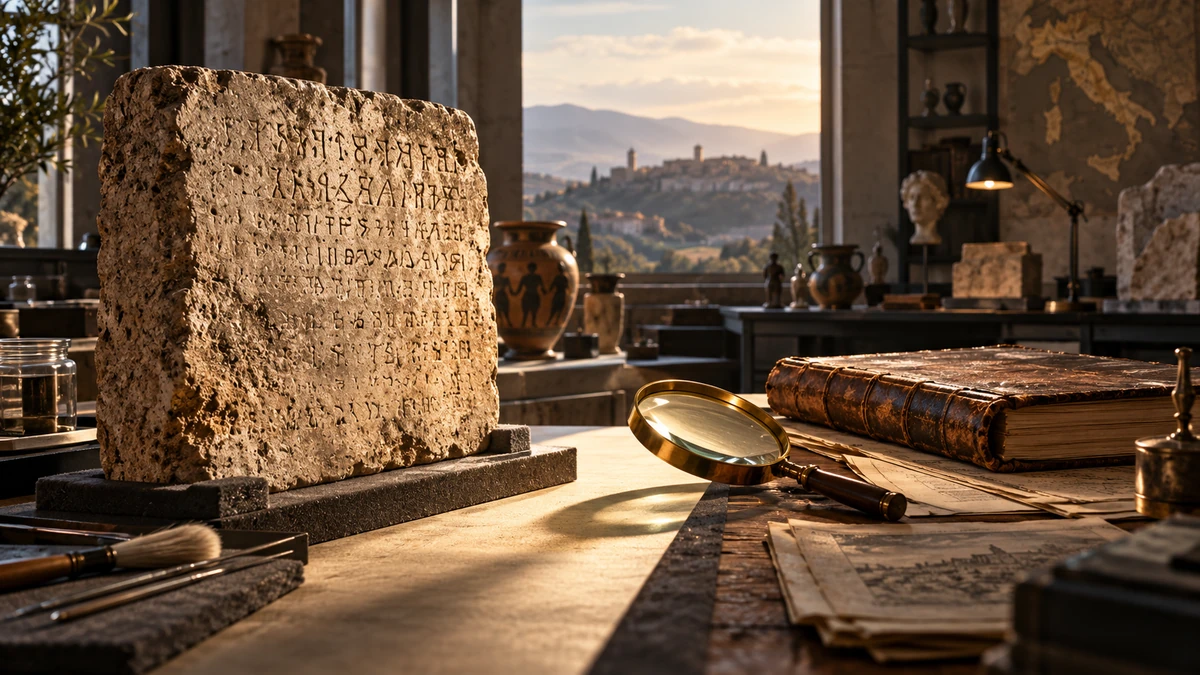
The Etruscans left behind cities, tombs, artworks, and thousands of inscriptions. Their civilisation profoundly shaped central Italy and the early Roman world, while their language remains the subject of intensive research. Alongside this history stands another question: how were they connected to the inhabitants of the Alpine region, the Raeti, and to people living on the Aegean island of Lemnos? And why did certain later writers seek traces of the Sloveni in those connections?
These questions need not be compressed into a single answer. Archaeological similarities may testify to trade and cultural contact; linguistic kinship may point towards an older shared linguistic history; an ancient writer may preserve a tradition without thereby proving it. The identity of people who, two thousand years ago, used names different from those of modern nations is an even more difficult matter. A name alone, whether in an ancient text or a later book, is no substitute for evidence of historical continuity.
In this article, we use the editorial designation Sloveni when discussing broader historical hypotheses that employ that term or a related one. This does not automatically equate every group so designated with modern Slovenes, nor does it alter the precise names of peoples found in primary sources. When discussing the Molise Croatian communities, we shall therefore state explicitly that present-day Italian institutions identify them as the Croats of Molise. Original terminology is retained in historical titles and quotations.
Our investigation begins not with modern pictures or online claims but with objects, inscriptions, chronology, and linguistic evidence. Only after examining that foundation can we ask what supports a proposed connection between Etruscans and Sloveni, where the argument depends on a later interpretation, and what remains genuinely unresolved.
The Etruscans: People, Cities, and Cultural Geography
The heartland of the Etruscan world was Etruria, broadly corresponding to modern Tuscany, northern Lazio, and part of Umbria. Important centres included Tarquinia, Cerveteri, Veii, Vulci, Volterra, and other cities. Etruscan political organisation was not a unified state in the modern sense. It consisted of city communities with their own elites, interests, and alliances, connected by shared religious and cultural patterns. Their relationships with Greeks, Phoenicians, other Italic communities, and later the Romans changed over the centuries. [1] [2]
The development of Etruscan civilisation becomes particularly visible from the Iron Age onwards. Archaeologists also use the designation Villanovan culture for material patterns of earlier periods across a broader part of Italy. Yet the name of an archaeological culture is not necessarily the name of a people or a language. Excavated objects reveal burial practices, techniques of production, and forms of settlement; they do not, by themselves, tell us how the people concerned defined their ethnicity. We should therefore not imagine Etruria as an unchanging population that lived for centuries without contact or migration.
What did the Etruscans say about themselves? Inscriptions preserve forms of names, personal names, and certain words belonging to their world. Greeks used the designations Tyrrhenians or Tyrsenians, while Romans used Etrusci or Tusci. The different names applied to the same historical region remind us that ethnonyms arise through relationships between communities and their neighbours. We cannot simply take one name from one language and, without additional evidence, derive the origin of an entire people from it.
The necropolises of Cerveteri and Tarquinia reveal an extraordinarily rich material and artistic heritage. Tomb structures resembling houses, painted burial chambers, everyday objects, and ritual imagery allow us to study social relationships even in the absence of surviving historical chronicles written in Etruscan. UNESCO particularly stresses the importance of these sites for understanding Etruscan urban and social life. [1]
The Etruscans are not a historical mystery because we know nothing about them. The difficulty lies in the uneven survival of evidence: we know much about their material world but considerably less about their language and their understanding of themselves. That very imbalance has often opened the door to widely differing explanations of their origins.
What Remains of Their Voice? Language, Script, and Lost Texts
Etruscan is a non-Indo-European language, attested in more than ten thousand inscriptions. The designation “non-Indo-European” means that it has not been reliably classified within the Indo-European language family. It does not mean that it has no history or that scholars understand none of its words. We can read or transliterate Etruscan writing considerably better than we can interpret every sentence written in it. [2] [3]
The Etruscans developed their script from Greek alphabetic forms transmitted to the Italian peninsula through maritime contacts. Many inscriptions were written from right to left. To an unfamiliar observer, the letters may therefore appear “reversed.” But a writing system is not the same as a language: people can adopt a foreign script without adopting its language, and the same language can be written in different systems over time.
Most surviving texts are short. They include funerary inscriptions, personal names, dedications to deities, marks of ownership, and other formulaic expressions. Such inscriptions are valuable evidence for grammatical forms and naming practices, but they tell us far less about philosophy, storytelling, or everyday conversation. Scholars can compare certain grammatical endings and sentence patterns; the meanings of other words, and the exact translation of longer passages, remain disputed. [2] [3]
One particularly important witness is the Zagreb Linen Book (Liber Linteus Zagrabiensis). Its linen text survived because it was later reused as the wrapping of an Egyptian mummy. Its existence shows that Etruscan written culture was not confined to inscriptions on stone, even though most other documents made from perishable materials have disappeared. The circumstances of preservation are strikingly unexpected: we know an Etruscan text because it was repurposed far from Etruria. [2]
This is also why claims that the whole of Etruscan can be translated merely by reading it through a modern language demand caution. A convincing translation requires more than a few sequences that resemble familiar words. An interpretation must work across many different inscriptions, consistently explaining grammatical forms, personal names, dates, and archaeological contexts.
Cippus Perusinus: An Ancient Stone and a Very Specific Legal Agreement

One of the most important longer Etruscan inscriptions is the Cippus Perusinus, also known as the Cippo di Perugia. The travertine monument was found in 1822 on the San Marco hill near Perugia. It is generally dated to the third or second century BCE. Its inscription contains 24 lines on the front and 22 on the side, for a total of 46 lines. Museum documentation describes it as a record of a legal agreement between the Velthina and Afuna families concerning the use or demarcation of land and a family tomb. [4] [5]
The object is valuable because it places Etruscan writing in the setting of ordinary legal practice. It is not merely the name of a deceased person or a short ritual formula. It is a record that involves a witness or judge, an agreement, terms relating to boundaries, and other legal details. Members of families identifiable within the wider Etruscan world are named. Nevertheless, scholars do not always agree about individual words or the division of the legal provisions. The cippus demonstrates the existence of a sophisticated written legal culture; it does not authorise an entirely confident translation of every line.
The physical appearance of the monument matters as well. The lines follow conventions of Etruscan writing unlike those of the present day. Some similarly shaped signs occur in other ancient Italic scripts. It is therefore understandable that readers become interested in comparisons with other languages. Yet resemblance to a modern word does not explain the legal meaning of an entire inscription. A method must show how the proposed meaning fits the sentence, its inflections, and other known Etruscan documents.
The museum account also draws attention to a noteworthy detail: the inscription is not simply a uniform flow of letters. There are perceptible transitions between sections, and some lines were corrected or adjusted. This raises questions about the preparation of a model text, the work of the stonecutter, and the transfer of a legal document onto stone. Such technical features constitute direct historical evidence that can be compared with other Etruscan objects. [4]
What does the object attest? Etruscan scribes, legal relationships, local names, and particular uses of the language. What does it not establish by itself? Neither a connection to any modern nation nor prehistoric migrations of origin. Such wider claims would require an additional, independent chain of evidence. The Cippus Perusinus is more interesting for its own history than as a mere backdrop for disputes about present-day identity.
The Raeti and Lemnians: Is Etruscan Really an Isolated Language?
Etruscan was often described in the past as an entirely isolated language. Today that description requires qualification. There is documented linguistic kinship with Raetic in the Alpine region and significant similarities with Lemnian from the Aegean island of Lemnos. Researchers group these languages under the designation Tyrsenian language family. The surviving evidence differs greatly in quantity and quality among the three, so not every question can be answered with the same degree of confidence. [6] [7] [8] [9] [10]
Raetic is known from several hundred inscriptions, mostly from the regions of modern Trentino and Tyrol, and less frequently from neighbouring Alpine areas, including a small number of finds within present-day Slovenia. The inscriptions date approximately from the sixth to the first century BCE. Some are dedications or marks of ownership; others are especially difficult to interpret because they are so brief. The University of Vienna's Thesaurus Inscriptionum Raeticarum systematically collects and compares this material. [6] [7]
The relationship between Raetic and Etruscan was not inferred from one similar-sounding word. Researchers compare grammatical endings, forms of personal names, and related sentence constructions. Some correspondences are systematic enough to support linguistic kinship, although the limited corpus restricts the precision with which a common ancestor can be reconstructed. This is a much stronger basis than a general resemblance between alphabets, since scripts can resemble one another through cultural contact even when the languages they record are unrelated. [7] [9] [21]
Lemnian is known from a much smaller body of inscriptions, principally from the sixth century BCE. The celebrated stele from Kaminia depicts a warrior-like figure and preserves a relatively long text. Additional finds on Lemnos have enlarged the comparative evidence, but it remains sparse. Its linguistic resemblance to Etruscan is significant. It does not, however, determine on its own whether the relationship arose through an older shared linguistic history, movements of speakers, or other forms of contact among communities. Archaeological and chronological explanations are also necessary. [10] [22]
What do these three languages tell us about the connections between northern Italy, the Alps, and the Aegean? Certainly that the linguistic map of antiquity differed from our own, and that languages spread, changed, and disappeared along historical routes we are still reconstructing. They do not directly tell us that all speakers of Tyrsenian languages belonged to a single political or ethnic people. Linguistic kinship is important evidence, but only one dimension of historical identity.
From Ancient Testimony to Later Interpretation
Ancient writers themselves observed connections between the Etruscans and the Alpine Raeti. In his history of Rome, Livy wrote about the Etruscan origins of certain Alpine communities and the surviving traces of their language. Pompeius Trogus and Pliny appear within a similar body of tradition. These accounts are not modern linguistic studies: observations, political geography, and narratives of migration may all be interwoven. Yet they are historically valuable because they show that a relationship between the Raeti and Etruscans was already being discussed in antiquity. [8]
In the sixth century CE, Stephanus of Byzantium compiled the Ethnika, a collection of geographical and ethnic names. In its later, mostly abbreviated transmission, the entry Ῥαιτοί offers a brief connection between the Raeti and the Tyrrhenians. In August Meineke's 1849 edition, the entry is conventionally cited as “Ῥαιτοί, Τυρρηνικὸν ἔθνος.” Its approximate meaning is “Raeti, a Tyrrhenian people.” This is a short lexicographical gloss, not a detailed history of every population of the Alps. [11]
The Greek wording does not contain the name Sloveni. It remains important, however, that the connection between the Raeti and Tyrrhenians was not invented: it belongs to an ancient tradition independently of later national interpretations. This distinction is central to fair-minded historical investigation. There is no need to discard genuine ancient testimony simply because some later writers expanded it into a hypothesis that the testimony itself cannot establish.
One such later writer was Yegor Klassen, who in the nineteenth century attempted to connect various ancient names and communities with the history of the Sloveni. The existing research record preserves his discussion of the Raetic entry on printed page 30 of the 1861 edition. His argument is interesting as part of the history of a hypothesis: it shows how ancient testimony could be incorporated into a much broader historical framework. But it is essential to distinguish Stephanus's brief statement from Klassen's additional interpretation. [12]
To transform the later hypothesis into a persuasive historical claim, one would need to show more than a similar name or a single ancient connection. A chronologically grounded relationship between languages, clearly defined names, and other independent evidence would be required. The ancient connection between Etruscans and Raeti is a well-founded subject of research; extending that connection to the Sloveni is a separate question.
Why Similar Names and Words Are Not Enough
Historical languages naturally invite independent investigation. A reader sees a sequence of old signs, tries to sound them out, and suddenly hears something resembling a word in their own language. Such a moment can lead to a useful question. It is not yet evidence that the languages are related or that the proposed translation is correct.
Comparative linguistics asks whether systematic phonological and grammatical correspondences recur between languages. Where sufficient material is available, we can investigate whether a particular sound in one group regularly corresponds to a particular sound in another, whether words have historically comparable forms, and whether similar patterns occur in grammar. A single accidental resemblance is less convincing than a set of independent, reproducible rules.
In the case of Etruscan, several limitations make that task difficult. Many inscriptions were intended for funerary or ritual contexts; no surviving historical books explain the language's entire vocabulary. That helps account for the understandable interest in alternative readings. But a proposal must explain complete sentence structures and succeed across different texts, not only a handful of selected examples. If an interpreter freely changes phonetic values for each inscription or ignores inconvenient signs, the method cannot be independently tested.
Personal names and place-names pose a particular problem. They may preserve traces of old languages, but they can also move between communities, change pronunciation, or remain in use long after a language has been replaced. Two names that sound alike therefore need not belong to the same people; conversely, names that sound different do not rule out a historical connection. What matters is the sequence of historical layers, the chain of written attestations, and demonstrable sound changes.
For a proposed connection between Etruscans and Sloveni, a particularly significant discovery would be a documented series of grammatical and lexical correspondences testable against multiple inscribed objects with reliable archaeological dates. The sources reviewed so far do not establish such a chain of evidence. That is not a claim that future research can produce no new evidence; it is a description of the present evidentiary position.
The Northern Adriatic and the Alps: Contact Is a Fact, Identity a Question
De Rubertis, Delle colonie Slave nel regno di Napoli (1856) — digitized edition
Etruscan history is not confined to Tuscany. Etruscan influences and objects also appear farther north, including in the Po Valley, while trade routes connected central Italy with the northern Adriatic and Alpine regions. Speakers of different languages lived within this broader landscape, among them Venetic, Raetic, and Celtic languages. Objects and writing systems can travel much farther than the people who first used them. [6] [20]
Cultural contact between the Etruscan and Alpine worlds is therefore an entirely legitimate historical subject. It can be investigated through archaeological finds, comparable objects, trading routes, and documented linguistic relationships. Not every similarity, however, demonstrates a mass migration, a single political authority, or an unchanged ethnic identity extending from antiquity to the present.
Raetic is especially instructive here. Its linguistic kinship with Etruscan has an evidentiary basis of its own, which makes it a stronger claim than a rough similarity between artefacts. At the same time, the Thesaurus Inscriptionum Raeticarum warns that the ancient designation Raeti cannot unreservedly be equated with a single, sharply bounded community defined by modern criteria of language, culture, or belonging. [6]
It is therefore worthwhile to investigate connections that have no simple national answer. An archaeological find close to the Slovenian border may belong to an important northern Adriatic network without implying that the person associated with it was a Sloven in the modern sense. Such caution does not diminish the importance of the Alpine region. It makes it possible to situate that region more precisely within the wider history of antiquity.
The Communities of Molise: Real Migrations, but a Much Later History
Thomas Dempster, De Etruria regali libri VII (1723) — volume I
Along Italy's eastern seaboard lies the history of communities whose ancestors arrived from across the Adriatic and preserved distinctive forms of speech. This is a documented story worthy of investigation in its own right. It does not, however, automatically belong to the same historical period as Etruscan civilisation.
In 1856, Giovanni de Rubertis published Delle colonie Slave nel regno di Napoli in Zadar. We retain its original historical title. The book concerns southern Italian settlements whose inhabitants maintained linguistic and cultural links to the eastern Adriatic. Among the places discussed are Montemitro, San Felice, Tavenna, and Cerritello, together with questions about their settlement or resettlement. Older sources associate some of these movements with events of the fifteenth century, including a period around 1468. [13]
Here we must distinguish the foundation of a settlement, the arrival of a new population, and the subsequent survival of that population's language. A settlement may predate later arrivals, may have been abandoned and then reoccupied, or may have experienced more than one wave of migration. A single date cannot therefore serve, without supporting records, as the founding year for every place named by a historical author. De Rubertis is an important source for the history of these traditions as they were recorded, but his book does not itself demonstrate that an independently preserved founding charter exists for each village.
Before de Rubertis, Giovanni Andrea Tria wrote about local history in a work published in 1744. His accounts use various historical designations for people arriving from the eastern side of the Adriatic. The variation is unsurprising: writers often categorised communities by their region of origin, ruler, language, religious affiliation, or other considerations. Present-day national categories should not be projected uncritically onto every older text. [14]
In the early twentieth century, Milan Rešetar also studied these communities from a linguistic perspective. His work helps distinguish living dialect features from historical narratives about the origins of individual villages. Today, Italy's central institute for intangible heritage explicitly refers to the Croats of Molise (Croati del Molise). A distinctive Molise Croatian variety has survived, also known locally as na-našo, with pronounced connections to the Štokavian-Ikavian linguistic area. Among its best-known communities are Acquaviva Collecroce, Montemitro, and San Felice del Molise. [15] [16]
The example is valuable because it shows how a linguistic community can preserve elements of its heritage over a long period while its names and surroundings change. Yet a vast chronological gap separates medieval and early modern migrations to Molise from Etruscan inscriptions dating to the centuries before the Common Era. A historically attested later community cannot, in the absence of intermediate evidence, resolve the origin of a much older language.
Research into earlier continuity across the Adriatic would require different evidence: long sequences of archaeological finds, dated linguistic developments, and documented contacts. De Rubertis provides a significant starting point for understanding the later history of these communities, not a demonstrated connection with the Etruscans.
How Have Historians Explained the Origins of the Etruscans?
The Etruscans attracted the attention of ancient writers, who proposed different accounts of their origins. One tradition linked them with Anatolia; other accounts placed greater emphasis on their local history in Italy. These narratives are themselves valuable for understanding the ancient world, but they should not automatically be treated as modern archaeological findings. Centuries could separate the formation of a tradition from the period it claimed to describe.
Early modern scholarship likewise pursued its own questions and ambitions. Thomas Dempster, a Scottish scholar active in Italy, worked in the early seventeenth century on the extensive De Etruria regali libri VII. It appeared posthumously in 1723–1724. The work is a landmark in the history of collecting and interpreting Etruscan heritage, while also reflecting the interest of its age in the grandeur of ancient Etruria. [17]
With such works, we must distinguish between the description of a monument, a historian's interpretation, and praise of an ancient civilisation. If an early modern scholar credited the Etruscans with an extraordinary range of cultural achievements, it does not follow that each one has been independently established as the first achievement of its kind in history. The work may be exceptionally important to the history of scholarship without every judgment in it amounting to a definitive finding.
The later researcher Aleksandr Nemirovsky also addressed the history of idealised portrayals of the Etruscans. The earlier version of this article preserved a lead to his critical summary of Dempster's views. Establishing the exact textual history of particular celebratory lists would require comparison between Nemirovsky and the relevant Latin passages in Dempster. That full, direct parallel has not been verified in the research available so far. We therefore do not present such a list as an already checked verbatim quotation. [18]
Modern questions about Etruscan origins are broader. Archaeology documents local development and numerous contacts; linguistics identifies relationships with other Tyrsenian languages; genetics sheds light on the biological histories of individuals and populations. No single one of these approaches supplies a complete ethnic answer. The question is not merely “where did a people come from?” but also how a culture formed, who spoke its language, which contacts altered it, and when the names of communities changed.
Archaeology, Languages, and Genetics: Which Forms of Evidence Can Be Combined?
Investigating ancient populations demands the cooperation of different methods. Archaeology examines material remains; linguistics studies the structures of languages and their relationships; textual research investigates written traditions; genetics analyses patterns of biological relatedness within the samples available. Important connections can emerge between their findings, but each type of evidence primarily answers its own questions.
A genetic study by Posth and colleagues (2021) analysed data from 82 ancient individuals across a time span of roughly two thousand years in Etruria and southern Italy. Iron Age samples showed affinities with neighbouring groups and an ancestry component linked to older migrations from the steppe region. The study did not support an expectation of substantial recent Anatolian admixture in the Etruscan population sampled. Major changes became visible during the later Roman period. [19]
This finding matters when evaluating certain historical models of migration. But it does not mean that researchers can “read” an individual's spoken language or political allegiance from a genome. Biological ancestry, language, and cultural identity are not always transmitted together. Within the same historical region, people could marry across communities, trade, adopt new languages, and retain older customs.
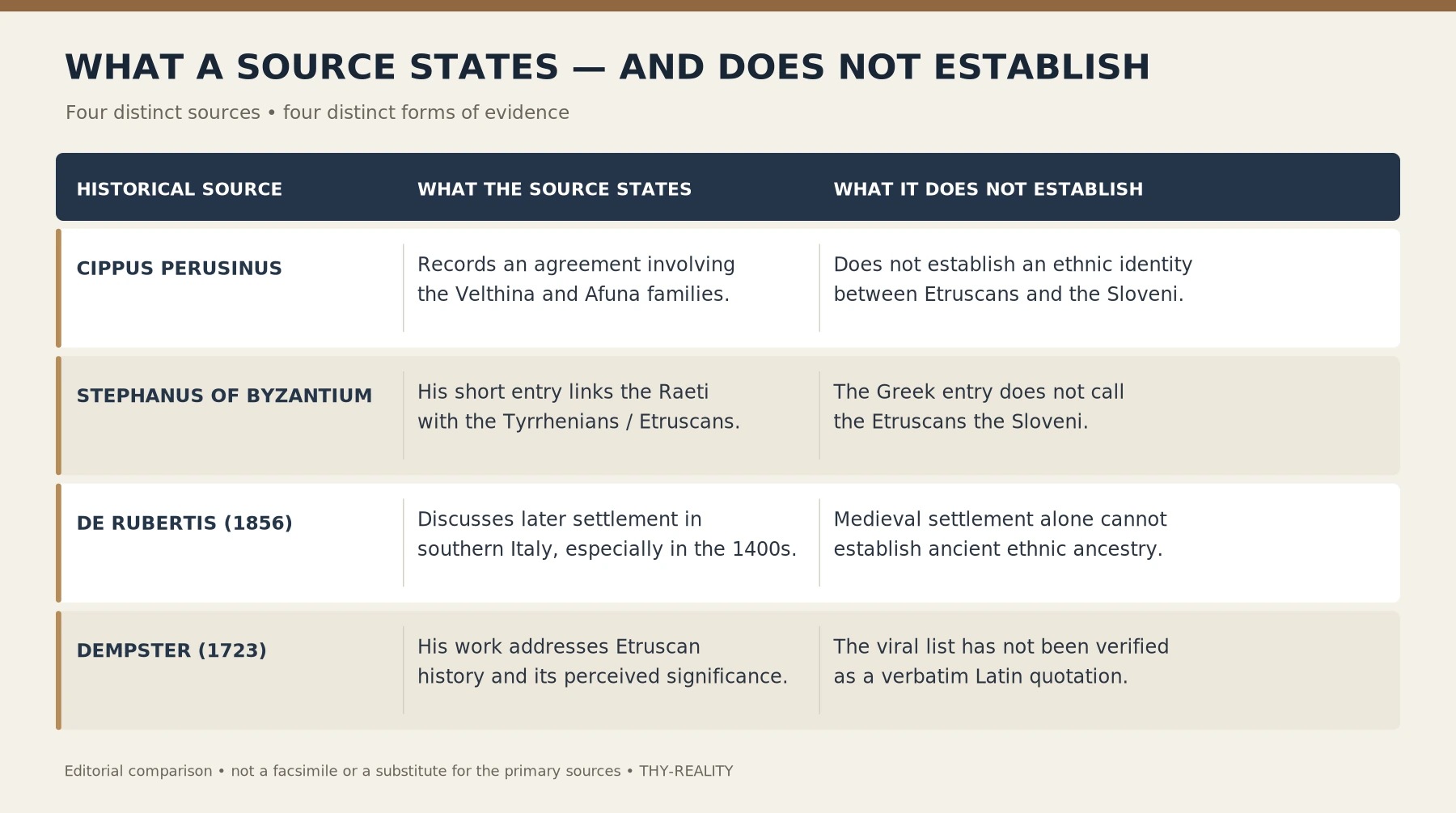
The following table summarises what particular forms of evidence support and where their explanatory power ends:
| Evidence or source | What it attests | What it does not establish by itself |
|---|---|---|
| Etruscan cities and tombs | A local civilisation, rituals, urban life, and trading contacts | A single “pure” ethnic identity |
| Cippus Perusinus | An Etruscan legal inscription of the third–second centuries BCE | A direct translation into modern Slovenian |
| Raetic inscriptions | Linguistic kinship with Etruscan | The automatic identity of all Raeti and Etruscans |
| Lemnian inscriptions | Significant linguistic parallels in the Aegean | One definitively established migration route |
| Ancient accounts of the Raeti | An ancient tradition linking them with the Tyrrhenians | An automatic conclusion about the Sloveni |
| De Rubertis and the Molise Croatian communities | Historical Adriatic migrations and a later linguistic heritage | Continuity with the Etruscan population |
| Ancient DNA from the 2021 study | Patterns of genetic relatedness and demographic change | Language, names, or modern national identity |
For the hypothesis concerning Etruscans and Sloveni, it is therefore useful to set a testable research standard. What new finds, inscriptions, or linguistic comparisons would establish a historical connection that current evidence does not demonstrate? Is there a chronologically grounded sequence rather than merely a resemblance between individual names? Can a proposed reading of an inscription succeed when applied to independent examples? Can indirect cultural contact be clearly distinguished from direct linguistic kinship?
Such questions do not prohibit the hypothesis. They specify how it could be investigated and what would count as genuine progress.
Conclusion: What Supports a Connection, and What Remains Open?
The Etruscans were a historically documented ancient civilisation with their own script, city communities, and recognisable material culture. Their heritage influenced the development of central Italy and the Roman world. Their inscriptions support an increasingly detailed understanding of their language, even though much of its vocabulary and parts of its longer texts remain difficult to explain. [1] [2] [3] [4]
The connection between the Etruscans and the Alpine world is not an invention. It is attested by ancient writers, archaeological contacts, and — most importantly — linguistic kinship between Raetic and Etruscan. Lemnian shows that a related linguistic history also reached the Aegean. The precise routes, periods, and communities involved in these connections remain subjects of research. [6] [7] [8] [9] [10]
The proposed connection with the Sloveni has a different evidentiary status. In the material examined, it occurs principally as a later historiographical hypothesis that attempts to place ancient ethnonyms and linguistic traces within a wider account of origins. The ancient description of the Raeti as a Tyrrhenian people does not contain a direct claim about the Sloveni. Nor do the real historical migrations of eastern Adriatic communities to Molise establish that their far more distant ancestors spoke Etruscan.
The absence of direct evidence does not mean that historical research has no questions left to ask. It does mean that we must not treat documented contact, linguistic kinship, later interpretation, and proven ethnic continuity as interchangeable. Each claim must be investigated on its own terms.
Future discoveries may bring new inscriptions, improved chronologies, convincing linguistic correspondences, or new archaeological links that change our picture. For now, the most revealing result of the investigation is the distinction itself: the genuine Etruscan–Raetic connection is a substantial historical lead; the wider identification of Etruscans with Sloveni remains an unproven hypothesis. That is not a reason to end the investigation. It is a reason to pursue it with more precise questions.
Sources and further reading
- UNESCO / Italian cultural heritage administration, “Etruscan Necropolises of Cerveteri and Tarquinia”: source. Source
- Theresa Huntsman, “Etruscan Language and Inscriptions,” The Metropolitan Museum of Art, 2013: source. Source
- University of Florence, “The Etruscan language,” Lingue e culture dell'Italia antica project: source. Source
- Musei nazionali di Perugia, “Il Cippo di Perugia,” official monument documentation: source. Source
- Enrico Benelli, “Il Cippo di Perugia come documento storico. Stato della conoscenza e problemi connessi,” Mélanges de l’École française de Rome – Antiquité 133/1 (2021), DOI: 10.4000/mefra.11088: source. This review verified the bibliographic record and context; the full text is not represented as having been independently reread. Source
- Thesaurus Inscriptionum Raeticarum, “Raetica,” University of Vienna: source. Source
- Thesaurus Inscriptionum Raeticarum, “The Raetic language”: source. Source
- Thesaurus Inscriptionum Raeticarum, “Ancient sources” (Livy, Pompeius Trogus, Pliny): source. Source
- Thesaurus Inscriptionum Raeticarum, “Modern research on Raetic”: source. Source
- Daniele F. Maras, “Lemnian,” Mnamon — Ancient Writing Systems in the Mediterranean: source. Source
- Stephanus of Byzantium, Ethnika, ed. August Meineke (1849), entry Ῥαιτοί (p. 543 in that edition), publicly accessible text index: source. The newer critical apparatus for this entry was not independently reviewed for this revision; the Greek wording is taken from the research record examined previously. Source
- Yegor Klassen, Древнейшая история Славян и Славяно-Руссов до Рюриковского времени (1861), p. 30 as recorded in the research file for the earlier article: source. The historical title is reproduced verbatim; the detailed text on that page was not collated again. Source
- Giovanni de Rubertis, Delle colonie Slave nel regno di Napoli (Zadar, 1856), facsimile: source ; transcription: source. Source 1 Source 2
- Giovanni Andrea Tria, Memorie storiche civili, ed ecclesiastiche della città, e diocesi di Larino (1744), book IV, “Di Ururi”: source. Source
- Milan Rešetar, Die serbokroatischen Kolonien Süditaliens (1911), later Italian translation/edition: source. Source
- Istituto Centrale per il Patrimonio Immateriale, “Croati del Molise: comunità e lingua”: source. Source
- Thomas Dempster, De Etruria regali libri VII, volumes I–II (1723–1724), Eton Collections library catalogue: source. Source
- Aleksandr I. Nemirovsky, Этруски. От мифа к истории (Moscow: Nauka, 1983), bibliographic record: source. Precise comparison of individual claims with the relevant Latin passages in Dempster remains an open research task. Source
- Cosimo Posth et al., “The origin and legacy of the Etruscans through a 2000-year archeogenomic time transect,” Science Advances 7 (2021), eabi7673, DOI: 10.1126/sciadv.abi7673: source. Source
- Jean Turfa, “Epigraphy, Etruscan,” Oxford Research Encyclopedia (2017), DOI: 10.1093/acrefore/9780199381135.013.8182: source. Source
- Corinna Salomon, linguistic study of Raetic and northern Italian inscriptions (2020): source. Source
- Rhaeti & Co., collection of recent research on the Raeti and related languages (2024), introduction and literature review: source. The collection provides research context, not proof of any one migration route. Source
Open research limitations: Billerbeck's critical apparatus for the entry Ῥαιτοί; a direct Latin counterpart for Dempster's entire list; the purported original archival document concerning Cerritello; and a demonstrable chain showing how this particular online collage originated. The references given do not constitute permission to republish protected scans or copyrighted texts without authorization.