Dolmens Across the World: Why Did Distant Cultures Build Similar Stone Monuments?
Why did communities from Ireland to Korea build similar megalithic tombs? A comparison of seven regions, archaeological evidence and possible connections.
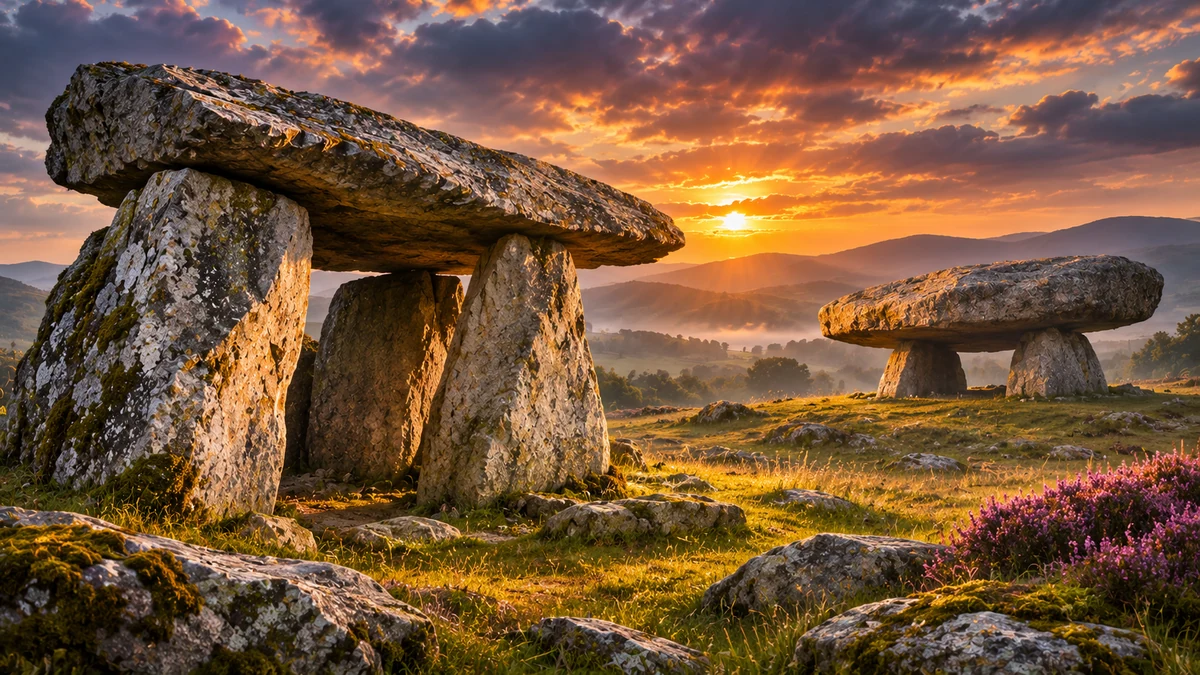
An artistic comparison of a European portal tomb and a Korean table-type dolmen in an imagined landscape; the monuments are not shown at a real shared archaeological site.
Stone Tables at Opposite Ends of the World


In the stony landscape of the Burren in western Ireland stands Poulnabrone. A large, slightly tilted stone slab rests on upright supports. Its outline is simple, almost geometric: like a table no one built for the living. Turn your gaze towards East Asia, to the many prehistoric stone tombs of the Korean Peninsula, and there, too, you find enormous capstones raised above the ground. The distance is vast, yet the underlying construction idea looks strikingly similar. [1] [2]
That resemblance raises a question that recurs whenever photographs of dolmens from different countries appear side by side: why did people so far apart erect stone structures of related shapes? Did they exchange ideas? Did similar solutions emerge independently? Or are we looking at traces of connections far older than those we can currently demonstrate?
A photograph alone cannot answer. It often fails to show the original structure as a whole; it tells us neither the monument's reliably established age nor what archaeologists found beneath the stones. Two apparently related monuments may have been built millennia apart, belonged to different burial traditions and were constructed differently. None of this makes their resemblance less intriguing. It simply asks us to frame the question more precisely: is a similar form evidence of a shared history, or merely the starting point for investigating one?
What Are We Looking at Today — and What Once Stood Here?

The word megalith means “large stone,” but the term covers a wide range of monuments: standing stones, stone circles, tombs and other monumental structures. Nor is the term dolmen used in precisely the same way everywhere. In one region, it describes a relatively simple chamber made from upright slabs and a capstone; elsewhere, it is applied to various funerary structures, sometimes even to forms that specialists would rather classify differently. The silhouette of a stone “table” is therefore not enough for a reliable typological identification. [3] [4]
For some European tombs, their present-day appearance is particularly misleading. A stone chamber standing exposed in the landscape may once have been concealed within a mound of earth or smaller stones. Elsewhere, a passage led into the chamber; some structures had divided spaces or an entrance that allowed later visits. As the protective mound collapsed, disappeared or was removed over centuries and millennia, the most durable slabs remained. A photograph may therefore show the skeleton of a former building rather than its original appearance. [5]
Antequera in Spain illustrates this well. It is home to the Menga and Viera dolmens as well as El Romeral, a differently constructed tomb known as a tholos, with a corbelled, or false, dome. All three are associated with former earthen mounds, but they are not the same architectural type. On the French island of Gavrinis, a tomb with an inner chamber and passage was built around 3500 BCE inside an extensive stone cairn; many of its stones bear carved motifs. To place all these monuments in a single category of “a slab on two stones” would erase essential differences. [6] [7]
These distinctions also matter when comparing monuments in Korea, India and the Levant. Before drawing conclusions about a common origin, we must first establish exactly what we are comparing. The form visible today is not necessarily the form known to its builders.
What the Finds Tell Us
Were dolmens tombs? For many specifically identified monuments, the answer is not a guess. Human remains, grave goods, the layout of chambers and excavation evidence support it. The claim that no explanation of their purpose is supported by evidence is therefore false. Yet evidence of burial does not, by itself, reveal every ritual, social meaning or later use of a particular place.
Poulnabrone is an especially clear example. According to Ireland's heritage authorities, the remains of 33 men and women were found there, dating to approximately 3800–3200 BCE. Decorative and everyday objects were also discovered, including a bone pendant, a stone axe, quartz crystals and other artefacts. Most of the bones were mixed together; one interpretation is that bodies were first placed elsewhere and their remains later transferred to the tomb. Particularly intriguing is the discovery of a newborn infant whose remains are considerably younger, dating to the Early Bronze Age. This points to a later connection between people and the site, but tells us little on its own about their relationship to the original builders. [1]
Dates, too, demand care. Dating a bone provides evidence about the person it belonged to and, more precisely, when that person died—not necessarily when someone first raised the capstone. Construction, burial and subsequent use may have been separate events. Such distinctions often vanish from online comparisons that compress thousands of years of human history into a single photograph.
On the Korean Peninsula, UNESCO describes the Gochang, Hwasun and Ganghwa sites as extensive prehistoric burial grounds with hundreds of dolmens, chiefly associated with the first millennium BCE. Here, too, we are looking not merely at incomprehensible arrangements of stone, but at monuments for which there is strong evidence of a funerary function. At the same time, their number, diversity and distribution across the landscape raise further questions about how communities were organised, the role of remembrance and the relationship between the living and the dead. [2]
Seven Regions — Several Different Histories
A collage that places photographs labelled Ireland, France, Spain, Germany, Jordan, India and Korea alongside one another is compelling because it extracts a related form from very different historical settings. But once time and place are restored to the images, a much more complex story emerges.
Along Europe's Atlantic fringe, various megalithic burial traditions had already developed during the fifth and fourth millennia BCE. Ireland's Poulnabrone is associated with Neolithic burials of the fourth millennium. France's Gavrinis belongs to roughly the same broad period, but its design is that of a very different funerary building. At Antequera in Spain, we encounter several types of monumental tomb from the Neolithic and later prehistory. The shared label “dolmen” cannot tell us whether two monuments followed the same plan or served exactly the same rituals. [1] [6] [7]
Seven regions, different chronologies
| Region and example | Period discussed in the article | What is actually dated or described |
|---|---|---|
| Ireland — Poulnabrone | approximately 3800–3200 BCE | documented Neolithic burials, not necessarily the first construction event |
| France — Gavrinis | approximately 3500 BCE | broad construction period of a passage tomb within a cairn |
| Spain — Antequera | Neolithic and later prehistory | several different megalithic tomb types, without one universal date |
| Germany — lower Saale and Elbe | middle of the fourth millennium BCE | regional megalith-building tradition, not all German monuments |
| Jordan — Early Bronze Age dolmens | approximately 3700–3000 BCE | regional Early Bronze Age I tradition |
| India — Hire Benkal | approximately 1200–200 BCE | broad Iron Age megalithic context, not all Indian dolmens |
| South Korea — Gochang, Hwasun, Ganghwa | predominantly first millennium BCE | burial traditions of the named groups, not every Korean monument |
A comparison of named examples and regional traditions, not a universal timeline for all dolmens in each country. Dates may refer to burials, construction or a broader period of use.
Germany's megalithic tombs likewise have their own regional chronology. The State Museum of Prehistory in Saxony-Anhalt notes that this form of monumental construction became established around the middle of the fourth millennium BCE around the lower reaches of the Saale and Elbe rivers, where several kinds of stone tomb were built, including elongated structures and passage graves. This is a date for the particular region under discussion, not for every megalith in Germany. [8]
In Jordan, well-documented groups of dolmens are associated with their local Early Bronze Age setting. Archaeologist James Fraser stresses the importance of examining Levantine dolmens in relation to geology, settlements and local burial practices. For many examples, the central chronological framework is Early Bronze Age I, approximately 3700–3000 BCE. This does not automatically demonstrate that the monuments of the Middle East and Europe shared a single building tradition. [4] [9]
Hire Benkal in the Indian state of Karnataka takes us into another prehistoric setting. Its burial landscape contains numerous types of megalithic structures, associated chiefly with an Iron Age tradition. The local government gives a broad date range of approximately 1200–200 BCE. India has placed the site on UNESCO's World Heritage Tentative List; that is not the same as inscription on the World Heritage List itself. [10] [11]
The Korean sites at Gochang, Hwasun and Ganghwa reveal another distinct history, with UNESCO placing particular emphasis on the dolmens of the first millennium BCE. Comparing them with Neolithic Ireland is genuinely fascinating, but these two groups cannot simply be treated as simultaneous products of one worldwide wave of construction. Their resemblance must also withstand scrutiny of differences in date, structure, materials and social use. [2]
A Tomb Changed by Time
A monument's story does not end when its builders finish their work. Sometimes its later life is the best clue to understanding why it remained important.
At dolmen ST_30 in the Rjile burial ground near Kufr Yuba in northern Jordan, researchers brought together evidence from construction, stratigraphy, human remains and several dating methods. In a study published in the Journal of Archaeological Science: Reports in 2026, they describe at least four phases of use. Their analysis suggests an initial construction and early use during the Bronze Age, followed by burials and interventions in different periods extending into the Iron Age. Samples of human remains from several later episodes fall within a broad span of approximately 3100–800 BCE. This is not one single construction date, but evidence of a long history in which, according to the study's authors, the monument regained funerary or commemorative significance at intervals. [12]
This example challenges an overly simple distinction: was a dolmen a “tomb” or a “sanctuary”? A place where people were buried could also have served as a site of remembrance, return visits, ritual and the marking of an important part of the landscape. These meanings need not be mutually exclusive. But each additional role calls for identifiable, testable traces; we cannot assign it to every similar monument simply because it looks imposing to us.
The Meaning of Stone Beyond the Grave
The builders of monumental tombs did not live in an empty landscape. They saw hills, valleys, pathways, springs and the sky. A monument's position can therefore be revealing, but we must distinguish its measured orientation from an assumption about the reason behind it.
Antequera in Spain makes the difference especially vivid. Menga is oriented towards the distinctive mountain of La Peña de los Enamorados, while the differently designed tholos of El Romeral is associated with an orientation towards the El Torcal mountain range. UNESCO highlights both relationships as exceptional features of the site and refers to the likely sacred significance of the natural landmarks. Orientation itself can be observed and measured; precisely what the mountain meant to individual builders remains a matter of historical interpretation, not something we can establish from written testimony by the builders themselves. [6]
That is why astronomical interpretations are neither useless nor a universal answer. For some monuments, it makes sense to examine orientations in relation to the Sun, celestial events and the horizon. Such an interpretation, however, needs to be demonstrated for an individual structure, not simply assigned to every dolmen in the world. A tomb associated with sunrise may still be a tomb; a stone building oriented towards a mountain does not automatically become some kind of unknown machine.
The wider Hire Benkal area in India offers another point of interest. India's submission to UNESCO's Tentative List mentions a distinctive ringing stone said to produce a clear sound when struck. The submission suggests it may have been used to warn or gather people. This is a description of one stone within a wider ritual landscape, not evidence that all dolmens functioned as acoustic devices, still less as mysterious energy generators. Demonstrating a precise acoustic or technological function would require measurements and a credible link to a particular ancient practice. [11]
Did Ideas Travel Across the Sea?
Whether the builders of these monuments were connected is a legitimate research question, not merely an internet conjecture. People migrated, traded, formed relationships and adopted one another's knowledge. But the sharing of ideas does not mean that all communities descended from a single civilisation; a similar solution can also emerge without direct contact. Two communities with access to large slabs, both wishing to construct a durable covered space, might arrive at related load-bearing designs because of the properties of stone itself.
In Europe, an influential research model poses a serious challenge to the easy answer that “everything happened independently.” In 2019, archaeologist Bettina Schulz Paulsson published an analysis in PNAS of 2,410 radiocarbon determinations from megalithic and comparative contexts. Bayesian modelling supported the possibility that some megalithic traditions spread along maritime routes, with particular emphasis on northwestern France and Europe's Atlantic region. This is a reasoned scientific model, not a definitive map of every route actually taken, and not proof of a connection linking Ireland, India and Korea. [13]
New methods offer other ways to investigate the social relationships of prehistoric people. A genetic study published in 2019 examined 24 individuals from five megalithic burial sites in northern and western Europe, identifying kinship links within the populations studied. A study published in Science in May 2026 analysed data from 203 individuals at six megalithic burial complexes in central Europe. It also found close genetic relatives at sites up to 225 kilometres apart, while showing that burial was not restricted to close biological relatives. The authors emphasise the importance of social ties and the cultural spread of monumental practices among the communities they studied. [14] [15]
These findings do not add up to a single account of the origins of every megalith. They do, however, reveal something valuable: cultural ideas and populations need not move in the same way, kinship can connect distant places, and different communities can adapt similar forms to their own needs. Genetic evidence from particular European burial grounds is not genetic proof that all builders of stone monuments across the world shared a common origin.
One Lost Civilisation — or Many Paths to a Similar Form?
The idea of an ancient, forgotten civilisation whose memory survives in similar stone structures is compelling, and it can be framed as a testable hypothesis. But a historical conclusion requires more than selected photographs. We need monuments with securely established provenance, comparable and well-supported chronologies, sufficiently distinctive shared construction features and traceable evidence of the movement of people, objects or knowledge between regions.
It is also important to distinguish resemblance from historically distinctive similarities. A large slab resting on supports is a relatively straightforward solution to a basic structural problem, even though lifting and positioning heavy stones demanded considerable knowledge, labour and organisation. If widely separated sites also shared an unusually specific sequence of building techniques, comparable original markings, portable objects or other independently dated connections, the case for contact would be stronger. For the broad claim of one worldwide dolmen-building civilisation, no such body of evidence has yet been established.
This does not mean that a lack of sufficient evidence proves no contact ever took place. It does mean that an open question and a confirmed historical explanation are not the same thing. Careful research must remain open to new discoveries without losing sight of what the existing finds already show.
An online collage usually removes precisely the details that matter most to archaeologists: a site's name and context, excavation layers, the size of the structure, reconstructions, differing chronologies and its original surroundings. Add only the labels “Ireland” and “Korea” to two images, and real, significant differences can become invisible. Stripping away the context creates an impression that the evidence is equivalent, although we may be comparing monuments with different histories. Yet the initial question remains valid: certain forms really do recur — and we should investigate why.
Stones That Still Hold Questions
Dolmens are not merely inexplicable structures left by unknown builders. At many sites, we can document their links to burial, their approximate dates, their construction features and traces of later use. Careful excavations, modern dating methods and ancient DNA analysis continue to enrich that account. But it would be equally misleading to claim that we know every meaning they held, every ritual associated with them or every route along which similar ideas travelled.
New connections may emerge in some regions, while evidence in others may strengthen explanations based on independent development. Both possibilities can be studied without ruling them out in advance or presenting the unproven as fact. The real mystery of these stones need not lie in a single lost civilisation spanning the globe. It may also lie in the many different histories of people who learned to use the heaviest of building materials to create something that outlived generations.
And when we look today at a stone slab still standing above an ancient grave, it is worth remembering those for whom it was raised. Before it became a puzzle to the modern world, it was part of a community's life — and its memory of the dead.
Sources and further reading
- Heritage Ireland / Office of Public Works, Poulnabrone Portal Tomb. source Source
- UNESCO World Heritage Centre, Gochang, Hwasun and Ganghwa Dolmen Sites. source Source
- Cousseau, Florian, and Tara Steimer-Herbet (2025), Megalithic architecture in the Levant: broader perspectives for defining what we are talking about. source Source
- Fraser, James A. (2018), Dolmens in the Levant; publisher's description. source Source
- Ministère de la Culture (France), Cairns and mounds. source Source
- UNESCO World Heritage Centre, Antequera Dolmens Site. source Source
- Ministère de la Culture (France), Tumulus-dolmen de l’île Gavrinis, Mérimée PA00091357. source Source
- Landesmuseum für Vorgeschichte Sachsen-Anhalt, Built to Last. source Source
- Fraser, James A., The visible dead: dolmens and the landscape in Early Bronze Age Jordan. source Source
- Government of Karnataka / Koppal District, Megalithic Burial Site Hirebenkal. source Source
- UNESCO World Heritage Centre, Hire Benkal, Megalithic Site, Indian nomination to the Tentative List. source Source
- Steimer-Herbet, Tara, et al. (2026), Biography of a Levantine dolmen during the Early Bronze Age: construction, reuse and memory at Rjile (Kufr Yuba, North Jordan), Journal of Archaeological Science: Reports 69, 105536; DOI includes the year 2025. source Source
- Schulz Paulsson, Bettina (2019), Radiocarbon dates and Bayesian modeling support maritime diffusion model for megaliths in Europe, PNAS. source Source
- Sánchez-Quinto, Federico, et al. (2019), Megalithic tombs in western and northern Neolithic Europe were linked to a kindred society, PNAS. source Source
- da Silva, Nicolas Antonio, et al. (2026), Long-distance genetic relatedness in megalithic central Europe, Science 392(6800), 839–844. source Source