Calendar as a cultural fossil: why September means seven and what follows
September means seventh, yet it is the ninth month. Is that an error, a trace of an older Roman calendar, or something more? A review of month names, the Numa tradition, Republican fasti, and Caesar’s reform.
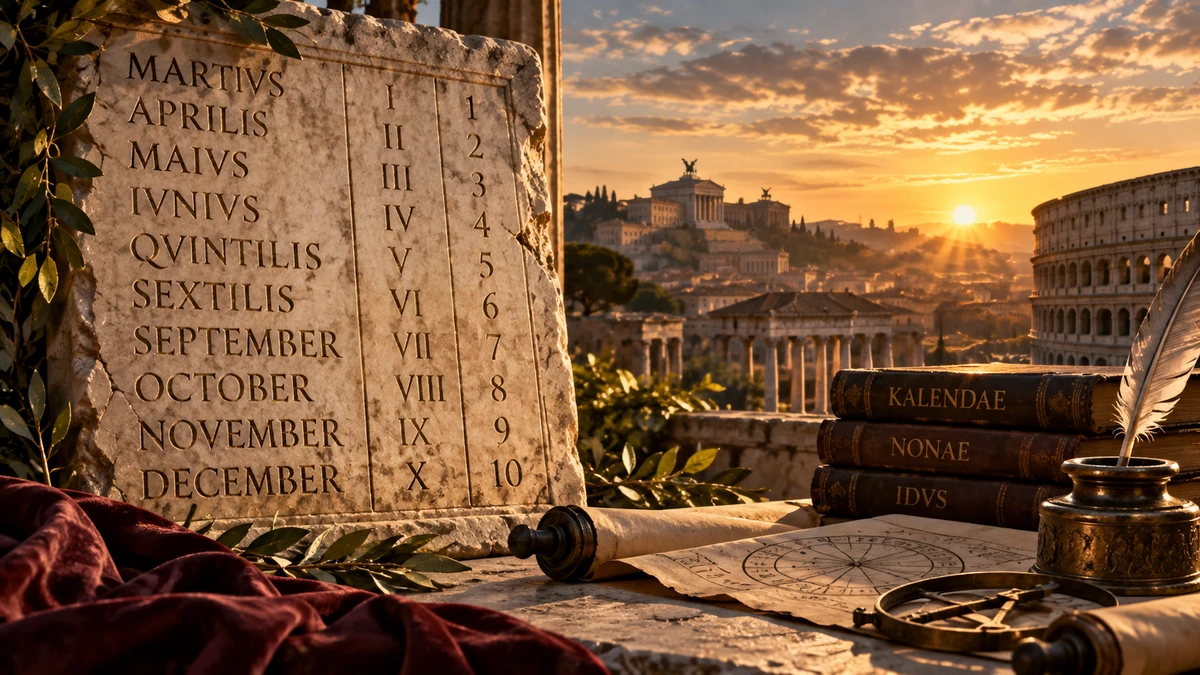
September is the ninth month of our year, yet its name points literally toward the number seven. The same is true of October, November, and December: Latin septem, octo, novem, and decem mean seven, eight, nine, and ten. This apparent mismatch is not a modern misunderstanding. Romans themselves noticed it, and ancient writers explained it as a trace of an older calendrical order in which March held a more prominent starting position.
Four month names, however, cannot reconstruct the earliest Roman calendar in full. Later ancient sources tell of a ten-month year of Romulus and of Numa adding or rearranging January and February, but their versions disagree. Modern scholarship likewise warns that the earliest history of the Roman calendar is partly reconstructed from later texts, ritual survivals, and names rather than continuously documented from the eighth century BCE onward.
That is precisely why the calendar is useful as a cultural fossil. Older names can survive later reforms. The political year can acquire a different beginning, months can be repositioned, their lengths revised, and some can even be renamed after rulers while older numerical names remain. Language can therefore preserve a trace of a system that nobody any longer uses in its original form.
This article therefore does not search for a hidden code in the month names. It asks a more concrete question: what does September = seventh actually tell us about Roman time, where does uncertainty begin, how did the Republic, Julius Caesar, and Augustus reshape the calendar, and why do we still live with names that belong to several historical layers at once?
September really does mean “seventh”
The basic etymology is secure. September is connected with Latin septem, seven; October with octo, eight; November with novem, nine; and December with decem, ten. The older names of modern July and August were numerical as well: Quintilis or Quinctilis meant the fifth month and Sextilis the sixth. Censorinus in the third century CE explicitly says that the names from Quintilis through December derived from their order.
If the sequence begins with March, the names align neatly: March 1, April 2, May 3, June 4, Quintilis 5, Sextilis 6, September 7, October 8, November 9, December 10. This is why the mismatch is usually explained through an earlier March-oriented year. An Oxford overview of Roman calendrical time likewise cites these names as important evidence that an older ordering once counted these months from March.
But the first evidentiary boundary appears immediately. The names strongly preserve an older numerical order; by themselves they do not prove every detail of the popular reconstruction, such as an exact 304-day ten-month year followed by a completely unnamed winter. That requires additional evidence, and the additional evidence is later and not entirely consistent.
The ten-month year: ancient tradition, not a contemporary record from Romulus
Plutarch, Ovid, Macrobius, and Censorinus know a tradition in which Rome's earliest year was shorter and began with March. Ovid's Fasti says that the ancients had fewer Kalends than later Romans, while Plutarch uses the name December — 'tenth' — as an argument for an earlier ten-month sequence.
Ancient authors, however, did not speak with one voice. Censorinus preserves the claim of Licinius Macer and Fenestella that the Roman year had twelve months from the beginning, before preferring other authorities who argued for ten. Plutarch likewise knows two different versions: in one Numa added January and February; in another the two months already existed and he merely moved them to the beginning of the year.
Modern scholarship is therefore more cautious than the classroom formula 'Romulus had ten months and Numa added two.' Jörg Rüpke has challenged a literal reconstruction of a 304-day Romulan calendar. Gary Forsythe, Agnes Michels, Denis Feeney, and, more recently, Daniel Gargola likewise emphasize in different ways that the earliest Roman calendar is reconstructed from later testimony, ritual survivals, and republican documents.
January and February: Numa is part of the tradition, not a timestamp
Roman tradition often credits the calendrical reform to Numa Pompilius, Rome's legendary second king. Livy attributes to him the division of the year into twelve lunar months and a system of intercalation intended to bring the calendar back into relation with the sun. Plutarch also assigns Numa a major role, yet in the same passage acknowledges competing traditions about January and February.
The sentence 'Numa added January and February in year X' therefore sounds more precise than the sources permit. Numa belongs to Roman royal tradition recorded by authors writing many centuries later. His name matters greatly for how Romans explained their calendar and religious order; it is not a contemporary archive from the seventh century BCE.
Nor do the names September–December prove that January and February were absent in every earlier phase. The history may have been more complicated, with different calendrical cycles, ritual years, and political year-beginnings overlapping. A cultural fossil preserves an older layer, not necessarily a complete original system.
When did the year begin? It depends on which year we mean
When we say the Roman year 'began in March,' we have to ask: the ritual year, the civil calendar, the magistrates' year, or a later antiquarian reconstruction? Ovid cites rites on 1 March as traces of an old New Year, but Roman institutions throughout the Republic did not preserve one immutable starting point for every purpose.
A concrete example is the inauguration of the consuls. Francisco Pina Polo summarizes that in one Republican phase consuls entered office on 15 March; in 153 BCE the date was permanently moved to 1 January, probably because of military needs in Hispania. This matters because a political or consular year-beginning is not the same thing as the etymology of month names.
By the late Republic January certainly stood at the beginning of the civil year, while September, October, November, and December still carried the numbers seven through ten in their names. That is the essence of a cultural fossil: the system changed, but the words were not 'corrected' to fit the new numbering.
The Republican calendar was legal and religious infrastructure
For Romans the calendar did more than count days. It regulated when political assemblies could meet, when legal activity was permitted, when festivals occurred, and when rituals had to be performed. The fasti were therefore at once calendars, public documents, and maps of social time.
The most important material witness to the pre-Julian calendar is the Fasti Antiates Maiores, a painted calendar from Antium dating to the first half of the first century BCE. It preserves months, nundinal letters, classifications of days with legal-religious consequences, and an intercalary month. This artefact is much stronger evidence for the calendar actually used in the Republic than late stories about Romulus.
The pre-Julian system required intercalation to keep civil time approximately aligned with the seasons. Management of that process belonged to the pontiffs and was not always ideally regular. Daniel Gargola's recent work emphasizes precisely the tension between ideal calendrical norms and the actual administration of time in Roman political and cultic practice.
Caesar's reform did not erase the old names
By the first century BCE the Republican system had drifted enough for Julius Caesar to impose a major reform. The transitional year 46 BCE was extraordinarily extended, and from 45 BCE the Julian system used an approximately 365¼-day solar year with regular leap-year intercalation. The reform changed the technical architecture of time without renaming every cultural layer.
The numbered months therefore survived. Quintilis was renamed Iulius — July — after Caesar's death, while Sextilis became Augustus in 8 BCE. Censorinus and Suetonius speak directly about these renamings. September, October, November, and December remained untouched, although they had long been the ninth, tenth, eleventh, and twelfth months.
The popular story that Augustus 'stole' a day from February merely to make August as long as Caesar's July is also not secure ancient history. Older evidence and reconstructions of the Julian reform indicate that Sextilis already had thirty-one days before it was renamed. The calendar contains enough real historical oddities without adding a later legend.

From Julian to Gregorian: repair the mechanism, not necessarily the vocabulary
The Julian calendar was extraordinarily successful, but its average year is not exactly equal to the tropical year. The small difference accumulated over centuries, so the Gregorian reform of 1582 adjusted the leap-year rule and omitted days to bring calendrical dates back toward the seasonal cycle.
Yet even that major reform did not rename September 'the ninth month' or December 'the twelfth.' Europe corrected the mathematics of the calendar without erasing its linguistic memory. The modern calendar is therefore not the product of one moment but a layering of Roman, Julian, Augustan, Christian, and Gregorian decisions.
The same principle applies to other institutions. A name, symbol, or ritual can remain in place long after its original function changes. Such a survival is a historical clue — not automatically evidence of a hidden intention.
What really follows from this — and what does not
From the names September through December we can reasonably infer that they preserve a memory of an older numerical ordering associated with a March-oriented sequence. We can also see that Romans had no difficulty preserving inherited names after institutional change. The calendar is therefore a useful case of historical path dependence: new systems are often built on old ones rather than redesigned from zero.
What we cannot derive from the word September alone is one exact Romulan calendar, a precise date for the reform, a hidden numerological code, or deliberate concealment. Even ancient writers disagreed about the earliest phase. Etymology is evidence for a historical layer of language; it is not a master key to everything that happened before it.
The most interesting conclusion is almost the opposite of the sensational one: the everyday calendar on our phone is a living archive of compromises. September is the ninth month with a name meaning 'seventh' because systems are not necessarily coherent wholes designed all at once. They are history still in use. That is why old mismatches deserve attention — not because every one hides a secret, but because they often reveal where a new order grew over an older one.
Sources and further reading
- Christopher S. Jones — ‘Theorization, Measurement, and Standardization of Calendrical Time,’ Oxford Handbook: Roman month names and evidence for an older March-oriented sequence
- Jörg Rüpke — The Roman Calendar from Numa to Constantine, Wiley: technical, political and religious history of the Roman calendar
- Jörg Rüpke — ‘Towards an Early History of the Roman Calendar,’ Wiley: reconstruction of the earliest phases
- Bryn Mawr Classical Review — review of Rüpke, noting his rejection of a simple early ten-month reconstruction
- Agnes Kirsopp Michels — Calendar of the Roman Republic, Princeton University Press: reconstruction from epigraphic and literary evidence
- Denis Feeney — Caesar’s Calendar: Ancient Time and the Beginnings of History, University of California Press
- Gary Forsythe — Time in Roman Religion, Routledge: Roman calendar, ritual and concepts of time
- Daniel J. Gargola — Calendar, Cult, and Law in Rome to the Age of Augustus, Cambridge University Press
- Daniel J. Gargola — ‘The Management of Intercalation,’ Cambridge: pontifical management and irregularity of intercalation
- Plutarch — Life of Numa 18–19: competing traditions about January, February and the ten-month year
- Livy — History of Rome 1.19: Numa, twelve lunar months and intercalation
- Ovid — Fasti Book 3: March, the beginning of the year and the old ten-month tradition
- Ovid — Fasti Book 1: poetic-antiquarian exploration of Roman calendrical order
- James G. Frazer commentary on Ovid’s Fasti, Cambridge: ancient disagreements about the ten-month year and addition of January/February
- Macrobius — Saturnalia 1.12–14: Roman month order, ten-month tradition and Julian reform
- Censorinus — De Die Natali 20–22: month names, competing early-calendar traditions, July and August renamings
- Francisco Pina Polo — The Consul at Rome, Cambridge: consular inauguration moved to 1 January in 153 BCE
- British Museum — ‘What’s in a name? Months of the year’: September–December and the numerical Roman month names
- Attalus — Fasti Antiates Maiores: translated pre-Julian calendar inscription from Antium
- Wikimedia Commons — Fasti Antiates Maiores: museum photograph and provenance of the pre-Julian calendar
- Ostia-Antica.org — Antium calendars: archaeological context and dating of the Fasti Antiates Maiores
- Royal Observatory of Belgium — The Roman and Julian calendars: overview and caution about legendary early reconstructions
- Suetonius — Life of Augustus 31: Augustan correction of the calendar and renaming of Sextilis
- Cambridge — The Julian Calendar and the Solar Meridian of Augustus: Caesar’s reform, Augustan correction and Sextilis/Augustus
- Perseus — Dictionary of Greek and Roman Antiquities, ‘Calendarium’: classical evidence and scholarly problems of the Roman calendar