Who Does Palestine Belong To?
Who does Palestine belong to? We distinguish the history of settlement, rule and legal claims from the present rights of both peoples.
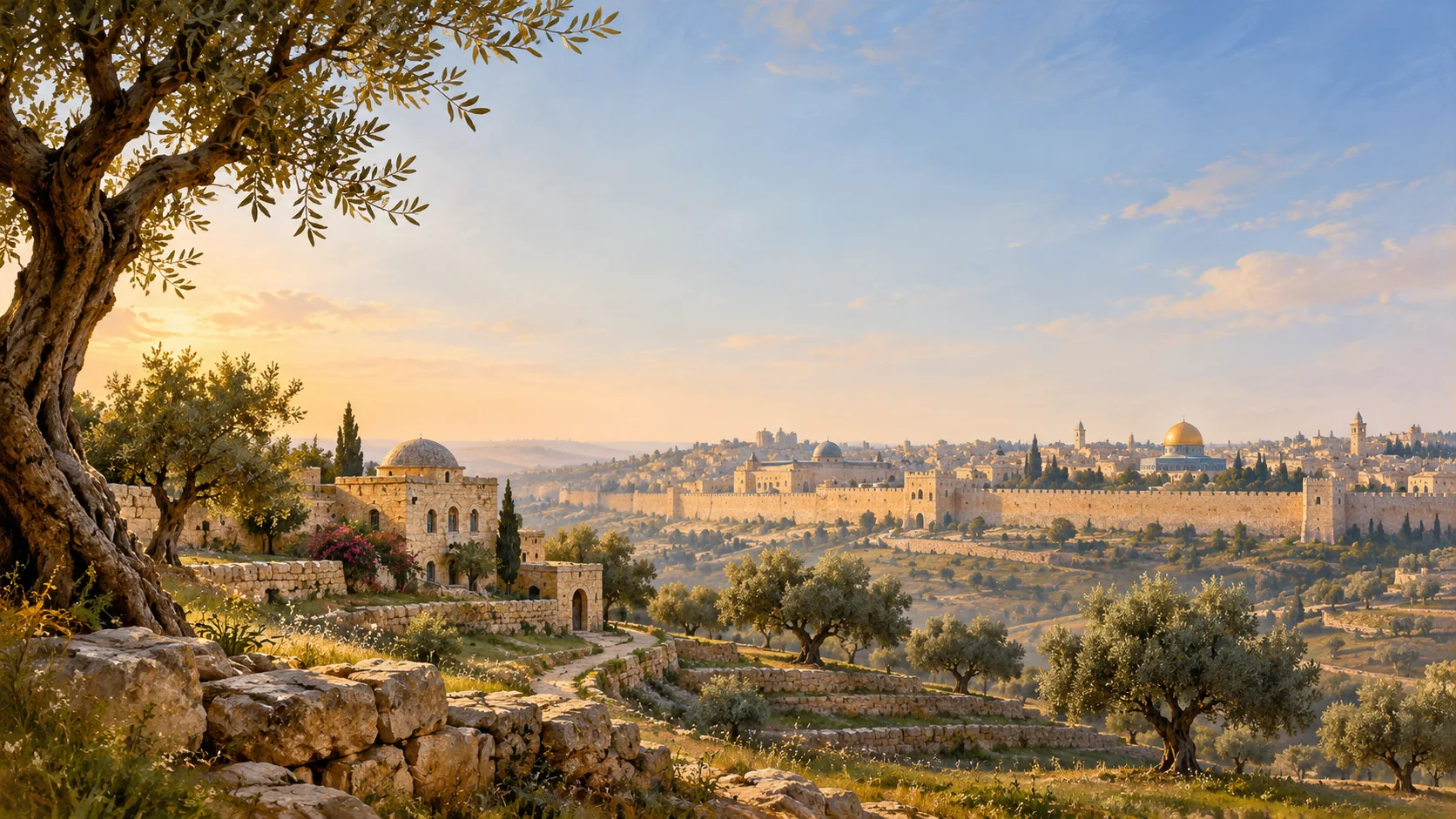
Artistic illustration of a historically inspired landscape. Not an archival photograph.
A land claimed by two peoples
“Who does Palestine belong to?” sounds like a simple question. But the answer depends on what whose means. Are we asking who lived here first? Which kingdoms and empires ruled the land? Who held title deeds? Who enjoys the right to political self-determination today? Or are we asking who should be entitled to determine the lives of all the other inhabitants?
These are not different ways of asking the same question. A historical connection to a land is not the same as private ownership of land; former rule is not the same as present-day sovereignty. Each question requires its own evidence. That is why the answer cannot be reduced to the slogan “Palestine has always belonged to us alone”—no matter who says it.
The Jewish people have a documented historical, religious and cultural connection to the Land of Israel, or Palestine. Palestinian Arabs likewise have a long and genuine history of life in this land, with their cities, villages, families, customs, economy and political demands. Neither statement, by itself, requires us to deny the other. Yet there is an important legal and moral distinction between recognizing a historical presence and recognizing a right to rule over other people.
Palestine has not had the same borders throughout history
The name Palestine has been used historically for a geographical region also referred to, in other contexts, as the Holy Land, the Land of Israel, Judea or the southern Levant. These names have different historical and political backgrounds; the territorial extent has not always been the same. Ancient Judea was not identical to the British Mandate territory in the twentieth century, and neither is identical to the occupied Palestinian territory today. When comparing maps from the Mandate era, we must also account for the special arrangements concerning Transjordan: under the decisions of 1922, the Mandate's provisions on the Jewish national home did not apply to the territory east of the Jordan River. [19]
One place can tell several stories at once. Sebastia, near Nablus, for example, is described in UNESCO documentation as a site containing remains from the Iron Age and the Hellenistic, Roman, Byzantine, medieval and Ottoman periods. Layer upon layer does not create a simple ranking under which the oldest community receives everything while later communities lose their rights. Above all, it shows how long peoples and authorities have changed, mingled and overlapped in the same place. [1]
Anyone speaking of “Palestine before Israel” must therefore clarify whether they mean the population before the establishment of the State of Israel in 1948, the administration of the British Mandate, or a historical region spanning thousands of years. These expressions are not interchangeable.
Israel, Judea and other ancient communities
Many communities emerged in ancient Canaan and the southern Levant. In the Iron Age, Israelite and Judahite political traditions took shape, forming the historical foundations of the Jewish cultural and religious connection to Jerusalem and other places. Archaeological and historical sources attest to the kingdoms of Israel and Judah/Judea, their conflicts, conquests and subsequent forms of life under larger empires. In its historical overview, the Metropolitan Museum of Art describes the northern kingdom of Israel and the southern kingdom of Judah, as well as Assyrian and Babylonian coercion directed at their populations. [2]
This history matters. Dismissing the Jewish presence as an invention would contradict the evidence. But archaeological proof of an ancient kingdom cannot, by itself, determine who has the right in the twenty-first century to dispossess a particular family or permanently control another people.
It is equally important not to reduce the region's history to a single people. Alongside Israelite and Judahite communities, other Canaanites and inhabitants of different cities and territories also lived here. Later Roman and Byzantine rule did not eliminate all the previous inhabitants. Administrative systems, languages, religious identities and local communities changed. Projecting today's national identities backward as if they had been fixed, unchanging ancient categories is historically questionable.
From the Byzantine period to Ottoman rule
Christianity was influential in the region in late antiquity. After the Muslim conquests of the seventh century, Arabic and Islam gradually gained influence over a long period. Arabization and Islamization do not necessarily mean that all previous inhabitants disappeared and were completely replaced by a new group. They were processes of political, linguistic, cultural, religious and demographic change that must be studied separately. Archaeological research into the Byzantine–Islamic transition emphasizes gradual change and local variation rather than a single, immediate replacement of the population. [15]
Communities of Jews, Christians and Muslims continued to exist in varying proportions in later centuries. The Ottoman Empire ruled most of the region from the sixteenth century until the First World War, and political and land-tenure systems changed over time. When Ottoman rule ended, there was as yet neither a modern State of Israel on the map nor an independent Palestinian state in today's sense. But there were inhabitants, economic rights, local ties and developing national demands.
The purpose of this historical overview is not to turn the past into an endless succession of foreign conquerors. It is to understand that today's question of self-determination cannot be resolved merely by invoking the oldest dynasty or the last empire to rule the land.
The Balfour Declaration: a promise that did not erase other rights
In 1917, the British government, through the Balfour Declaration, supported the establishment of a national home for the Jewish people in Palestine. The same text stipulated that nothing should be done to prejudice the civil and religious rights of existing non-Jewish communities in Palestine, or the rights of Jews in other countries. [3]
The declaration was enormously important politically to the Zionist movement, which advocated Jewish national revival and sought a secure homeland for Jews after a long history of discrimination and persecution. But a British political declaration was not a land-registry document through which the rights of those already living in the land simply disappeared.
In 1922, the Council of the League of Nations adopted the Mandate for Palestine. Its preamble explicitly recognized the historical connection of the Jewish people with Palestine. Article 2 charged the British administration with creating conditions for a Jewish national home and the development of self-governing institutions, while safeguarding the civil and religious rights of all inhabitants regardless of race or religion. Article 6 encouraged Jewish immigration and settlement under specified conditions, subject to the requirement that the rights and position of other sections of the population not be prejudiced. [4]
Here we encounter the legal and political contradiction that marked the Mandate period: the document expressly addressed Jewish national aspirations, but did not make an equivalently formulated promise of political self-determination to the Arab majority. This does not prove that Palestinian inhabitants lacked political demands or rights. It means that the Mandate system did not frame them in the same way it framed the Jewish national home.
Two national movements in the same territory
During the first half of the twentieth century, both the Jewish Zionist movement and the Palestinian Arab national movement grew stronger in the region. For Jewish communities, the prospect of statehood and immigration was particularly important in the face of violent antisemitism in Europe and the Holocaust. Palestinian Arabs demanded the independence of a land in which they constituted the majority of the population and opposed having their political future determined without their consent.
Historical data allow for a more precise account than the general phrase “Arabs and Jews lived there.” The estimate for 31 December 1946, published in 1949 by the United Nations Conciliation Commission for Palestine (UNCCP) on the basis of the Supplement to the Survey of Palestine, covered 1,845,560 settled inhabitants: 1,076,780 Muslims, 608,230 Jews, 145,060 Christians and 15,490 others. These are religious categories for the settled population, not a complete ethnic census and certainly not land-registry data. A separate estimate listed approximately 127,000 Bedouin or nomadic inhabitants, producing a broader estimate for the end of 1946 of approximately 1,972,560 inhabitants. The two tables use different population categories and must not be conflated. The Jewish community thus accounted for roughly one-third of the settled population, while its share of the broader estimate was somewhat smaller. [5][17]
In 1947, the United Nations Special Committee on Palestine (UNSCOP) explicitly considered both Jewish historical and international-political claims and the Arabs' long-standing presence and demand for political independence. The committee did not reach agreement on a single solution. Its majority proposal envisaged partition, while the minority proposal envisaged a federal arrangement. [6]
The distinction still matters today: the conflict did not arise because one of the communities was absent, but from the difficult question of how to give effect to different collective rights while also protecting individuals.
What did the United Nations actually decide in 1947?
On 29 November 1947, the UN General Assembly adopted Resolution 181 (II). It recommended a plan to partition Mandatory Palestine into a Jewish state and an Arab state linked by an economic union, with a special international regime for Jerusalem. The resolution was adopted by 33 votes in favour, 13 against and 10 abstentions. [7]
The word “recommended” matters. Resolution 181 (II) did not itself complete a territorial demarcation, establish both envisaged states in the manner proposed, or transfer title to every privately owned plot of land to a new authority. On the contrary, the proposed constitutional framework for both states required equal legal protection for inhabitants and restricted expropriation of land belonging to the Arab minority in the Jewish state, or the Jewish minority in the Arab state, to public purposes with full compensation paid in advance. These were provisions of the proposed plan, not proof that such an arrangement was subsequently put into effect. The plan was not implemented as written, but it remains a turning point in international political recognition of the possibility of two states. [7]
The Jewish Agency accepted partition, although it had reservations about the proposed borders and Jerusalem's exclusion from the envisaged Jewish state. The Palestinian Arab leadership and Arab states rejected it: they considered that the majority population's right to determine its future had been overridden and that partition was unjust. Both positions are documented in statements made at the time before UN bodies and in diplomatic records. [8]
Recognizing these two positions does not require declaring them legally and morally equivalent in every respect. It does require us not to conceal the reasons why each section of the population feared the proposed arrangement.
In 1948, a political plan became war and displacement
After the vote on partition, violence broke out between Jewish and Arab armed groups. The State of Israel was proclaimed on 14 May 1948, and the British Mandate formally ended at midnight between 14 and 15 May. The following day, the armies of neighbouring Arab states entered the war. [9]
These events were not merely a dispute on a map. For many Palestinian families, 1948 meant the loss of their homes, flight, expulsion and the disintegration of local communities—an experience Palestinians call the Nakba, or catastrophe. Drawing on archival research, historian Benny Morris distinguishes between flight from fighting and fear, direct expulsions, and decisions by authorities that prevented many displaced people from returning; individual localities experienced different histories. [16] Jewish communities faced attacks during the same conflict, along with fears for their security and for the survival of the newly established state. Those fears, too, do not justify depriving other civilians of their rights.
After the war, Israel controlled more territory than had been envisaged under the UN plan. The West Bank, including East Jerusalem, came under Jordanian control, and Gaza under Egyptian administration. The 1949 armistice agreements established demarcation lines but expressly emphasized that those lines were not final political or territorial boundaries. This is how the line commonly called the Green Line came into being. [10]
We must distinguish three maps: the proposed partition of 1947, the armistice lines of 1949, and the territories Israel occupied during the 1967 war. Treating these as a single map would distort the legal and historical meaning of the events.
1967 and the question of occupied territories
During the war of June 1967, Israel occupied the West Bank, including East Jerusalem, and Gaza, as well as other territories. On 22 November 1967, the UN Security Council adopted Resolution 242, emphasizing the inadmissibility of acquiring territory by war and linking withdrawal from occupied territories with the termination of hostilities and recognition of the right of states in the region to live within secure and recognized boundaries. [11]
This formulation matters: recognizing Israel's right to security does not amount to consenting to the permanent annexation of territory occupied in 1967. Conversely, recognizing the Palestinian right to self-determination does not remove the protection owed to Israeli civilians or negate the Jewish people's historical connection to the land. The specific legal obligations of an occupying power will be examined separately in article PL-03.
What does international law say about self-determination today?
In 2012, Palestine was granted non-member observer State status at the United Nations. That status is not the same as full UN membership, nor does it settle every question of statehood, territorial borders or effective control. It is, however, an important fact of international institutional practice. [12]
In its advisory opinion of 19 July 2024, the International Court of Justice (ICJ) concluded that Israeli policies and practices in the occupied Palestinian territory interfere with the Palestinian people's right to self-determination and that Israel's continued presence in that territory is unlawful. The finding concerns the territory occupied in 1967, including East Jerusalem, and the requirements of international law. It does not mean that the Jewish people have no history in the land or that the State of Israel has no right to exist. Nor is an advisory opinion a criminal conviction of individuals. [13]
The Israeli government and its representatives rejected this legal assessment. According to UN reporting, on 19 July 2024 the Israeli Foreign Ministry described the opinion as wrong and one-sided, emphasizing that a political solution could be achieved through direct negotiations; Prime Minister Benjamin Netanyahu invoked the historical Jewish connection to Jerusalem and to Judea and Samaria on the same day. [18] An official Israeli explanation issued in 2007 had already challenged the prevailing international legal interpretation of settlements and emphasized historical and security arguments. [14] These are documented positions of representatives of the Israeli state, not judicial findings; their presentation must be distinguished from the ICJ's legal conclusions.
The Court made clear in particular that security concerns cannot override the prohibition on the acquisition of territory by force. The advisory opinion also does not assess the legality of every individual military operation in Gaza after 7 October 2023; such an assessment requires a separate subject, timeframe and body of evidence. The issue, then, is more precise than the slogan “one side is right and the other has no rights”: it concerns the limits of lawful control, the population's right to self-determination and the duties of the authority exercising that control.
So—who does Palestine belong to?
Historically, Palestine is not the story of a single people. The Jewish connection to Israel and Judea is documented and enduring; Palestinian Arab presence, local life and national identity are equally historical and political realities. History can be described without erasing either community.
In terms of land ownership, the land was never a single parcel owned in its entirety by one nation. Title deeds, land use, state land and expropriation require an examination of individual legal regimes and documents. That is the subject of the next article, PL-02 — Who Owned the Land Before the Establishment of Israel?
Politically and legally, the existence of the Israeli state and the rights of its inhabitants do not extinguish Palestinian self-determination. Equally, Palestinian self-determination does not render Jewish religious and historical ties worthless. The international legal assessment of 2024 is very clear about the unlawfulness of Israel's continued presence in the occupied Palestinian territory; it does not, however, resolve every private property dispute or every question of a future political settlement.
The central question is therefore not to whom we can retrospectively assign every layer of history. It is how to ensure that no historical narrative becomes an excuse to deprive another human being of a home, freedom and fundamental rights.
Documentary sources and archive links
These links lead to documents, archival records or photographs hosted by their original source institutions.
- Damascus Gate, Jerusalem, between 1860 and 1890. Source: Library of Congress, LC-USZ62-104832.
- “Olive trees,” 1919. The photograph also shows a group of people on a garden terrace. American Colony Photo Department; Hand-colored photographs of Jerusalem and Palestine, p. 13, image 7. Source: Library of Congress (LCCN 2012648193).
- Proposed partition of Palestine under UN Resolution 181 (1947); UN Map No. 103.1(b), February 1956 edition. The proposal does not represent the boundaries later established on the ground.
Sources and further reading
- UNESCO World Heritage Committee, Sebastia (State of Palestine), 2026 decision: source Source
- The Metropolitan Museum of Art, Cyrus and the Judean Diaspora: source ; scholarly background: Richard D. Nelson, Historical Roots of the Old Testament (2014), source Source 1 Source 2
- Balfour Declaration, text in the US diplomatic archive (1917): source Source
- League of Nations, Mandate for Palestine (1922), especially preamble and Articles 2 and 6: source ; also published by the Israeli MFA: source Source 1 Source 2
- UNCCP, Palestine population estimates for 1946 (1949, based on the Supplement to the Survey of Palestine): source Source
- UNSCOP (1947), Report and proposals: source Source
- United Nations, A/RES/181(II), 29 November 1947: source ; voting record: source Source 1 Source 2
- US Department of State, Foreign Relations of the United States, summary of statements by the Jewish Agency and the Arab Higher Committee (1947): source Source
- British letter to the UN on the termination of the Mandate (11 May 1948): source ; Israeli MFA, timeline for 14/15 May 1948: source Source 1 Source 2
- Israel–Egypt Armistice Agreement (1949), Article V(2): source ; UNCCP explanation of other agreements: source Source 1 Source 2
- UN Security Council, S/RES/242 (22 November 1967): source Source
- UN General Assembly, A/RES/67/19 (29 November 2012): source Source
- ICJ, Legal Consequences arising from the Policies and Practices of Israel in the Occupied Palestinian Territory, including East Jerusalem, advisory opinion of 19 July 2024, especially paragraphs 230–264 and 285: source Source
- Israeli Ministry of Foreign Affairs, Israel, the Conflict and Peace: Answers to Frequently Asked Questions (2007), the Israeli legal and political interpretation: source Source
- Gideon Avni, The Byzantine-Islamic Transition in Palestine: An Archaeological Approach, Oxford University Press (2014), synthesis: source Source
- Benny Morris, The Birth of the Palestinian Refugee Problem Revisited, chapters on preventing return and post-armistice expulsions, Cambridge University Press (2003/2004, depending on catalogue): source ; source Source 1 Source 2
- UNCCP, The Problem of Palestine Refugees in Concrete Terms, Annex I, table “Estimated Population of Palestine as at 31st December 1946” and estimate of 127,000 Bedouins: source ; see also UNCCP document W/4 (1949), note [5]. Source
- UN News, Israel's continued occupation of Palestinian territory 'unlawful': UN world court, 19 July 2024 (summary of the Israeli Foreign Ministry's response): source ; The Times of Israel, 19 July 2024 (Netanyahu's public statement): source Source 1 Source 2
- Library of Congress, Mandate for Palestine and Memorandum by the British Government Relating to its Application to Transjordan: source Source