Gaza: From the Blockade to the War After October 7, 2023
How did Gaza’s history, blockade and the events after 7 October 2023 shape the war? We distinguish documented facts, legal rules and duties toward civilians.
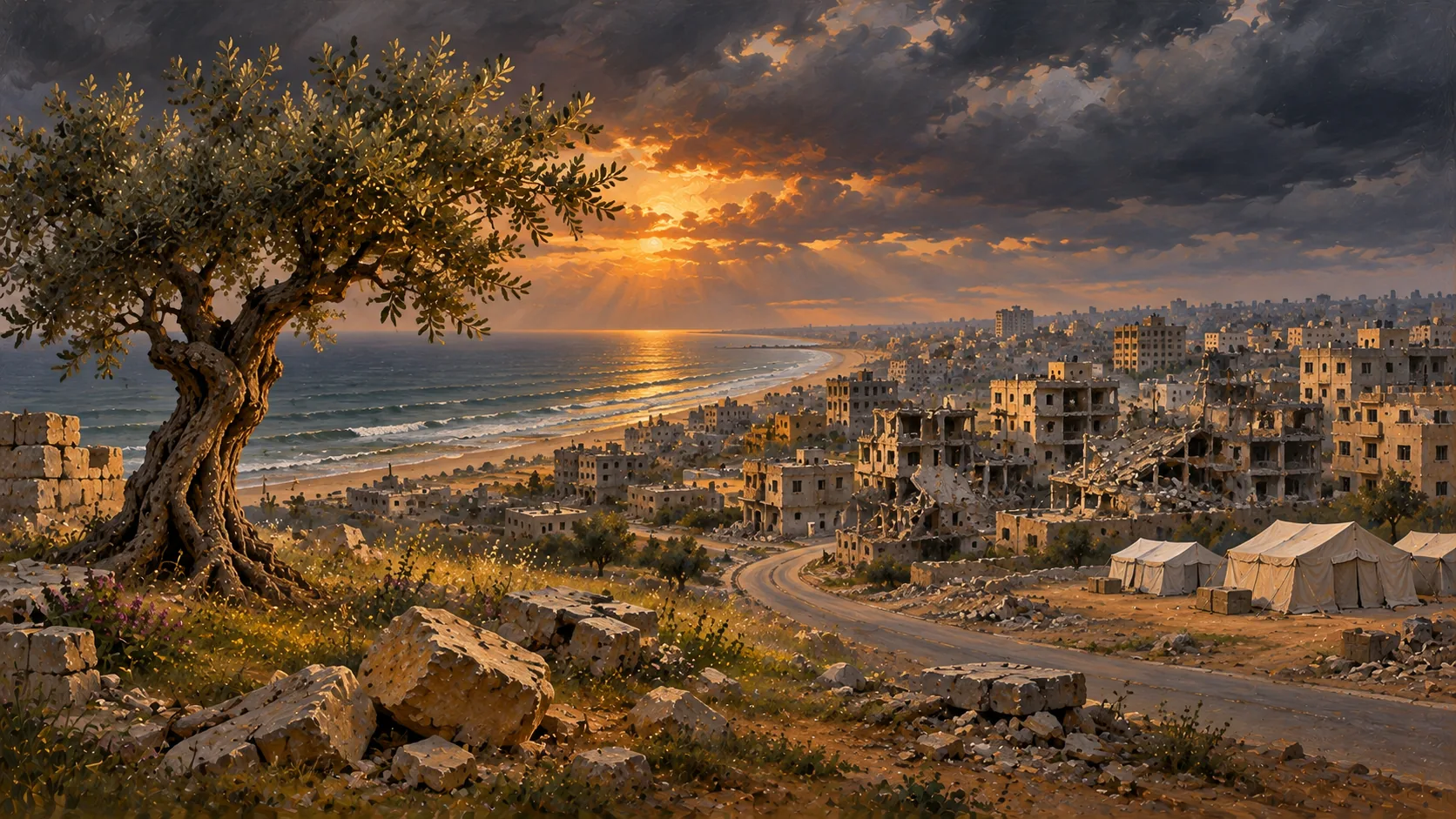
Artistic illustration; not a documentary depiction of a verified event or precise location.
Editorial premise. Understanding Gaza's history does not mean excusing attacks on civilians. Attacks on Israeli civilians, the abduction of hostages, the bombing of civilian facilities without observing the rules of distinction and proportionality, collective punishment, and the obstruction of urgently needed humanitarian aid each require their own factual and legal assessment. Responsibility must be established on the basis of actions and decisions, not nationality or religion.
Gaza Did Not Become a Theater of War in 2023
Gaza is a small, densely populated coastal strip on the Mediterranean Sea. Many of its families descend from Palestinian communities whose members fled their homes or were expelled from them during the 1948 war. Egypt administered the area between 1948 and 1967; after the 1967 war, it came under Israeli occupation. This history makes the question of Gaza inseparable from displacement, the right to self-determination and the wider Israeli–Palestinian conflict. [1][2]
Over the decades, the territory has experienced military confrontations, restrictions on movement, economic dependency and political upheaval. Palestinian political groups have not acted as a single bloc: the Palestinian Authority, Fatah, Hamas and other organizations have differed in their programs, political methods and use of violence. It is therefore inaccurate to speak as though all Gaza residents share a single political view, or as though the civilian population bears collective responsibility for decisions made by armed groups.
The same principle applies to Israelis: Israeli citizens' security concerns and experience of attacks are real. Yet a genuine need for security does not, by itself, establish which measures are lawful. The way in which the opposing side's civilians are treated remains subject to legal restrictions.
The Year 2005: Withdrawal of Soldiers and Settlers Did Not End Every Dispute
In 2005, Israel carried out a unilateral withdrawal of its permanent ground forces and settlers from the interior of Gaza. Israel's Ministry of Foreign Affairs states that the final withdrawal of troops was completed on September 12, 2005, and presents that decision as the end of Israeli military administration over the area. The original Israeli plan also maintained that, after withdrawal, there would no longer be grounds for describing Gaza as occupied territory. [3][4]
The important question, however, is whether the withdrawal of permanent units also ended effective control. Israel continued, to varying degrees, to determine access by sea and air, movement through a large share of the land crossings, the movement of people and goods, and certain other administrative and economic functions. Egypt played its own role at the Rafah crossing; Palestinian authorities carried out internal security and civilian functions. These different dimensions cannot simply be collapsed into the single word “control.”
The International Committee of the Red Cross (ICRC) therefore continued to regard Gaza as occupied territory after 2005. Its interpretation focuses on the test of effective control. In its advisory opinion of July 2024, the International Court of Justice (ICJ) explained that Israel's obligations under the law of occupation were commensurate with the degree of control it had retained. The October 2025 opinion further emphasized that the degree of effective control had increased after the war began. [2][5][6]
The key distinction: “Israel's permanent presence inside Gaza ended in 2005” is not the same assertion as “Israel had no obligations towards Gaza's inhabitants after 2005.”
From Internal Palestinian Division to the Blockade After 2007
Hamas achieved a significant electoral victory in the 2006 Palestinian parliamentary elections. Increasing antagonism between Hamas and Fatah led to armed confrontation; in 2007 Hamas took internal control of Gaza, while the Fatah-associated Palestinian Authority remained principally based in the West Bank. This deepened the political and institutional division of the Palestinian territories.
After 2007, Israel sharply tightened restrictions on access to Gaza by land, sea and air. Israel justified these measures by citing the danger of rocket attacks, weapons smuggling, and the activities of Hamas and other armed groups. Egypt also imposed restrictions at the Rafah crossing. OCHA notes that these restrictions affected economic activity, trade, family ties and the possibility of obtaining medical treatment outside Gaza. [7]
The legality of a particular border inspection cannot be determined solely from the fact that it was introduced. A state may adopt security measures and prevent weapons smuggling. But the long-term restriction of essential supplies, medical treatment and ordinary civilian life raises different questions: Is the measure necessary, proportionate, directed at an actual threat, and consistent with the obligation of humane treatment? Is an individual being penalized for their conduct, or an entire population for the actions of armed groups? [5][6]
This period saw recurring hostilities, shelling, Israeli military operations and economic deterioration in Gaza. This background is necessary to understand the war of 2023, but it does not justify subsequent violations by either side.

October 7, 2023: Attacks on Israeli Civilians and the Taking of Hostages
On October 7, 2023, Hamas and other Palestinian armed groups launched attacks from Gaza into Israeli territory. They attacked communities, homes, public places, the site of a music festival and military facilities. They killed many civilians and members of the security forces, wounded others and took hostages into Gaza. Rockets were fired towards populated areas of Israel. A United Nations independent commission of inquiry documented deliberate attacks on civilians, hostage-taking and other serious violations of international humanitarian law during the attacks. [8]
Israeli sources and OCHA's overview dated November 4, 2026 report more than 1,200 people killed in Israel, mostly on October 7 and in its immediate aftermath, including foreign nationals; OCHA separately reports 1,162 identified fatalities. These are not identical categories; the methodologies and cutoff dates used in comprehensive public summaries also differ. [9]
The abduction and detention of hostages require particular attention because international humanitarian law prohibits hostage-taking regardless of the cause of a war. Every detainee must be treated humanely. Attacks on civilians do not become permissible when those who carry them out invoke their own community's prior suffering. Nor is there any basis for concluding from these events that every Gaza resident supported the attacks or that civilians could lawfully be targeted in retaliation.
The UN commission of inquiry also examined complex questions relating to individual incidents and the conduct of Israeli forces during the attack, including events at Kibbutz Be'eri. This does not diminish the attackers' established responsibility for attacks on civilians; rather, it underscores the need to support descriptions of each incident with evidence instead of viral accounts. The commission applied a “reasonable grounds to conclude” evidentiary threshold and stated that it had not been granted access to the sites of incidents in Israel. That limitation affects the scope and manner in which individual allegations could be verified. [8]
Israel's Response: Military Objectives and Their Legal Limits
After October 7, Israel began a large-scale military operation in Gaza. Its stated objectives included rescuing hostages, preventing further attacks and dismantling Hamas's military capabilities. The Israeli government maintained that it was fighting Hamas rather than the Palestinian population; it also stressed the presence of military facilities and tunnels in populated areas and the issuance of warnings to civilians before attacks. These are positions and claims advanced by the Israeli side, which must be compared with verified information about particular events. [10]
A military objective, even if it may in itself be lawful, does not displace the rules governing the conduct of hostilities. Attacks must be directed at military objectives; foreseeable civilian harm must be assessed against the concrete and direct military advantage anticipated; and feasible precautions must be taken. Even if a fighter hides among civilians or a military installation is located next to a hospital, that does not give the opposing side unlimited permission to bomb all nearby civilians. At the same time, a civilian object may, under certain factual conditions, become a military objective; that determination cannot rest on its designation alone. [5][6][11]
Since October 2023, numerous Israeli strikes have affected residential areas, schools, routes, infrastructure and the health-care system. In report A/HRC/56/CRP.4, concerning principally the period through December 31, 2023, while treating some subsequent events as part of wider patterns, the UN commission of inquiry found several grave violations under its “reasonable grounds to conclude” evidentiary standard, including unlawful forcible transfers of civilians. The report was prepared without the commission having access to Gaza and without cooperation from the Israeli government, which the commission lists as methodological limitations. Its findings constitute a serious investigative record, but are not, by themselves, criminal convictions of individuals. [11]
A legal assessment of any given strike requires, at minimum, the following questions: What was the target? What did the attacker know at the time of the decision? What civilian harm could reasonably have been expected? Which alternatives were feasible? Which information was subsequently verified? High overall casualty and destruction figures are important indicators of the scale of harm, but are not by themselves conclusive proof of every individual criminal offence.
How Many People Have Died, and What Can the Statistics Tell Us — or Not Tell Us?
OCHA's Reported Impact Snapshot of November 4, 2026 lists 74,618 reported Palestinian fatalities and 175,920 reported injuries since October 7, 2023. OCHA explicitly attributes these figures to Gaza's Ministry of Health; they are not presented as the UN having independently verified the death of every individual. A separate category comprises 74,237 deceased people identified in the Gaza Ministry of Health's records as of October 7, 2026. Being identified in those records does not mean that the UN independently investigated the circumstances of each person's death. The figures reflect different reporting dates and record-keeping statuses. [9]
The breakdown of identified fatalities includes children, women, older people and men; these are demographic rather than military categories. It would be wrong to assume that the category “men” means members of armed groups. Such classification requires independent verification of a person's status and the circumstances involved. Equally, a direct death register does not capture all indirect consequences of illness, hunger, interrupted care or deaths occurring later. Estimating those effects requires a different methodology. [9]
For the Israeli side, the same OCHA overview reports more than 1,200 fatalities in Israel, predominantly from the October 7 attack and its immediate aftermath, as well as 474 reported Israeli military fatalities in Gaza since the start of the ground operation, according to Israeli military figures. These concern different populations and time periods; adding them together without explanation would be misleading. [9]
Numbers cannot replace individuals' names, experiences or rights. They can, however, reveal the scale of the violence and how many people it directly affected. Every public figure should therefore be accompanied by its source, date and an explanation of whom it includes.
Life Among the Ruins: Food, Water, Hospitals and Displacement
Damaged or destroyed infrastructure means more than the loss of buildings. When water systems, sewage networks, electricity, waste collection, health care or access to food fail, civilians also face threats that are not caused by a direct explosion. Data on food, health and displacement must be understood in this context, rather than treated as abstract additions to the military chronology.
In its November 4, 2026 overview, OCHA summarized a UNOSAT assessment that 82% of all structures in Gaza had been damaged or destroyed as of June 16, 2026. A different indicator, based on a joint assessment of housing units, gave 76.6% of housing units damaged or destroyed, using a different reference date. The two figures do not describe the same set of structures and are therefore not contradictory. [9]
In September 2026, the World Health Organization reported that 19 of 36 hospitals were operating at least partially, while none was operating at full capacity. Shortages of medicines, fuel and medical equipment, together with limited possibilities for evacuating patients, posed further risks to patients, newborns and injured people. [12]
Since the war began, a vast number of people have had to relocate repeatedly within Gaza. An evacuation order or warning does not, by itself, establish that a route was safe or that suitable shelter existed. Forcible transfers are generally prohibited under international humanitarian law; narrowly defined temporary evacuations may be permitted under specific conditions for the safety of the population or imperative military reasons. In all cases, obligations concerning protection, care and return once the danger has passed remain applicable. [6]
The war also directly endangered access to relief. There are genuine security needs associated with inspections, but permissible screening of shipments must be distinguished from the prohibited obstruction of aid urgently needed by the population. In its advisory opinion of October 22, 2025, the ICJ explained the obligation to ensure basic necessities and facilitate humanitarian assistance, including the work of relevant UN organizations. The Court emphasized that the law of occupation and the rules governing the conduct of hostilities can apply simultaneously, and that the extent of the occupying power's obligations varies with the degree of its effective control. The opinion defined state obligations; it was not a trial of individual guilt for every alleged war crime. [6]

The October 10, 2025 Ceasefire and Its Limitations
According to OCHA, a new ceasefire entered into force at noon on October 10, 2025. Under the agreement, the ICRC facilitated the release of hostages and Palestinian detainees, as well as the transfer of human remains, on October 13 and 14. The ceasefire allowed humanitarian organizations to expand some operations again and enabled greater movement of people. It did not automatically rebuild destroyed towns or bring a permanent end to all hostilities. [13]
In reporting subsequent incidents, it is therefore essential to distinguish “a ceasefire was in effect” from “violence had ended.” In a report published on November 6, 2026, OCHA stated that, for the period October 27–November 2, 2026, Gaza's Ministry of Health reported 36 Palestinians killed and 145 injured. The same report recorded 1,593 reported deaths and 5,748 injuries since the ceasefire, again using figures from the local ministry rather than OCHA's independent confirmation of every case. [14]
Since October 2025, debates have continued over control of particular areas, access through crossings, aid distribution, disarmament of groups and the political administration of Gaza. An agreement can reduce immediate violence, but lasting security also requires viable living conditions, oversight of armed actors and the protection of civilians' rights.

The Flooding of November 2026: A Natural Event Revealing the Consequences of War
Between November 6 and 8, 2026, Gaza experienced heavy rainfall and strong winds. The rain itself was not caused by military operations. But a territory with destroyed drainage systems, damaged homes, makeshift tents and limited supplies is far more vulnerable than one with functioning infrastructure.
In a report published on November 9, 2026, OCHA stated that, by November 8, partners had received requests for assistance from more than 26,000 households reporting damaged shelters or property. These were preliminary requests and appeals for help that still required assessments on the ground; they were not a final, independently verified count of all damaged dwellings. The figure refers to households, not individuals, and does not equal the total number of people exposed to flooding. [15]
According to the same report, large quantities of tents and other materials were available outside Gaza, while local stocks had been severely depleted. OCHA identified approvals for the entry of goods and equipment, as well as funding, among the factors limiting the response. In a statement on November 11, 2026, the UN humanitarian relief chief called for winter supplies to be allowed in immediately. That is the humanitarian office's position and should be attributed to its source; it is not a separate judicial ruling on the legality of every individual restriction. [15][16]
These conditions reveal the connection between war and reconstruction: meaningful protection of civilians is not merely the absence of bombing, but also the ability to obtain safe shelter, drinking water, basic medical care and essential supplies.
What Have the Courts Established — and What Have They Not Yet Decided?
Public debate often conflates different legal proceedings. This produces two opposite errors: treating provisional measures as though they were already a final conviction, or dismissing their legal consequences because no final judgment has yet been given.
ICJ — advisory opinion of July 2024 (case 186). This opinion on the legal consequences of Israel's policies in the Occupied Palestinian Territory addresses the status of the occupation and Israel's obligations. The Court expressly excluded from its temporal scope consideration of Israeli operations in Gaza in response to the October 7, 2023 attack. It is therefore incorrect to cite the opinion as a judgment on every subsequent military operation. [2]
ICJ — advisory opinion of October 2025 (case 196). This opinion concerns Israel's duties in relation to the work of the UN, international organizations and third states, particularly the provision of humanitarian aid in the Occupied Palestinian Territory. It also explains UNRWA's role and obligations concerning the basic necessities of life. It is not a criminal conviction. [6]
ICJ — South Africa v. Israel (case 192). This is a dispute under the Convention on the Prevention and Punishment of the Crime of Genocide. In 2024, the Court issued several orders indicating provisional measures. Those orders are legally significant, but they are not a final judgment that genocide has or has not been committed. An order dated May 21, 2026 set further deadlines for written pleadings: November 22, 2027 for South Africa and May 22, 2029 for Israel. As of the research cutoff, no final judgment on the merits had been issued. Israel denies the allegations of genocide; its position and procedural defense do not replace the Court's decision. [17]
UN commission of inquiry — findings of genocide (2025 and 2026). In report A/HRC/60/CRP.3 of September 16, 2025, the UN Human Rights Council's Independent International Commission of Inquiry concluded, applying its evidentiary standard, that Israeli authorities and security forces had committed and continued to commit genocide in Gaza, setting out its assessment of the acts and the required specific intent. In a further report, A/81/430 of October 2026, it reiterated its finding of continuing genocidal acts. These are serious findings by a UN investigative body, not final judgments on the merits by the ICJ or criminal convictions of individuals. Israel's Ministry of Foreign Affairs firmly rejected the September 2025 report, accused the commission of bias and maintained that its conclusions were methodologically unfounded. Disagreement over the evidence matters, but a state's rejection does not, by itself, invalidate the findings of an investigative body. [19][20][21]
ICC — individual criminal responsibility. On November 21, 2024, the International Criminal Court issued warrants of arrest for Benjamin Netanyahu and Yoav Gallant for alleged war crimes and crimes against humanity. An arrest warrant means that judges have found that the applicable threshold of suspicion is met at the pretrial stage; it is not a final conviction. On the same date, the ICC also issued a warrant for Mohammed Deif of Hamas's military wing, but it terminated the proceedings against him on February 26, 2025, following notification of his death. These procedural situations must not be confused. [18]
For future allegations against individual members of either side, the same distinctions must be maintained among a documented allegation, an investigative finding, the initiation of judicial proceedings and a final court ruling.
Can We Speak of Justice Without Security — or Security Without Rights?
Israeli civilians have the right to live free from rocket attacks, massacres and abductions. Palestinian civilians have the same right not to be targeted by attacks, collective punishments, arbitrary transfers or living conditions incompatible with survival. One community's security is not a legal exemption from the basic protection owed to another.
Gaza has become a place where the history of displacement, Palestinian political fragmentation, rocket attacks, Israeli security decisions, a long-running blockade, war, repeated internal displacement and the loss of infrastructure intersect. Removing any one of these dimensions from the account can diminish both our understanding of events and our ability to assess them fairly.
A lasting transition from ceasefire to peace will require the protection and dignity of all civilians, accountability for documented crimes, verifiable prevention of renewed attacks, access for humanitarian assistance, the clearance of explosive remnants of war, the restoration of health-care and public-service infrastructure, and a political framework that recognizes Palestinians' right to self-determination and Israelis' right to security. The precise institutional form of such a solution cannot be established solely from the history of the past three years.
The central research question, then, is not which civilian population deserves greater protection. It is whether we are willing to apply the same rules even when the perpetrator is politically close to us and the victim is far away. That is the standard by which the defense of human dignity can be distinguished from the justification of violence.
Sources and further reading
- UNRWA, historical background and organizational mandate: source Source
- ICJ, advisory opinion of July 19, 2024, case 186: source Source
- Israeli Ministry of Foreign Affairs, chronology of the 2005 disengagement: source Source
- Israeli Ministry of Foreign Affairs, disengagement plan (2004): source Source
- ICRC, obligations of an occupying power and effective control over Gaza: source Source
- ICJ, summary of the advisory opinion of October 22, 2025, case 196: source Source
- OCHA, historical overview of the Gaza blockade (2016): source Source
- UN commission of inquiry, A/HRC/56/CRP.3, October 7, 2023 attacks: source Source
- OCHA, Reported Impact Snapshot – Gaza Strip, as of November 4, 2026: source Source
- Israeli Ministry of Foreign Affairs, official answers concerning the objectives of the operations, published on the IDF website (December 15, 2023): source Source
- UN commission of inquiry, A/HRC/56/CRP.4, operations in Gaza from October 7 through December 31, 2023: source Source
- WHO, public remarks by the Director-General, September 24, 2026: source Source
- OCHA, Humanitarian Situation Update #331, October 16, 2025: source Source
- OCHA, Humanitarian Situation Report, November 5, 2026 (published November 6): source Source
- OCHA, Heavy Rains in the Gaza Strip, November 8, 2026 (published November 9): source Source
- OCHA, statement by the UN humanitarian relief chief, November 11, 2026: source Source
- ICJ, order setting further deadlines in South Africa v. Israel, May 21, 2026: source Source
- ICC, official page on Palestine and ongoing proceedings: source Source
- UN Human Rights Council's Independent International Commission of Inquiry, A/HRC/60/CRP.3, legal analysis of genocide (September 16, 2025): source Source
- Independent commission of inquiry, report A/81/430 on further violations (October 2026): source Source
- Israeli Ministry of Foreign Affairs, official response to the UN commission's report (September 16, 2025): source Source