What Can I Learn from My Grandparents and Family Traditions?
You don't have to live the way your grandparents did to learn something they know that no one else may be able to show you.
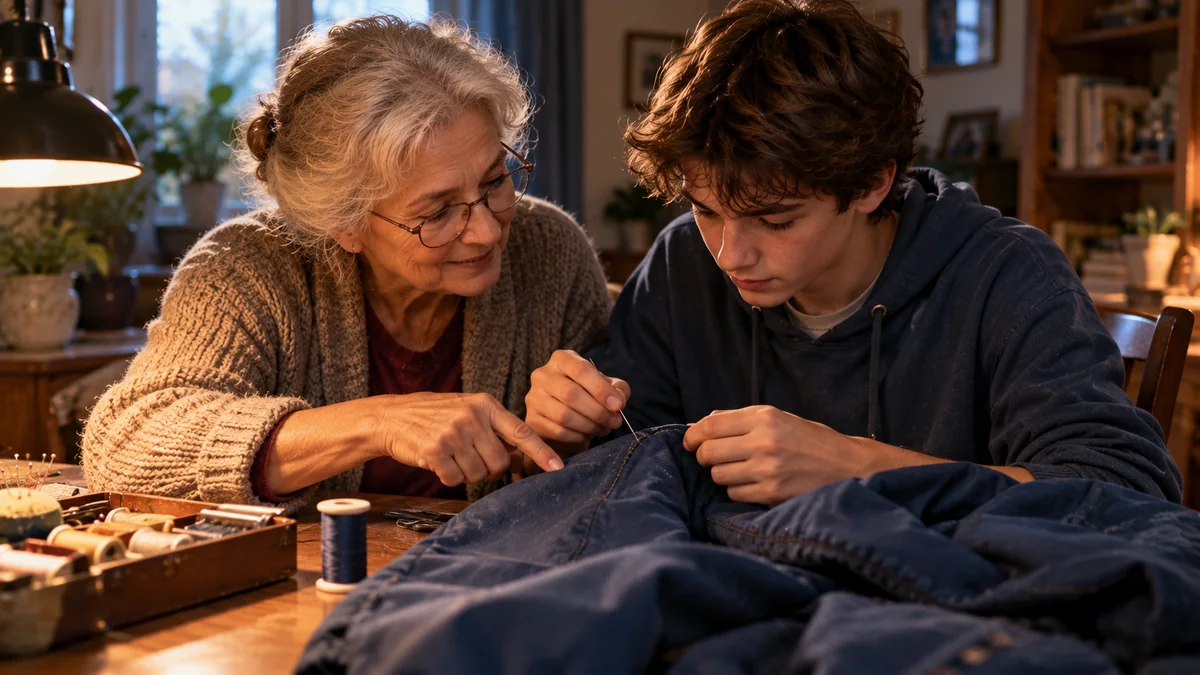
You don't have to live the way your grandparents did to learn something they know that no one else may be able to show you.
Your jacket has ripped. You're already looking for a replacement on your phone when someone at home remarks, “That can be fixed.” You can already imagine the familiar story about how people used to have to do everything themselves. But the person in front of you picks up a needle, examines the fabric, and spots something you missed: the seam has come undone, while the fabric itself is almost undamaged.
Would it be worth putting your phone down for a moment and asking how they spotted it? And what if that same person then gave you advice that seems completely inappropriate today?
My advice: choose one thing someone with experience knows how to do, and ask them to show you how they do it—and why. You don't have to absorb a lifetime of experience in one conversation. Learn one step, ask why it works, and decide for yourself whether it is useful. Being grateful to someone does not oblige you to accept every piece of advice they offer. This matters especially with health, safety, money, and relationships, where circumstances and knowledge may have changed considerably.
A family tradition is not a test of obedience. It can be one of the ways you learn to make better judgments for yourself.
Some of the Most Useful Things Cannot Be Explained in One Sentence
Some people can quickly tell you what needs to be done. What is harder to explain is how they recognize what a situation calls for. Someone who has experience sewing notices tension in a piece of fabric. An experienced cook has learned how to judge when food has been cooked thoroughly enough. Someone who repairs things can tell when a repair is worthwhile—and when it would be unsafe or cost more than a replacement. Not every grandparent has these abilities. But they are a good reason not to judge a person's knowledge solely by how well they use the latest device.
Sometimes one question changes the whole conversation. Instead of asking, “Can you do this for me?” try, “How did you know where the problem was? Can you show me the first step?” If your grandmother hands you a needle and shows you how to mend the seam rather than repairing the jacket for you, the task may take longer at first. Next time, though, you won't be entirely dependent on her. This kind of help doesn't do everything for you; it helps you become more independent.
Not everything worth learning is a practical skill. Someone might explain why they compare prices before a major purchase or why they never promise something they cannot deliver. Another person could tell you how they repaired a relationship after an argument, made a decision about moving, or turned down an attractive but risky offer. The most valuable part of the story isn't necessarily its happy ending. Sometimes it's a decision the storyteller would make differently today.
Yet even the most sincere life story has limits. Someone who managed to save for a home may teach you a lot about patience and making sacrifices. Their experience, however, does not mean that house prices, wages, loans, or opportunities are the same today. Someone who recovered from an illness while using a home remedy has not thereby proved that the remedy is effective or safe for anyone else. Learn from the reasons and consequences, rather than copying every old method.
Lea, a Loose Seam, and a Question That Changed the Conversation
The following scene is fictional.
Sixteen-year-old Lea notices that a seam has opened up on the sleeve of her favourite jacket. She wants to wear it on a Saturday trip, so she has already started looking at the prices of similar new jackets.
“You don't need a new one straight away,” her grandmother says. “Let me take a look.”
“I just don't want it to look patched up,” Lea replies.
Her grandmother turns the sleeve over. “See this? The fabric is fine. It's just the seam that's come apart. If we stitch along the same line, you'll hardly notice it.”
“I wouldn't even have noticed the difference. How could you tell?”
“I first check whether the fabric is torn or only the stitching has given way. Come here, I'll show you.”
Lea sits beside her. Her grandmother shows her how to catch the edge of the fabric with the needle, then lets her have a go. Lea tangles the thread on her first stitch, and her grandmother chuckles. “See? That's why I told you not to pull so hard.” Lea tries again. They are no longer arguing about who is right. They are looking at something they can both see and test.
As they work, her grandmother explains that people in her household often mended clothes because they couldn't simply go out and buy new ones. Lea doesn't envy that scarcity, nor does she describe it as “the good old days.” But she understands why her grandmother still notices what can be reused. A difficult situation can teach a useful skill without making the hardship itself something worth repeating.
“So should we try to repair absolutely everything?” Lea asks.
“Of course not. First you find out what's wrong. And whether the thing will still be safe afterwards.”
That is an important boundary. A good lesson from the past is not an instruction to solve every problem the old-fashioned way. You can learn to mend an ordinary seam; damaged protective equipment, electrical appliances, and other hazardous tasks call for appropriate professional judgment and modern safety standards. Experience is valuable, but by itself it is no guarantee of safety.
Lea doesn't decide that from now on she will do everything the way her grandmother does. She might still choose a different jacket for Saturday's trip. But she now knows how to examine a seam and, at least with this kind of damage, recognize when it's worth asking about a repair. That's far more useful than merely listening to a story about the past.
Lace Was Made by Practised Hands, Not by Good Advice Alone
Slovenia has a well-documented tradition in which passing knowledge between generations is central to the heritage itself. Bobbin lacemaking in Slovenia was inscribed on UNESCO's Representative List of the Intangible Cultural Heritage of Humanity in 2018. Threads wound onto bobbins are crossed, twisted, and interlaced according to a pattern on a special lacemaking pillow. UNESCO's official description says that the skill is often passed from grandmothers to grandchildren. Groups in which lacemakers meet and learn from one another are important too. [1]
Bobbin lacemaking in the Idrija area is documented from the second half of the seventeenth century. During the nineteenth century, the craft spread from Idrija, and its designs changed in other places as well. This is the history of a particular skill in particular communities—not evidence that people made lace in every Slovenian household. [2]
You cannot learn to make lace simply by being told to “be patient.” A learner has to see how the hands move, follow the sequence, recognize when a thread has been crossed the wrong way, and correct the mistake. The finished lace comes from a series of small corrections, not merely from being told to be patient. The fact that bobbin lacemaking is recognized as heritage does not prove that everyone who practises it is more patient or a better person. What makes the example useful is that it shows how a demanding skill is taught and passed on.
If lacemaking was predominantly associated with women in the past, that doesn't mean learning it should now be morally or professionally reserved for girls. A boy can learn bobbin lacemaking; a girl can learn to repair a bicycle. Both can respect knowledge someone has spent years developing. What matters most here is the quality of the knowledge we can pass on and the opportunity for anyone interested to learn it.
There's another point. This tradition has not remained alive because every learner has copied one design exactly. Patterns, uses, and working conditions have changed. That does not diminish the skills of earlier generations. It shows that preserving something can involve understanding what is worth carrying forward—and what may need to evolve.
What If Your Grandfather Is Right—But Not in the Same Way Today?
Another Slovenian example is beekeeping. UNESCO inscribed Beekeeping in Slovenia, a way of life on the same list in 2022. Its official account says that knowledge is passed on within families, as well as through schools and beekeeping clubs. It also stresses continued learning and research. [3] [4]
Imagine your grandfather showing you what he looks for at an apiary before deciding what work needs doing. That would not mean every grandfather who keeps bees is right about everything. But it could begin a good conversation: “What does that tell you? Is there a decision you would have made differently years ago? Where do you go to learn more about it today?”
Tradition and new knowledge need not be rivals. Years of experience may help someone notice something important, while professional training can help them check whether an established method is still appropriate. Don't attempt to work with live bees on your own merely because a relative has told you how: you need competent guidance and appropriate safety precautions. And old stories about bee products are no substitute for sound medical advice.
The same reasoning applies to far more ordinary things. A family recipe may be delicious and full of memories, but ingredients, allergies, and health needs differ from person to person. An old family rule about saving can teach careful judgment without telling you whether a loan offered today is fair. The advice “we used to do everything ourselves” may encourage practical skills, but it may also overlook how much time you have or how dangerous a task could be.
So ask an older person something that doesn't usually belittle their experience but opens up a conversation: “What have you changed about the way you do things over the years?” If they can tell you something new they themselves have learned, they're passing on an especially valuable attitude: being committed to doing good work does not mean insisting you have always been right.
What If a Family Custom No Longer Fits Your Life?
A family tradition needn't involve a demanding skill. It could be a song someone sings at a holiday, a familiar route when you visit your family's hometown, a group photograph, a word in a local dialect, or a way of remembering someone who has died. To one person it brings a sense of closeness. To another it's just an obligation nobody has ever explained.
The following scene is fictional.
Seventeen-year-old Jan has a friend waiting for him. But whenever the family gets together for a larger gathering, everyone still stands outside his grandparents' house for a group photograph. Granddad wants them to stand in exactly the same place and in exactly the same order as always.
“Granddad, do we really have to stand there for half an hour again?” Jan asks.
“You know we always take a photograph.”
“Yeah, but why does it have to be exactly the same?”
His grandfather falls silent for a moment. Then he explains that, years ago, it was difficult to get the whole family together. When he looks through the old photographs now, he recognizes people who are no longer with them. Jan listens. Before, he had seen only a waste of time. Now he understands why the moment means so much to his grandfather.
“What if we take one photo right away, and then you show me the oldest one? I need to leave in twenty minutes,” he suggests.
His grandfather would have preferred more time, but they reach an agreement. The purpose of the custom—to preserve memories—remains. Jan doesn't have to cancel all his plans to honour it.
This is not an ideal ending you can insist on in every family. It does, however, show the difference between the purpose of a custom and its exact form. If the aim is to keep memories and connections alive, the method can change. And if a custom depends on pressure, humiliation, unwanted physical contact, or one person always having to set aside their needs, it doesn't have to be repeated just because it has been around for years.
Slovenia's Ministry of Culture describes intangible cultural heritage as knowledge and practices that people pass on between generations and also adapt to their environment, nature, and history. [5] That's a description of cultural heritage. Our moral assessment is a separate matter: when deciding what to do with a particular family custom, we should also ask whether it is fair, safe, and respectful towards those involved.
Sometimes you'll be happy to continue a custom. At other times you'll choose a different version or decide not to take part. It helps to be able to explain why: “I'd like to keep the memory alive, but not the part of the custom that humiliates someone.” A respectful answer doesn't have to mean agreement.
How Can You Ask Questions That Turn a Story into Knowledge?
Sometimes you ask a grandparent, “What was it like back then?” and get little more than “Completely different.” Oral-history specialists suggest more open and specific questions: what happened, how someone experienced it, who helped them, what they did, and why. Smithsonian guides to oral history recommend photographs, places, and everyday activities as useful starting points. It's important to keep questions open and let the person answer in their own way. [6] [11]
If you find an old photograph, for example, don't just ask, “Who is that?” Start with what you notice: “I can see you're standing outside a different house. When did you move? Why there? Was it equally difficult for everyone?” If someone talks about having to start work at an early age, ask what made it possible—or impossible—for them to stay in school. That brings circumstances and other people's lives into the story, rather than reducing everything to the lesson “we worked harder than you do.”
You could also ask, “Can you remember a mistake you would handle differently today?” But nobody is obliged to talk about painful or private experiences simply because you're related or need to complete a school assignment. If someone doesn't want to speak about something, respect that boundary.
And what if two people remember the same event differently? Granddad says school used to be stricter, while Grandma remembers that teachers varied a great deal. You don't have to immediately call one of them a liar. Ask which schools they attended, when they went there, which teachers they knew, and whether any letters, documents, or other people's recollections might help. A family story is a valuable source of what someone remembers and how they understand their life. By itself, though, it doesn't prove that everything happened exactly as told—or that it was the same everywhere. That's why professional oral-history guidance recommends putting accounts in context and checking claims when presenting them as facts. [8]
If you'd like to record the conversation, ask first—not after you've already put your phone on the table and started recording. Explain why you want to record it and who will be able to listen. “You can keep this for the family” does not mean “You can publish this online.” Ask for separate permission before sharing the recording publicly, and respect the privacy of other people mentioned in the story. If the person doesn't want a part of the story shared, stop there. [7] [8]
Older People Can Learn from You, Too
Perhaps your grandmother shows you how to tell a loose seam from torn fabric. You might then help her organize a digital album of old family photos—if she actually needs that help. The reverse could just as easily happen: an older person may be excellent with phones, while you are using a particular app for the first time. Neither generation comes with all the answers. If you listen to one another, you can both learn.
An older person may explain how they dealt with a difficult period. A younger person may know about more recent information, different social circumstances, or new tools. Age alone makes no one infallible—or irrelevant. In its discussion of ageism, the World Health Organization also warns about the effects of stereotypes that judge people solely on their age. [9]
That's especially worth remembering when somebody says, “You're too young to understand,” or “Old people are all behind the times.” Both statements replace the actual person with an assumption about their generation. It's far more useful to ask, “What have you learned from experience? What could we check together?”
Respect doesn't mean you have to become the only person helping an older relative, take responsibility for an adult's care, or neglect school and your own needs. A relationship where people listen to one another can also include an honest sentence: “I can't manage that today. Let's find some other help.” We'll return to the fair division of family responsibilities when discussing relationships with other people at home.
What If You Don't Know Your Grandparents—or Don't Want to Visit Them?
For many people, grandparents are a source of warmth and knowledge. Others have lost them, never lived near them, grew up in a different family arrangement, or have painful relationships with them. None of that means they have lacked moral guidance or opportunities to learn.
An experienced person could also be an aunt, an uncle, a trusted neighbour, a family friend, a teacher, a craftsperson, a librarian, or a mentor in your community. What matters more than being related is having a relationship in which knowledge and respect are genuinely present. If you don't know the person well, make sure the setting is appropriate and safe, and seek support from adults you trust.
If a relative humiliates you, pressures you into things you don't want, or puts you in danger, nobody should demand an interview, a visit, or “reconciliation” as a condition of being respectful. Your safety comes first. You can ask a trusted adult or an appropriate professional service for help. Article N25 deals specifically with what to do when home isn't safe.
And if you miss someone who has died? You can keep a memory alive through an object, something written down, a skill, or another person's story, if that helps you. You don't have to revisit painful memories on command or do anything you're not ready for.
One Thing Worth Asking This Week
If you have the opportunity and feel safe with someone, choose just one thing you'd like to learn this week. It might be a way of sewing a stitch, an old local expression, a decision made during a move, or the story behind a family photograph. Ask: “Can you show me how you did that? And what would you do differently today?” If the skill involves risks, don't attempt it without appropriate guidance.
Then do something yourself: write down a step you've understood or try it out when it's safe. Explain what you find useful and what you wouldn't adopt. That way you can show gratitude even when you disagree with an older person.
You don't have to live by every rule of the people who came before you. But it's worth trying to understand what they learned, why they acted as they did, and what you can responsibly put to use today. Then heritage is not an order handed down from the past, but knowledge you can weigh up and, when necessary, build upon.
Sources and Further Reading
- UNESCO (2018), Bobbin lacemaking in Slovenia. https://ich.unesco.org/en/RL/bobbin-lacemaking-in-slovenia-01378
- Register of the Intangible Cultural Heritage of Slovenia, Bobbin Lacemaking in Slovenia; inscription on the list on 29 November 2018 and a historical overview. https://nesnovnadediscina.si/en/unesco/bobbin-lacemaking-in-slovenia
- UNESCO (2022), Beekeeping in Slovenia, a way of life. https://ich.unesco.org/en/RL/beekeeping-in-slovenia-a-way-of-life-01857
- UNESCO ICH Committee (2022), Decision 17.COM 7.B.27. https://ich.unesco.org/en/decisions/17.COM/7.B.27
- Ministry of Culture of the Republic of Slovenia, Intangible Cultural Heritage [Slovenian: Nesnovna kulturna dediščina]. https://www.gov.si/teme/nesnovna-dediscina/
- Smithsonian Center for Folklife and Cultural Heritage (2016), The Smithsonian Folklife and Oral History Interviewing Guide. https://folklife.si.edu/the-smithsonian-folklife-and-oral-history-interviewing-guide/smithsonian
- Smithsonian Center for Folklife and Cultural Heritage, The Interview. https://folklife.si.edu/the-smithsonian-folklife-and-oral-history-interviewing-guide/the-interview/smithsonian
- Oral History Association (2018), Best Practices and Core Principles. https://oralhistory.org/best-practices/ ; https://oralhistory.org/oha-core-principles/
- World Health Organization (2021), Global report on ageism. https://www.who.int/publications/i/item/9789240016866
- Ministry of Culture of the Republic of Slovenia (2022), Čebelarstvo v Sloveniji, način življenja vpisano na Unescov seznam nesnovne kulturne dediščine [Announcement of UNESCO inscription]. https://www.gov.si/novice/2022-12-01-cebelarstvo-v-sloveniji-nacin-zivljenja-vpisano-na-unescov-seznam-nesnovne-kulturne-dediscine/
- Smithsonian Institution Archives, How to Do Oral History. https://siarchives.si.edu/history/how-do-oral-history