The Tale of the Turnip: Earliest Records, Mysterious Legs, and the Myth of Giants
A source-based investigation of the turnip folktale, its early records, five mysterious legs, children’s games and modern giant myths.
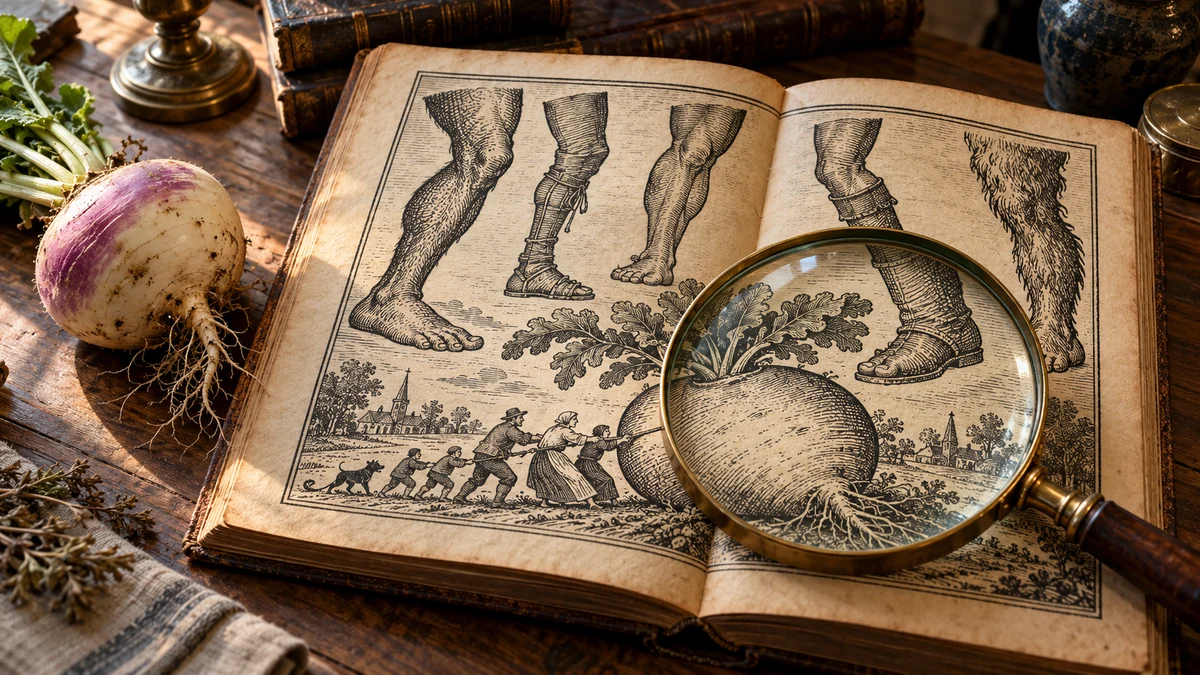
Contemporary symbolic illustration of the turnip tale: five unusual legs are drawn inside the book, not presented as historical evidence of giants.
How unusual helpers from a Russian folktale became part of a historical illustration—and why it is not evidence of a lost civilization of giants.
Most people know the tale of the enormous turnip: a grandfather tries to pull it out of the ground but cannot. The grandmother, granddaughter, dog, cat, and finally a mouse join him. Only when they all pull together do they manage to uproot it. The message seems simple: even the smallest contribution can make a decisive difference. Yet the history of this short tale is not nearly as straightforward as the familiar children's version.
An old Russian illustration is circulating online in which gigantic legs appear alongside human figures. Some posts present it as an image of the “original” Repka that supposedly preserves a memory of real giants. This interpretation combines two distinct claims. The first is verifiable: an early version of the tale does indeed feature five strange “legs.” The second is far stronger: that those legs portray giant human beings who once existed. A historical source supporting the first claim does not automatically support the second.
To understand the distinction, we need to follow the trail from manuscripts and early printed editions to children's games, literary adaptations, and popular prints. The inquiry also exposes a fundamental limitation of research into oral tradition: the earliest known documentary trace does not necessarily mark the birth of a story. The tale may have circulated orally before anyone wrote it down.
The 1856 Manuscript: The Earliest Identified Trace
The earliest dated manuscript trace identified in this investigation leads to Vladimir Governorate in the Russian Empire. In 1856, Yakov Ivanovich Borisoglebsky collected material under the title Песни, скороговорка, сказка и три духовных стиха (Songs, a Tongue-Twister, a Tale, and Three Spiritual Verses). The material is registered in the scholarly archives of the Russian Geographical Society. [3]
Crucially, the document's title alone does not reveal which tale it contains. The connection to the turnip emerges only in a more detailed archival description published in 1914 by the ethnographer Dmitry Zelenin. On page 166, entry no. 32, he briefly explains that a man pulling up a turnip receives help from “one leg, two legs, three legs,” and so on. This is the earliest specifically dated trace of this unusual motif identified among the materials examined. [3][4]
But the evidence has limits. We can directly check that the manuscript material exists and that Zelenin later described its contents; we cannot yet examine the full 1856 text. The original manuscript pages were not obtained for this investigation. We therefore cannot reconstruct with confidence every character, the order in which help arrives, the ending, or the storyteller's precise words. Nor do we know how long the story had already been known before it was written down.
The 1856 manuscript is thus a valuable historical lead, not a license to reconstruct missing text from imagination. It also comes from a different region than the version subsequently published by Alexander Afanasyev. Their resemblance does not establish direct copying: the two may be related forms of folk tradition that circulated in parallel.
Afanasyev's 1860 *Repka*: What Does the Book Actually Say?
The second key document is the fourth fascicle of Народныя русскія сказки (Russian Folk Tales), edited and published by Alexander Nikolayevich Afanasyev. The title page of the copy examined identifies it as the second edition, published in 1860. The tale Рѣпка appears as no. 34, on printed page 106. We examined that page directly in a digitized copy rather than relying solely on a modern transcription. [1]
The tale is brief and consists almost entirely of repetition. Grandfather plants a turnip, tries to pull it up, and then calls Grandmother. Granddaughter and a female dog join them; the dog is simply called сучка (“female dog”) in the original. Then the first “leg” arrives, followed by a second, and eventually by the others up to the fifth. The story ends when the group finally manages to pull the turnip out. This version does not include the cat and mouse that are almost inseparable from the tale today. [1]
Page 106 also contains a curious detail: a question mark appears beside the first leg—«Пришла но́га (?)», meaning “A leg arrived (?)”. The question mark is not merely an intervention by editors of later editions; it is already visible in the 1860 scan. The page itself does not tell us what the recorder, editor, or typesetter intended to indicate. It might mark the unusual nature of the expression or uncertainty about its transcription, but choosing one explanation without further evidence would be speculation. [1]
A note below the tale also states that A. Kharitonov recorded it in Arkhangelsk Governorate. In this case, Afanasyev was the publisher of collected folk material, not the demonstrated author of the story itself. Because the date of Kharitonov's field recording is not given, we cannot determine how much time passed between the telling, its transcription, and publication. [1][5]
The different numbers assigned to the tale in different books can create further confusion. In the 1958 scholarly edition it is numbered 89, while the editorial apparatus explains the older designations 46 and fourth fascicle, no. 34. These belong to different editorial numbering systems; they do not represent three independent original tales. [5]
Primary Texts
Repka (Afanasyev, 1860) — Russian text and English translation
The source is tale no. 34, printed on page 106 of fascicle IV of Afanasyev’s collection (second edition, Moscow, 1860), also listed as source [1]. The Russian text is a transcription in modern orthography, retaining unusual dialect forms and the question mark beside the first “leg.” It is neither a facsimile nor the unexamined 1858 edition.
Russian text — modern-orthography transcription
Репка
Посеял дедка репку; пошел репку рвать, захватился за репку: тянет-потянет, вытянуть не может!
Созвал дедка бабку; бабка за дедку, дедка за репку, тянут-потянут, вытянуть не можут!
Пришла внучка; внучка за бабку, бабка за дедку, дедка за репку, тянут-потянут, вытянуть не можут!
Пришла сучка; сучка за внучку, внучка за бабку, бабка за дедку, дедка за репку, тянут-потянут, вытянуть не можут!
Пришла но́га (?). Но́га за сучку, сучка за внучку, внучка за бабку, бабка за дедку, дедка за репку, тянут-потянут, вытянуть не можут!
Пришла дру́га но́га; дру́га но́га за но́гу, но́га за сучку, сучка за внучку, внучка за бабку, бабка за дедку, дедка за репку, тянут-потянут, вытянуть не можут!
(И так далее до пятой но́ги.)
Пришла пя́та но́га. Пять ног за четыре, четыре но́ги за три, три но́ги за две, две но́ги за но́гу, но́га за сучку, сучка за внучку, внучка за бабку, бабка за дедку, дедка за репку, тянут-потянут: вытянули репку!
English translation — new editorial translation
The Turnip
Grandfather sowed a turnip. He went to pull it up, grasped it, and pulled and pulled, but could not pull it out!
Grandfather called Grandmother. Grandmother held on to Grandfather, Grandfather to the turnip; they pulled and pulled, but could not pull it out!
The granddaughter came. The granddaughter held on to Grandmother, Grandmother to Grandfather, Grandfather to the turnip; they pulled and pulled, but could not pull it out!
A female dog came. The dog held on to the granddaughter, the granddaughter to Grandmother, Grandmother to Grandfather, Grandfather to the turnip; they pulled and pulled, but could not pull it out!
A leg came (?). The leg held on to the dog, the dog to the granddaughter, the granddaughter to Grandmother, Grandmother to Grandfather, Grandfather to the turnip; they pulled and pulled, but could not pull it out!
Another leg came. The second leg held on to the first, the first to the dog, the dog to the granddaughter, the granddaughter to Grandmother, Grandmother to Grandfather, Grandfather to the turnip; they pulled and pulled, but could not pull it out!
(And so on up to the fifth leg.)
The fifth leg came. Five legs held on to four, four legs to three, three to two, two to one, one leg to the dog, the dog to the granddaughter, the granddaughter to Grandmother, Grandmother to Grandfather, Grandfather to the turnip; they pulled and pulled — and pulled out the turnip!
Textual note: the third and fourth legs are not separately narrated in the source; after the second leg it states “and so on up to the fifth.” Neither translation invents extra scenes or characters. The historical edition’s full editorial notes are not reproduced here.
The 1858 Edition: It Exists, but We Have Not Seen Its Text
Here we encounter an important bibliographic question. The Russian State Library has a catalogue record for the first edition of Afanasyev's fourth fascicle, dating to 1858. The record gives its extent and library shelfmarks. More importantly, the page granting printing permission in the 1860 copy states that it was printed from the 1858 edition. The existence of an earlier edition is therefore more than an online conjecture. [1][2]
Yet the existence of a book is not direct confirmation of a particular text on its pages. Despite searching library catalogues and digital collections, we were unable to obtain a legible page containing Repka from the 1858 copy. We therefore cannot directly establish whether the tale appeared there in precisely the same form, with the same notes and the same succession of helpers.
The evidence-based formulation is this: 1858 is the bibliographically confirmed date of an earlier edition of the fourth fascicle; 1860 is the date of the earliest printed copy of Repka that we directly examined in this investigation. That does not mean the tale was absent in 1858. It means that this particular link in the chain of evidence has not yet been verified firsthand.
The distinction is more than a formality. It identifies which information comes from a directly examined document, which from a library catalogue, and where verification currently ends.
What Might the Five “Legs” Mean?
Seeing gigantic legs in an old illustration naturally raises the question of what these figures were intended to represent. But the 1860 text does not say that the helpers are giants. It describes them through an unusual word and a sequence, without specifying their height, bodily form, or origin. Nor are the stress mark and question mark sufficient to establish the word's meaning reliably without further evidence.
Other regional versions offer useful comparisons. The scholarly commentary to the 1958 Afanasyev edition preserves the opening of a tale from Vologda Governorate in which a little “leg” (ножка) comes running along a path and is asked to help. In a song text published by Pyotr Bessonov in Детские песни (Children's Songs) in 1868, however, the “leg” and its successors fly in; this passage was checked through a later scholarly reproduction, not directly in Bessonov's volume. These examples alone suggest that the helper was not a single, definitively described figure. [5][6][7]
In 2017, folklorist Anastasia Lizlova and researcher Andrey Repin compared early records, children's songs, and games. Of particular interest is a folk song or humorous tongue-twister in which one-legged, two-legged, and other helpers arrive one after another to pull up a turnip, eventually reaching a ten-legged helper. Numbers organize the story: each new figure expands the group, while repeated expressions create rhythm and anticipation of the outcome. [7]
This material suggests a research hypothesis that can be tested: the “legs” may belong to humorous enumeration, wordplay, or performance rather than being anatomical descriptions of a particular being. But this interpretation also requires caution. Some of the comparable songs were only recorded or published in the twentieth century. Their resemblance to an older account does not establish that the later-documented form was the original version of the 1856 tale.
Popular explanations also link the unusual “leg” to a mythical bird called nog, or to a griffin. Since no direct linguistic confirmation of this interpretation for Afanasyev's text could be verified, it would be unjustified to present it as the established meaning of the word. The same applies to interpretations that assign astronomical, calendrical, or ritual symbolism to the five legs: a numerical resemblance is not evidence of the motif's historical origin.
Between Song, Game, and Tale
One of the strongest comparative leads points not toward giants, but toward collective pulling as part of a game. Alongside his 1868 version, Bessonov included a description of a game in which one player represents the turnip, another tries to pull that person out, and additional helpers join in. Eventually they succeed. In other recorded games compared by Lizlova and Repin, players sit in a row and hold on to one another, while the remaining players try to pull them out. The authors caution that the words accompanying these games are not identical to Afanasyev's or Bessonov's texts. [6][7]
The resemblance to a game may help explain several features of the narrative: repetition aids memory, every new helper increases anticipation, and collective pulling produces an easily recognized conclusion. Nevertheless, this is a comparison of structure and performance, not proof that the rules of a particular game were the source of every version of the tale.
Lizlova and Repin therefore propose that Afanasyev's prose version may be related to an older song tradition. Prose could have preserved the rhythm of repetition even where the melody was no longer retained. The explanation makes sense in light of the comparisons, but it does not establish a one-way development from an “original game” to a “later tale.” Games and spoken versions may also have influenced one another. [7]
The diversity of forms is itself the best argument against premature conclusions. In some versions, a small helper arrives last; in others, the characters are counted by their legs; elsewhere, the tale ends differently or is joined to another story. We cannot treat an oral tradition as though someone once wrote a single definitive text that everyone else subsequently copied more or less accurately.
How Did the Cat and Mouse Enter the Story?
The version now dominant in children's books is associated with the educator Konstantin Dmitrievich Ushinsky. In 1864, Repka was included in his textbook Родное слово (The Native Word). In this adaptation, the mysterious legs disappear; the female dog is given the name Zhuchka, and a cat and mouse appear in the expanded sequence. The text reproduced in scholarly literature also contains the name Mashka. Because the sequence and naming have some peculiarities, a literal reconstruction requires examination of the particular historical edition, not just a later simplified retelling. [7][8]
This represents a significant change. The order of the helpers becomes clearer to young readers, and the characters form a family alongside familiar domestic animals. The story takes on a form that can be read quickly, repeated, and illustrated. As the textbook circulated through numerous reprints, it is also reasonable to consider the possibility that a printed adaptation influenced later oral tellings—and not only the other way around.
This does not mean that Ushinsky invented every character from scratch, or that every subsequent version can be shown to derive directly from his book. Folklore and printed literature interacted. The more important point is that the Repka most widely known today is not necessarily the same text as the early documented version.
An Old Illustration and a New Story About Giants
The disputed picture shows several successive scenes of the turnip being pulled from the ground. Near the bottom, enormous legs appear beside smaller human figures. Its composition and sequential depiction place it within the tradition of Russian popular prints known as lubok. The reproduction circulates under the title Сказка, как посеял дедка репку. A secondary online catalogue dates it to 1879, whereas a reproduction in a later book identifies it more broadly as a chromolithograph from the nineteenth century. [9]
The exact year, printer, artist, and museum inventory number of the specific print have not been independently verified. It is therefore safer to call it a historical nineteenth-century illustration, with 1879 remaining a catalogue attribution in need of independent confirmation. In particular, there is no basis for identifying the picture as a verified illustration from an 1863 edition of Afanasyev's collection. The tale, historical print, and later online reproduction are not one and the same source.
What, then, does the picture establish? It shows that at some point somebody depicted the strange helpers as enormous legs. This is evidence of a particular visual interpretation of a tale, not of the reality of the depicted scene. It does not establish that the artist had seen real giants, or that the storyteller was describing an archaeological or historical event. Fairy-tale imagery may be literal, humorous, grotesque, or symbolic. An outsized figure may be an artistic response to an unusual word rather than a report on people's physical stature in the past.
The modern viral post makes its decisive leap at precisely this point. It brings together a real picture and a real old text, then adds a third, unsupported assertion: that together they prove a lost civilization of giants existed. Such a conclusion would require independent, verifiable evidence for the beings themselves and a clear connection with this particular tradition. Neither the illustration nor a sentence from the tale can supply that evidence.
The post also mentions that a collection of folk legends by Afanasyev was banned in 1860. There is a historical basis for this statement, but it is misleading in the context in which it is used. The ban concerned a different book, Народные русские легенды (Russian Folk Legends), which bears the publication date 1859, or 1860 on its wrapper. The censorship dispute concerned popular religious stories and how they portrayed Christ and the saints, not alleged evidence of giants in Repka. The documented history of one banned book does not disclose the secret meaning of another. [11]
A Related Motif Beyond Russia
Repka is not an isolated Russian curiosity. In the international classification of folktales, it belongs to ATU 2044, a type in which several participants gradually join forces in a single task. The analytical catalogue compiled by Yuri Berezkin and Evgeny Duvakin lists related tales among Baltic, Northern European, and Central European peoples, among others. The core motif is not necessarily the same plant or identical characters, but a chain of helpers whose cooperation brings success. [10]
Of particular interest is the Hungarian variant listed as 2044B*. To pull up a root vegetable, people with one, two, and eventually ten legs arrive in sequence. The counting continues into the division of the harvest. Here the number of legs clearly organizes the narrative, yet it tells us nothing in itself about whether the tale records real people with such anatomy. [10]
Cross-cultural comparison supports an understanding of Repka as a flexible narrative pattern. But resemblance does not settle the question of origin. It cannot tell us whether the motif first emerged among East Slavs, in another region, or in several local forms. Nor can it establish how old the story was before its earliest documented records.
What Remains When Evidence Is Separated from Interpretation?
Some facts are clear from the material examined. A tale in which unusual legs help pull up a turnip is documented in material dating from the middle of the nineteenth century. The earliest dated manuscript trace identified in this investigation points to Borisoglebsky in 1856, while the earliest printed text inspected directly is Afanasyev's 1860 edition. That text includes five legs, a question mark beside the first, and an attribution to Kharitonov as recorder. Nineteenth-century variants also feature rhythmic enumeration, children's games, and different helpers.
At the same time, three important limitations remain. We have not read Borisoglebsky's original 1856 manuscript. The contents of the first edition of Afanasyev's fourth fascicle, published in 1858, have not been verified directly. And the precise date and provenance of the particular print showing the enormous legs have not been established by an independent museum record. These are genuine limits of the evidence; none should be filled with conjecture.
The tale thus reveals something more interesting than a sensational theory about giants. A short children's story preserves traces of earlier forms of storytelling, rhythm, counting, regional expressions, and group games. Books and pictures reshaped those forms; the modern internet has attached a new meaning to one of their most peculiar motifs. Investigating this process does not diminish the value of folk tradition. On the contrary, it allows us to take it seriously as historical and cultural material without demanding that it prove claims it does not itself support.
The five mysterious legs are a documented part of the tale's history. Their original meaning remains an open question; neither the historical text nor the illustration is evidence for the existence of a civilization of giants.
Sources and further reading
- A. N. Afanasyev, Народныя русскія сказки, fourth fascicle, second edition, Moscow, 1860, “Рѣпка,” no. 34, p. 106; the page containing “Печатано съ изданія 1858 г.” The digitized historical edition was examined directly. Bibliographic record at the National Electronic Library. Source
- Russian State Library, Народныя русския сказки, издал А. Афанасьев. Выпуск IV, Moscow, 1858, 169, III, [2] pp., catalogue record 01007511063. Catalogue. A full facsimile of the tale in this edition was not obtained for this investigation. Source
-
Y. I. Borisoglebsky, Песни, скороговорка, сказка и три духовных стиха, 1856 manuscript, Scholarly Archive of the Russian Geographical Society, shelfmark
НА РГО. Р-VI / 1 / 32; Presidential Library catalogue record. The original manuscript was not examined directly. Source - D. K. Zelenin, Описание рукописей ученого архива Императорского Русского географического общества, vol. 1, Petrograd, 1914, p. 166, entry 32. Digitized book. A summary of the manuscript's contents can also be checked in source [10]. Source
- A. N. Afanasyev, Народные русские сказки, vol. 1, Moscow: Goslitizdat, 1958, tale no. 89 and scholarly commentary on p. 480. The digitized edition was examined directly.
- P. A. Bessonov, Детские песни, Moscow, 1868, pp. 59–60, as documented and cited in study [7]. The original facsimile of this passage was not examined directly when this text was prepared.
- A. S. Lizlova and A. V. Repin, “Выросла репка больша да крепка”: о некоторых особенностях популярной сказки, in VII Кирилло-Новоезерские чтения, Belozersk, 2017, pp. 376–392. Full research paper (PDF). Source
- K. D. Ushinsky, Родное слово для детей младшего возраста, Saint Petersburg, 1864. Digitized edition at the National Electronic Library; the text of Repka and its development are also discussed in source [7]. Source
- Сказка, как посеял дедка репку, chromolithograph; the secondary Russkaya Starina catalogue gives 1879. No independent museum record, artist attribution, or provenance for the specific print has been confirmed; reproduction rights remain unresolved. Source
- Y. E. Berezkin and E. N. Duvakin, Тематическая классификация и распределение фольклорно-мифологических мотивов по ареалам, entry M157D / ATU 2044. Analytical catalogue. Source
- A. M. Gorky Institute of World Literature, bibliographic description of Afanasyev's *Народные русские легенды*; A. N. Afanasyev, Russian State Library catalogue. For the censorship dispute, see the scholarly commentary. Source 1 Source 2 Source 3
Methodological note: The available sources and supplied historical copies were examined on 21 October 2026. Where a source was available only through a catalogue entry or a scholarly reproduction, this is stated explicitly.