The Sutras and Modern Mindfulness — Is Today’s Mindfulness Still a Buddhist Practice?
Mindfulness is now found in psychotherapy, hospitals, schools, companies, sports, and apps. It has important Buddhist roots, but modern mindfulness is the result of transmission, reinterpretation, modernization, and secularization.

The word mindfulness is almost everywhere today. In psychotherapy. Hospitals. Schools. Companies. Sports. Apps. Stress-reduction programs. Sometimes it means meditation on the breath. Sometimes the ability to be more present. Sometimes a few minutes of calmly observing thoughts in the middle of a demanding day. But modern mindfulness has an important part of its historical roots in Buddhist meditative traditions. That raises an obvious question: is today’s mindfulness the same practice described in Buddhist sutras? The shortest answer is no — but the connection between them is not invented. Modern mindfulness is the result of a long process of transmission, reinterpretation, modernization, and secularization of Buddhist practices. Some things were preserved. Some changed. And some were created anew.
Sati Was Not a Standalone Relaxation Technique
The Pāli term is sati. The Sanskrit form is smṛti. Today it is usually translated into English as mindfulness. But no single translation captures all of its early meanings completely. Sati is connected both with present awareness and with the capacity to remember or not forget what is important for practice. In early Buddhism it is also not a standalone stress-management technique. Right mindfulness — sammā-sati — is one factor of the Noble Eightfold Path. Alongside it stand right view, right intention, right speech, right action, right livelihood, right effort, and right concentration. Early Buddhist mindfulness therefore cannot be fully understood if it is removed from ethics, wisdom, and the goal of liberation.
What Does the Satipaṭṭhāna Sutta Actually Observe?
The most important early text for this topic is the Satipaṭṭhāna Sutta. It presents four broad domains of contemplation: body, feelings, mind, and dhammas. This alone shows that mindfulness is not merely watching the breath. Under body appear breathing, postures, everyday activities, parts of the body, material elements, and contemplations of death and bodily decay. With feelings, the practitioner recognizes pleasant, unpleasant, and neutral feeling. With mind, one notices whether greed, hatred, confusion, distraction, collectedness, or liberation is present. Under dhammas appear, among other things, the five hindrances, factors of awakening, and the Four Noble Truths. This is considerably more than the instruction: “Be here now.”
The goal is nibbāna. The purpose of the practice is also defined very clearly in the early text. Satipaṭṭhāna is to lead to purification, the overcoming of sorrow and pain, the right path, and the realization of nibbāna. This is a soteriological project. The goal is liberation. Meditation may make a person calmer. It may help them tolerate stress better. It may change how they respond to unpleasant feelings. But within the early Buddhist framework, none of that is yet the final goal. The final problem is not merely How can I be less stressed?, but How do greed, hatred, delusion, and clinging — the processes that sustain dukkha — come to an end?
What about breathing? Modern mindfulness often begins with the breath. Here too, the connection with early Buddhism is real. The Ānāpānasati Sutta presents a developed practice of mindfulness of breathing. The practitioner knows they are breathing in. Knows they are breathing out. But the practice does not end with attention to air entering and leaving the nostrils. Sixteen steps gradually connect breathing with body, feelings, mind, and dhammas. The text then connects mindfulness of breathing with the four satipaṭṭhānas, those with the seven factors of awakening, and those in turn with knowledge and liberation. The breath is therefore part of a much larger path. It is not merely a relaxation technique.
Does Sati Mean Being in the Present Moment?
Yes — but not only that. The practice clearly involves very direct awareness of what is happening now. Yet the word sati is historically also connected with remembering or recollection. In early texts, good sati can also mean the ability to remember something done or said long ago. Scholars therefore continue to debate how exactly to understand the relationship among memory, non-forgetfulness, holding an object in awareness, and present attention. The safest formulation is: sati is not simply memory, but neither can its entire meaning be reduced to bare present-moment attention. In meditation it helps keep the relevant object or framework of practice in awareness without letting the mind lose it.
“Being in the present” is not the whole goal either. Modern language sometimes turns the present moment almost into an absolute value. The past is bad. The future is bad. Only the present is real. Early Buddhism does not require this. A person must remember the teaching. Learn from past actions. Reflect on consequences. Develop intentions for future conduct. The problem is not that past and future exist. The problem is ignorant clinging and automatic reaction. Mindfulness therefore does not mean losing the ability to remember or plan.
What does “nonjudgmental” mean? Modern mindfulness is very often defined as intentionally paying attention to the present moment in a nonjudgmental way. This formulation became highly influential especially through the work of Jon Kabat-Zinn and later psychological literature. But the term can be understood in two ways. The first means: do not automatically react to every experience with aversion, clinging, or an immediate story about it. That is highly compatible with Buddhist meditation. The second would mean: never distinguish between wholesome and harmful, between greed and non-greed, between hatred and goodwill. That is not the early Buddhist path.
Buddhist mindfulness also discriminates. Satipaṭṭhāna requires recognition. Greed is present. Greed is absent. A hindrance has arisen. A hindrance has ceased. A factor of awakening is present. It is to be developed. Right effort likewise includes preventing harmful states, abandoning harmful states that have arisen, developing wholesome states, and maintaining them. Sammā-sati is therefore not moral blindness. It can be nonreactive. But it is not necessarily value-neutral.
Mindfulness is not the same as concentration. These are often confused as well. A person can be extremely focused and still not be practicing right mindfulness at all. A thief can be attentive while picking a lock. A sniper while aiming. A gamer while playing a computer game. Buddhist tradition distinguishes sati from samādhi — concentration or stabilization of mind. The practices work together. But they are not the same. A strong ability to focus by itself is therefore not yet a Buddhist practice of liberation.
Mindfulness is not an empty head. Another popular idea says that meditation means stopping thought. But satipaṭṭhāna does not require a blank mind. If greed arises, the practitioner knows it is present. If hatred arises, it is recognized. If the mind is scattered, scattering is noticed. If it is collected, collectedness is noticed. Mental contents are not necessarily the problem. The problem is the way we cling to them and react to them ignorantly. Mindfulness therefore does not mean the absence of thoughts. It means a different relationship to their arising.
Acceptance does not mean passivity. The word “acceptance” needs a similar safeguard. It can mean: I see that this experience is here right now, and I do not deny it. It does not necessarily mean I must not change anything. If a harmful mental hindrance is present, the Buddhist path includes understanding how it arises and how it ceases. If a person is driven by hatred, the goal is not merely: “I accept that I am hateful.” The goal is also to understand and remove the conditions that feed hatred.
Modern Mindfulness Did Not Come Directly from a Single Sutra
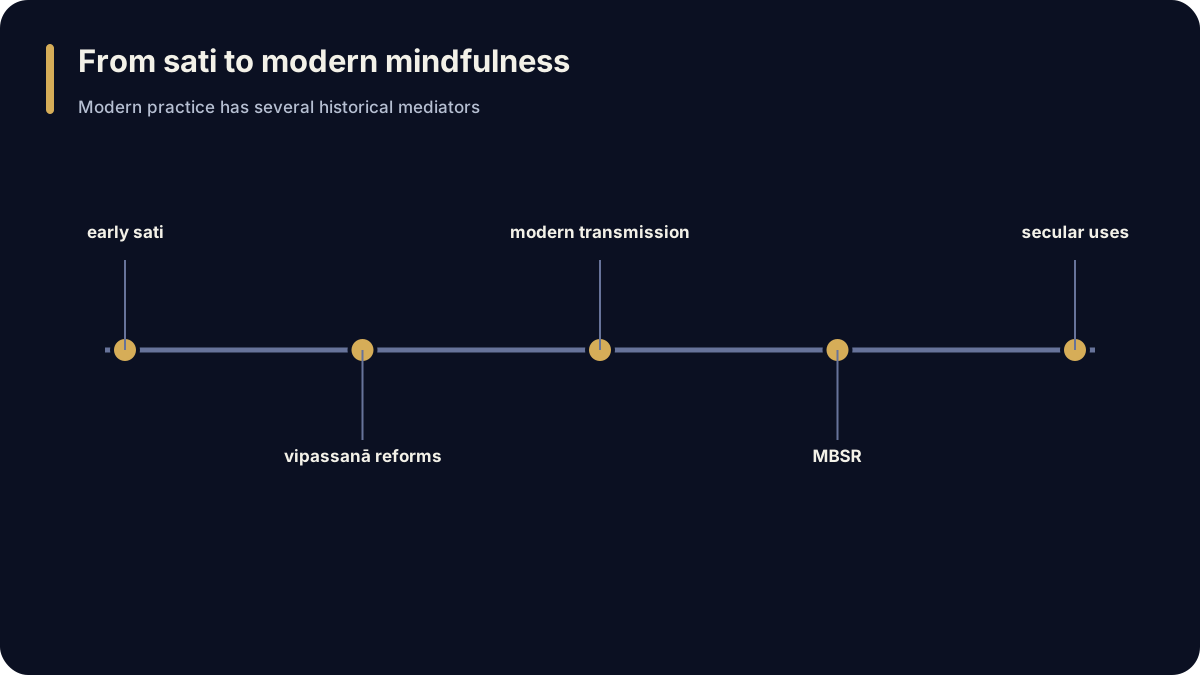
The story of modern mindfulness is not: the Buddha taught satipaṭṭhāna, someone translated it into English, and then we got MBSR. More than two thousand years of Buddhist history lie in between. Asian meditative traditions changed as well. In the nineteenth and twentieth centuries, Theravāda vipassanā movements greatly expanded meditation among laypeople and developed new ways of teaching and systematizing it. Asian teachers, Western monks, and lay practitioners then carried meditative methods into Europe and North America. There they encountered psychology, medicine, modern ideas of individuality, and cultures of personal development. Modern mindfulness emerged within this multi-stage process.
An important shift occurs in 1979. In 1979, Jon Kabat-Zinn began a program at the University of Massachusetts Medical Center from which Mindfulness-Based Stress Reduction — MBSR developed. The program was intended for people living with chronic health problems and stress. It took shape as an eight-week program. It includes meditative exercises, body awareness, mindful movement or yoga, home practice, group exploration of experience, and psychoeducation. This represents a major historical shift. Meditation enters a different institution. Not only the monastery. The hospital as well.
The goal changed. In satipaṭṭhāna, the final horizon is nibbāna. In MBSR the immediate goal is different. A person learns a different relationship to stress, pain, unpleasant feelings, thoughts, and life difficulties. Both systems speak about suffering. But “suffering” does not mean exactly the same thing. In early Buddhism, dukkha includes the fundamental problem of conditioned saṃsāric existence. In a healthcare program, the problem is generally defined within the present life.
Much of the cosmology disappeared. To participate in MBSR, a person does not have to accept rebirth, karma across multiple lives, six realms of existence, nibbāna, Buddhist cosmology, or a Buddhist religious identity. They can be Buddhist. Christian. Muslim. Atheist. Agnostic. Or they may not think about religion at all. This is a defining feature of the secular therapeutic model.
But the Buddhist genealogy did not disappear. On the other hand, MBSR did not arise without the meditative history from which it draws. We can recognize attention to breathing, body awareness, observation of feelings, observation of thoughts, less automatic reactivity, development of more stable attention, and regular meditative discipline. It is therefore wrong to say: modern mindfulness has nothing to do with Buddhism. It has important Buddhist roots. But roots are not the same as identity.
What happened to non-self? Here the difference is especially clear. In the early Buddhist project, mindfulness, impermanence, non-self, dependent origination, and liberation are interconnected. The practitioner does not observe experience only in order to tolerate it better. Observation is meant to undermine deep clinging to “I” and “mine.” Secular mindfulness does not require that goal. A person can successfully complete MBSR without ever accepting or even discussing in detail the Buddhist teaching of anattā. This is an important transformation of the practice.
What About Ethics?
The same applies to ethics. Early Buddhist meditation stands within a path that includes right speech, right action, and right livelihood. Modern MBSR does not require participants formally to undertake the five Buddhist precepts. This does not mean the program is value-free. It may emphasize kindness, compassion, curiosity, acceptance, non-harming, and care. But the ethical framework is not structured in the same way as in the classical Buddhist path.
Can there be “wrong mindfulness”? If mindfulness means only the capacity to monitor experience attentively, a person can also use it for a harmful goal. That is why early Buddhism does not speak only about sati. It speaks about right mindfulness. The word “right” places it in the broader framework of the path. Attention by itself is therefore not enough for liberation. Intention, understanding, and the way one acts also matter.
Modern mindfulness is therefore not necessarily “diluted Buddhism.” The label is tempting, but it already contains a value judgment. A medical program is not a failure because it does not teach rebirth. If its goal is to help someone with stress or chronic pain, it should first be evaluated according to that goal. Likewise, Buddhist satipaṭṭhāna cannot be declared a failure because it was not designed as modern psychotherapy. These are different projects. A problem arises only when one is presented as a completely unchanged version of the other.
Does Mindfulness Work Clinically?
Modern mindfulness interventions have been the subject of a large amount of clinical research. The results are neither “mindfulness is a placebo” nor “mindfulness cures almost everything.” Numerous reviews show benefits for certain forms of stress, anxiety, depressive symptoms, and pain. In some populations the effects are clinically useful. But outcomes depend on the population, type of program, comparison group, duration, quality of the study, and the selected outcome. When mindfulness is compared with active therapies rather than only with a waitlist, the differences are often smaller.
MBSR, MBCT, and an app are not the same thing. Scientific findings also need to be read carefully. A “mindfulness intervention” can mean MBSR, Mindfulness-Based Cognitive Therapy, another structured program, a short online exercise, or a phone app. These are not the same interventions. For example, more recent research on apps shows small average effects on symptoms of depression and anxiety, while the advantage is less clear when compared with active therapeutic controls. It therefore makes little sense to combine all practices into a single statement that “mindfulness works.” A better question is: which form, for whom, for what goal, and compared with what?
Meditation is not completely risk-free either. Popular wellness discourse sometimes presents meditation as an activity that can only help. That too is too strong. Research reports unpleasant and, in some cases, harmful experiences associated with meditation. These can include increased anxiety, intense emotional states, unusual perceptual experiences, and, in some vulnerable individuals, more serious difficulties. This does not mean that mindfulness is dangerous for most people. It means only that it should be treated like other psychological interventions: benefits and risks are not the same for everyone.
Secularization Is Not Only Subtraction
The story could be told as one of decline: first there was an integrated Buddhist practice, then the West removed ethics, philosophy, and liberation, leaving a commercial technique. But the history is more interesting. Secularization did not only remove things. It also added psychological models, medical language, clinical research, standardized programs, group therapy, outcome measurement, new forms of access, and new goals. Modern mindfulness is therefore not simply “less Buddhism.” It is a new cultural formation with Buddhist roots.
The paradox of success. Precisely because of this transformation, mindfulness reached people who would probably never have entered a Buddhist monastery or meditation center. A physician can suggest it to a patient. A psychotherapist can integrate it into treatment. A school can use short attention exercises. A person can meditate without changing their religious identity. This is one reason for its global spread. But the farther the practice moves from its original context, the more important the question becomes: what exactly are we still calling mindfulness?
One term, many practices. Today the word can refer to early Buddhist satipaṭṭhāna, Theravāda vipassanā meditation, Zen practice, MBSR, MBCT, a short therapeutic breathing exercise, a school exercise, an app, or simply general advice to live more consciously. These things can be related. They are not identical. Almost no claim about “mindfulness” is precise enough until we know which practice is meant.
Is Modern Mindfulness Still Buddhist?
It depends on the question. If we ask: Do modern mindfulness practices have important historical roots in Buddhist meditation? Yes. If we ask: Is MBSR the same as the practice in the Satipaṭṭhāna Sutta? No. If we ask: Is the capacity for awareness itself exclusively Buddhist? Also no. The Buddhist distinctiveness does not lie in claiming that only a Buddhist can pay attention. It lies in the way mindfulness is integrated into an entire path of ethics, wisdom, meditation, and liberation.
What was preserved? Attention to direct experience. The body. Breathing. Feelings. Thoughts. Observing automatic reactivity. Regular practice. Changing one’s relationship to pain and unpleasantness. In some modern programs also compassion, kindness, acceptance, and the exploration of impermanence. The connection is real.
What changed? The final goal. Philosophical framework. Cosmology. Institution. Language. The role of ethics. The understanding of self. The meaning of suffering. The relationship to death and rebirth. In an early Buddhist text, mindfulness stands within a path to nibbāna. In a modern healthcare program, it can stand within a path toward living better with pain, anxiety, or stress. That is not a small change.
Authentic or inauthentic? Perhaps this is not the most useful question. The debate quickly becomes a struggle over ownership: real mindfulness versus fake mindfulness, East versus West, religion versus science. It is more useful to ask: Which form of mindfulness are we looking at? Which traditions does it come from? What has it preserved from them? What has it left out? What has it added? And what is it trying to achieve? If our goal is to reduce stress, a secular program can make perfect sense within its own framework. But if we want to understand Buddhist sutras, we cannot simply project modern therapeutic definitions two thousand years into the past.
When We Return to the Sutras
A modern practitioner may be surprised by many things on first reading the Satipaṭṭhāna Sutta. Death. Corpses. The five hindrances. Factors of awakening. The Four Noble Truths. Removing greed and distress with regard to the world. Nibbāna. This is not the ordinary language of a wellness app. But at the same time the reader recognizes breathing, the body, feelings, mind, observing arising, and observing ceasing. It is precisely this combination of similarities and differences that shows what happened historically.
Old practice, new practice. Modern mindfulness is not a simple copy of Buddhist sati. Nor is it a Western invention with no Buddhist history. It is the result of transmission. And in every transmission, something is preserved, something transformed, and something created anew. Early Buddhist right mindfulness is part of a path whose final goal is liberation from greed, hatred, delusion, and saṃsāric dukkha. Modern therapeutic mindfulness is generally a way for a person to respond differently to experience within this life. The first is not merely a relaxation method. The second is not necessarily Buddhism in disguise. Yet a real historical thread runs between them. So perhaps a more interesting question than Is modern mindfulness still Buddhist? is: What happens to a Buddhist meditative practice when its immediate goal is no longer nirvāṇa, but a better way of living here and now?
Sources and Literature
Primary Texts and Reference Editions
- SuttaCentral: MN 10 / DN 22 and MN 118; modern clinical literature is listed separately as secondary literature.
Research and Verification Literature
- Kabat-Zinn, Jon. “Mindfulness-Based Interventions in Context: Past, Present, and Future.” Clinical Psychology: Science and Practice 10.2 (2003). DOI 10.1093/clipsy.bpg016.
- Linardon, Jake, Mariel Messer, Simon B. Goldberg, and Matthew Fuller-Tyszkiewicz. “The efficacy of mindfulness apps on symptoms of depression and anxiety: An updated meta-analysis of randomized controlled trials.” Clinical Psychology Review 107 (2024): 102370. DOI 10.1016/j.cpr.2023.102370.
- Farias, Miguel, et al. “Adverse events in meditation practices and meditation-based therapies: a systematic review.” Acta Psychiatrica Scandinavica 142.5 (2020): 374–393. DOI 10.1111/acps.13225.
Note: verification sources are part of the editorial apparatus. Where the original edition used during reconstruction was not preserved, a standard reference edition is not presented as the article’s presumed original source.