Ānāpānasati Sutta — How Can a Single Breath Become a Path to Awakening?
Breathing is probably the simplest meditation object we can imagine. It does not need to be created, bought, or visualized; as long as we are alive, it is already here.
Breathing is probably the simplest meditation object we can imagine. It does not need to be created, bought, or visualized; as long as we are alive, it is already here. That is precisely why it can be surprising that the Ānāpānasati Sutta develops an entire map of the path from such an ordinary process — from simply noticing long and short breaths to contemplating impermanence, cessation, and relinquishment. The Pāli version is preserved as Majjhima Nikāya 118. The text itself says that mindfulness of breathing, when properly developed, fulfills the four establishments of mindfulness; these fulfill the seven factors of awakening; and those lead to clear knowing and liberation. This means that breathing here is not merely a calming technique. It can become the supporting structure of the entire path.
Ānāpānasati means mindfulness of breathing
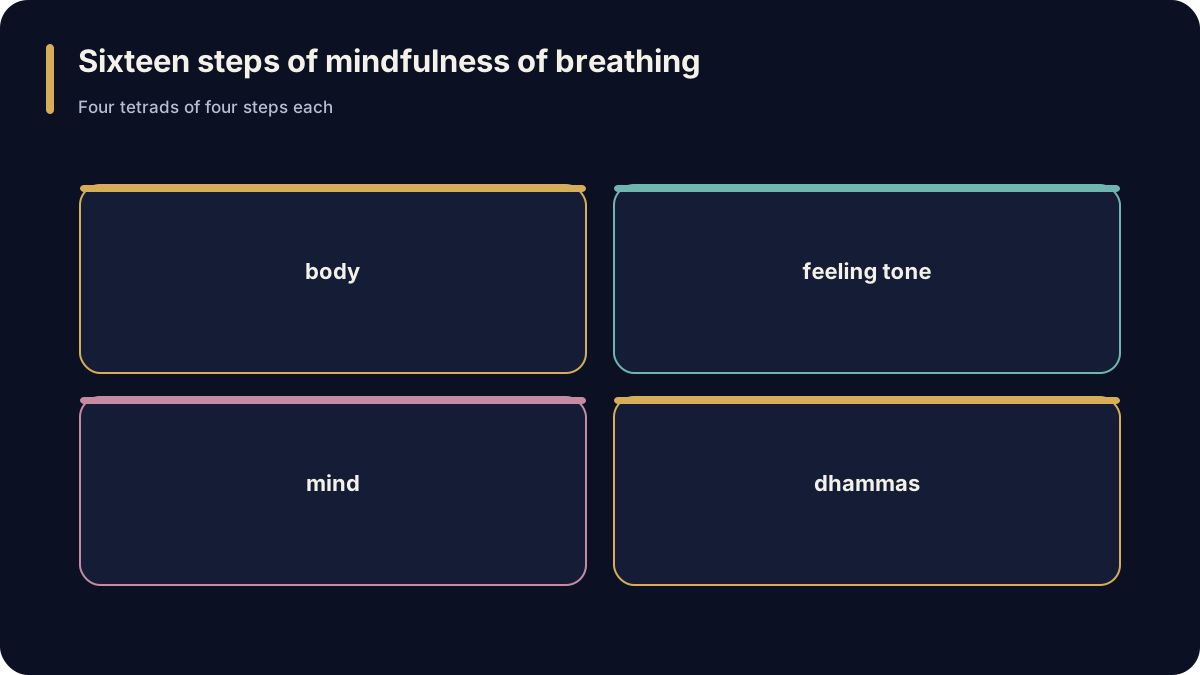
The Pāli term is composed of ānāpāna — breathing in and breathing out — and sati — mindfulness. As the basic English rendering we will use mindfulness of breathing, or more precisely, mindfulness of inhalation and exhalation. The sutta does not merely teach: “focus on the breath.” It presents sixteen stages or exercises, arranged in four groups of four. This structure is one of the most elegantly organized meditation schemes in early Buddhism.
At first, you simply know how you are breathing. The beginning is very simple. The practitioner sits down, straightens the body, and establishes mindfulness. Then: when breathing in long, one knows that one is breathing in long; when breathing out long, one knows that one is breathing out long; when breathing in short, one knows that one is breathing in short; when breathing out short, one knows that one is breathing out short. There is no complicated philosophy yet. At first it is simply a matter of knowing what is actually happening. From there, however, the practice begins to deepen.
The first tetrad: body
The first four stages are connected with the body.
- recognizing a long breath,
- recognizing a short breath,
- breathing in and out while experiencing the whole body,
- calming bodily formation.
An important translation question appears here: what does “the whole body” mean? Traditional commentaries sometimes interpret it as the whole “body of breath,” while some modern translators understand it as the broader bodily experience. Thanissaro Bhikkhu notes that the context allows a reading in which the practitioner is aware of the body as a whole, since a little later the sutta explicitly classifies in-and-out breathing among bodily processes. In the translation used here, therefore, we will not close the meaning too quickly. We will use “experiencing the whole body” and explain the main interpretations in a note.
Breath as a bodily process. MN 118 then explains its own connection with Satipaṭṭhāna. When the practitioner observes long and short breaths, the whole body, and the calming of the bodily process, they develop contemplation of the body as body. The sutta says something very important here: inhalation and exhalation belong to bodily processes. This makes clear why the first four steps correspond to the first establishment of mindfulness. Breathing is the chosen doorway into the body.
What does “calming bodily formation” mean? The Pāli term is kāyasaṅkhāra. In this context the sutta itself connects breathing with bodily formation or bodily process. The final step of the first tetrad therefore means that the practitioner trains in such a way that breathing and bodily activation gradually become calm. This is not a forced stopping of the breath. It is a natural refinement. As the mind settles, the breath settles as well.
The second tetrad: feelings
The next four stages are:
5. experiencing rapture, or pīti,
6. experiencing pleasure, or sukha,
7. experiencing mental formation,
8. calming mental formation.
The practice is no longer merely bodily. Breathing becomes a way of observing the quality of experience.
Pīti and sukha are not the same thing. These two terms are often translated almost identically. But it is useful to distinguish them. pīti can mean rapture, exhilaration, enlivening joy, or meditative energy. sukha is closer to pleasure, well-being, pleasantness, or bliss. In meditative contexts they often occur together, but they do not mean exactly the same thing. We will therefore use: pīti → rapture sukha → pleasure or pleasantness, while retaining the Pāli terms where useful.
Mental formation. The seventh and eighth steps are more demanding. The sutta speaks of cittasaṅkhāra — mental formation. In the early texts this expression is especially associated with feeling and perception. The practitioner begins by becoming aware of it and then calming it. An important point becomes visible here: breathing is not merely an object of attention. It becomes a way of regulating the whole psychophysical system. The body settles. Feelings become clearer. Mental processes are calmed.
The third tetrad: mind
The next four stages are:
9. experiencing the mind,
10. gladdening or brightening the mind,
11. concentrating the mind,
12. liberating the mind.
Now meditation turns directly to citta — mind. This is the same framework we encountered in the third establishment of mindfulness in MN 10. The practitioner is no longer following the breath only as a bodily process. They observe what is happening to the mind through breathing.
The mind is not merely something we observe passively. Modern presentations of meditation sometimes create the impression that the ideal is to change nothing, direct nothing, and simply observe. MN 118 does not support that as the whole picture. The practitioner gladdens the mind, concentrates it, and liberates it. This is active training. Mindfulness and intentional cultivation work together.
What does “liberating the mind” mean? The expression can be understood on several levels. It can mean temporarily freeing the mind from hindrances and disturbances. In the broader context of the path, however, the practice aims toward complete liberation. The sutta itself shows that it does not understand these sixteen steps in isolation, because it links them with Satipaṭṭhāna, the factors of awakening, and final clear knowing and liberation. “Liberating the mind” therefore does not merely mean: “I feel more relaxed now.”
The fourth tetrad: insight
The final four steps are:
13. contemplating impermanence,
14. contemplating virāga — fading or dispassion,
15. contemplating cessation,
16. contemplating relinquishment or letting go.
Here the character of the practice changes. The earlier stages build stability and sensitivity. The final four directly cultivate insight. SuttaCentral explains them as a transition from calming toward discernment or insight into impermanence and relinquishment.
Impermanence. The practitioner now uses the breath to observe anicca — impermanence. Breath is almost an ideal object for this. Every inhalation arises, lasts briefly, and ceases; the same is true of every exhalation. There is no breath that can be held as permanent. And when attention is stable enough, the same structure begins to appear in feelings, states of mind, thoughts, and the whole of experience. Breath becomes a model of conditionality.
Virāga. The fourteenth step uses the term virāga. We already encountered it in the Anattalakkhaṇa Sutta. It can mean dispassion, the fading of passion, or the extinguishing of attachment. But the word also carries a literal image: losing color, fading. That makes it a beautiful expression. Things do not necessarily lose their existence. They lose the power by which they hold us.
Cessation. The fifteenth step is nirodha — cessation. This takes us directly back to the third noble truth. In the first discourse we understood it as the cessation of dukkha. Here practice approaches direct observation: phenomena arise and cease. In this way an abstract doctrine becomes experience.
Relinquishment. The sixteenth step speaks of paṭinissagga — relinquishment, letting go. This is the final direction of the practice. It is not merely the thought “I see that something is impermanent,” but the insight: because I see its impermanence and cessation, I can let it go. The point of Buddhist insight is not the accumulation of information, but the reduction of clinging.
Four groups of four. The complete structure is therefore:
Body
- long breath
- short breath
- whole body
- calming the bodily process
Feelings
5. rapture
6. pleasure
7. mental formation
8. calming mental formation
Mind
9. experiencing the mind
10. gladdening the mind
11. concentration of the mind
12. liberating the mind
Phenomena or insight
13. impermanence
14. virāga
15. cessation
16. relinquishment
This is not merely a convenient list. MN 118 then shows that the four tetrads correspond directly to the four establishments of mindfulness.
Breathing fulfills Satipaṭṭhāna
The first tetrad: body. The second: feelings. The third: mind. The fourth: dhammā, or phenomena viewed through the categories of the Dhamma. This means that in MN 118 mindfulness of breathing is not a small meditation technique placed alongside Satipaṭṭhāna. When developed through all sixteen steps, it can fulfill all four establishments of mindfulness. It is an elegant structure in which a single object can carry the entire path.
Satipaṭṭhāna then fulfills the seven factors of awakening. The sutta goes even further. When the four establishments of mindfulness are well developed, the following begin to develop: mindfulness, investigation of phenomena, energy, rapture, tranquility, concentration, and equanimity. These are the seven factors of awakening. We therefore get the sequence: breathing → four establishments of mindfulness → seven factors of awakening → clear knowing and liberation. This is almost the whole architecture of practice in a single sutta.
Why is breathing so useful? Because it always lies on the boundary between the voluntary and the involuntary. Breathing happens by itself, yet we can also influence it: we can observe it without control, or gradually calm it. When we become afraid, it changes. When we calm down, it changes. Body and mind meet very directly in breathing. It is therefore an ideal bridge between body, feeling, state of mind, and insight. The sutta does not explain this in modern physiological language. But its structure makes practical use of exactly this quality.
Do we need to control the breath? This is one of the most common questions. The first two steps say: one knows when the breath is long and one knows when it is short. That points more toward observation. The later steps, however, use the expression “one trains thus …”, which clearly implies a degree of intentional direction in the practice. A strict division between only observing and actively regulating the breath is therefore probably not the best reading. MN 118 combines both: first recognize, then train.
Breath is not merely an anchor. Modern meditation often uses the expression “the breath is an anchor for attention.” That can be a useful metaphor. But in MN 118 the breath is more than an anchor. It is a laboratory. Through breathing the practitioner investigates body, feelings, mind, impermanence, cessation, and relinquishment. Breath is not simply something to return to whenever thoughts wander. It becomes a medium for understanding experience.
Is the goal relaxation? Relaxation may occur. Calming bodily and mental formation is explicitly part of the sixteen steps. But relaxation is not the final goal. If it were, the sutta would end roughly at the eighth step. Instead it continues to impermanence, dispassion, cessation, and relinquishment. Relaxation is therefore a means, not the final aim.
How does Ānāpānasati differ from modern breathwork? Today there are countless breathing methods. Some accelerate the breath. Others use breath retention. Some prescribe particular ratios between inhalation and exhalation. Some aim at relaxation or intense bodily sensations. MN 118 is not such a system. It does not prescribe a rhythm such as four seconds in, seven holding, eight out. It does not require hyperventilation. It does not seek dramatic bodily effects. Its basic logic is mindfulness → calming → concentration → insight → relinquishment. That is an important difference.
Must the sixteen steps be practiced strictly one after another? The sutta presents them in a clear sequence. But it does not follow that we must understand the practice as a mechanical protocol: until I have completely finished step 1, I may not even think about step 2. In early Buddhist texts, meditative structures often overlap and support one another. SuttaCentral notes that the first twelve stages are strongly associated with calming, while the final four move more clearly into insight. This suggests a developmental direction, but not necessarily a laboratory-style linear protocol.
How old is the sixteen-step model?
Mindfulness of breathing is not limited to MN 118. Its instructions also appear in MN 10, MN 62, AN 10.60, several discourses in the Ānāpāna Saṁyutta — SN 54, the Vinaya, and other early Pāli texts. This indicates that the practice is deeply rooted in the early Buddhist corpus. Individual formulations and expansions have their own textual histories, but mindfulness of breathing itself is clearly not a late addition.
Tradition also associates it with the Buddha’s own practice. The Pāli tradition connects breath meditation with Gautama’s practice both before and after awakening. This matters for the method’s traditional authority. Historically, of course, we cannot turn that into a stenographic proof of the precise meditation technique used by the historical Gautama. We can, however, say: in very early Buddhist tradition, mindfulness of breathing is presented as one of the most central meditation practices.
Breathing and non-self. Here we can connect all of the articles so far. Is the breath mine? To some extent I can influence it, but not completely. If I had to consciously produce every breath myself, I would die in my sleep. Breathing happens in a conditioned body. It changes. It arises. It ceases. From this perspective it is an excellent object for directly understanding the teaching we encountered in the Anattalakkhaṇa Sutta. The process is intimate, but it is not a permanent self.
Breathing and dukkha. The connection with the first discourse is clear as well. Craving is often expressed through the body. Restlessness changes the breath. Fear changes the breath. Anger changes the breath. Concentration changes it. Calm changes it. The practitioner can therefore observe that mental and bodily experience are not separate realms. Both are conditioned. And precisely because they are conditioned, they can be trained.
The four great discourses now form a path. After four key texts we already have a very clear architecture. Dhammacakkappavattana Sutta What is the problem, and what is the path? Anattalakkhaṇa Sutta Why can what we cling to not be regarded as a permanent self? Satipaṭṭhāna Sutta How do we directly observe body, feelings, mind, and phenomena? Ānāpānasati Sutta How can this entire practice be developed through a single continuous process — breathing? This is already a fairly complete model of early Buddhism: understanding → non-identification → observation → systematic training.
But Buddhism is not only analysis. So far our articles have been strongly oriented toward dukkha, non-self, impermanence, observation, and cessation. If we stopped here, Buddhism could appear very cold. Yet the early texts also develop another side of practice: warmth, goodwill, and the wish that other beings be safe and happy. The next discourse is therefore an important corrective to any impression that Buddhism is only deconstruction: Karaṇīya Mettā Sutta — how far should loving-kindness extend?
Sources and further reading
Primary texts and reference editions
- SuttaCentral: MN 118 (Ānāpānasati), Bhikkhu Sujato.
- Thanissaro Bhikkhu, trans., “Ānāpānasati Sutta: Mindfulness of Breathing” (MN 118), Access to Insight.
Research and verification literature
- SuttaCentral. Early Buddhist texts, translations, and parallels. For English Pāli translations, principally Bhikkhu Sujato. Dynamic digital corpus; cite individual text IDs where possible.
- Thanissaro Bhikkhu, trans. “Ānāpānasati Sutta: Mindfulness of Breathing” (MN 118). Access to Insight, 2006; rev. 2013.
Note: verification sources are part of the editorial apparatus. Where the originally used edition was not preserved during reconstruction, a standard reference edition is not presented as the presumed original source of the article.