Satipaṭṭhāna Sutta — the Discourse on the Establishments of Mindfulness
If the *Dhammacakkappavattana Sutta* and the *Anattalakkhaṇa Sutta* are primarily maps of the teaching, the *Satipaṭṭhāna Sutta* is something different. It is an instruction for **observing experience**: body, feelings, mind, and phenomena through the categories of the Dhamma.

If the Dhammacakkappavattana Sutta and the Anattalakkhaṇa Sutta are primarily maps of the teaching, the Satipaṭṭhāna Sutta is something different. It is an instruction for observing experience: body, feelings, mind, and phenomena through the categories of the Dhamma. The Pāli version is preserved as Majjhima Nikāya 10. A closely related expanded version is also found as Dīgha Nikāya 22 — Mahāsatipaṭṭhāna Sutta. For modern Theravāda meditation, this is one of the most influential texts. But precisely because of its modern fame, we first need to clarify something important.
Satipaṭṭhāna is not simply “be in the present moment”
Today the word mindfulness can mean almost anything: observing the breath, relaxation, stress reduction, focused work, or simply being present while drinking coffee. Such modern practices can have value of their own. But the Satipaṭṭhāna Sutta is speaking about something much more specific. The Pāli term sati is connected with the capacity to keep something in mind, remember it, and sustain an appropriate orientation of attention. In this series we will translate satipaṭṭhāna as establishment of mindfulness. The term has more than one possible etymological interpretation. It can emphasize a “foundation” or domain on which mindfulness is grounded, or the act of establishing it. For our purposes the second emphasis is more useful because the sutta describes an active practice: mindfulness is established and maintained in relation to a particular frame of experience.
Buddhist mindfulness here is not simply: “observe neutrally whatever appears.” The practice has a direction. It is oriented toward the path of liberation.
The four establishments of mindfulness
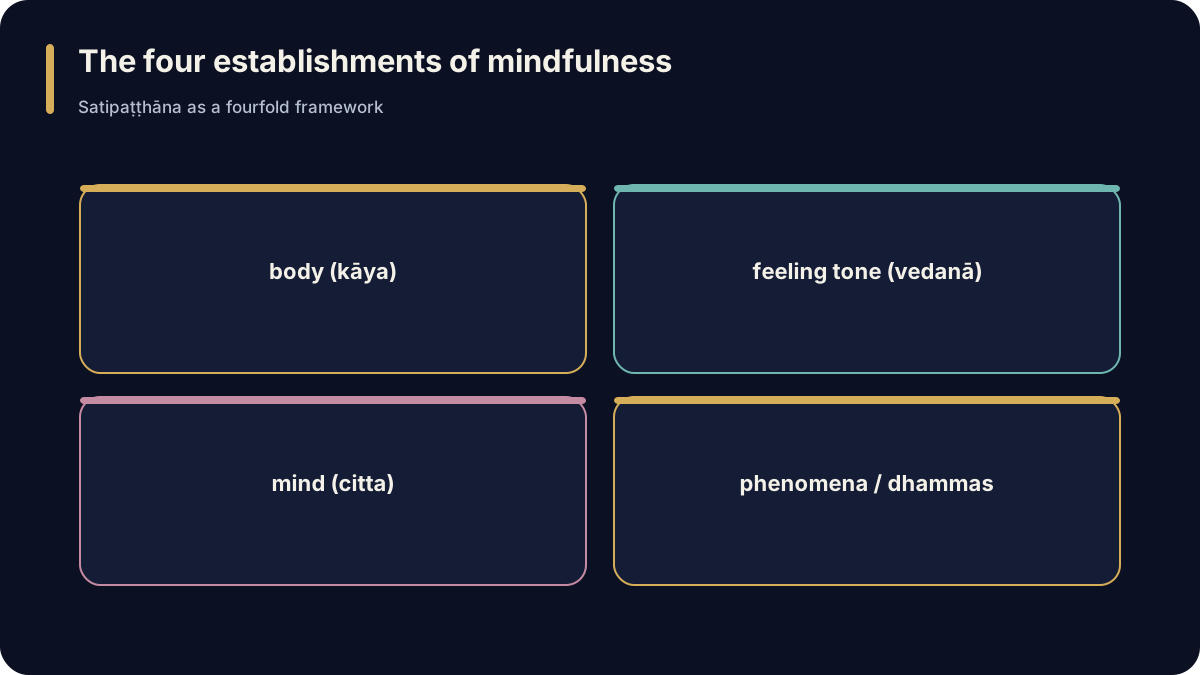
The sutta presents four great domains: kāya — body, vedanā — feelings or feeling tone, citta — mind or state of mind, dhammā — phenomena observed through categories of the Dhamma. The practitioner observes body as body, feelings as feelings, mind as mind, and phenomena as phenomena. For the fourth domain we will not use the translation “observing thoughts.” That would be misleading. The dhammānupassanā section includes the five hindrances, five aggregates, six sense fields, seven factors of awakening, and Four Noble Truths. It is therefore an observation of experience through Buddhist analytical categories, not merely the monitoring of thoughts.
Why “body as body”? The formula can sound odd. Why not simply say “observes the body”? Because the distinction matters. The body very quickly becomes my body. A feeling becomes my pain. A state of mind becomes I am angry. The sutta redirects the practice toward the phenomenon itself: body as body, feeling as feeling, mind as mind. Here the teaching of the Anattalakkhaṇa Sutta continues directly. First we analyzed why it is unwise to treat the aggregates as a permanent self. Now we begin to observe them directly.
The first establishment: body
The most extensive section begins with the most obvious object: the body. Breathing. The practitioner sits. Mindfulness is established. When breathing in long, one knows: I breathe in long. When breathing out long, one knows: I breathe out long. When breathing in short, one knows it; when breathing out short, one knows it. The practice then develops toward experiencing the whole bodily process and calming bodily formation. Breathing here is not merely a relaxation technique. It is a way of directly observing a bodily process. Later, the Ānāpānasati Sutta develops this very practice into a much more detailed sixteen-step system.
Walking, standing, sitting, lying down. The sutta then becomes almost strikingly simple. When one walks, one knows that one is walking. When standing, one knows that one is standing. When sitting, one knows that one is sitting. When lying down, one knows that one is lying down. In this way the practice leaves the meditation seat. Mindfulness is not something done only with the eyes closed.
Clear comprehension of everyday actions. The practitioner maintains clear comprehension while walking, looking, bending, stretching, dressing, eating, drinking, attending to bodily needs, sitting, sleeping, waking, speaking, and remaining silent. This shows that satipaṭṭhāna is a method for the whole field of ordinary experience.
The body begins to be disassembled. The practice then becomes much less like modern wellness. The body is analyzed into parts: hair of the head, body hair, nails, teeth, skin, flesh, sinews, bones, organs, bodily fluids, and more. This is not an anatomy lesson. The purpose is to reduce our automatic fascination with the body as a beautiful, unified, permanent whole. What we spontaneously experience as “my body” is broken down into component processes and materials.
The four elements. The body is then analyzed through the ancient Indian model of four elements: earth, water, fire, and air. These are not chemical elements. They correspond roughly to qualities of solidity, cohesion or liquidity, heat, and movement. Again the purpose is analytical. The body is not treated as the unchanging owner of experience, but as a collection of conditioned material qualities.
The corpse. The most radical part of contemplation of the body is observation of a corpse in decay. The sutta describes different stages of death and decomposition. The practitioner is to understand: this body too is of the same nature. It cannot escape this. For a modern reader, such a practice can be uncomfortable. Its purpose, however, is clear: to remove the illusion that our own body is somehow exempt from anicca — impermanence.
The second establishment: vedanā
Here an important terminological standard comes into play. vedanā is not simply “emotion.” It refers primarily to the feeling tone of experience: pleasant, unpleasant, or neutral. The practitioner recognizes a pleasant feeling as pleasant, an unpleasant one as unpleasant, and a neutral one as neutral. This is especially important because it is precisely at this level that the connection with craving begins to become visible. In the first discourse we encountered taṇhā — craving. Here we approach the moment at which reaction can be seen beginning.
A feeling is not yet a story. An unpleasant feeling appears. That is one thing. Then there may follow: “Why me?” “This has to stop.” “I cannot bear this.” “This always happens to me.” A story about the self grows out of the feeling. Satipaṭṭhāna tries to make this process visible. First: an unpleasant feeling tone is present. That is different from: I am my pain. Once again we are at non-self.
The third establishment: citta
Now the practitioner observes the mind, or state of mind. One knows when the mind is: with lust, without lust, with aversion, without aversion, with delusion, without delusion, contracted, scattered, concentrated, unconcentrated, liberated, or unliberated. This is highly practical introspection. The sutta does not begin with the demand “You must never be angry.” It first requires: recognize that a state of mind with aversion is present. That changes the relationship to experience.
“I am angry” or “anger is present.” The difference only looks small at first. “I am angry” fuses identity with the state. But if we recognize a state of mind with aversion is present, anger becomes a phenomenon that can be observed. It arises, persists for a time, changes, and ceases. This is not suppression. It is the ending of automatic identification.
The fourth establishment: dhammā
This is the most difficult section to translate. Dhamma has many meanings in Buddhism. Here the term does not simply mean the Buddha’s teaching. Nor will we reduce it to mental object. The most useful approach is to understand it as phenomena, or experience observed through the categories of the Dhamma. The sutta then shows which categories it has in mind.
The five hindrances. The first group is: sensual desire, aversion, sloth and torpor, restlessness and remorse, and doubt. The practitioner recognizes whether a hindrance is present, how it arises, how it can be abandoned, and how its future arising can be prevented. Here it becomes completely clear that Satipaṭṭhāna is not passive observation. If a hindrance appears, the aim is to understand its causality and its cessation. SN 47.40 likewise explicitly connects the development of satipaṭṭhāna with observing arising and cessation and with the Eightfold Path.
The five aggregates. They appear again: material form, feeling, perception, mental or volitional formations, and consciousness. But now the main question is not whether they are self. The practitioner observes how they arise and how they cease. In this way the Anattalakkhaṇa Sutta and the Satipaṭṭhāna Sutta connect directly.
The six sense fields. Next come eye and visible forms, ear and sounds, nose and odors, tongue and tastes, body and touch, mind and mental phenomena. The arising of fetters associated with sense contact is also observed. The focus, then, is not only on the object but on the process of attachment.
The seven factors of awakening. Practice is not oriented only toward identifying problems. The sutta also observes beneficial qualities: mindfulness, investigation of phenomena, energy, rapture, tranquility, concentration, and equanimity. The practitioner sees whether they are present, how they arise, and how they can be developed.
The Four Noble Truths. At the end they appear again: dukkha, the origin of dukkha, the cessation of dukkha, and the path. The circle is closed. The first discourse and Satipaṭṭhāna are not separate systems. The Four Noble Truths now appear as something that can be observed directly in experience.
The four domains are not four separate compartments. In real experience they interweave. An unpleasant bodily sensation appears. That is body and vedanā. Then aversion arises. That is citta. Then we recognize aversion as one of the five hindrances. That is dhammānupassanā. A single experience can therefore be read through several domains at once. The sutta offers a map. It does not claim that experience is actually cut into four isolated parts.
Internally, externally, both. Almost every major section is accompanied by a similar formula. The practitioner observes internally, externally, and both internally and externally. Then: arising, cessation, and arising-and-cessation. Finally one remains independent and clings to nothing in the world. The essence of the method is to observe a phenomenon, its conditions, and its cessation without turning it into a permanent self or clinging to it.
Satipaṭṭhāna is not merely concentration. If it were only attention training, “stay focused” would be enough. But the sutta demands far more: discrimination, clear comprehension, recognition of hindrances, development of beneficial factors, observation of causality, observation of cessation, and non-clinging. It is training attention in the service of insight and liberation.
What does ekāyana magga mean? At the beginning of the sutta stands the famous expression ekāyano maggo. It has often been translated as “the only way.” That rendering can create the impression: “Only this technique is correct and everything else is wrong.” But the Pāli expression is not so unambiguous. It has also been translated as the direct path, the path leading straight to the goal, or the path going in one direction. In this series we will therefore use the more cautious wording direct path, with a note explaining that the meaning of the phrase is debated among translators. Modern translations differ on this point as well.
How old is the text?
The basic scheme of the four establishments of mindfulness is very well rooted in early Buddhist material. But the present long MN 10 did not necessarily arise at a single moment as a stenographic record of one discourse. The establishments of mindfulness also appear in other early texts, for example throughout the Satipaṭṭhāna Saṁyutta. This suggests an old network of teachings that may have been organized and expanded during transmission into larger composite discourses. Once again we therefore distinguish an old core of practice from the final redactional form of the text.
MN 10 and DN 22. The Pāli Canon preserves two closely related versions: MN 10 — Satipaṭṭhāna Sutta and DN 22 — Mahāsatipaṭṭhāna Sutta. DN 22 is considerably longer, mainly because of its expanded explanation of the Four Noble Truths. For that reason, we will use MN 10 as the primary text for this article and for future selected translations. DN 22 will later be treated as an important expanded Pāli version.
Is this a manual for modern mindfulness? In part — but not completely. Modern secular mindfulness practices have adopted important elements from Buddhist traditions: observation of breathing, body, feelings, and thoughts, and less automatic reactivity to experience. But MN 10 has an explicitly different final horizon: overcoming sorrow and distress, the right method, nibbāna, and liberation. The sutta even ends with very strong traditional claims about the possible results of intensive development of these four establishments of mindfulness. If the religious and soteriological framework is removed, what remains is a modern technique. But it is no longer the full meaning of the Satipaṭṭhāna Sutta.
Mindfulness itself is not the goal. This is one of the most important points. In early Buddhism, mindfulness is not the final goal. It is a factor of the path. Within the Noble Eightfold Path, right mindfulness is connected with right effort, right concentration, and right view. SN 47.40 likewise explicitly identifies the path of developing satipaṭṭhāna with the Eightfold Path. The real question is therefore not How do I become more mindful?, but What does mindfulness enable me to see, and what do I stop clinging to because of that?
What are we supposed to see? The body: it arises, changes, and decays. Feeling: it arises, changes, and ceases. A state of mind: it arises, changes, and ceases. Hindrances: they arise and cease. Aggregates: they arise and cease. Factors of awakening: they can be developed. In this way Satipaṭṭhāna brings us practically closer to anicca — impermanence, dukkha — the unreliability of clinging, and anattā — the unsuitability of identification. It is therefore not separate from the preceding suttas. It is their practice.
The three discourses now form a clear sequence. The Dhammacakkappavattana Sutta: there is dukkha, there is a cause, there is cessation, there is a path. The Anattalakkhaṇa Sutta: what we cling to as self is impermanent and unreliable. The Satipaṭṭhāna Sutta: observe these processes directly as they arise and cease. These are not three separate philosophies. They are: diagnosis → analysis of identification → method of observation.
Why, then, do we need the Ānāpānasati Sutta? Because Satipaṭṭhāna is a broad map. It describes many different domains of contemplation. One of its clearest starting points, however, is breathing. The Ānāpānasati Sutta takes the breath itself and develops it into a systematic sixteen-step practice connected with the four establishments of mindfulness and the factors of awakening. The discussion therefore naturally continues with the Ānāpānasati Sutta — how can a single breath become a path from the body to awakening?
Sources and literature
Primary texts and reference editions
- SuttaCentral: MN 10 and DN 22 (Satipaṭṭhāna), translated by Bhikkhu Sujato; parallels via SuttaCentral.
Research and verification literature
- SuttaCentral. Early Buddhist texts, translations, and parallels. For English Pāli translations, principally Bhikkhu Sujato. Dynamic digital corpus; cite individual text IDs where possible.
Note: verification sources are part of the editorial apparatus. Where the original edition used during reconstruction was not preserved, a standard reference edition is not presented as though it were the presumed original source of the article.