The Black Nobility: Aristocracy in the Shadow of the Papacy
After 1870, “Black Nobility” described Roman aristocratic families loyal to the pope. Political allegiance is not evidence of a hidden occult hierarchy.
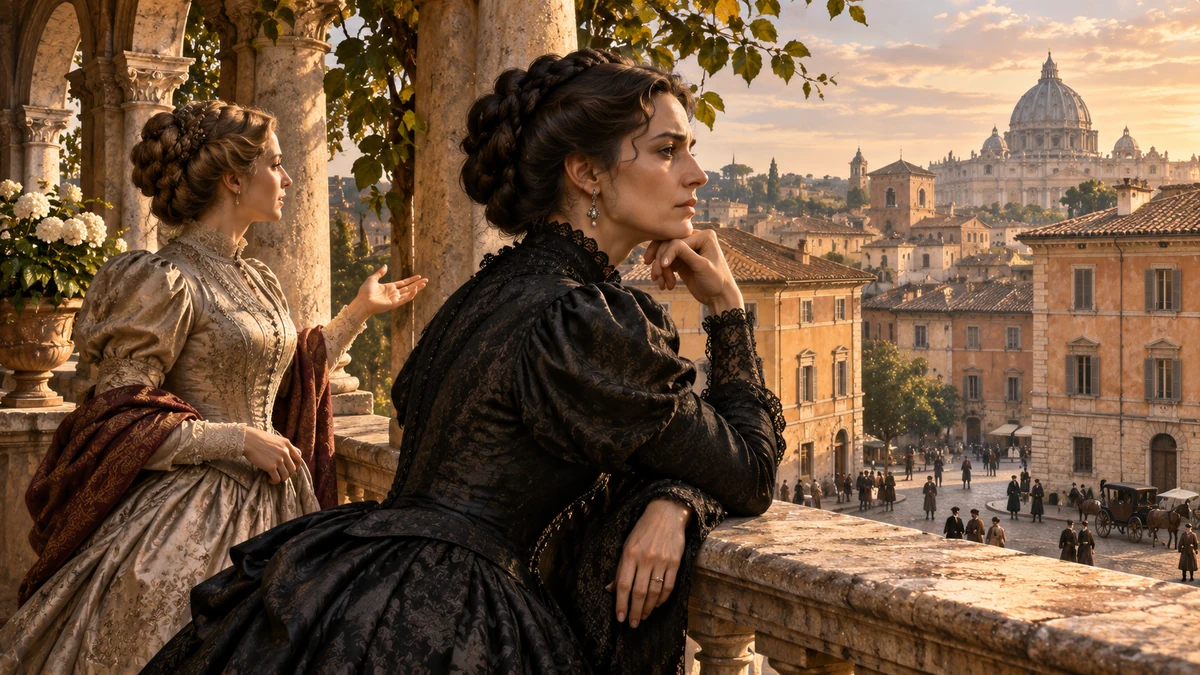
Artistic interpretation of Roman aristocratic society after 1870; the clothing colors do not represent a documented dress rule.
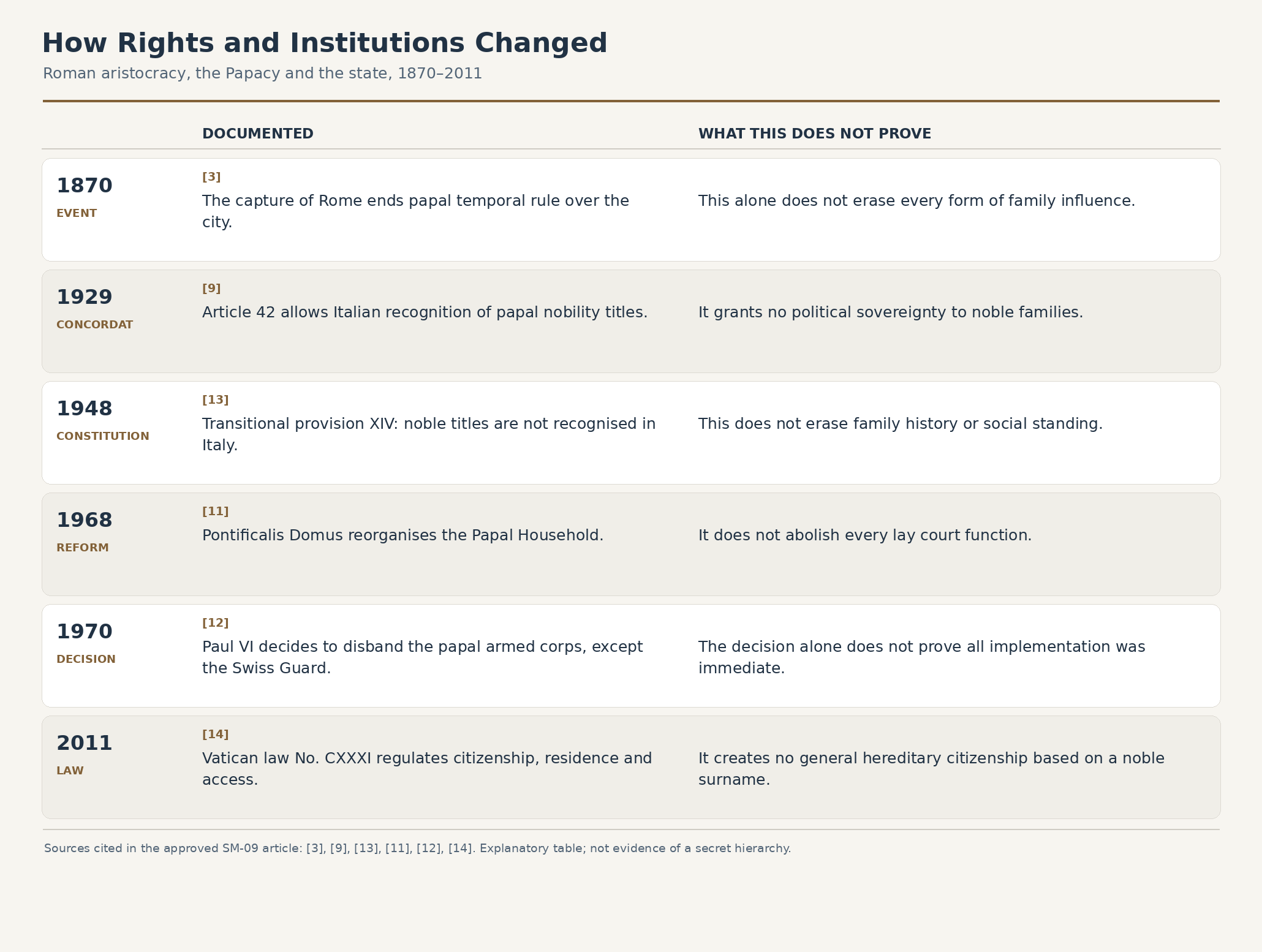
On 20 September 1870, Italian troops entered Rome after breaching the city walls, bringing the pope's direct temporal rule over the city to an end. For Pius IX, this was the violent loss of legitimate authority; a month and a half later, in his encyclical Respicientes ea, he forcefully rejected the new situation. But the Roman noble families that had been linked to the papal court for centuries did not respond to this turning point in the same way. Some drew closer to the new Italian state, while others remained loyal to the pope. It is with the latter that the historical designation “Black Nobility” is associated. Here, “black” did not refer to an occult ritual but to political allegiance in the dispute over Rome. [1] [2] [3]
This leads to the central question of this article: how did the power of old Roman families intersect with a religious institution that had also been a state for centuries? Did it consist of demonstrable privileges, landed estates, court offices, and intergenerational connections—or something more? We will not look for the answer in a surname alone. A historical charter, a family archive, a legal provision, and a claim about secret leadership do not carry the same evidentiary weight.
Rome, where the pope was also a temporal ruler
In the Middle Ages and the early modern period, the pope was not only the spiritual leader of the Catholic Church. He also exercised territorial power in the Papal States. Around his court worked ecclesiastical dignitaries and numerous lay professionals, including notaries, lawyers, bankers, and administrators. Court appointments, proximity to decision-makers, land, and kinship ties could become family assets in the broad sense: not just possessions that could be inherited, but opportunities unavailable to most inhabitants. [4] [5]
That did not mean Rome had a single hereditary master. The papacy was not a hereditary monarchy: popes came from different families, and in the late medieval and early modern periods the next pope was chosen by the College of Cardinals. Meanwhile, noble houses in the city and the countryside competed over estates, alliances, and influence with the elected ruler. Historian Maria Antonietta Visceglia has described tensions between Roman factions around the turn of the fifteenth and sixteenth centuries, noting that even individual families were not entirely unified political groups. [5]
Colonna and Orsini: from kinship to rivalry
The Colonna and Orsini families illustrate a form of power that left traces in urban palaces, landed estates, church offices, and armed confrontations. The official history of Palazzo Colonna describes the dynasty's medieval origins and its long occupation of the same Roman complex. Oddone Colonna was elected Pope Martin V in 1417; from 1420, he lived in the family palace, which at that time also served as a papal residence. It is a concrete example of a family space overlapping with an institution of ecclesiastical government. [6]
Members of the Orsini family likewise reached the highest positions in the Church. Pietro Francesco Orsini became Pope Benedict XIII in 1724, as confirmed by the Vatican's official list of popes. The link between the family name and a pope is demonstrable, but it does not establish continuous, unified control by all the family's later branches. [7]
The historical rivalry between Roman noble families themselves is an important counterargument to any picture of a coordinated, centuries-old leadership. The Colonna and Orsini entered alliances, fell out, fought, and sometimes made temporary accommodations. Historical studies show the differing interests of individual branches and their cooperation with opposing political camps. Kinship helped mobilize people and money, but it did not eliminate conflict. To establish a common chain of command, we would need evidence other than a list of famous surnames. [5] [6]
From a pope's relative to a noble house
In the early modern period, alongside Rome's older aristocratic families, other houses rose particularly through their connections to the papal office. Historical accounts name the Borghese, Barberini, Aldobrandini, Chigi, Odescalchi, and others. In a published excerpt now accessible to researchers, Giulio Marchetti Ferrante distinguished in 1929 between older feudal families and houses whose rise was especially associated with the election of a relative as pope. It would therefore be misleading to speak of all of them as though they followed the same path to power or possessed one common founding charter. [2]
Historian Tracy L. Ehrlich describes the Roman papal court as a distinctive political environment in which ecclesiastical careers and the secular advancement of families were closely connected. Papal patronage could help a family acquire estates, build villas, arrange status-enhancing marriages, and sponsor cultural displays of rank. These are mechanisms that historical research can examine. Yet the success of one house did not entail the permanent subordination of every other house: the election of a new pope often changed the distribution of opportunities. [4]
This arrangement raises a serious question about nepotism. When a ruler who exercises public power benefits relatives, we should investigate the actual privileges and their consequences for other inhabitants. Who received an office, land, a tax advantage, or military command? Who decided, and on what grounds? These are questions a historical document may be able to answer. A surname, by itself, cannot.
Why were some called “black”?
The capture of Rome in 1870 gave rise to a prolonged dispute between the papacy and the Italian state, known as the Roman Question. In his encyclical of 1 November 1870, Pius IX rejected the loss of papal temporal authority and described it as a violation of his rights. The text is a direct source for the pope's perspective, not an impartial verdict on the legitimacy of Italian unification. [3]

In this setting, part of the Roman nobility refused to cooperate with the new Italian regime. The Italian encyclopedia Treccani explains aristocrazia nera precisely in terms of opposition to the abolition of papal temporal power and to cooperation with the state after 20 September 1870. Other aristocrats adapted to the new political order. The historical “blacks” and “whites” thus denoted a political division in a particular era, not two supernatural or occult orders. [1]
Marchetti Ferrante described both groups in an article published in September 1929, but he, too, was writing at a historical moment when the Lateran Accords had only just been concluded. His judgment that the divide was coming to an end is valuable contemporary testimony about the outlook of part of the aristocracy. It is not proof that all private networks dissolved at that point, or that a single signature erased political differences forever. [2]
The Pacelli family: influence does not always begin with ancient princely lineage
The Pacelli family offers an instructive example of change within Rome's elite circles. Eugenio Pacelli, the future Pope Pius XII, grew up in a family with longstanding legal and administrative links to the Holy See. In an accessible introductory excerpt from his historical biography, Robert A. Ventresca explains how legal appointments, papal connections, and recognition of the family strengthened the Pacellis' standing in Roman Catholic society. [8]
This example challenges the oversimplified idea that “Black Nobility” must always mean a single ancient bloodline. Social standing could also arise from a profession, an office, bestowed titles, and proximity to the papal court. Nor would it be sound to explain all of Pacelli's later decisions solely through his family background. Each of his roles must be examined against specific documents and historical circumstances. [8]
The year 1929: what did the Lateran Accords actually establish?
On 11 February 1929, representatives of the Holy See and the Kingdom of Italy signed the Lateran Accords. These included a treaty resolving the Roman Question, a financial convention, and a concordat governing relations between the Italian state and the Catholic Church. The documents identify Cardinal Pietro Gasparri and Italian Prime Minister Benito Mussolini. Among other things, the agreements established the new Vatican City State and recognized its sovereignty. [9]
For the history of the nobility, Article 42 of the concordat is particularly significant: it provided for the possibility of Italian recognition of noble titles conferred by the popes, including after 1870. That article was not part of the treaty itself, although it belonged to the broader set of Lateran Accords. It concerned the recognition of titles in the then Kingdom of Italy, not the establishment of a private supranational government of aristocratic families. The legal framework changed with the creation of the Italian Republic: the Fourteenth Transitional and Final Provision of the Italian Constitution expressly states that titles of nobility are not recognized. We must therefore not present the historical concordat provision of 1929 as if it meant that noble titles enjoy legal recognition in Italy today. [9] [13]
The treaty and concordat are official documents governing legal relationships. They show that noble titles and historical honorary relations remained politically significant in 1929. But the possibility of recognizing a title cannot, on its own, establish that its holder acquired authority over the pope, Italy, or other countries. Such a conclusion would require a legally defined power or a traceable act.
Citizenship is not a hereditary entry pass for every family
Some later accounts attribute an automatic, special right to Vatican citizenship to the Black Nobility. Here we need to consult the legislation itself. An official explanation published by the Holy See about the rules of 1929 primarily lists cardinals, certain persons permanently resident because of their duties or position, individuals holding special permission, and some family members under specified conditions. Vatican citizenship was therefore chiefly linked to service and residence, not to a blanket list of aristocratic surnames. [10]
The text allows certain forms of concurrent nationality, but this does not confer an automatic right to dual citizenship on members of every old Roman family. Nor should the historical rules of 1929 be presented as the complete legal regime in force today. Vatican City State Law No. CXXXI of 22 February 2011 specifically regulated citizenship, residence, and access: employment or service, diplomatic status, authorization to reside, and certain legally defined family cases matter—not an automatic hereditary right for members of any aristocratic house. The verified rules are more precise than the modern claim of a general hereditary “entry pass.” This is precisely why noble titles, citizenship, public office, and actual political power must be distinguished. [10] [14]
When the institutions of the papal court changed
Court functions and honorary positions afforded proximity to the pope for centuries. They did not, however, remain unchanged. On 28 March 1968, Pope Paul VI reorganized the Papal Household through Pontificalis Domus, abolishing or renaming a number of traditional offices. An important detail is that the document also lists offices retained within the new arrangement; it would therefore be inaccurate to say that every secular court function disappeared overnight. [11]
Two years later, in a letter dated 14 September 1970, Paul VI announced the decision to disband the papal armed corps other than the Swiss Guard and envisaged a reorganization of the security service. Putting individual changes into effect required further steps. These acts provide concrete evidence that the institutional framework was changing. Even if a family retained cultural prestige or property, it does not follow that it retained the same office or powers it had possessed before the reforms. [12]
There is still room to investigate informal influence. Acquaintances, social connections, and access to influential people can persist after a formal position is abolished. But such influence must be demonstrated for a particular period, particular individuals, and particular decisions; it cannot simply be carried forward from an earlier century by assumption.
What about Venetian families and modern theories of a secret hierarchy?
Some contemporary research and alternative accounts, also noted in the history of this series, add Venetian families such as the Contarini and Dandolo to lists of Roman names, alongside references to a supposed “Council of 13” or “Committee of 300.” The origins and circulation of these lists have not yet been independently checked against bibliographic evidence. Venetian nobility certainly existed historically, but in a different political environment: the Republic of Venice and its institutions. In its precise historical sense, the designation “Black Nobility” belongs to a specifically Roman setting after 1870. A list of European aristocratic surnames does not, by itself, prove membership in one formal organization. [1] [2]
Earlier research for this series identified modern writers who associate the Roman aristocracy with a worldwide secret hierarchy. In the accessible research records, these links are documented as claims made by those authors, not as a reviewed founding instrument or a verified chain of orders within a single hierarchy. The historical sources considered here establish the existence of families, papal offices, legal forms of recognition, and political loyalties—not a unified global conspiratorial organization. That does not rule out investigating specific present-day contacts. It simply requires each alleged connection to be substantiated separately. [2] [5] [9]
For that reason, this article will not reconstruct a hypothetical pyramid ruling the world. A detailed examination of the origins of bloodline theories belongs to the later SM-14; financial ownership and investment structures belong to the separate series Who Owns the World?. The present subject is Rome's aristocratic families and their demonstrable relationships with papal institutions.
Power visible in the documentary record
The story of the Black Nobility matters without any supernatural explanation. Families could acquire estates, rights, and access to institutions; a name could open doors that remained closed to others. Papal patronage, ownership of palaces, marriage ties, and court appointments were real historical mechanisms of social inequality. They also involved personal decisions, competition, and conflict, revealing the limits of such power. [4] [5] [6]
Yet no single, unchanging legal and political order endured across all these centuries. The Papal States lost Rome; Vatican City State was subsequently established, while the legal standing of noble titles and court offices changed. Anyone seeking to demonstrate hidden power in a particular period must therefore first identify the institution that made decisions, the person who held authority, who benefited from those decisions, and who bore their consequences. The question is not whether a surname is ancient or impressive; it is what someone holding a specific position could actually do. [3] [9] [11] [12]
This approach also allows for a clear moral judgment. Hereditary privilege can be criticized wherever it is documented without accusing an entire family of a supposed plan for which reliable evidence is lacking. Investigating power does not require invented omniscience: it requires historical memory, verifiable traces, and the same standard of accountability for everyone.
Sources and further reading
- Treccani, Enciclopedia: “Aristocrazia,” encyclopedia entry explaining the designation aristocrazia nera after 20 September 1870. source Source
- Giulio Marchetti Ferrante (1929). “The Roman Aristocracy Since 1870: The End of the ‘Blacks’ and the ‘Whites’.” Blackfriars, 10(114), 1320–1325. DOI: source (the published abstract/excerpt and bibliographic record were accessible; the full text was not examined; the archival article was published online in 2024). Source
- Pius IX (1 November 1870). Encyclical Respicientes ea, official Italian text. source Source
- Tracy L. Ehrlich (2002). Landscape and Identity in Early Modern Rome: Villa Culture at Frascati in the Borghese Era, Cambridge University Press, chapter “Papacy and Aristocracy,” p. 15 ff. source (accessible portions of the text preview were reviewed, not the whole book; an attempt to review the PDF as images was unsuccessful). Source
- Maria Antonietta Visceglia (2017). “Factions in Rome between Papal Wars and International Conflicts (1480–1530).” Open-access scholarly chapter, p. 83 ff., DOI: 10.1163/9789004345348_006. source (the opening section of extracted text was reviewed; review of the pages as images was unsuccessful). Source
- Galleria Colonna. “The Colonna Family” and “Colonna Palace,” history of the family and palace. source ; source Source
- Holy See. “Benedict XIII,” official list of popes, Pietro Francesco Orsini, pontificate 1724–1730. source Source
- Robert A. Ventresca (2013). Soldier of Christ: The Life of Pope Pius XII, Belknap Press/Harvard University Press, chapter 1, “The Black Nobility and Papal Rome,” pp. 7–37; the accessible introductory excerpt was reviewed, not the full chapter. source Source
- Holy See and Kingdom of Italy (11 February 1929). Patti lateranensi: treaty, financial convention, and concordat; in particular treaty Articles 1–3 and 26, and concordat Article 42. source Source
- Holy See Press Office. “Cittadinanza vaticana,” officially published historical information page (citing Mondo Vaticano – Passato e Presente, edited by Niccolò Del Re, 1995) explaining Law No. III of 7 June 1929. source (does not, by itself, establish the full body of law in force in 2026). Source
- Paul VI (28 March 1968). Motu proprio Pontificalis Domus, §7 and other provisions reorganizing the Papal Household. source Source
- Paul VI (14 September 1970). Letter to Cardinal Giovanni Villot concerning the decision to dissolve the papal armed corps apart from the Swiss Guard and reorganize security arrangements. source Source
- Italian Republic. Costituzione della Repubblica Italiana, Fourteenth Transitional and Final Provision: titles of nobility are not recognized; the Constitution entered into force on 1 January 1948. Official publication by the Italian Senate: source Source
- Vatican City State. Legge sulla cittadinanza, la residenza e l’accesso, Law No. CXXXI, 22 February 2011, particularly Article 1 (ways of acquiring citizenship). Official publication: source ; explanation: Library of Congress, “The Current Legislation on Citizenship in the Vatican City State” (2012), source (the official law and explanatory article were reviewed; a comprehensive review of all subsequent amendments was not undertaken). Source