The Rothschilds: Family, Diplomacy and Influence
Records of the Rothschilds reveal banking networks, the Suez transaction and political contacts. How did documented influence become a myth of omnipotence?

Artistic depiction of the relationship between private finance and state decision-making in the nineteenth century, not a documented meeting.
In February 1876, British MPs publicly debated a transaction that Benjamin Disraeli’s government had concluded several months earlier. The London bank N. M. Rothschild & Sons had temporarily provided the funds for shares in the Suez Canal Company purchased from the Egyptian khedive. The parliamentary record gives the purchase price, the commission, and the objections of MPs who wanted more time to examine the arrangement. That debate raises a question more interesting than any legend about invisible masters: what happens when a private financial house has access to the highest levels of government at the very moment decisions are made about a strategic route of world trade? [8] [9]
The Rothschilds were among the most influential banking families in nineteenth-century Europe. Across several generations, they developed a network of family and business relationships that crossed national borders; individual members also entered Parliament, philanthropic institutions and political circles. Yet family members were not interchangeable, and proximity to state power does not in itself prove that the family could command the state. This article investigates the identifiable channels of access, intermediation and influence—and their limits. [1] [2] [3]
From a Frankfurt street to five European centres
Mayer Amschel Rothschild (1744–1812) developed his trading and financial activities in Frankfurt. In the nineteenth century, his five sons established connected banking houses in Frankfurt, London, Paris, Vienna and Naples. A significant turning point was the partnership agreement of 27 September 1810. According to the Hessian historical account, three sons signed it alongside their father: Amschel, Salomon and Carl; Nathan was already living in England, while James was not yet of legal age. The agreement consolidated family business cooperation, out of which a network of five European banking centres subsequently developed. The five sons were not all signatories to the same document in 1810. [1] [2] [19]
Such connections offered a clear advantage over an isolated local bank. The London branch could learn what was happening on the Continent, while branches on the Continent followed British loans and trade. But a “family network” does not mean a permanent single institution with unchanging powers: the Naples house later ceased operating, while the others adapted to different legal and economic circumstances. Without further evidence, the history of the five branches cannot be transformed into a story about one command structure that has remained unchanged to the present day. [2] [15]
When kinship becomes a means of organisation
The surviving family correspondence contains business instructions, market information, private reactions and news from centres of state power. In one specific collection of letters, the Rothschild Archive describes more than 20,000 pieces of correspondence exchanged among the brothers between 1811 and 1868. This is an exceptional documentary basis for examining how the family coordinated business, received information and sustained a sense of shared interest across borders. But the catalogue and the excerpt presented are not substitutes for reading every letter; any specific claim about a secret political order would require a particular letter, date, recipient and consequence. The Archive also notes that parts of the private family material are subject to special access conditions. [3] [17]
Marriages within the extended family and a shared family identity helped maintain connections among the branches, although their internal relationships also changed over time. Genealogy is important in establishing who was related to whom; it does not automatically tell us who was authorised to make a particular arrangement with a ministry, a bank or a government. The distinction may seem almost technical, but it is essential: to establish actual power we must follow signatures, obligations, meetings and decisions, not surnames alone. [1] [2] [18]
Access to the court is not the same as governing the state
Even the early history of the Frankfurt house reveals the intersection of finance and the needs of rulers. The Hessian historical record states that in 1769 Mayer Amschel Rothschild acted as a court financial intermediary for the future Elector William I of Hesse-Kassel, and that by 1803 he had attained the position of senior court agent. This was a relationship between a banker and an identifiable political client. The granting of a court title can be documented; the extent of the powers and individual duties involved in each instance, however, requires the relevant document. A financial service could open doors to public funds, information and allies, but it does not by itself demonstrate that the banker possessed the prince’s legal or military powers. [4]
Court banking operated among people who could simultaneously be relatives, advisers, officers or members of other social circles. Yet even when a particular kinship or financial connection is documented, it does not follow without further evidence that two distinct organisations coordinated their decisions. Such a conclusion would require a letter, resolution or traceable authority explicitly linking particular court financial activities to the actions of a given lodge or another association. [4]
The Napoleonic Wars: an information advantage and the Waterloo legend
During the Napoleonic Wars, the London house helped supply Wellington’s army with gold. The Rothschild Archive cites British government contracts from 1814–1815; this work required access to bullion, connections with foreign cities and rapid communication. A financial intermediary that enables payments during wartime is not merely a passive observer. Its effectiveness can materially affect the state’s ability to carry out decisions already taken. [5]
Alongside this documented role, a story took shape according to which Nathan Mayer Rothschild secretly learned the outcome of the Battle of Waterloo, deceived other investors through stock-market manipulation and thereby took control of the financial system. The Rothschild Archive documents extensive communications channels, but it does not provide confirmation for the story that in 1815 a pigeon brought the battle’s outcome directly to the London bank. Nor is the dramatic account of a deliberate market fraud and enormous profit supported by a comparable direct documentary trail. This does not mean that no information advantage existed; it means that the details of the popular story are not historically established. [5] [6]
Lionel de Rothschild and the right to sit in Parliament
The family’s influence was not limited to finance. Lionel Nathan de Rothschild (1808–1879) was elected to the British House of Commons in 1847 but could not take his seat because the required oath contained Christian wording. Following legislation in 1858 and a decision of the House of Commons allowing an acceptable form of oath, he was finally able to take his parliamentary seat on 26 July that year. The parliamentary record of that day documents a specific institutional and religious obstacle, not a secret family arrangement. [7]
This episode calls for a double perspective. Lionel possessed substantial financial resources and connections with influential people, but as a Jew he also faced a legal obstacle that elected Christians did not have to overcome. Wealth did not remove every restriction; constitutional change required a political struggle in Parliament. We can therefore neither deny the family’s influence nor infer unlimited political power for all Jews from the wealth of one Jewish family. [7] [16]
The Suez Canal: who supplied the money, and who made the decision?
In November 1875, the London house N. M. Rothschild & Sons enabled the British government to pay promptly for the Egyptian shares in the Suez Canal Company. During the debate of 14 February 1876, the Chancellor of the Exchequer presented a reduced purchase price of £3,976,582 for 176,602 shares, a bank commission of 2.5 per cent, or £99,414, and a proposal that Parliament authorise no more than £4,080,000 for the price and associated costs. The proposed budgetary ceiling must not be mistaken for an amount already paid. The bank’s archive also holds documentation concerning repayment of the funds in March 1876. This is a rare opportunity to discuss influence in terms of names, dates and sums rather than generalisations. [8] [9]
The agreement gave the bank a commission and direct contact with the top of the British government. But the transaction was a British state purchase of 176,602 shares in the company, not a private purchase by the bank, nor the purchase of the entire company or the whole canal. In Parliament, the minister linked the purchase to British trade, the route to India and influence over the management of the canal. This colonial context makes a critical question unavoidable: how much democratic oversight accompanied such a rapid decision, and how did the interests of the imperial state, a private intermediary and indebted Egypt intersect? The record also contains objections concerning the timetable for parliamentary scrutiny. [8]
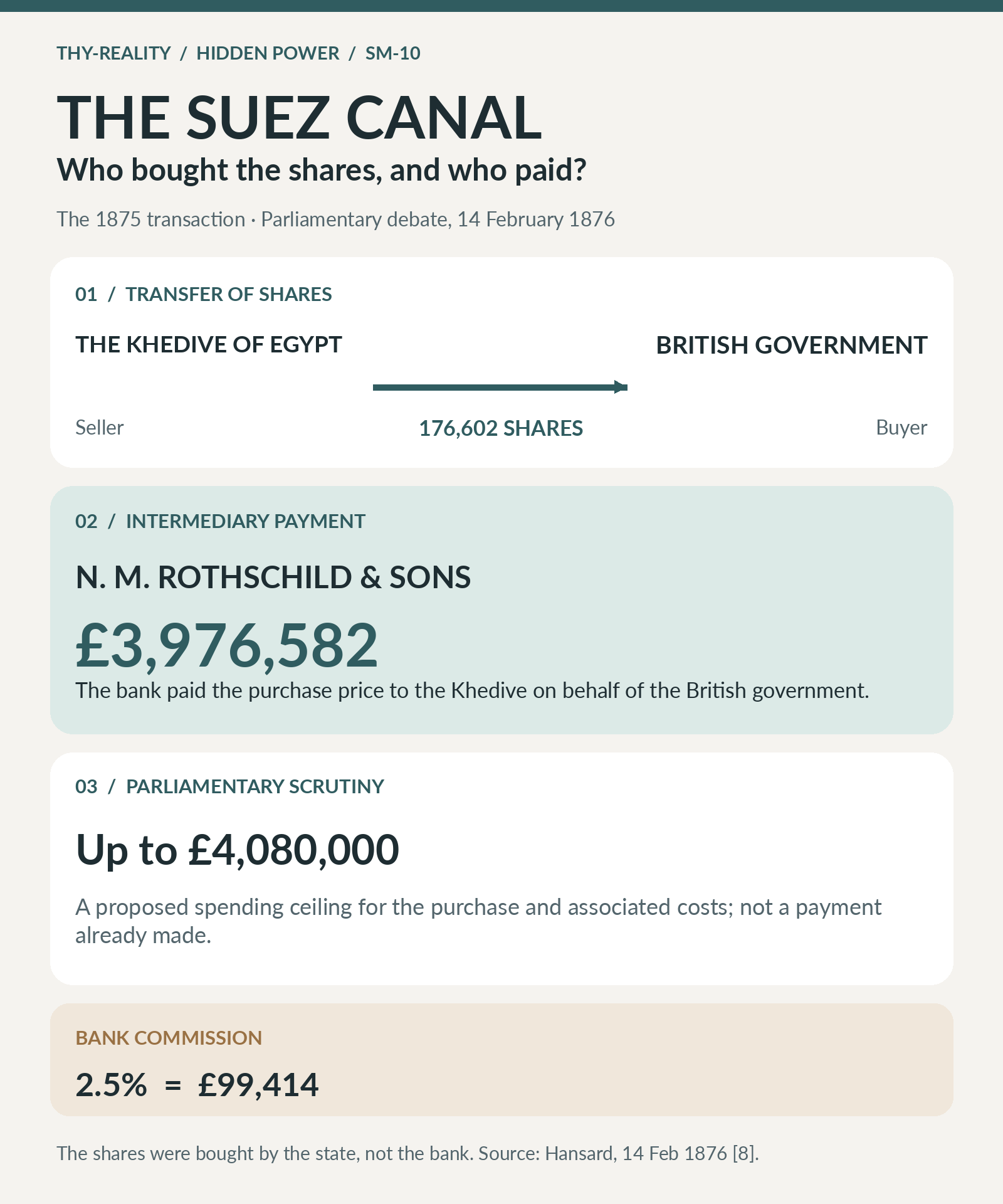
The conclusion is not that the family secretly ruled the British Empire. Something historically more precise is documented: in an important strategic transaction, the state relied on the particular capabilities and network of a private financial house, generating reciprocal access and economic interests. Detailed share ownership, interest, public-debt positions and later business effects belong in the separate series Who Owns the World?; the focus here is the connection between a family network and a public decision. [8] [9]
Ferdinand de Rothschild and a documented Masonic circle
Ferdinand James Anselm de Rothschild (1839–1898), the owner of Waddesdon Manor and a British MP, was an active Freemason. In 1892 he took part in the establishment of Ferdinand de Rothschild Lodge No. 2420. A contemporary report in The Freemason, dated 11 June 1892, states that the lodge’s first Master was James Stephens, while Ferdinand was its first Senior Warden. According to a published textual transcription of an obituary report from December 1898, Ferdinand became the lodge’s second Master the following year—that is, in 1893. [10] [11]
A biographical summary associated with Waddesdon Manor compresses his role in the foundation and his position as Master into 1892. The two more detailed contemporary newspaper accounts require a more exact chronology: founder and Senior Warden in 1892; Master in 1893. This shows why even well-organised archival summaries need to be compared with their underlying statements. One person’s membership and office are historically significant, but without further documents they do not establish a common Masonic policy across all the family branches or control over state authorities. [10] [11] [12]
Walter Rothschild and a diplomatic letter in 1917
On 2 November 1917, British Foreign Secretary Arthur Balfour wrote to Lionel Walter Rothschild (1868–1937), the second Lord Rothschild. He asked him to convey the British government’s statement to the Zionist Federation. The letter, subsequently known as the Balfour Declaration, expressed British support for the establishment of a Jewish national home in Palestine. It referred to protecting the civil and religious rights of existing non-Jewish communities, but did not explicitly mention their political rights; it also referred to the political status of Jews in other countries. The precise wording matters when assessing both the possibilities and the limitations of the pledge. [13] [14] [20]
The letter documents Walter Rothschild’s position as its particular recipient and intended intermediary in conveying a diplomatic statement. The document alone does not establish that he personally determined British state policy or represented the unified interests of all Jews. The broader British wartime and imperial circumstances, Zionist diplomacy, the numerous decision-makers and the people of Palestine who would bear the consequences of later decisions must also be considered. A detailed treatment of Palestinian history and the subsequent conflict belongs in a separate research series; SM-10 primarily examines the documentary trail connecting the addressee to a diplomatic decision. [13] [14]
How does real influence become a myth of omnipotence?
On one side are archival letters, contracts, parliamentary records and the names of lodge members. On the other are narratives claiming that one family has continuously directed every state, orchestrated every war or controlled the world economy. The difference is not merely one of tone: the two kinds of claims demand different kinds of evidence. To establish an individual transaction, we need evidence of the contract; to establish an alleged centuries-long supreme command, we would need a traceable organisation, a mandate, an uninterrupted chain of decisions and independently verifiable consequences. The documents reviewed here do not demonstrate any such structure. [2] [3] [8] [16]
Because of their wealth and Jewish background, the Rothschilds also became the targets of stereotypes in which a particular family was presented as evidence of an alleged collective Jewish conspiracy. The United States Holocaust Memorial Museum specifically addresses the history of the antisemitic forgery The Protocols of the Elders of Zion. Recognising this background does not place financial or political power beyond investigation. It calls for the same method we apply to the Medici, Roman noble families and other influential dynasties: claims must concern verifiable actions by identifiable people, not a religious community as a whole. [16]
What does the history of a family tell us about power?
The Rothschild case calls for neither glorification nor demonisation. The evidence points to the multigenerational organisation of capital, efficient transmission of information, access to courts, intermediation in state decisions, parliamentary office and personal political ties. At the same time, it reveals limits: legal barriers, different national institutions, public debate, the closure of individual family branches and instances in which popular legends are not supported by reliable evidence. [1] [7] [8] [15]
The philosophical question extends beyond a surname. Under what circumstances do elected representatives and the public have a genuine opportunity to understand the terms of transactions that shape state policy? In the Suez case, Parliament at least debated the purchase price, the commission and the intermediary’s role; this does not settle the question of accountability, but it puts it on a demonstrable footing. Investigating hidden power is most valuable when it illuminates a concrete relationship between private access and public authority, rather than replacing unknown decisions with a myth about a family supposedly capable of anything. [8]
Documentary sources and archive links
These links lead to documents, archival records or photographs hosted by their original source institutions.
Sources and further reading
- The Rothschild Archive. “The Family.” Historical overview of the family and its five European branches. source Source
- The Rothschild Archive. “Family Partnership.” History of the partnership agreement of 27 September 1810 and the establishment of the family businesses. source Source
- The Rothschild Archive. “Letter in Judendeutsch from Nathan Mayer Rothschild to his brothers, 1816.” Description of a sample of the brothers’ correspondence and the collection of letters from 1811–1868. source Source
- Hessisches Landesamt für geschichtliche Landeskunde / LAGIS. “Hessen im 19. und 20. Jahrhundert.” Historical record concerning Mayer Amschel Rothschild and William of Hesse (1769 and 1803). source Source
- The Rothschild Archive. “Nathan Mayer Rothschild and the Waterloo commission.” Documented supply of gold to the British army and a critical account of later legends. source Source
- The Rothschild Archive. “Rothschilds and pigeon post.” Review of historical communications and the evidentiary limitations of the Waterloo story. source Source
- Hansard / UK Parliament. “Admission of Baron de Rothschild.” House of Commons, 26 July 1858, parliamentary record. source Source
- Hansard / UK Parliament. “Supply—The Suez Canal Shares.” House of Commons, 14 February 1876, parliamentary account of the transaction, the £3,976,582 purchase price and the £99,414 commission. source Source
- The Rothschild Archive. “Suez Canal Loan Receipts, 1876.” Archival description of receipts and correspondence, including a letter from the British Treasury dated 9 March 1876. source Source
- The Freemason. “Consecration of the Ferdinand de Rothschild Lodge, No. 2420.” 11 June 1892, p. 2, contemporary newspaper report on the lodge’s foundation. source Source
- The Freemason. Obituary report concerning Ferdinand de Rothschild, 24 December 1898, p. 7; states that he became the lodge’s second Master the following year. source Source
- Rothschild Family / The Rothschild Archive. “Waddesdon Manor, Buckinghamshire, England.” Archival biographical overview of Ferdinand and his connection to the lodge. source Source
- The Rothschild Archive. “Walter Rothschild and the Balfour Declaration.” Biographical and documentary context of the addressee of the 1917 letter. source Source
- House of Commons Library. “Balfour Declaration.” Research briefing on the letter of 2 November 1917 and its political context. source Source
- The Rothschild Archive. “Rothschild Timeline.” Historical chronology of the family branches, including the closure of the Naples house. source Source
- United States Holocaust Memorial Museum. “An Antisemitic Conspiracy: The Protocols of the Elders of Zion.” Historical account of the antisemitic forgery and its use. source Source
- The Rothschild Archive. “Access Policy.” Conditions for accessing archival records and restrictions affecting private family collections. source Source
- The Rothschild Archive. “The Rothschild Name and Arms.” Family name, coat of arms and noble titles. source Source
- Landesgeschichtliches Informationssystem Hessen (LAGIS). “Gesellschaftervertrag von Mayer Amschel Rothschild mit seinen Söhnen.” Archival account of the agreement of 27 September 1810 and the names of its actual signatories. source Source
- United Nations — Question of Palestine. “Balfour Declaration – UK/Non-UN document.” Published transcription of the letter of 2 November 1917 (not a directly verified original manuscript). source Source