The Rockefellers and the Architecture of Modern Elites
Rockefeller Foundation grants supported research reaching government officials. What do the archives show about philanthropy’s influence—and what remains unproven?

Editorial illustration.
In its 1942 annual report, the Rockefeller Foundation stated that research groups at the private Council on Foreign Relations had already sent nearly four hundred memoranda on the war and the future peace settlement to American government decision-makers. In 1942, the foundation approved $70,700 for the program's continuation in 1943 and 1944; approval is not the same as evidence that the full amount was disbursed. This is no hidden legend, but a trail recorded in the institution's own financial and program report. Yet what does it mean when a privately funded network of experts prepares material for a state that will decide questions concerning the postwar world? [6]
The documents show something tangible: private wealth enabled institutions to be established and operate; those institutions connected experts, and their recommendations reached political decision-makers. None of this, by itself, proves that the family dictated government decisions. The Rockefeller story lets us follow this path across several generations, but only if we distinguish individual family members, foundations, a bank, research organizations and government offices. [3] [7]
Before the foundations came industrial wealth
The story begins with nineteenth-century industrial capitalism. John D. Rockefeller was one of the principal builders of the Standard Oil empire. In 1911, the United States Supreme Court upheld an order to dissolve the monopolistic business combination for violations of the Sherman Antitrust Act. The wealth in this story did not arise outside political and legal conflicts; on the contrary, the court's intervention shows that the company's power had grown great enough to provoke a response from the state. [1]
Nor can this period be explained by attributing a single motive to everyone involved. Rockefeller's philanthropy encompassed public-health campaigns, education and scientific institutions. His Sanitary Commission, established in 1909, funded efforts to prevent hookworm infections in the American South, and in 1913 he established the Rockefeller Foundation. The charitable effects are documented; it is equally legitimate to ask whether vast private wealth and the foundations' standing also increased the family's social influence. The two effects are not mutually exclusive. [2]
One family name, several distinct institutions
The Rockefeller Foundation, established in 1913, is not the Rockefeller Brothers Fund, incorporated on 28 December 1940. The former is a major philanthropic institution with its own mission, assets and board; the latter began as the joint charitable initiative of five brothers, grandsons of Standard Oil's founder, and in its first decade received the funds for its grants from their annual contributions. The Rockefeller Foundation explicitly describes itself as legally independent of other organizations bearing the same name. To investigate historical influence, we must therefore examine a particular board decision, donation or individual's involvement, rather than merging every institution into an imagined command center. [3] [4]
The five brothers were not a single political personality, either. John D. Rockefeller III emphasized population-related work and cultural exchange, Nelson pursued a distinctly public political career, and David became a prominent banker and participant in foreign-policy circles. In its own historical account, the Rockefeller Brothers Fund describes their different personalities, division of responsibilities and the gradual professionalization of family philanthropy. Shared wealth created opportunities to cooperate, but it did not erase differences in purpose, institutional identity or actual authority. [20]
Philanthropy as social infrastructure
A private foundation can operate on two levels at once. By funding public-health campaigns, medical education, research or agriculture, it can deliver genuine public benefits. But by selecting certain research questions, institutions and expert approaches, it may also influence which knowledge becomes visible, which specialists enjoy sustained opportunities and which solutions come to be regarded as serious. Influence understood in this way requires no secret plan: it is already apparent in the allocation of resources, organization of research and choice of partners. [2] [18]
One example is the foundation's cooperation with the Mexican government on a program to improve agriculture, launched in 1943. The program supported crop research and the training of specialists and became one of the foundations of the later Green Revolution. This was cooperation between a private foundation and Mexican public institutions and scientists, not an interstate agreement between two governments or evidence that policies were dictated unilaterally. Still, the spread of a particular development paradigm raises questions about its effects on local needs, technological choices and reliance on outside expertise. Those consequences require separate assessments; it would be unfair to label the program itself a form of covert coercion. [17]
The same applies to public health. Historical research on Rockefeller-sponsored health campaigns in Mexico points to the interplay of medical goals, state institutions, economic interests and efforts to persuade local populations. The aim of reducing disease can coexist with contested assumptions about who should set the priorities of health policy. Any evaluation of such a policy must also consider actual health outcomes and the voices of the people affected; without them, criticism of philanthropy becomes merely propaganda in reverse. [19]
When a foundation funds research into a country's future
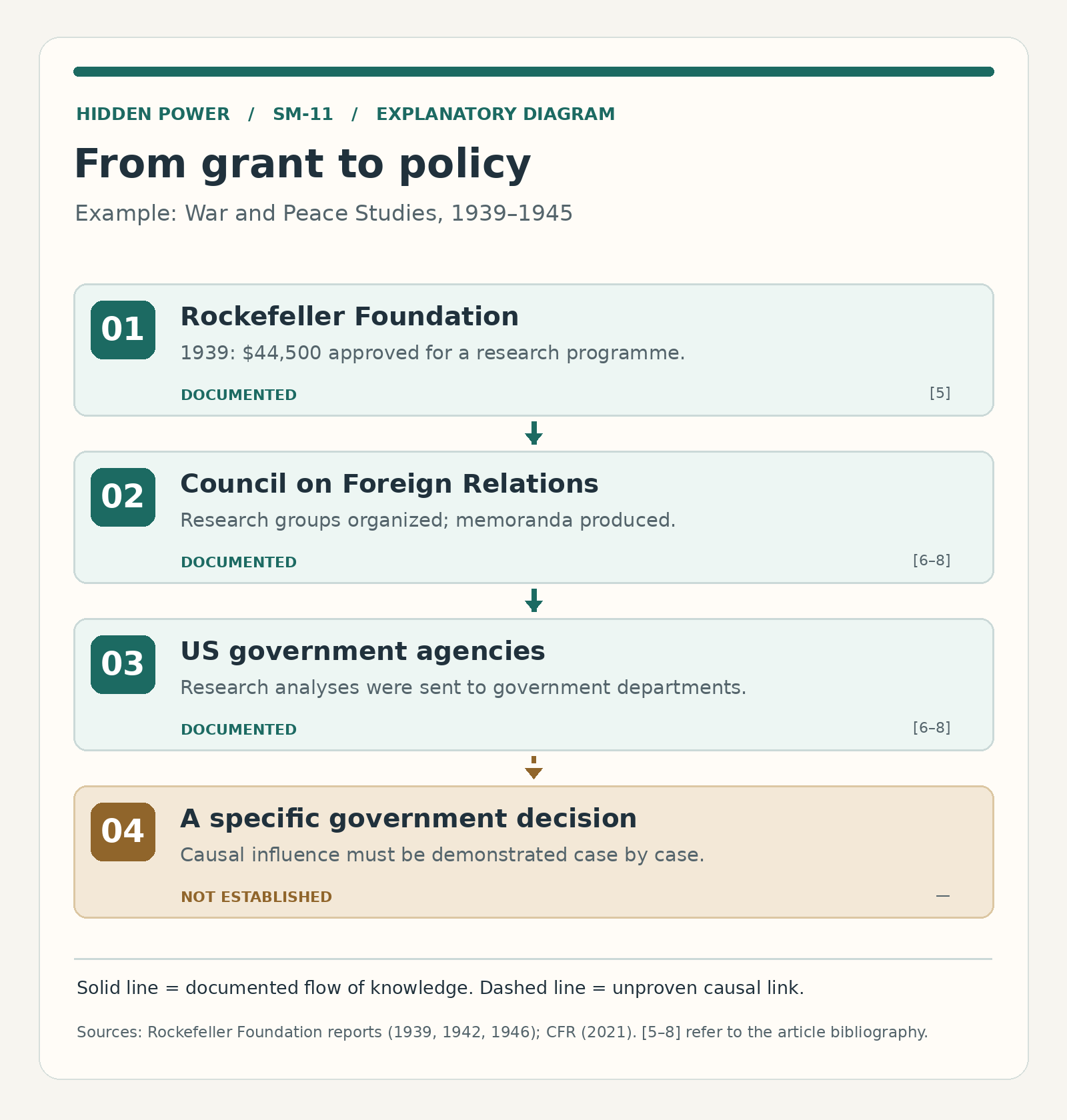
One of the clearest documented mechanisms begins in 1939, when, following the outbreak of war in Europe, the Council on Foreign Relations organized special groups to examine the war and the future peace settlement. The Rockefeller Foundation recorded the approval of $44,500 for this research purpose in its 1939 annual report. It was a private research project with a public-policy purpose: to explore possible responses to issues that would concern American interests after the war. [5]
The 1942 report tells us that the groups studied security, economic, political and territorial questions; by that time they had sent nearly four hundred memoranda to government decision-makers. For the project as a whole, which ended in 1945, the CFR records 361 meetings and 670 memoranda prepared and submitted to the U.S. State Department. The figure of nearly four hundred in the 1942 report is an earlier interim count; 670 is the final count for the longer period. Neither figure is automatically a count of government decisions adopted. The distinction matters: advice delivered is not yet policy implemented. [6] [8]
The foundation's 1946 report adds a detail of particular significance to this investigation: according to the foundation, the program operated with the approval and cooperation of the U.S. Departments of State, War and the Navy. That statement alone does not establish that any government powers were legally transferred to the CFR. Here lies the boundary between documented institutional influence and an exaggerated interpretation. We can establish funding, cooperation and the transmission of analyses. If we wish to show that a particular recommendation caused a government decision or the creation of an international organization, we must go further and compare the specific memorandum, official draft and adopted measure. [7]
Special Studies: when a private foundation opens a public debate
After the Second World War, the institutional method continued in another form. In 1956, Nelson Rockefeller initiated the Special Studies Project at the Rockefeller Brothers Fund, and Henry Kissinger was selected as its director. Groups of experts from universities, business, the military, labor unions and public institutions considered foreign policy, security, the economy, education and democratic institutions. Their findings were not kept secret: the individual groups' reports were publicly released, and in 1961 they were collected in the volume Prospect for America. [9]
The project demonstrates that substantial private resources can enable a coordinated discussion of long-term national goals. It also demonstrates continuity in personal networks, as some participants later held important public offices. Yet we must distinguish a published recommendation, the subsequent career of its author and a specific official action. To claim that the foundation therefore directed later administrations would skip precisely the evidentiary step that needs investigating. [9]
Nelson and David: two different faces of influence
Nelson Rockefeller was far more than a family philanthropist: he held public office and served as Vice President of the United States from 1974 to 1977. His authority in that role derived from the constitutional process of nomination and confirmation, not from his family name, although wealth undoubtedly shaped the opportunities available to him from the outset. In his case, then, we are not investigating a hidden substitute for the state, but the passage of a person from an exceptionally privileged background into formal, publicly accountable power. [10]
Gerald Ford, Nelson Rockefeller and Henry Kissinger in the Oval Office, 28 April 1975
David Rockefeller operated differently. He led a major bank and chaired the board of the Council on Foreign Relations from 1970 to 1985. The position gave him access to diplomats, business leaders and foreign-policy experts, but the title of CFR chairman carried no authority over the U.S. State Department. With both brothers, it is therefore more useful to trace particular institutions and channels of activity than to portray them as two agents carrying out one unified family plan. [11]
The Trilateral Commission and the boundary between a network and a government
David Rockefeller founded the Trilateral Commission in 1973, bringing together influential people from North America, Western Europe and Japan, and later from wider Asian circles. The commission describes its purpose as exchanging ideas and developing cooperation on international problems. In a historical overview, the U.S. State Department explains Zbigniew Brzezinski's role in shaping the trilateral approach. This is a real private international institution, not merely a name circulating in online conspiracy theories. [12] [13]
The inquiry becomes more concrete with Jimmy Carter. Before becoming U.S. president, he spoke to the American Chamber of Commerce in Tokyo on 28 May 1975 and then attended the Trilateral Commission meeting in Tokyo and Kyoto on 30–31 May. Editorial notes in the diplomatic series Foreign Relations of the United States describe how Brzezinski subsequently began preparing foreign-policy materials for Carter. Such personal and intellectual continuity is historically important. It does not, however, follow that the commission made decisions in place of the elected administration, or that Carter implemented every commission proposal. [14]
A conversation we can actually read
An even more direct trail is provided by the transcript of a telephone conversation between Henry Kissinger and David Rockefeller on 8 February 1974. Kissinger discussed relations with European allies and the energy crisis, explicitly referring to Rockefeller's position in the Trilateral Commission. Rockefeller expressed his willingness to help with relations with Europe; he also mentioned the concerns of energy specialist Walter Levy and suggested that Kissinger speak with him. This is not a later recollection or a conjecture based on a photograph: the conversation survives in the official diplomatic record. [15]
That is precisely why the conclusion must be all the more exact. The document establishes a private representative's direct access to a senior government decision-maker, a recognized opportunity for mediation and contact in a sensitive area of foreign policy. It does not establish that Rockefeller subsequently changed the French position, American negotiating instructions or the outcome of the energy conference. There is no evidentiary basis for the leap from “I can help” to “I decided.” [15]
Philanthropy and the question of bodily autonomy
The family's influence was not confined to diplomacy. In 1952, John D. Rockefeller III founded the Population Council, which developed research on population, fertility and family planning. The archive of Rockefeller institutions notes that he personally provided funds and that other organizations, including the Ford Foundation and the Rockefeller Brothers Fund, also supported its work. The Population Council is not simply a department of every Rockefeller institution. Nor does the foundations' early interest in demography by itself demonstrate a unified secret program. [16]
This field carries particular ethical weight. Research into reproductive health, access to contraception and voluntary family planning can expand people's freedom to make their own choices; policies that treat human reproduction primarily as a population-management target can threaten bodily autonomy and dignity. Historians have critically examined how American demographers, foundations and development policy linked scientific programs to global political goals. Claims of coercive practices in any particular program would require examination of its documents, actual implementation, state responsibility and testimony from those affected—not merely the founder's name. Critical investigation of the political aims of demography does not, by itself, prove coercion in every program. [16] [21]
An architecture of influence is not a supreme command
In Foundations of the American Century, researcher Inderjeet Parmar understands the Rockefeller, Ford and Carnegie foundations as important builders of the expert and policy networks of American foreign affairs. This is an influential scholarly interpretation, not a ruling that the three foundations secretly controlled the state as a single authority. His argument raises a serious question: if foundations fund research centers, scholarships and meetings, they can help shape over time the selection of ideas and people who become influential—even when they have no power to issue a single government order. [18]
The opposing perspective also carries evidentiary weight. Foundations enabled significant work in health, education and agriculture; in many instances, their research reports were public and were produced by people from different fields. Not every international conference is a covert meeting, and not every professional connection is a conflict of interest. Yet public benefits alone do not resolve the question of democratic accountability: who chose the research question, who was invited, whose needs remained invisible, and who had the opportunity to challenge the chosen course? [2] [9] [17]
Conclusion: the power to choose the possibilities
The Rockefeller story is politically significant without any assumption of a unified hidden command. It reveals a mechanism through which private wealth can finance knowledge, institutions can open doors to decision-makers, and personal connections can outlast changes of government. The strongest cases verified so far are the traces of CFR funding and memoranda, the public Special Studies program, Nelson Rockefeller's official positions, the founding of the Trilateral Commission and the specific Kissinger–David Rockefeller telephone conversation. The investigation of individual policy outcomes must continue document by document. [5] [7] [9] [10] [12] [15]
The philosophical question is not merely whether benefactors acted with good intentions, but who, in a democratic society, can choose the future that everyone else will be asked to discuss. Publicly accountable power allows scrutiny, opposition and correction of mistakes; institutional influence that escapes such scrutiny demands even greater attention. Criticism should address actions, rules and verifiable decisions—not inherited guilt attached to a family or the community to which it belonged.
Sources and further reading
- United States Supreme Court. Standard Oil Co. of New Jersey v. United States, 221 U.S. 1 (1911). source Source
- Rockefeller Archive Center. John D. Rockefeller, 1839–1937 (n.d.). source Source
- The Rockefeller Foundation. Our Mission and Vision (n.d.). source Source
- Rockefeller Brothers Fund. RBF Founded (n.d.). source Source
- The Rockefeller Foundation. Annual Report, 1939 (Council on Foreign Relations, printed p. 273) (1939). source Source
- The Rockefeller Foundation. Annual Report, 1942 (The Social Sciences, printed pp. 170–171) (1942). source Source
- The Rockefeller Foundation. Annual Report, 1946 (The Social Sciences, printed p. 187) (1946). source Source
- Council on Foreign Relations. Celebrating a Century: From the Think Tank (2021). source Source
- Rockefeller Brothers Fund. In Depth: The Special Studies Project (n.d.). source Source
- U.S. Senate. Vice Presidents of the United States (n.d.). source Source
- Council on Foreign Relations. Board of Directors — Historical Chairmen (n.d.). source Source
- The Trilateral Commission. About Us (n.d.). source Source
- U.S. Department of State, Office of the Historian. Trilateral Diplomacy: The United States, Western Europe and Japan (n.d.). source Source
- U.S. Department of State, FRUS. Jimmy Carter, Address Before American Chamber of Commerce in Tokyo, 28 May 1975 (FRUS 1977–1980 I, doc. 2) (1975). source Source
- U.S. Department of State, FRUS. Transcript of Telephone Conversation Between Kissinger and David Rockefeller, 8 Feb. 1974 (FRUS 1969–1976 XXXVI, doc. 311) (1974). source Source
- Rockefeller Archive Center. Rockefeller Philanthropy and Population-Related Fields (2022). source Source
- Rockefeller Archive Center. The Rockefeller Foundation’s Mexican Agriculture Program, 1943–1965 (2022). source Source
- Inderjeet Parmar / Columbia University Press. Foundations of the American Century: The Ford, Carnegie, and Rockefeller Foundations in the Rise of American Power (2012). source Source
- Anne-Emanuelle Birn in Armando Solórzano / Social Science & Medicine. Public health policy paradoxes: Science and politics in the Rockefeller Foundation’s hookworm campaign in Mexico in the 1920s (1999). source Source
- Rockefeller Brothers Fund. Lessons from Family Philanthropy (n.d.). source Source
- Emily Klancher Merchant / Modern American History, Cambridge University Press. American Demographers and Global Population Policy in the Postwar World (2021). source Source