The Romanovs and the Networks of European Dynasties
The Romanovs belonged to a web of European courts. Their fate reveals how state interests could prevail over even close dynastic kinship.
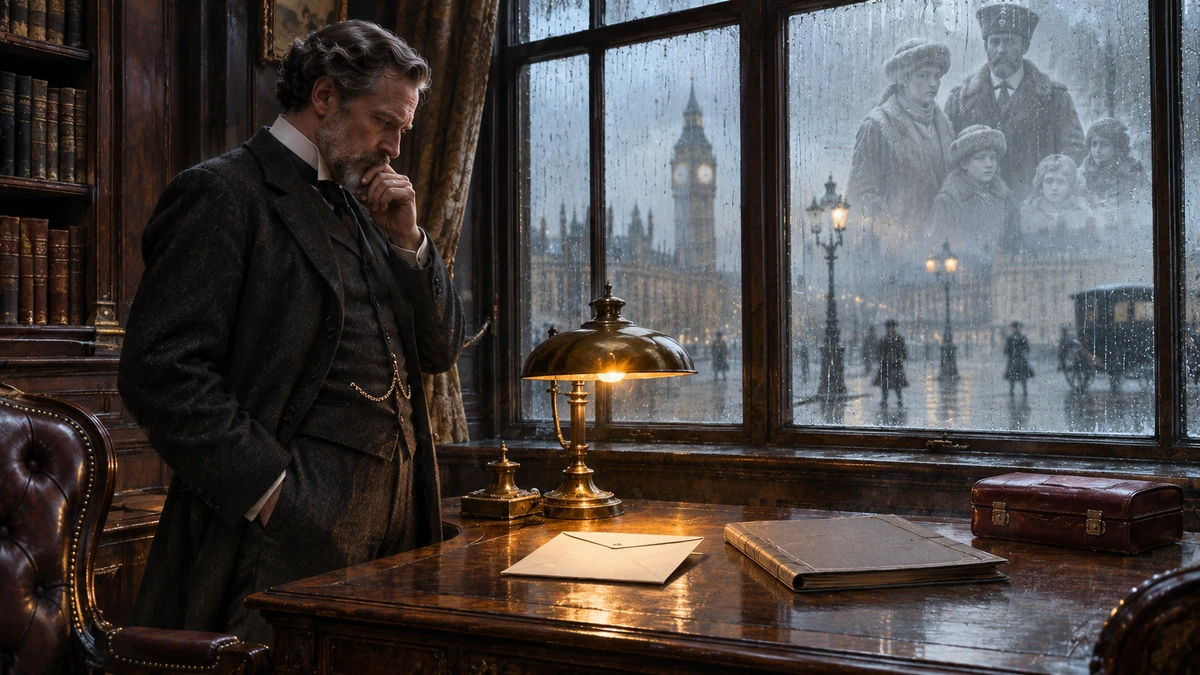
Interpretive editorial artwork, not a documented meeting or an authentic portrait of the Romanovs.
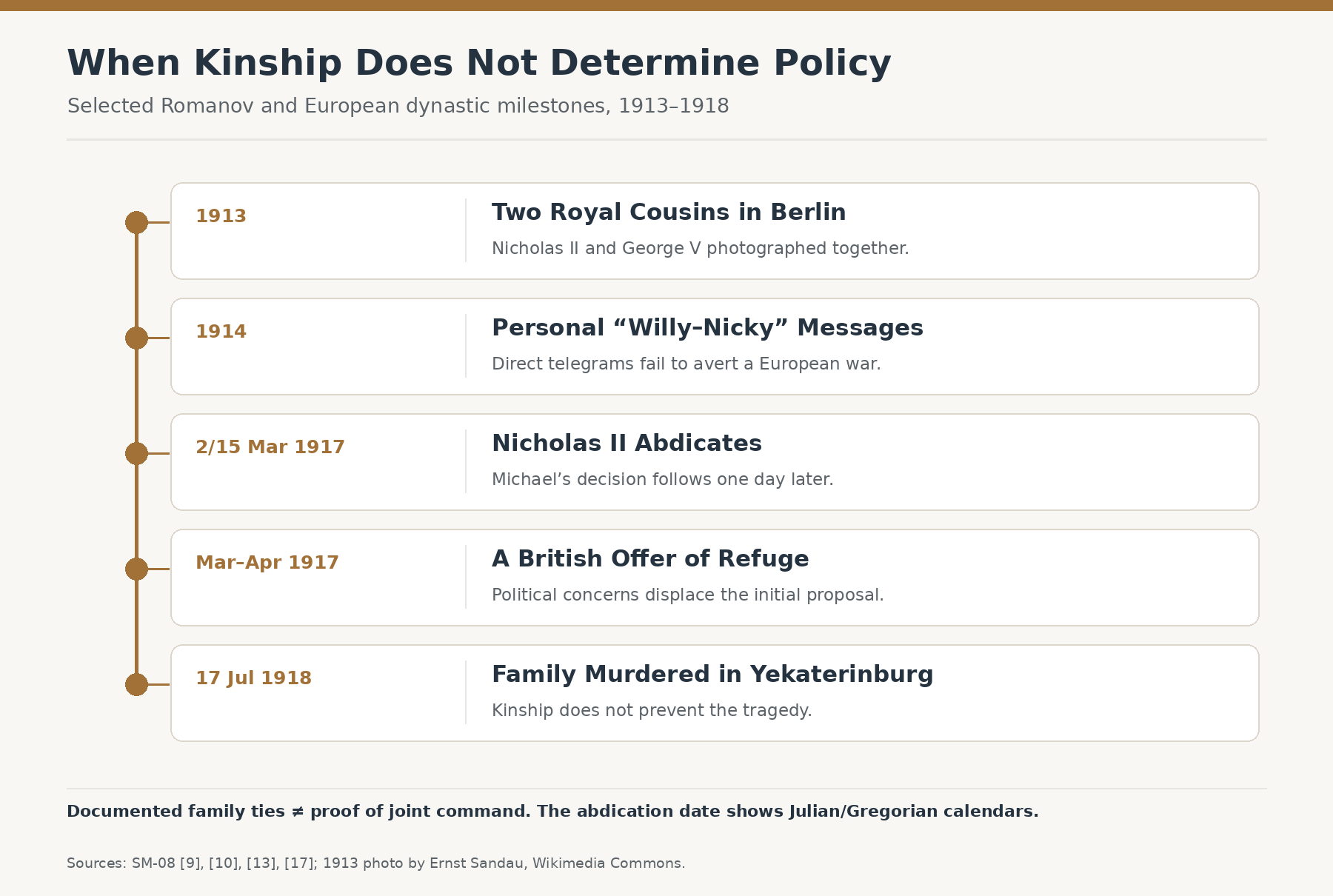
In March 1917, the British government faced a question that a family tree alone could not resolve. Russia's Tsar Nicholas II had lost his throne; Britain's King George V was his first cousin. On 22 March, the British Foreign Office offered refuge to the former tsar and tsarina, but on 6 April the king's private secretary warned of a potentially hostile public reaction. The plan to receive the family was abandoned. These documents do not prove that admitting the family to Britain would certainly have prevented the tragedy that followed. They do, however, reveal the limits of family solidarity when kinship encounters state policy and fear of social repercussions. [9]
For a little over three centuries, the Romanov dynasty stood at the head of the Russian monarchy. Through marriage, its members were connected to German, Danish and British royal houses; they corresponded with one another and paid visits. How much of this network amounted to personal closeness, how much to a diplomatic channel, and how much to actual political power? The answer lies not in a single secret chain of command linking the families, but in documents that expose both the strength of these connections and the fractures within them.
A Dynasty Is Not an Unchanging Bloodline
In 1613, Mikhail Fyodorovich Romanov was chosen as tsar of Russia. This marks the beginning of the dynasty's historical rule, which continued until the revolution of 1917. Yet the history of succession was not a simple, uninterrupted sequence of fathers and sons. Under Peter I's succession decree of 1722, the ruler could designate an heir; in actual transfers of power, court factions, guards regiments and dynastic marriages also played a part. Historian Paul Bushkovitch notes that a strict legal system of primogeniture did not exist in Russia from the outset and that succession disputes recurred over the centuries. [1]
The year 1762 is particularly important. Through his mother, Anna Petrovna, Peter III was a grandson of Peter the Great; through his father, Charles Frederick, he belonged to the House of Holstein-Gottorp. His accession linked Russian succession to another European dynastic branch. The term Holstein-Gottorp-Romanov is therefore a genealogical designation for a branch of succession, not evidence of secret foreign administration of Russia. To establish who governed, we must still investigate institutions, decisions, social groups and historical conflicts. [2]
Rules Intended to Govern the Family
In 1797, Emperor Paul I introduced a hereditary order of succession based on primogeniture, with priority for male heirs. In doing so, he sought to reduce the uncertainty that had accompanied the choice of successors and palace coups during the eighteenth century. Researchers distinguish between the right to the throne and the rules governing the position of other members of the imperial family. Both levels mattered: the order of succession determined eligibility for supreme authority, while house rules governed marriage, status and family obligations. [1][3]
During the nineteenth century, this arrangement became more complicated as the dynasty expanded and questions arose concerning the equal dynastic standing of marriage partners, financial rights and relations among members of the house. In his study of the 1797 rules and subsequent amendments, Russell E. Martin shows how family matters became intertwined with state law. This is a concrete mechanism of power, not merely a story about royal blood: succession and house rules determined who could claim rights by virtue of dynastic membership and whose claims were restricted. [3]
Two Danish Sisters, Two European Monarchies
The Romanov network became even more closely linked to the British Crown through two Danish sisters. Alexandra, a daughter of King Christian IX of Denmark, married Britain's heir to the throne, Edward, the future Edward VII, in 1863. Her sister Dagmar married the future Russian tsar Alexander III in 1866 and took the name Maria Feodorovna. Alexandra became the mother of Britain's King George V, and Dagmar the mother of Tsar Nicholas II. The two future monarchs were thus first cousins. [4][5][6][16]
This link is more than a modern genealogical calculation. The Royal Collection Trust holds a photograph of the two sisters and an image from around 1872 showing the young Nicholas with his British cousins Albert Victor and George. The photographic record directly establishes that these relatives posed together; by itself, it proves neither the nature of their later political relationships nor any ability to command one another or foreign parliaments. This is the difference between personal access and political authority. [4][6]
The Marriage of Nicholas and Alexandra and the World of European Courts
Nicholas II married Alexandra Feodorovna, born Princess Alix of Hesse-Darmstadt, in 1894. Alexandra was a granddaughter of Britain's Queen Victoria. Their marriage connected the Russian imperial court with British and German dynastic networks. A photograph of the couple at Balmoral Castle in September 1896 is direct evidence of a personal visit to Britain and the contacts accompanying that kinship. [7][15]
Such visits carried several meanings at once. They enabled personal closeness, informal conversations and diplomatic symbolism. They did not, however, remove national borders, military interests or social tensions within the individual monarchies. Detailed evidence of visits and family ties does not, in itself, demonstrate a single continuous, all-powerful familial command structure.
A Photograph as Evidence of Closeness — Not Joint Rule
The Royal Collection Trust explicitly identifies Nicholas II and George V as first cousins and records that the British king called him “Nicky.” Photographs and accounts of visits give this relationship a personal dimension. In political history, such acquaintances can matter: relatives may be able to contact one another directly, understand court protocol and exchange information outside ordinary public channels. [6][8]

Yet access to a person does not imply the power to direct that person's state. To establish a specific instance of covert decision-making, we would need a traceable request, action and outcome: a letter, an order, a record of a meeting or independently corroborated implementation of an agreement. A court photograph proves a meeting; it does not establish coordinated secret government.
“Willy” and “Nicky”: Telegrams at the Outbreak of the First World War
Between 29 July and 1 August 1914, Russia's Tsar Nicholas II and Germany's Emperor Wilhelm II exchanged several personally addressed telegrams. In the published transcripts they signed with the familiar names “Nicky” and “Willy.” Both referred to efforts to resolve the conflict between Austria-Hungary and Serbia, and the danger of a wider war, without a European catastrophe. But the telegrams also reveal conflicting state obligations and positions regarding mobilisation. [10]
As the conflict escalated, the personal channel failed to stop war between their states. This is one of the clearest answers to the question of how far dynastic connections could reach. The correspondence was neither invented nor insignificant; its documented failure demonstrates that personal closeness could not replace military commands, alliance commitments and political decisions. Interpretation requires attention to chronology and the full diplomatic context, not just the cordial signatures on the telegrams. [10]
Two different bodies of correspondence must not be confused. The Library of Congress catalogues Herman Bernstein's edition of 65 “Willy–Nicky” telegrams from 1904–1907, while the exchange of July and August 1914 belongs to another historical sequence. The earlier collection documents a longer period of personal communication, not a single decisive family strategy. [10][11]
When an Emperor Loses Support
In 1917, wartime strain, discontent, demonstrations, strikes and mutiny among parts of the armed forces accompanied the collapse of Russia's imperial regime. Foreign diplomatic observers reported these events from their own vantage points, with limited access to all participants. In a telegram from Petrograd dated 17 March, US Ambassador David R. Francis reported on the uprising, the new provisional authorities and the emperor's abdication. Such a document establishes what American diplomacy learned and communicated at the time; it is not, by itself, a complete explanation of the causes of the Russian Revolution. [12]
The difference between calendars also matters. Nicholas II signed his abdication on 2 March according to the Julian calendar then used in Russia, or 15 March 1917 according to the Gregorian calendar. On 3/16 March, his brother Grand Duke Michael Alexandrovich declined to assume power immediately, making any acceptance conditional on the will of a future Constituent Assembly. Both dates are explicitly given in a communication from Foreign Minister Pavel Milyukov to the Russian ambassador in Washington, subsequently passed to the US Secretary of State on 18 March; a separate American diplomatic telegram of 19 March publishes Michael's proclamation. These are published diplomatic documents, not our own inspection of the original signed instruments. [13][14]
These two successive steps signify more than the replacement of one name on the throne. The legal and practical question of political authority moved from the dynastic house into a state transformed by revolution. An inherited title was no longer enough to ensure that rule could simply continue through the next branch of the family.
London in 1917: Kinship Versus State Policy
An educational transcript published by the UK's National Archives describes a British Foreign Office telegram sent to the ambassador in Petrograd on 22 March 1917, offering refuge to the former tsar and tsarina. The archive also presents a transcript of a letter dated 6 April from the king's private secretary, Arthur Bigge, expressing George V's concern about public reaction. A telegram from Ambassador George Buchanan dated 15 April further reflects political reservations. The offer was not carried out. The evidence used here consists of published archival transcripts and their interpretation, not direct examination of the original folios. [9]
It is tempting to turn this story into a simple moral verdict: a relative supposedly had the power to save another relative and deliberately sacrificed him. But the actual evidential basis is narrower. The sources establish the offer, political concerns and abandonment of the plan. They do not establish that a successful evacuation was logistically or politically guaranteed at that moment, or that a single decision would inevitably have prevented the later murders. The change of position remains open to political and moral assessment: the cited documents show that concern about the consequences of admission prevailed over the initial offer to a related family. [9]
This is not a secret global hierarchy, but a real example of private solidarity yielding to public political risk. In this respect, history is often more revealing than legend.
July 1918: The Tragic End of the Ruling Family
During the night leading into 17 July 1918, Nicholas II, Alexandra, their five children and companions held captive with them were killed in Yekaterinburg. The British Library describes their confinement in the Ipatiev House and the killings in the early hours of 17 July; it identifies Yakov Yurovsky and a group of guards in carrying them out. The precise distribution of responsibility between local authorities and higher political leaders, however, is a separate research question. The sources used here do not suffice to reconstruct the entire chain of command. [17]
The murder of the family is not an argument in favour of a hereditary right to rule. On the contrary, family membership does not diminish anyone's right to life and dignity. Nor should the account of these deaths erase the documented repression, social inequalities and violent consequences of the imperial regime. Understanding history requires us to assess both the ruler's decisions and the impermissibility of murdering captives.
What Remains of a Dynasty When the Throne Is Gone?
Family ties do not disappear along with a state. After 1917 there were still relatives, descendants, archives, personal memories and public debates about Russia's monarchist heritage. But an emperor's legal authority, a family's traditions and the biographies of individuals are three different things. A genealogical connection to the Romanovs does not mean that anyone actually inherited Russian sovereignty after 1917. [1][12][13]
That is also why we should not treat “bloodlines” as self-evident political organisations. A verifiable relationship can be of historical interest and sometimes political use. Actual power, however, requires identifiable institutions, competencies, resources, decisions and circumstances in which others accept or reject those decisions in practice. The Russian example reveals both the once extraordinary strength of dynastic position and its ultimate limits.
The story of the Romanovs is therefore a story of two contrasting truths. The family connections were real, and personal channels of communication are documented. The events examined from 1914, 1917 and 1918 do not demonstrate a unified, supranational family authority capable of controlling their outcome. A broader question remains open, with implications for our own world: can closeness to power ever replace public accountability, and who should decide when private loyalty collides with the rights of those affected by government?
Sources and further reading
- Paul Bushkovitch (2021). Succession to the Throne in Early Modern Russia: The Transfer of Power 1450–1725, introduction and conclusion. Cambridge University Press. source (publicly accessible summaries, not the complete book). Source
- Deutsche Biographie. “Peter III.” Biographical and genealogical entry, German edition. source (genealogy of Peter III; not archival material from the imperial family). Source
- Russell E. Martin (2010). “For the Firm Maintenance of the Dignity and Tranquility of the Imperial Family: Law and Familial Order in the Romanov Dynasty.” Russian History, 37, 389–411. source (accessible summary and bibliographic details; the original texts of the statutes were not transcribed directly). Source
- Royal Collection Trust. “Alexandra, Princess of Wales and Princess Dagmar of Denmark.” RCIN 2926570. source (museum catalogue record of a photograph). Source
- Royal Collection Trust. “Who were the Edwardians?”, section on Queen Alexandra and the Danish dynastic network. source (curatorial synthesis; marriage ties). Source
- Royal Collection Trust. Georg Emil Hansen, “Prince Albert Victor and Prince George of Wales, with their cousin, Grand Duke Nicholas Alexandrovitch of Russia,” c. 1872, RCIN 2926580. source (identification in the photograph and the kinship relationship). Source
- Royal Collection Trust. “Tsar Nicholas II and Empress Alexandra Feodorovna, Balmoral,” September 1896, RCIN 2802369. source (museum catalogue record; photographer unknown). Source
- Royal Collection Trust. “The Diary of King George V,” section “Nicholas II.” source (official curatorial summary, not the complete diary). Source
- The National Archives (UK), Education Service. “Spotlight on the Russian Revolution,” interview with Dr Juliette Desplat, transcript. source (description and excerpts from archival documents on the offer of refuge; original folios must not be equated with the transcript of the presentation). Source
- “The Willy–Nicky Telegrams,” 29 July–1 August 1914, published transcript of historical telegrams based on The Kaiser's Letters to the Tsar (1920). source (secondary web reproduction of primary texts; the complete originals have not been independently collated). Source
- Library of Congress. The Willy-Nicky correspondence, being the secret and intimate telegrams exchanged between the Kaiser and the Tsar (edited by Herman Bernstein, 1918), LCCN 18001519. source (bibliographic record of a separate set of telegrams from 1904–1907, not the same as the exchange of 1914). Source
- US Department of State, Office of the Historian. “The Ambassador in Russia (Francis) to the Secretary of State,” Petrograd, 17 March 1917, telegram 1103. Foreign Relations of the United States, 1918, Russia, vol. I, document 4. source (published primary diplomatic document). Source
- US Department of State, Office of the Historian. “The Russian Minister of Foreign Affairs (Milyukov) to the Ambassador at Washington,” March 1917. Foreign Relations of the United States, 1918, Russia, vol. I, document 6. source (published primary diplomatic document, dates of 2/15 and 3/16 March). Source
- US Department of State, Office of the Historian. “The Russian Minister in Sweden ... proclamation of Grand Duke Michael Alexandrovich,” 19 March 1917. Foreign Relations of the United States, 1918, Russia, vol. I, document 8. source (published transcript of the proclamation transmitted through a diplomatic mission). Source
- Royal Collection Trust. Heinrich von Angeli, “Alexandra Feodorovna, Tsarina of Russia (1872–1918),” portrait of 1897, RCIN 404572. source (museum record; explicitly confirms Alexandra was Victoria's granddaughter and married Nicholas II in November 1894). Source
- Royal Collection Trust. “Queen Alexandra,” museum story, section concerning her sister Dagmar and the 1866 marriage. source (historical curatorial synthesis, not an original marriage certificate). Source
- Susan Reed (2017). “Victims and pretenders: the murder of the Romanovs.” British Library, 17 July 2017. source (curatorial historical overview; not a direct transcription of a document establishing the entire chain of command). Source