European Royal Houses and Dynastic Alliances
Dynastic marriages and succession shaped European politics, but family ties did not guarantee a unified or unlimited command of states.
Interpretive illustration of an imagined late-medieval dynastic negotiation; it does not depict a specific documented marriage.
When Maximilian of Habsburg married Mary of Burgundy in 1477, he entered into more than a family union. He married the heiress to the Burgundian possessions, whose wealth, towns and trade routes were contested by European powers. The marriage offered the Habsburgs a route to a western European inheritance, but it did not eliminate French claims or resistance among the inhabitants. The inheritance had to be fought for. In that difference between a marriage contract and power actually exercised lies one of the central questions of European history: how much power could be passed on through blood, and how much did dynasties still have to establish in the face of other people and institutions? [1]
The European aristocracy was not one family, nor were the royal houses a single coordinated organisation. Yet marriages, succession rules, court appointments and political negotiations created links that crossed national borders. Some were set out in public rules and treaties; others took shape within narrower court circles. To understand their influence, we need to distinguish an actual rule of succession, a political opportunity, a personal acquaintance and a claim that states were being directed in secret. [2][5][8]
When Marriage Becomes a Question of Territory
The rise of the Habsburgs in the late fifteenth and early sixteenth centuries shows how closely family decisions and European politics were intertwined. Maximilian's marriage to Mary of Burgundy in 1477 gave his house a prospect of acquiring part of the Burgundian inheritance. But marriage did not in itself transfer uncontested control of all those territories. France pursued its own interests; opposition emerged in the towns of the Low Countries; armed conflict and negotiations followed. In 1488 the citizens of Bruges even held Maximilian captive. A dynastic title amounted to a claim whose success depended on military and political power. [1]
A similar gulf between intention and outcome can be seen in 1496. Maximilian's son Philip the Handsome married Joanna of Castile, while his daughter Margaret married John, Prince of Asturias. The two marriages were intended primarily as an alliance against French influence. After the deaths of several Spanish heirs, Joanna unexpectedly moved up the line of succession. Only that turn of events enabled the Habsburgs to extend their power so dramatically. The historical record cautions against treating the eventual outcome as proof of a comprehensive plan drawn up at the time of the marriages. [2]
When a ruling family married into another dynasty, questions of inheritance, trade, security, loyalty and future children became entwined. For people who had no seat at the negotiating table, the consequences might mean new taxes, a change of ruler or war. There is no need to claim that every marriage was accompanied by a secret agreement: the official documents and the wars that followed already show how closely rulers' private decisions were bound up with public consequences.
The Habsburgs and Inheritance Agreements
In the Habsburg–Jagiellonian relationship, marriage diplomacy was intertwined with interstate succession arrangements. The Vienna marriage and inheritance agreements of 1515 strengthened the possibility of ties between the two dynasties; the marriage of Ferdinand of Habsburg to Anna Jagiellon followed in 1521. When Louis II died at the Battle of Mohács in 1526, Ferdinand asserted claims to the Bohemian and Hungarian crowns. The outcome required political and military action as well as family connections; in Hungary especially, succession did not mean an undisputed takeover of the entire kingdom. [3]
The Habsburgs tried to reduce uncertainty through rules. Charles VI's Pragmatic Sanction of 1713 established the indivisibility of the Habsburg hereditary lands and an order of succession that, under certain circumstances, also permitted inheritance through women. When Maria Theresa succeeded in 1740, some European rulers challenged her position. The War of the Austrian Succession followed. An event that should have demonstrated the strength of the rule instead revealed its limits: recognising succession on paper was not the same as respecting it in international politics. [4]
Dynastic influence therefore cannot be equated with unlimited power. A claim to a crown often depended on the estates, the army, foreign rulers, local law, the treasury and the ability to govern different territories. Blood ties might open a door, but they could not in themselves guarantee that everyone beyond it would be willing to obey.
Written Rules within a Private Imperial House
On 3 February 1839, the Imperial Austrian Family Statute was adopted. In 61 provisions, the House of Habsburg-Lorraine set out its internal legal relationships in greater detail. The rules covered membership of the imperial house, maintenance of family members, marriages and wills. The head of the house had the authority to oversee important family matters. These are not conjectures about an invisible hierarchy, but a documented system of family authority governed by specific rules. [5]
Section 15 is especially revealing: a member of the imperial house could not simply disregard the consent of its head when marrying. The statute also specified consequences for a marriage without the necessary permission and made provision for special permission for marriages between people of unequal dynastic rank, or morganatic marriages. These were rules about dynastic status and rights within the imperial house. Without examining the whole body of civil law then in force, we must not automatically equate them with the civil-law invalidity of every such marriage. [5]
In 1900 Archduke Franz Ferdinand obtained permission to marry Sophie Chotek, but had to accept that their children would not enjoy the corresponding dynastic rights of succession. Although Sophie came from a noble family, the house's internal rules did not regard her as a bride of equal dynastic standing. The case shows that preserving a family's hierarchy was not merely a strategy of foreign policy: it also reached into individuals' lives, their choice of spouse and the status of their descendants. [6]
In such a system, the boundary between personal and state affairs was blurred. Not because there was some mysterious, undocumented force, but because a private family decision determined access to a succession of public importance. The moral question arises naturally: how much personal freedom did a dynasty demand that its members surrender in the name of continuity of the state?
The Aristocracy Was Not a Single Command Structure
The European aristocracy encompassed many different positions: reigning monarchs, non-reigning princely houses, nobles with landed estates and members of the nobility serving at court or in diplomatic and military posts. Their influence depended on the period, the country, their wealth, legal privileges and relations with the ruler. The fact that many families married into one another does not mean they all made the same political decisions.
Dynastic connections could ease access to court, secure a recommendation or improve someone's chances of appointment, but they also generated rivalries. On one side stands a formal rule, such as the Habsburg statute; on the other, an informal recommendation from a relative or an ordinary family acquaintance. The useful questions for research are: who appointed whom, to which institution, with what powers and with what documented outcome? A shared name in a family tree is not enough to establish a common political line. [5][6]
The historical record of dynastic marriages also reveals the limits of such policies. Alliances could turn into competition; attempts to prevent disputes between states did not guarantee peace. The narrative that the aristocracy formed a single secret European headquarters throughout the centuries would therefore require a different kind of evidence from genealogies: demonstrable powers, orders, records of decisions and independently verified continuity between institutions. That evidence does not follow from the family trees and marriage rules examined here.
The British Monarchy and Europe's Map of Kinship
The British case followed a different path from the family law of the Habsburg imperial house. Queen Victoria married Prince Albert of Saxe-Coburg and Gotha in 1840. Their children formed ties with other European royal houses: Victoria, the Princess Royal, married the Prussian crown prince, later German Emperor Frederick III; Albert Edward, later Edward VII, married Princess Alexandra of Denmark. The map of kinship spread across several monarchies, but it did not erase disagreements between states. [8][9]
A dynastic name is not the same as biological or political continuity. Following Victoria and Albert's marriage, the name Saxe-Coburg-Gotha became part of British dynastic history. On 17 July 1917, amid the First World War and anti-German sentiment, George V adopted the name Windsor for the British royal house. This did not create a new line of biological ancestors, nor did it in itself alter Britain's constitutional distribution of power. It showed how a monarchy could adapt to its political and symbolic environment while kinship links remained. [9][10]
We must therefore consider the question “Who are the Windsors?” on at least three levels: as a history of a house name, as documented European family ties and as a present-day constitutional institution. Combining all three into one can turn kinship into supposed evidence of direct orders to governments. Distinguishing them, however, allows for a more precise assessment of influence.
Who Chooses the Successor: the Family or Parliament?
Succession to the British throne has never been merely a private decision of the royal family. Following the constitutional upheavals of the seventeenth century, Parliament passed the Act of Settlement in 1701, directing the succession towards the Protestant branch of the dynasty associated with Sophia of Hanover. When Queen Anne died in 1714, Sophia's son George I of Hanover succeeded to the throne, since Sophia had died shortly before Anne. This shows how Parliament used legislation to shape hereditary succession and thereby intervened in a question that might appear to belong exclusively to the dynasty. [11]
The Succession to the Crown Act 2013, whose key provisions came into force on 26 March 2015, ended male preference in the order of succession for people born after 28 October 2011. It also removed disqualification on the grounds of marriage to a Roman Catholic and restricted the requirement for the monarch's consent to royal marriages to the first six people in the line of succession. This is an example of a dynastic rule that can be changed through legislation and is not beyond the oversight of democratic institutions. The Act did not remove all religious requirements for a British monarch, so its effects should not be described more broadly than they were. [12]
The British monarchy today is a constitutional monarchy. Parliament makes laws, while the monarch performs primarily constitutional and representative functions; many legal powers of the Crown are exercised in practice on ministerial advice and according to constitutional conventions. This does not mean that the constitutional role has no political significance or that examining its influence is inappropriate. It means that we must not automatically attribute the powers of historical dynastic rulers to today's British royal family. [13][14]
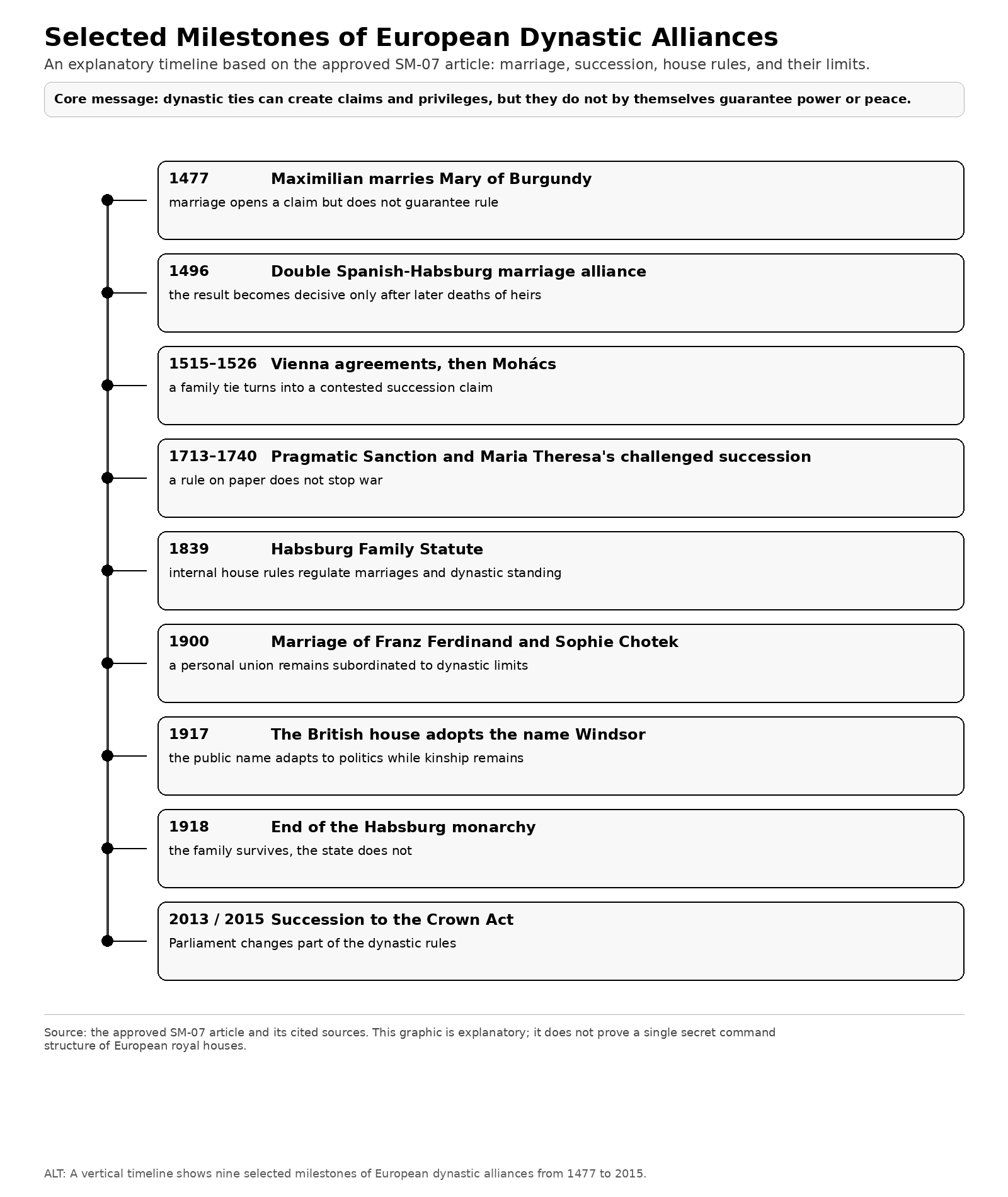
Selected Milestones of European Dynastic Alliances
An explanatory timeline based on the approved SM-07 article: marriage, succession, house rules, and their limits.
Core message: dynastic ties can create claims and privileges, but they do not by themselves guarantee power or peace.
- 1477. Maximilian marries Mary of Burgundy — marriage opens a claim but does not guarantee rule.
- 1496. Double Spanish-Habsburg marriage alliance — the result becomes decisive only after later deaths of heirs.
- 1515–1526. Vienna agreements, then Mohács — a family tie turns into a contested succession claim.
- 1713–1740. Pragmatic Sanction and Maria Theresa's challenged succession — a rule on paper does not stop war.
- 1839. Habsburg Family Statute — internal house rules regulate marriages and dynastic standing.
- 1900. Marriage of Franz Ferdinand and Sophie Chotek — a personal union remains subordinated to dynastic limits.
- 1917. The British house adopts the name Windsor — the public name adapts to politics while kinship remains.
- 1918. End of the Habsburg monarchy — the family survives, the state does not.
- 2013 / 2015. Succession to the Crown Act — Parliament changes part of the dynastic rules.
Source: the approved SM-07 article and its cited sources. This graphic is explanatory; it does not prove a single secret command structure of European royal houses.
Relatives on Opposite Sides of History
European court families were connected through kinship, yet their states waged wars against one another over the centuries. The dispute over the Burgundian inheritance already showed that marriage was no guarantee of cooperation. The War of the Austrian Succession likewise exposed the limited force of agreements and international recognition. Different houses, armies, parliaments, ministers and economic interests had priorities of their own that kinship could not simply sweep aside. [1][4]
The First World War exposed the contradiction even more starkly: close dynastic ties existed among European monarchies, but they did not prevent their states from going to war. Kinship should not be presented as a principal cause of that war, which had broader political, military and economic causes. The important point is different: a network of family connections was not a single chain of command. Britain's choice of the name Windsor in 1917 offers another example of how wartime politics could reshape a dynasty's public symbol even though the family relationships themselves did not disappear. [8][10]
Dynastic continuity also had an ultimate limit. The Habsburg monarchy collapsed at the end of the First World War in 1918. On 11 November 1918, its last emperor, Charles, signed a declaration relinquishing further participation in affairs of state, but he did not formally abdicate; he subsequently went into exile. The family and its genealogy survived, but its former state sovereignty did not. [7][15]
What Remained after the Crowns?
Losing direct political authority does not necessarily mean losing every social connection, family asset, cultural reputation or form of public recognition. But each kind of influence requires a different kind of evidence. Ownership calls for specific documents; constitutional status for a legal basis; political influence for traceable contacts and decisions. Personal prestige does not in itself confer the ability to command elected representatives. [7][13][14]
With historical dynasties, it is especially important to distinguish family tradition from institutional competence. The brief label “ruling family” indicates the historical origin of a dynasty's legitimacy; it does not tell us what legal rights its members possess today, what their powers are or whether a particular connection affects politics at all. Without documented actions to support them, such claims must remain research questions, not settled accusations.
Informal power can be real even when it is not written into a constitution. It may take the form of access to influential interlocutors, public trust, patronage or the ability to direct attention. But the existence of these possibilities is not proof that all European monarchs act in concert or that any particular family secretly makes decisions for foreign parliaments. The method is the same as for any other influential institution: who made the decision, under what authority, and with what traceable consequence?
Who Bears the Consequences of Dynastic Politics?
When we treat dynastic alliances as little more than family trees, it is easy to lose sight of those who lived in the territories that were inherited, divided or conquered. In the Burgundian inheritance, towns, trade and people's lives were at stake. In succession disputes involving the Habsburg lands, political questions were also settled by armies. Records of marriages and titles are therefore a starting point for research, not its final word. [1][4]
The Habsburg family statute reveals a less visible cost: members of the house were not always free to choose their spouses or determine their children's status. The story of Franz Ferdinand and Sophie Chotek does not show that every dynastic marriage lacked personal affection; it does document how intimate relationships were subordinated to the rules of the house and of succession. An ethical assessment can plainly describe this as a restriction on individual autonomy without having to invent a hidden social hierarchy ruling every state. [5][6]
The study of hidden power is most useful here when it moves from a well-known family name to the rules that family actually employed and to their consequences for people beyond its circle. A well-founded criticism of hereditary privilege need not rest on unproven theories. It is enough to ask why some people's political status depended on birth while most others had to live with the consequences of their decisions.
Between Genealogy and Evidence of Authority
European dynasties formed genuine cross-border connections. Marriage contracts opened routes to territories and titles; internal statutes protected the boundaries of the family; succession laws determined access to thrones. Yet none of these findings demonstrates that all aristocratic houses formed a single secret authority. At several points, the sources show quite the opposite: contingency, war, rebellion, parliamentary constraints, the loss of thrones and tensions within dynasties themselves. [1][2][5][7][11]
That is why we need to discard two simplifications from the history of power. The first says that dynastic ties were merely private and politically irrelevant. The second turns every family connection into evidence of a shared secret conspiracy. A more credible conclusion is more demanding: kinship can create access, and hereditary rules can transfer office, but actual power also depends on institutions, conflict and the actions of individuals. The reader is left with a question that goes beyond crowned families: which rules today allow privileges to pass between generations, and who has the power to change those rules?
Sources and further reading
- Stephan Gruber. “Marrying into Burgundy: Maximilian I and Mary of Burgundy.” Die Welt der Habsburger. source (historical overview, including the military consequences of 1477). Source
- Stephan Gruber. “Marrying into Spain: Philip the Fair and Joan the Mad.” Die Welt der Habsburger. source (marriage agreement of 1496 and the unforeseen succession outcome). Source
- “Ferdinand I: marriage and offspring.” Die Welt der Habsburger. source (Habsburg–Jagiellonian connections and the 1515 agreements; historical synthesis). Source
- “The Pragmatic Sanction, 1713.” Die Welt der Habsburger. source (date, order of succession and the dispute following 1740). Source
- Stephan Gruber. “Rights and duties in the archducal house.” Die Welt der Habsburger. source (secondary account of the statute, including an excerpt from §15; the complete original statute was not transcribed or examined in C0). Source
- Martin Mutschlechner. “Love follows its own laws … Franz Ferdinand’s marriage and offspring.” Die Welt der Habsburger. source (morganatic marriage and restrictions on succession, 1900). Source
- “Habsburgs in Exile – the Dynasty after 1918.” Die Welt der Habsburger. source (collapse of the monarchy and subsequent dynastic history). Source
- “Victoria (r. 1837–1901).” The Royal Family. source (family marriages and British–European ties). Source
- “Saxe-Coburg-Gotha.” The Royal Family. source (the dynastic name's place in the British royal house). Source
- “The Royal Family name.” The Royal Family. source (the adoption of the name Windsor in 1917 and the status of the house name). Source
- “The Act of Settlement.” UK Parliament. source (legislative framework of 1701 and Hanoverian succession). Source
- Succession to the Crown Act 2013, 2013 c. 20, §§1–3; key provisions commenced on 26 March 2015. legislation.gov.uk. source (primary legal source). Source
- “The role of the Monarchy.” The Royal Family. source (official account of the monarch's constitutional and representative role). Source
- David Torrance (2025). “The royal prerogative and ministerial advice.” House of Commons Library, Research Briefing CBP-9877. source (specialist overview of contemporary royal powers). Source
- Martin Mutschlechner. “The last days of the Monarchy.” Der Erste Weltkrieg / The World of the Habsburgs. source (historical overview, dated excerpt from Charles I's statement of 11 November 1918; the page links to the original scan). Source