Medici and Borgia: Families Behind the Thrones
In Florence, the Medici gained influence through banking and republican politics; the Borgias through the papacy. The Pazzi conspiracy was real; later legends need scrutiny.
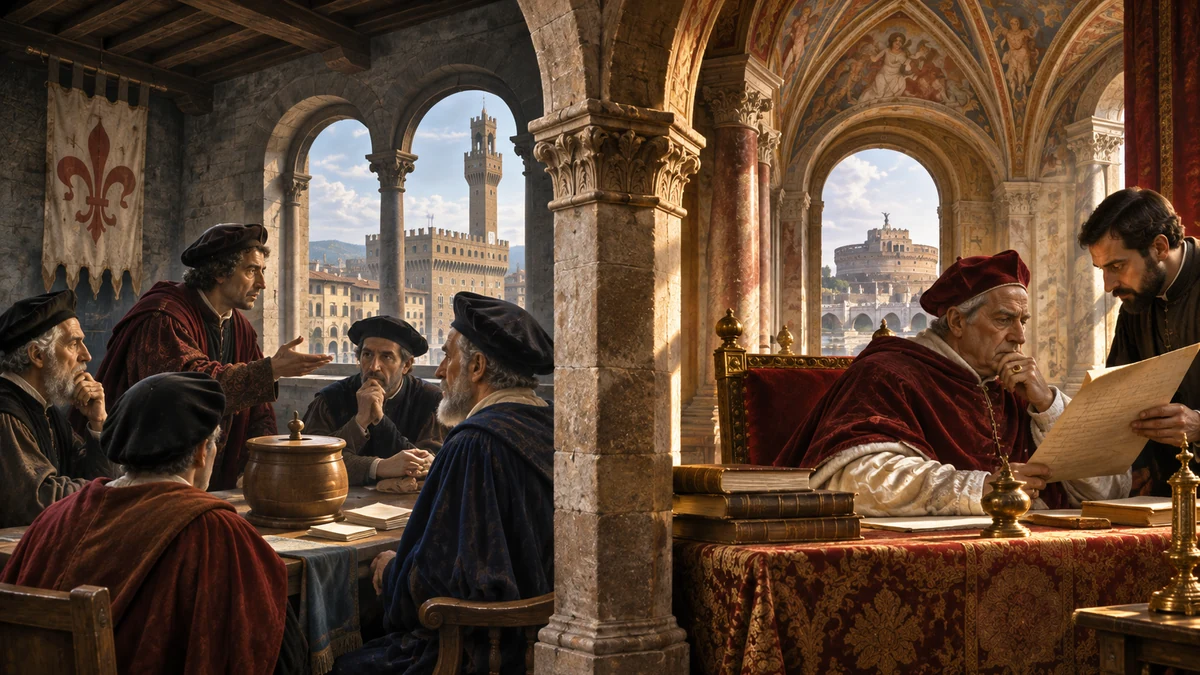
Interpretive illustration of two different routes to Renaissance power; it does not depict a documented joint meeting.
In Renaissance Florence, the republic could retain its councils, magistrates and procedures for selecting officials even as decisive political influence became concentrated around one family. In Rome, the situation was different: the pope was both a religious leader and the ruler of a territorial state, and his family connections had direct diplomatic and military consequences. The stories of the Medici and the Borgias do not establish the existence of a single secret organization. Together, however, they reveal how personal trust, financial resources, public offices and kinship alliances can be turned into power that official titles alone cannot explain.
In both families' histories, we can investigate identifiable individuals, institutions, financial relationships and political decisions. At the same time, we must distinguish documented events from later legends that transformed Renaissance politics into a story of almost supernatural family power. [1][2][10]
Two Families, Two Different Paths
The Medici rose to prominence in the commercial and banking republic of Florence. Their political power in the fifteenth century was predominantly de facto, rather than legally hereditary. Cosimo de' Medici and his successors influenced coalitions, the selection of officeholders, diplomacy and patronage, while the city outwardly retained its republican system. Historian Nicolai Rubinstein sees this not as the simple replacement of a republic by a monarchy, but as the gradual formation of a system of influence within existing constitutional rules. [1]
The Borgias present a different case from the same period. One of their power bases was the papal curia, where senior ecclesiastical offices brought diplomatic contacts, revenues, prestige and access to secular rulers. The Borja, or Borgia, family produced Popes Callixtus III (1455–1458) and Alexander VI (1492–1503). Yet the papacy was not an inherited family crown, and the personal interests of a particular pope cannot be taken as evidence of the actions of every member of the Church. [8][15]
This distinction is essential to the question of hidden power. In Florence, a family extended its influence over selection procedures within a restricted circle of citizens eligible for public office. In Rome, a family could use a supreme office already obtained to strengthen the position of its relatives. In both cases, the task is to investigate the mechanism, rather than substitute a mysterious family name for evidence.
Money as an Entry Point into Political Relationships
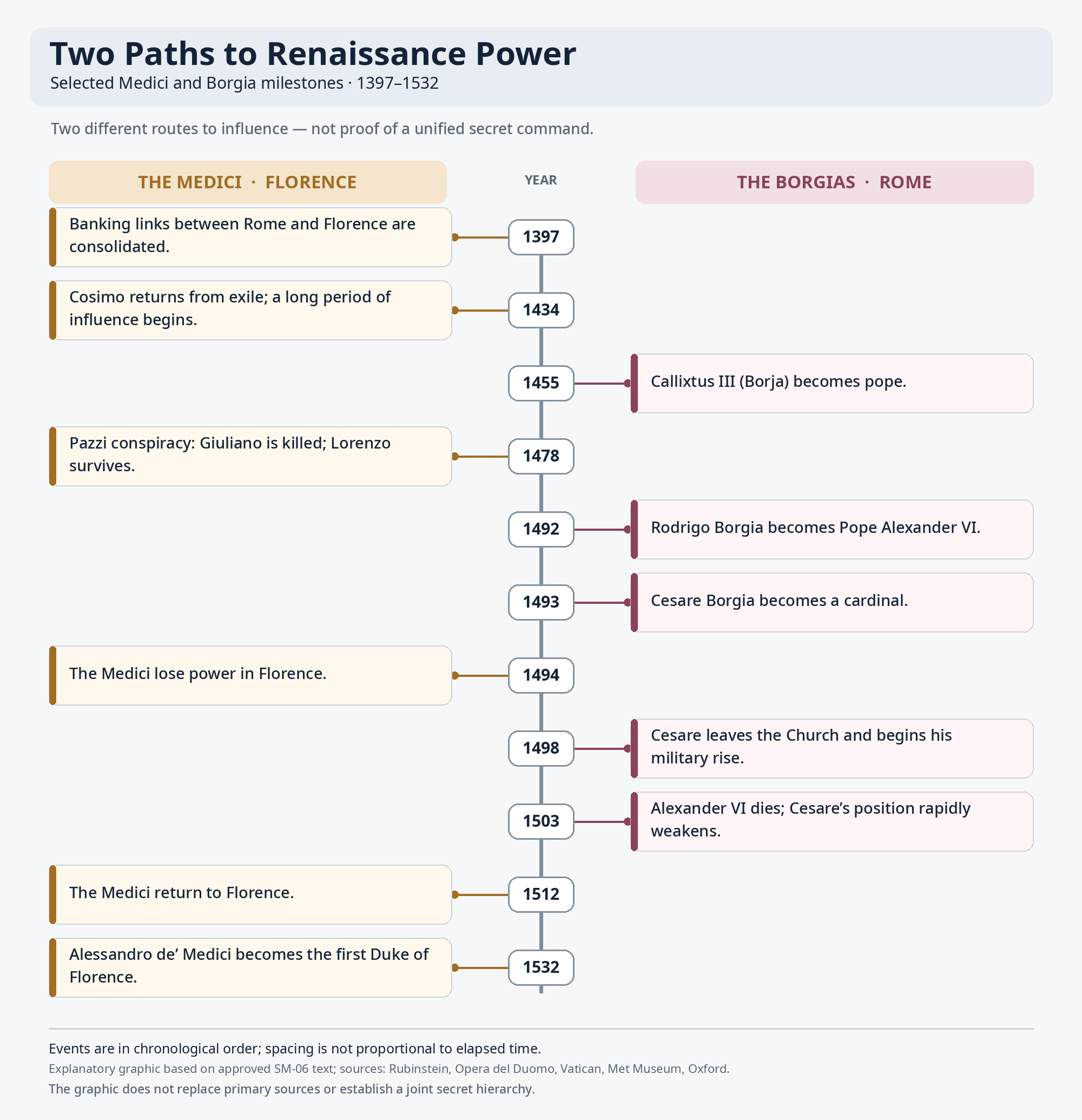
The rise of the Medici was closely tied to banking. In the late fourteenth century, Giovanni di Bicci de' Medici consolidated banking activities connected with Rome and Florence. Heinrich Lang identifies 1397 as the founding year of an important Roman banking enterprise; in reconstructing that history, however, we must distinguish operations in Rome, the Florentine headquarters and later separate partnerships. The Medici Bank became an important financial intermediary for the papal administration. That position opened business and personal connections with the curia, while also exposing the enterprise to credit risks, competition and political change. [3]
Surviving account books offer a revealing glimpse. The University of Pennsylvania's collections hold a manuscript, Oversize Ms. Codex 1321, recording Alamanno de' Medici's income, expenses and loans between 1465 and 1494, including dealings with other Florentine families. Another manuscript, Ms. Codex 1435, describes family assets and their management between 1456 and 1495. These catalogue descriptions establish the existence of concrete economic connections; they do not, on their own, reveal secret political orders or the consequences of any particular loan. Nor should the private accounts of family members be equated with the entire operation of the Medici Bank. [4][5]
This boundary can easily be overlooked when investigating influential families. A loan is not in itself a political bribe, and providing banking services to the papal administration is not proof of controlling the pope. But when commercial relationships intersect with control over the selection of public officials, the research question changes: who obtained political office, who gained economically, and what documented connection explains those gains?
A Republic in Which Power Became Concentrated
In 1433, Cosimo de' Medici's Florentine opponents had him arrested and secured his exile. The following year, the political balance shifted and Cosimo returned. Arthur Field treats this period as a conflict between oligarchic factions and two successive political upheavals, not as one family's peaceful and inevitable rise. [2]
Florentine government did not operate through a simple direct election resembling a modern parliament. The successive stages of determining eligibility for office, selecting candidates and drawing names by lot meant that influence over the pool of candidates could also shape the composition of public bodies. Medici dominance therefore did not require the abolition of every republican institution. What mattered was who could steer those institutions, who had access to office and which groups benefited from political power. [1][12]
Economists Marianna Belloc, Francesco Drago, Mattia Fochesato and Roberto Galbiati investigated this mechanism using historical data on political appointments, wealth and group affiliation. In their study's abstract, they report that the family influenced the distribution of offices and that political participation under its regime became a source of individual wealth accumulation; they specifically examined benefits to the wealthiest. They interpret this as institutional capture and the extraction of private benefits from public office. This is an important empirical analysis, not proof of wrongdoing by every political ally of the Medici. [12]
Power can thus be concealed within the rules of selection without every stage of the process being secret. The question is not merely who sits in the council chamber, but who drew up the list of people who could enter it in the first place. At the same time, such a system was not invincible: political opposition existed, and the Medici lost power more than once.
When a Conspiracy Was Real: 1478
On Easter Sunday, 26 April 1478, conspirators attacked the Medici brothers in Florence Cathedral. Giuliano was murdered, while Lorenzo survived. The Pazzi conspiracy is one case in which the word conspiracy does not merely describe later speculation. There were participants, a political objective, a prepared plan and an actual violent attack. Florence's Opera del Duomo cites Giovanni da Montesecco's confession of 4 May 1478 among the important accounts. For this article, that reference has been checked against the museum's description, not against a directly examined transcript of the confession. [6]
Yet the reality of the conspiracy does not make every later allegation about it true. Influential members of other Florentine and Italian families were involved, and political antagonisms also reached the papal sphere. Pope Sixtus IV's role in the broader political conflict and any advance knowledge he may have had of the planned murders are not the same claim. They must not be collapsed into a single unequivocal conclusion without separate evidence. [6]
The failed attack was followed by violent reprisals, including lynchings and executions of conspirators or their supporters. The event showed that alliances, rivalries and a willingness to use political violence existed behind seemingly ordinary institutions. It is also a reminder that investigating genuine operations behind the scenes calls for stricter, not looser, standards of evidence.
Ficino: Patronage, Hermeticism and a Supposed Secret Academy
The Medici did not invest only in business and politics. Among those they supported was the philosopher Marsilio Ficino, who studied Plato and Hermetic writings and had an important influence on European Renaissance thought. Cosimo's support was material and identifiable. In a letter from 1462, Ficino referred to activity at Careggi; in 1463, he received land and a house from Cosimo. This latter detail rests on a deed cited in modern scholarship. [7]
It is precisely here that a historical fact is often transformed into a much broader hypothesis. The phrase Platonic Academy suggests a formally structured institution with internal rules, regular meetings and perhaps even secret membership. Christopher S. Celenza, writing in the Stanford Encyclopedia of Philosophy, cautions that the surviving evidence is insufficient to reconstruct such an institution. The sources attest to patronage, philosophical contacts and at least one gathering in a Medici setting; they do not establish the existence of a permanent, formal secret organization. [7]
This does not diminish Ficino's importance or the influence of the Hermetic tradition. It does show that the spread of philosophical ideas is not the same as proof of an organizational hierarchy. To claim that an uninterrupted secret political structure emerged from the Medici circle, we would need an entirely different kind of evidence: founding documents, membership lists, internal instructions and demonstrable institutional succession.
The Borgias: Ecclesiastical Office as a Family Political Opportunity
Long before his election as pope, Rodrigo Borgia held a senior position in the papal administration. K. E. Fellows's doctoral research, summarized in the University of Oxford repository, examines his service as papal vice-chancellor from 1457 to 1492, his relationships with cardinals and popes, and his patronage in Rome and ties to the Iberian royal courts. Such a network was part of the public and private politics of the Renaissance curia: recommendations, favors, diplomacy and reciprocal obligations could generate lasting influence. [10]
When Rodrigo became Pope Alexander VI in 1492, his office offered his family still greater opportunities. As pope, he was not merely a religious authority but also a central figure in the temporal government of the Papal States. He used his position for political arrangements, appointments and support for relatives. Understanding such politics does not require us to posit a unified occult command structure: access to an institution whose jurisdiction extended beyond a single country's borders was already decisive. [8][10][11]
Borgia power was not without rivals. Renaissance Italy was a landscape of conflict among city-republics, duchies, royal houses, the Papal States, and French and Spanish interests. Marriages, ecclesiastical offices, diplomatic missions and military alliances were therefore important tools of family politics, not guarantees of lasting rule. [10][11]
Cesare: How Far Can Power Dependent on a Father Reach?
Cesare Borgia was made a cardinal in 1493, but in 1498 he left his ecclesiastical career behind and pursued military and territorial ambitions. He used alliances with France and conflicts among Italian rulers to consolidate his position in Romagna. His career clearly illustrates how personal ability, military force and family protection can reinforce one another without necessarily producing an enduring state system. [11]
Niccolò Machiavelli discussed Cesare's rise at length in Chapter VII of The Prince. What matters for this investigation is that Machiavelli distinguishes between obtaining power through the support of others and being able to retain it after that support disappears. He describes Cesare as a ruler who acquired most of his territorial power during his father's pontificate and lost it after his father's death. But The Prince is a political treatise in which the author selects examples to advance his own argument; it is not an independent judicial account of every action Cesare took. [13]
When Alexander VI died in 1503, Cesare's position deteriorated rapidly. This reversal runs counter to the image of an all-powerful and untouchable family network. Family access to a crucial office brought exceptional advantages, but also created dependence on one particular person, his alliances and the wider political balance. [11][13]
Lucrezia: A Diplomatic Link and the Later Black Legend
Lucrezia Borgia mattered to family politics through her marriages and connections with other Italian ruling houses. Her marriages into the Sforza family, the Aragonese dynasty of Naples and the Este family were part of the period's diplomacy. It would therefore be inadequate to portray her solely as a passive figure; equally, descriptions of family strategies do not justify assuming that she personally decided every consequence of those strategies. [14]
Later tradition associated her name with the image of a poisoner and allegations of incest and other family scandals. National Geographic History describes how such rumors spread in a hostile political environment and in later popular culture; the account used here does not substantiate them as proven acts committed by Lucrezia herself. This does not establish that every historical accusation against the Borgias was false, nor does it excuse violence that is genuinely documented. Every specific allegation requires its own sources and independent assessment. [14]
This story also matters to Hidden Power because it reveals another kind of influence: power over reputation. Political opponents can combine real family connections, public scandals and unverified rumors into a narrative that survives for centuries. Readers may inherit such a narrative as “common historical knowledge” without knowing which parts rest on documents and which on polemic.
When a Republic Becomes a Duchy — and a Family Network Falls Apart
After Lorenzo the Magnificent died in 1492, the Medici political order entered a crisis. Two years later, the family lost power in Florence. The Medici returned in 1512, and the family subsequently produced Popes Leo X (1513) and Clement VII (1523). An attempt to restore the republic followed in 1527–1530, ending with the city's siege; in 1532 Alessandro de' Medici became Florence's first duke. This sequence matters: the de facto control of republican politics in the fifteenth century and the later formal ducal rule were not the same form of government. [9]
The Borgias established no comparably stable succession of the Florentine kind. The outcome of Cesare's attempt at territorial expansion exposed the limits of a dynasty whose standing depended particularly heavily on Alexander VI's papal office. It is therefore not historically justified to claim that the two families directed Italy's fate through one uninterrupted, shared secret hierarchy. Such a claim would require independent evidence of common instructions, membership, authority and long-term organizational continuity—evidence the sources considered here do not provide. [1][11][13]
Both histories show that family wealth and office can create extraordinary opportunities without necessarily guaranteeing loyalty, political stability or hereditary success. Wars, rival coalitions, urban institutions and changes in the highest offices could sever even exceptionally influential connections.
What Do These Examples Really Tell Us About Hidden Power?
The Medici show how public republican institutions can survive while informal relationships and appointment procedures are reshaped to benefit a powerful network. The Borgias show how the papal office, personal patronage, marriage alliances and military policy can produce a family's rise beyond ordinary private wealth. In both cases, political networks can be investigated historically, but that does not make them identical to a secret initiatory order.
Two extremes are dangerous when studying the history of power. The first is to deny real personal and family networks simply because formal institutions continue to operate. The second is to turn every kinship or financial connection into evidence of one all-encompassing secret conspiracy. Between them lies a more demanding field of inquiry: named individuals, verified offices, documented relationships, measurable consequences and explicitly acknowledged gaps in the evidence.
The question of who governs is therefore often inseparable from who can choose those who will govern—and who benefits from their rule. An equally important question is accountability: we judge the particular people who wield power for particular acts, not every member of a family, religion or community.
Sources and further reading
- Nicolai Rubinstein (1997). The Government of Florence Under the Medici (1434 to 1494). Oxford University Press. source (publicly available book summary consulted). Source
- Arthur Field (2017). “The Political Collapse of the Oligarchic Regime, 1426–1434.” In The Intellectual Struggle for Florence. Oxford University Press. source (chapter abstract consulted). Source
- Heinrich Lang (2022). “Medici Bank.” Oxford Bibliographies in Renaissance and Reformation. source (introductory bibliographic synthesis consulted). Source
- University of Pennsylvania, Kislak Center / FromThePage. Oversize Ms. Codex 1321: Ledger of Medici accounts (1465–1494). source (manuscript description; individual folios not read). Source
- University of Pennsylvania, Kislak Center. Oversize Ms. Codex 1435: Ledger of Medici accounts and memoranda (1456–1495). source (manuscript catalogue description consulted). Source
- Opera di Santa Maria del Fiore, Florence. “The Pazzi conspiracy.” source (museum's historical overview and reference to Montesecco's confession). Source
- Christopher S. Celenza (2024). “Marsilio Ficino.” Stanford Encyclopedia of Philosophy, Summer 2024. source (especially §1, including the letter and deed of 1462–1463). Source
- Holy See. “Alexander VI.” Official chronology of the popes. source. Source
- Metropolitan Museum of Art. “The Medici and Florence, 1513–37.” The Medici: Portraits and Politics, 1512–1570, exhibition material. source. Source
- K. E. Fellows (2020). The Long Apprenticeship: Rodrigo Borgia as Papal Vice-Chancellor, 1457–1492. Doctoral dissertation, University of Oxford. source (dissertation abstract consulted). Source
- Stella Fletcher (2018; updated version 2022). “Cesare Borgia.” Oxford Bibliographies in Renaissance and Reformation. source (bibliographic introduction consulted). Source
- Marianna Belloc, Francesco Drago, Mattia Fochesato and Roberto Galbiati (2022). “Wealth Accumulation and Institutional Capture: The Rise of the Medici and the Fall of the Florentine Republic.” CEPR Discussion Paper 17456. source (published working-paper abstract consulted). Source
- Niccolò Machiavelli. The Prince, Chapter VII: “Concerning New Principalities Which Are Acquired Either By The Arms Of Others Or By Good Fortune.” Accessible English translation: source (a primary historical author's commentary, not a neutral chronological record). Source
- Josep Palau i Orta (2017). “Lucrezia Borgia, Predator or Pawn?” National Geographic History. source (secondary historical overview; caution regarding legends). Source
- Holy See. “Callixtus III.” Official chronology of the popes. source. Source