When Power Is Inherited
Heirs inherit more than wealth: connections, reputation and political advantages can endure. When does a family network become a lever of power?

Editorial illustration of the intergenerational transfer of social connections; no particular people or institutions are depicted.
When an influential person dies, their heirs may inherit houses, businesses, land or shares. But the advantages of belonging to a family are not limited to an estate. A recognizable surname, access to influential people, experience of how power works, and a place in a network of relationships built over decades may all be passed on much earlier. Where public offices are not hereditary, these advantages do not necessarily disappear. They may simply take another form.
This is the starting point for the second section of the Hidden Power series. We are not asking whether every descendant of an influential family is part of a secret plan. We are asking how social influence can endure across generations, which institutions carry it forward, and where documented connections end and unproven assumptions begin. Before examining the Medici, royal dynasties, industrial families and contemporary elite circles, we need to distinguish the different meanings of inheritance.
Inheriting Power Does Not Always Mean Inheriting Office
Under traditional dynastic succession, family relationships are legally linked to the right to hold a position. Succession to the British Crown is a contemporary example: rules determine the order of succession, and a 2013 law removed the preference for one sex over the other for people born after 28 October 2011. The relevant provision came into force on 26 March 2015. This is a public, legally regulated form of succession, not evidence of a covert network. [1]
Things are different in a republic such as the United States. Article I of the US Constitution sets out the composition of Congress and prohibits both the federal government and individual states from granting titles of nobility. A congressional seat cannot be legally inherited like land or a title. Yet the constitutional prohibition on titles of nobility does not, by itself, prevent members of the same family from standing for office. [2] That raises another question: why do some candidates enter a race with an established circle of supporters, a recognizable surname and experience that others find much harder to acquire?
The distinction is fundamental. Formal succession means that a rule connects family membership to entitlement to a particular office. Informal transmission of advantage means that a relative does not receive the office by law but may inherit circumstances that improve their chances of obtaining it. This is not, in itself, evidence of unfairness, still less of a conspiracy. It is a phenomenon that can be studied using historical documents and data on social mobility, elections and networks.
What Is Passed On When Influence Is Passed On?
Money is the most visible source of advantage, but not the only one. Wealth can give the next generation time, security and the means to pursue education, a political campaign or a career in which early success is uncertain. A family environment can also transmit knowledge: how public institutions operate, how to negotiate, who makes decisions and which rules apply in influential circles. A family name's reputation may inspire confidence or suspicion before a first meeting has even taken place. None of these factors constitutes power on its own, but together they can change an individual's starting position.
In The Forms of Capital, sociologist Pierre Bourdieu distinguished several forms of capital and discussed social capital in particular: resources associated with durable relationships and membership in a network. Such connections are not created by personal goodwill alone; maintaining them often requires contact, mutual recognition and the investment of time. His account is a theoretical tool for understanding advantage, not empirical proof that any particular family controls a state. [3]
Different kinds of advantage can also be converted into one another. Wealth can make education possible; education can lead to new acquaintances; acquaintances can open doors to institutions; and reputation can help attract support. But none of this is guaranteed. Heirs can fall out with one another, business houses can collapse, public trust can evaporate, and rivals can win. If we want to describe a genuine transfer of power, we must demonstrate a specific mechanism rather than merely point to several successive generations with a familiar surname.
Florence: A Family Can Lead a Republic Without a Crown
The history of the Medici provides an early, well-studied example of this distinction. The family's wealth grew through commerce and banking. In 1434, after a period of exile, Cosimo de’ Medici the Elder returned to Florence and became the de facto leader of the city's politics. The republic did not simply disappear. Its institutions remained, but the family gradually consolidated its dominance within them. London's National Gallery also describes the succession of Cosimo's son Piero and grandson Lorenzo. [4]
Historian Nicolai Rubinstein emphasizes that between 1434 and 1494 the Medici did not rule by virtue of special formal political rights unavailable to other prominent citizens. Their authority took shape within a republican system, through a complex pattern of influence and amid continued opposition. Only later did this power assume an explicitly dynastic and legal form: Alessandro de’ Medici became duke in 1532, and in 1569 the dynasty's rule in Tuscany was elevated to grand-ducal status. [5][6]
This case matters precisely because there is no need to explain it by invoking an unproven, all-encompassing secret organization. The documented mechanisms are wealth, alliances, political institutions and family succession. Banking networks, court connections and cultural patronage belong in the more detailed SM-06 dossier. Any possible ties to scholarly or initiatory circles would likewise require separate verification; this article does not establish that such ties existed. Here the Medici serve primarily as a historical bridge between de facto and formal power.
Can a Political Dynasty Emerge Through Elections?
In a democracy, the successor of an influential politician formally stands as one candidate among others. That does not mean that everyone starts from the same position. In Political Dynasties, published in 2009, Ernesto Dal Bó, Pedro Dal Bó and Jason Snyder examined the history of political dynasties in the US Congress. Their central question was not simply how many politicians had relatives in office, but whether serving in office for longer itself increased the likelihood that relatives would subsequently enter Congress. [7]
To distinguish, as far as possible, the advantage conferred by holding political office from more persistent family characteristics, the authors compared, among other cases, politicians who narrowly won or lost their first reelection contest. In a subsample of members of the House of Representatives who won or lost that contest by a margin of less than 2.5 percentage points of the vote, 8.2 percent of narrow winners (267 people in that group) and 3.6 percent of narrow losers (253 people in that group) subsequently had relatives in Congress. The comparison appears in Table 2 on page 125. The limitations are essential: these are historical US data concerning legislators born before 1910, without earlier relatives in Congress, and subject to additional selection criteria. The figures therefore do not mean that the same proportion of all elected politicians today will establish a dynasty. [7]
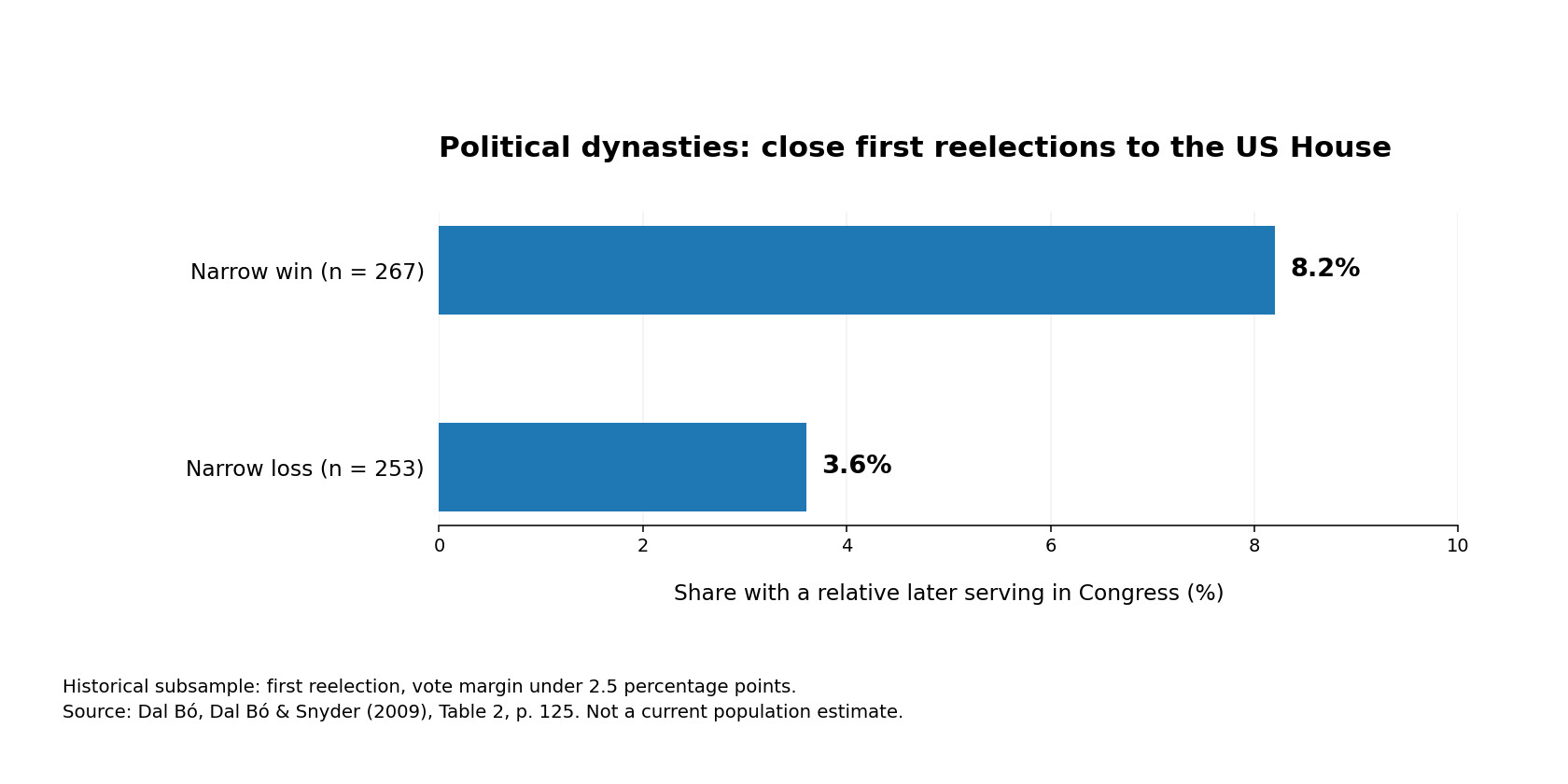
The study supports the interpretation that holding political office can itself create advantages for future relatives. It does not show that every instance of family succession results from nepotism, nor does it identify every channel through which the advantage arises. Possible channels include organizational support, reputation, public recognition and many other circumstances whose relative importance must be tested separately.
Brian D. Feinstein examined one such channel. In an analysis of elections for open seats in the US House of Representatives between 1994 and 2006, he found that candidates from political dynasties benefited from their family names being recognizable. His analysis did not support the explanations that their advantage stemmed primarily from prior political experience or fundraising ability. This is a separate study, based on a different sample, which complements rather than duplicates the findings of Dal Bó and his colleagues. [8]
A Family Network Can Also Serve as Electoral Infrastructure
Kinship operates not only vertically, from parents to children, but also horizontally, through marriage, relatives and other personal ties. In Politician Family Networks and Electoral Outcomes: Evidence from the Philippines, Cesi Cruz, Julien Labonne and Pablo Querubín analyzed family networks constructed from data on more than twenty million people across approximately fifteen thousand villages in the Philippines. They found that candidates were more likely to come from families occupying more central positions in these networks, and that such positions were associated with higher vote shares. These findings could not be explained solely by wealth, historical elite status or previous electoral success. [9]
The study concerns specific local family networks, not a secret international hierarchy of bloodlines. In a preliminary version published in 2015, the authors also discuss the organizational and logistical benefits of such ties, including the possibility of clientelistic political exchanges. A network of this kind can help a candidate reach voters, distribute tasks and organize support. Whether any particular conduct constitutes legitimate political organization, an improper benefit or a criminal offence is a separate question that network statistics alone cannot settle. [9]
The OECD's 2018 report A Broken Social Elevator? provides a wider social context. It finds limited intergenerational mobility in several areas and the persistence of advantages near the top of the social hierarchy. This is important background, but the report does not directly measure the inheritance of public political office and must not be treated as evidence of the operation of any particular dynasty. [10]
When Does a Connection Become Covert Power?
A historical family, a private society, a family business and a political party may operate through similar human relationships, but they are not the same kind of institution. A family involved in public life is not necessarily a secret society. Personal acquaintance does not prove control; an invitation to a meeting does not prove that orders are being issued; and membership in a club does not establish a shared political agenda. A documented connection is the beginning of a research question, not its final answer.
To substantiate a claim of nepotism, we would need to show that a relative received an unjustified advantage because of kinship in hiring, an appointment or another decision. To substantiate a conflict of interest, we would have to identify the person, their public duty, their private interest and the conduct that brought the two into conflict. To substantiate covert coordination, we would need traceable agreements, communications, joint decisions or other relevant evidence. Covert influence can be real and historically documented, but a surname or family tree is no substitute for proof of it.
The same applies to popular narratives about secret bloodlines. A genealogy may establish a family relationship; it does not automatically establish ideological loyalty, coordinated political action or inherited guilt. If a particular claim rests on an alleged uninterrupted secret order, it must be checked period by period, member by member and document by document. Before we can decide whether a narrative is true, we must clarify what could actually be demonstrated and what a given piece of evidence would mean.
The Limits of Inherited Advantage — and the Question of Accountability
Several generations of influential people sharing a surname may raise serious questions about equality of opportunity. That alone does not mean that their descendants lack ability or that voters acted against their own wishes. Some successors follow a family path; others reject it. History records both the consolidation and the collapse of dynasties, exiles, losses of wealth and decisions that interrupt an expected succession. That is precisely why it matters more to investigate actual channels through which power is passed on than to assume that a family name determines a person's fate.
We must also distinguish the right to private life from the duty of public accountability. People have a right to family, friendship and association. When those relationships affect the allocation of public funds, public appointments or decisions about rules that apply to everyone, transparency becomes a legitimate public concern. Criticism should focus on acts, decisions, procedures and institutions, not on supposedly innate moral qualities attributed to family origin.
This is also the ethical core of the investigation of hidden power. If we want to understand authority, we must not confuse scrutiny of unjust structures with collective condemnation of individuals. Equal human dignity remains valid even when we confront genuine abuses of power. The response to opaque authority is not renewed blind faith in genealogies, but verifiable facts, public accountability and the ability to distinguish evidence from suspicion.
From Mechanisms to Families
Power can therefore be inherited in several senses: through legally prescribed succession, through wealth, through social networks, through reputation and through access to institutions. These mechanisms can reinforce one another, but they are not identical. None of them, on its own, proves the existence of a single global secret hierarchy. At the same time, the absence of such proof does not erase real, documented cases of concentrated and abused power.
In the next installment, “Medici and Borgia: Families Behind the Thrones”, we will apply this general framework to Renaissance Italy: where family wealth, ecclesiastical positions, political offices and private alliances meet — and which of these links can be verified in the historical record.
Documentary sources and archive links
These links lead to documents, archival records or photographs hosted by their original source institutions.
Sources and further reading
- United Kingdom. Succession to the Crown Act 2013, c. 20, §1; official statutory text; §1 in force since 26 March 2015. source Source
- US National Archives. The Constitution of the United States: A Transcription, Article I, §§2–3 and 9–10. source Source
- Bourdieu, Pierre (1986). “The Forms of Capital.” In John G. Richardson (ed.), Handbook of Theory and Research for the Sociology of Education, Greenwood, pp. 241–258, especially pp. 248–251. source Source
- National Gallery, London. The Medici family, institutional historical overview. source Source
- Rubinstein, Nicolai (1997). The Government of Florence Under the Medici (1434 to 1494). Oxford University Press; the published bibliographic summary was consulted, not the entire monograph. source Source
- Scuola Normale Superiore. The Medici Dynasty, historical overview on the Piazza dei Cavalieri portal. source Source
- Dal Bó, Ernesto; Dal Bó, Pedro; Snyder, Jason (2009). “Political Dynasties.” Review of Economic Studies 76(1), pp. 115–142, especially Table 2 on p. 125. source; accessible PDF: source Source
- Feinstein, Brian D. (2010). “The Dynasty Advantage: Family Ties in Congressional Elections.” Legislative Studies Quarterly 35(4), pp. 571–598; publisher's abstract consulted. source Source
- Cruz, Cesi; Labonne, Julien; Querubín, Pablo (2017). “Politician Family Networks and Electoral Outcomes: Evidence from the Philippines.” American Economic Review 107(10), pp. 3006–3037. source. The authors' 2015 working-paper version of the same study, not an independent study, was also consulted for its account of methods and local elections: source Source
- OECD (2018). A Broken Social Elevator? How to Promote Social Mobility. OECD Publishing; official summary consulted. source Source