Second Temple Judaism: The World from Which Rabbinic Judaism and Christianity Emerge
Second Temple Judaism was not one uniform tradition but a plural world of Temple, Torah, diaspora, sects, apocalyptic expectation and empire, from which rabbinic Judaism and Christianity gradually emerged after 70 CE.
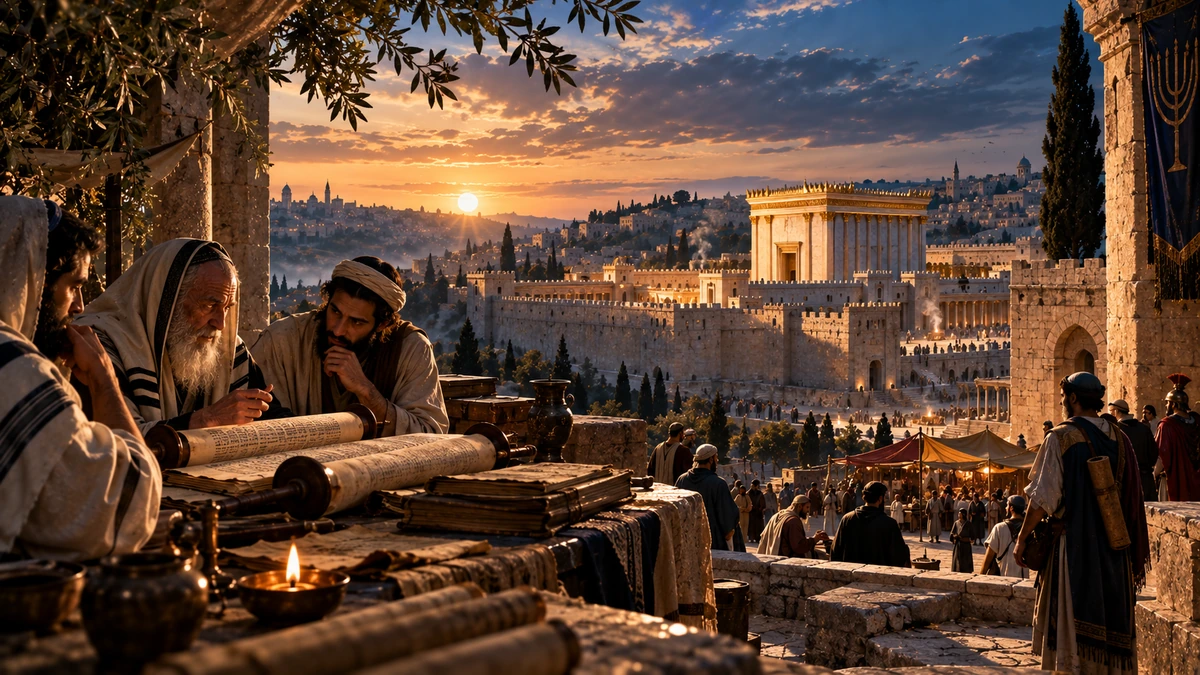
Second Temple Judaism is often viewed through two later traditions: rabbinic Judaism and Christianity. That is understandable, but historically dangerous. A person living in Jerusalem, Alexandria, Galilee or by the Dead Sea in the first century BCE did not inhabit a world in which those two later religious forms had already been fully defined. They lived within a diverse Jewish world whose communities shared devotion to the one God, Torah and Israel's distinctive history while disagreeing sharply over the Temple, priesthood, calendar, purity, interpretation of law, resurrection, angels, messianic expectation and relations with foreign power.
The Second Temple period is conventionally framed from the restoration of the Jerusalem Temple in the late sixth century BCE under Persian rule to its Roman destruction in 70 CE. Across those centuries Persian, Hellenistic, Hasmonean, Herodian and Roman political orders followed one another. Jewish communities lived both in Judaea and across a large diaspora, used Hebrew, Aramaic and Greek, and developed different ways of remaining faithful to inherited tradition in an imperial world.
this article therefore does not look for one 'true' version of Second Temple Judaism. It asks what historical world made it possible for rabbinic Judaism and Christianity to emerge from it later, without treating either as the only inevitable conclusion of the earlier period.
This also matters for the study of authority. Institutions often project their present form backward and create the impression that history was always moving toward them. The Second Temple age was instead a period of dispute, adaptation, resistance and multiple possible futures. History is not required to validate a later monopoly over what the 'true' faith had supposedly always been.
The Second Temple did not mean one single Judaism
The phrase 'Second Temple Judaism' is useful only if it is not mistaken for the name of one uniform religion. The Israel Antiquities Authority, in presenting the Dead Sea Scrolls, explicitly stresses the diversity and complexity of Jewish religious life in this era. Josephus describes Pharisees, Sadducees and Essenes as different 'philosophies', but even his classification is not a complete map of society: priestly circles, apocalyptic movements, local communities, scribes, revolutionary currents and Jews with no formal sectarian affiliation also existed.
Shared foundations nevertheless mattered: the God of Israel, Torah, circumcision, Sabbath, festivals, the memory of the Exodus, Jerusalem and the Temple formed a powerful framework of identity. Yet a shared text does not generate one interpretation. Disputes over how the Law should be lived, who possessed legitimate priestly authority and how the calendar should be ordered show that internal plurality was real, not a modern invention.
It is therefore anachronistic to take later rabbinic norms or later Christian theology and use them as the measure of all first-century Jews. Their own world has to be reconstructed first.
The Temple was the center — but not the whole religious landscape
The Jerusalem Temple was the central institution of the Second Temple age: the location of sacrifice, priesthood, pilgrimage and the great festivals. Even groups that condemned the existing Temple administration often did not reject the ideal of the Temple itself. Qumran texts could regard the contemporary priesthood as corrupt while elaborating detailed visions of a properly ordered Temple and pure cult. Criticism of an institution is not the same thing as rejection of the sacred reality that institution claims to represent.
Jewish life, however, was not limited to sacrificial worship. Synagogues, Torah reading, prayer, communal meals, charity and local legal-religious life created religious infrastructure far from Jerusalem as well. The synagogue's origin is not as simple as textbook narratives sometimes suggest; the Cambridge History of Judaism cautions that the popular story of its creation in the Babylonian exile as a direct 'replacement for the Temple' lacks direct ancient documentation.
That matters for 70 CE: the destruction of the Temple was a catastrophic rupture, not the instant invention of a religion capable of living without it. Some structures that enabled post-Temple life already existed.
Empires were not merely the background to theology
The Second Temple stood through a succession of empires. After Persian rule, Alexander's conquest opened the long Hellenistic age; Judaea passed between Ptolemaic and Seleucid control, the Maccabean revolt eventually produced a Hasmonean state, and Pompey brought Judaea into the Roman political order in 63 BCE. Herod ruled as a Roman client king and rebuilt the Temple complex on a monumental scale.
The history is therefore not a simple story of 'pure Judaism versus Greek influence'. Greek language, Hellenistic political forms, architecture and philosophical vocabulary became part of the environment even for Jews who remained deeply committed to Torah. Philo of Alexandria is the clearest example: a Jewish interpreter of Scripture reasoning in the language of Greek philosophy. The Hasmoneans themselves, born from resistance to the coercive policies of Antiochus IV, later used Hellenistic political and cultural forms.
Cultural exchange did not erase coercion. Empire could tax populations, install or remove political and priestly leaders, and crush rebellion militarily. Political power does not have to rewrite every doctrine in order to penetrate the sacred; controlling institutions, appointments, money and punishment can be enough.
Torah was a shared axis; its interpretation was contested territory
Nearly all major Jewish groups appealed to Torah, yet they disagreed over its proper interpretation. Pharisaic traditions emphasized interpretive practice and the application of law to ordinary life; Sadducean elites were more closely associated with Temple and priestly power; communities reflected in the Dead Sea Scrolls developed their own rigorous rules, calendar and purity interpretations. Josephus also presents disagreements over providence, human freedom and the afterlife.
The Dead Sea Scrolls further show that even 'Scripture' was not yet a simple closed book collection in the modern sense. Manuscripts of almost every later book of the Hebrew Bible appear alongside Jubilees, Enoch, community rules and other works that some groups clearly valued highly. Multiple textual forms of individual scriptural books also circulated.
This extends the “How Do Sacred Texts Form? Oral Tradition, Redaction and Canon” rule: an authoritative text is not necessarily identical with a later closed canon, and shared Torah does not automatically imply one institutionally controlled interpretation.
Pharisees, Sadducees and Essenes were not three modern denominations
Josephus's triad of Pharisees, Sadducees and Essenes is useful, but it is dangerous to translate it into a modern model of three churches or political parties with clear membership rolls. Josephus writes for a Greco-Roman audience and deliberately presents them as 'philosophies'. His description is both a precious primary source and an authored representation.
He associates the Sadducees with elite circles and distinctive views of the afterlife; he attributes broad popular influence to the Pharisees and combines divine providence with human responsibility in their teaching; and he portrays the Essenes as disciplined communities with striking property, ritual and ascetic arrangements. The Dead Sea Scrolls have important parallels with ancient descriptions of Essenes, but contemporary scholarship is no longer simple enough to label every Qumran manuscript automatically 'Essene'.
The point is not to produce a perfect taxonomy but to see that political and religious authority were distributed in different ways. Temple office, popular influence, interpretive authority and separate communal discipline represented distinct forms of power.
Purity, resurrection, angels and the end of the age were not marginal topics
Late Second Temple Judaism was full of debates that later readers can mistakenly assign only to Christianity: resurrection of the dead, final judgment, angels and demons, future renewal of the world, messianic figures and apocalyptic expectation. Daniel, Enochic traditions, the Dead Sea Scrolls and other texts display a wide range of such ideas. Again, there was no single doctrine. Resurrection became an important and increasingly influential hope, not a belief shared by every Jew; Josephus attributes its rejection to the Sadducees.
Ritual purity was likewise not merely abstract theology. Archaeological evidence from immersion installations and stone vessels, together with literary sources, indicates that purity rules strongly shaped everyday practice in the late Second Temple era. Different groups, however, extended and interpreted those rules in different ways.
When later religions inherit concepts such as resurrection, messiah, judgment or ritual purity, they therefore do not receive them from a vacuum. They enter older Jewish debates and transform them.
The diaspora was not the periphery of 'real' Judaism
Large Jewish populations lived outside Judaea: in Babylonia, Egypt, Asia Minor, Syria, Rome and elsewhere. Diaspora was therefore not a late consequence of 70 CE but a basic reality of Jewish history centuries earlier. These communities could maintain strong connections with Jerusalem and the Temple while living in different linguistic and political environments.
Alexandria is the clearest case. Greek became a medium of Jewish thought and scriptural reading there; the Septuagint enabled Jewish writings to live in Greek, while Philo interpreted the Mosaic heritage through Platonic and Stoic concepts without understanding himself as having ceased to be Jewish.
This breaks down the false choice between 'Jewish' and 'Greek'. Identity in antiquity could be layered. That diaspora world later became one of the major environments through which the early Jesus movement spread.
The Jesus movement begins inside this Jewish world
Jesus of Nazareth, his first disciples and the earliest Jerusalem community did not enter history as adherents of an already formed religion called Christianity. They operated within the Jewish world of the first century: debating Torah, Temple, Sabbath, purity, resurrection, the Kingdom of God and messianic expectation. Even many conflicts narrated in the Gospels are intra-Jewish disputes, although the texts were written in periods when relationships were already changing.
This does not mean that later Christianity was simply 'one Jewish sect'. The movement opened rapidly to Gentiles, developed distinct communal and theological forms, and gradually created identities that could exist without full adoption of Jewish law. The process was neither linear nor identical everywhere.
Methodologically, it is therefore dangerous to read the first century through a later binary of 'Jews versus Christians'. At the beginning, a more accurate question is which Jews were disputing with other Jews over how to understand God, Messiah, Torah and the coming restoration of Israel.
70 CE was catastrophe and rupture — not a magic switch
The Roman destruction of Jerusalem and the Temple in 70 CE removed the institution around which sacrifice, priesthood and major pilgrimage had been organized for centuries. Jewish communities had to adapt profoundly. But finalized rabbinic Judaism did not appear the next morning, and every earlier current did not vanish in a single moment.
Older textbooks sometimes spoke of a 'Council of Jamnia/Yavneh' that supposedly organized Jewish orthodoxy after 70 or even closed the biblical canon. Modern scholarship is much more skeptical of that reconstruction. Rabbinic activity at Yavneh matters, but rabbinic authority and institutions developed gradually; the canon was not finalized by one vote in one town either.
The same applies to Christianity. After 70 the trajectories increasingly diverged, yet the 'parting of the ways' is not one date. Jewish and Christian groups overlapped, competed, polemicized and defined themselves against one another for a long period in late antiquity.
.jpg)
Two major later traditions emerge from one plural world
Rabbinic Judaism inherited Torah, legal argument, prayer, synagogue life, festivals, interpretive traditions and many older disputes from the Second Temple world, then reworked them into new systems of learning and practice after the loss of the Temple. Christianity inherited Hebrew scriptures, messianic language, apocalyptic expectation, belief in resurrection and the Jewish ethical-theological heritage from the same world, but reorganized them around Jesus and an increasingly Gentile majority.
Neither path was already written into the first century. Other Jewish communities and ways of life also existed, some later lost or poorly documented. Victorious canons and institutions can create the illusion that their predecessors were the only realistic possibility. this article resists that illusion: history was broader than the institutional memories that survived it.
Under a Natural Law standard the conclusion is straightforward. Sacred tradition does not become true because an empire, priestly elite, council or later majority stands behind it. Nor can it be dismissed merely because institutions later formed around it. The task is to distinguish faith, tradition and moral content from authorities that may claim the right to impose the only permitted interpretation. Second Temple history shows how dangerous it is to rewrite a plural past as one official story.
Sources and further reading
- Israel Antiquities Authority — Dead Sea Scrolls Historical Background: Second Temple Jewish life was diverse and complex; disputes concerned Temple, priesthood, calendar, afterlife, law and observance.
- Cambridge — Religion of Second-Temple Judaism: Temple-centered first-century Judaism, Torah, festivals, synagogue and eschatology; earliest Jesus followers arose within Jewish practice.
- Cambridge — Varieties of Second-Temple Judaism: common commitment to God and Torah coexisted with significant differences among groups including Pharisees, Sadducees and Essenes.
- Josephus, Antiquities XVIII: ancient description of Pharisees, Sadducees and Essenes and their differing views of fate, law and the afterlife.
- Josephus, Jewish War II: parallel ancient description of Pharisaic, Sadducean and Essene traditions.
- Israel Antiquities Authority — Dead Sea Scrolls Introduction: biblical and non-biblical literature, sectarian texts and scholarly caution regarding the identification of all Qumran material with one group.
- Israel Antiquities Authority — Scrolls Content: Yahad literature, apocalyptic expectation, law, calendar and diversity within the Qumran corpus.
- Israel Museum — Nature and Significance of the Dead Sea Scrolls: biblical, non-canonical and sectarian manuscripts from the Hellenistic-Roman period.
- Israel Museum — Versions and Translations of Isaiah: evidence for concurrent textual forms and the later rise of the proto-Masoretic tradition.
- Israel Museum — Temple Scroll: ideal Temple law and evidence that criticism of existing priestly arrangements could coexist with intense Temple idealization.
- Cambridge History of Judaism — The Temple and the Synagogue: Temple centrality, emergence of synagogues and caution against an overly simple exile-origin theory.
- Cambridge History of Judaism — Interpenetration of Judaism and Hellenism: complexity of Hellenization and the limits of a simple Judaism-versus-Hellenism binary.
- Cambridge Ancient History — Jews under Hasmonean Rule: Hasmonean state formation, internal conflict and Roman intervention.
- Cambridge History of Judaism — Hasmonean Revolt and Dynasty: political and religious transformation under the Hasmoneans.
- Metropolitan Museum — The World between Empires: Jerusalem, Herod, pilgrimage, Roman client kingship and the Second Temple landscape.
- Oxford/Yale — Ritual Purity, The Origins of Judaism: textual and archaeological evidence for widespread purity observance in late Second Temple Judaea.
- Oxford — Resurrection of the Dead in Early Judaism: resurrection as an emerging and contested Second Temple belief tied to divine justice.
- Cambridge History of Christianity — The Jewish Diaspora: diaspora as a formative feature of Second Temple Jewish history long before 70 CE.
- Cambridge Companion to Philo — Introduction: Philo at the intersection of Jewish biblical heritage and Greek philosophical culture in Alexandria.
- Cambridge History of Christianity — Social and Ecclesial Life of the Earliest Christians: the Jesus movement began as a Jewish sect and diversified rapidly in the Greco-Roman world.
- Cambridge Companion to the Apostolic Fathers — Image of Jews and Judaism: rabbinic Judaism and Christianity both trace back to diverse late Second Temple Judaism, with separation developing after 70 CE rather than in one instant.
- Cambridge History of Religions — Post-70 Judaism in Judea and the Near East: later rabbinic ritual, law, exegesis and liturgy developed across centuries after 70.
- Shaye J. D. Cohen — The Significance of Yavneh: challenges the older model of Yavneh as a single triumphalist council that imposed uniform orthodoxy and closed the canon.
- Timothy H. Lim, The Formation of the Jewish Canon — The Emergence of the Canon Reconsidered: re-evaluation of the old three-stage/Yavneh canonization model.
- Jason A. Staples, The Idea of Israel in Second Temple Judaism: identity and the boundaries of Israel were themselves contested throughout the period.