Sacred Geometry: between mathematics, architecture, and esotericism
Circles, squares, triangles, regular solids, geometric grids, and mandalas appear in mathematics, architecture, religious art, and modern esotericism. Yet the same shape does not imply the same doctrine. This article follows documented connections from Plato’s cosmology and Vitruvian proportion through Gothic and Islamic geometry to Buddhist mandalas, then examines how modern “sacred geometry” assembled different traditions into a new common language.
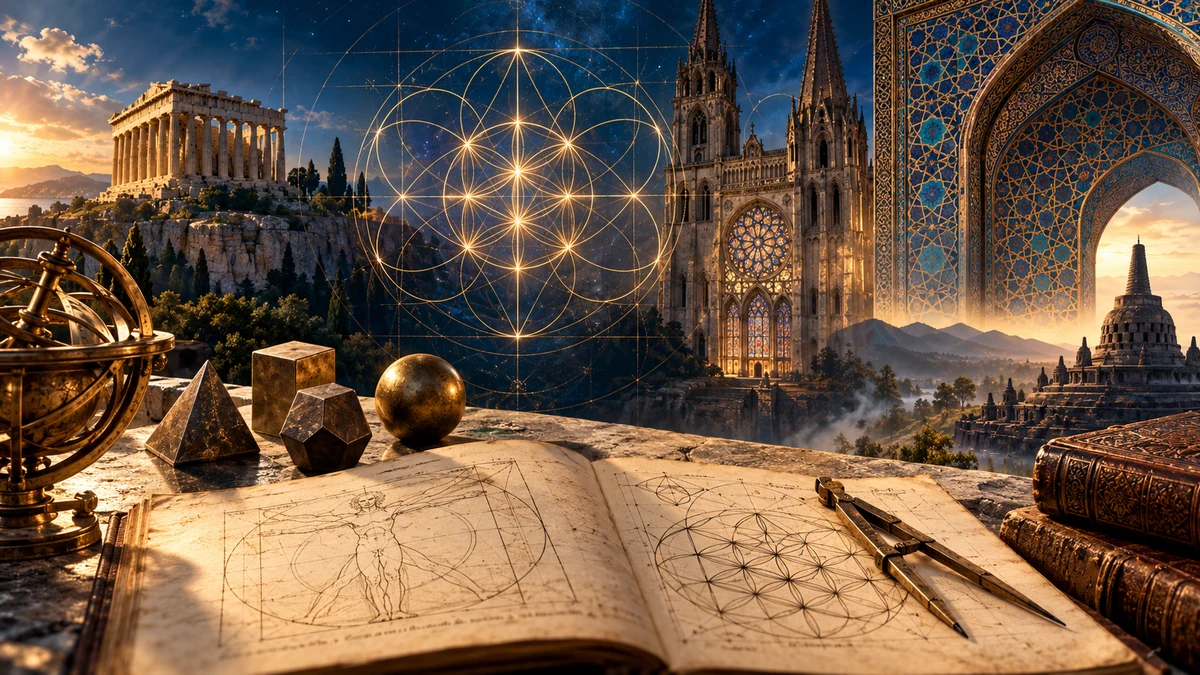
Geometry can be both extremely simple and heavily charged with meaning. A circle is the set of points equidistant from a center; a square is a quadrilateral with equal sides and right angles; regular solids possess precisely defined mathematical properties. Yet people in different periods have also used these forms to organize temples, cities, ornaments, cosmological diagrams, and meditative images. When mathematical form becomes linked to the order of the world, divine design, or a spiritual path, we enter the field now commonly called sacred geometry. [1][2][5][6]
The difficulty is that the modern phrase can suggest a single ancient doctrine transmitted continuously from Egypt, Greece, India, and medieval building lodges into contemporary esotericism. The historical picture is more diverse. In some sources the symbolic meaning of geometry is explicit; elsewhere the evidence primarily shows practical construction; in still other cases later writers combine separate traditions into one system after the fact. We therefore need to keep three questions distinct: what a form is mathematically, how it was actually used in a particular historical setting, and what meaning a specific tradition or later interpreter assigned to it. [3][4][7][8][9]
Geometry is not “sacred” by itself
Mathematics does not require a religious explanation for a circle, triangle, or regular polygon to possess its properties. Those properties follow from definitions, relations, constructions, and proofs. An equilateral triangle has three equal sides; a square can be constructed with straightedge and compass; the five regular convex polyhedra occupy a distinctive place in geometry regardless of whether symbolic meaning is assigned to them. When we speak of “sacred geometry,” then, we are not describing a separate branch of mathematics operating by different rules, but the cultural and philosophical meaning attached to geometric forms. [1]
This distinction matters. Two cultures may independently use the circle because it is a natural solution for rotation, radial symmetry, domes, or the organization of space around a center. Similarity alone is therefore not evidence for the transmission of secret knowledge. To argue for a historical connection, we need more: a text, drawing, building record, transmission history, shared terminology, or some other evidence showing that not only the shape but also its intended meaning was related.
Plato: when geometry becomes a model of the cosmos
One of the most influential ancient examples is Plato’s Timaeus. The world is not presented there as an accidental collection of matter but as an ordered cosmos to which a divine Craftsman, or Demiurge, gives mathematical order. In the dialogue’s physical account the four elements are associated with geometric bodies: fire with the tetrahedron, air with the octahedron, water with the icosahedron, and earth with the cube. The dodecahedron receives a special role in relation to the cosmos as a whole. [1]
This is a historically secure link between geometry and cosmology, but it must be read within Plato’s philosophy. It does not prove that every later teaching about the “Platonic solids” inherited the same esoteric system. It does show something more important: already in antiquity geometric regularity could be understood as more than a calculating convenience—as an expression of the order through which nature could be conceived. That idea strongly influenced later philosophy, theology, and the history of science. [1]
Vitruvius: body, measure, and temple
Vitruvius gives us a different but equally direct connection. In Book III of On Architecture he states that temple design must depend on symmetry and proportion, with exact relations between individual parts and the whole comparable to those found in a well-shaped human body. He then places the body within the circle and square: when a person lies with arms and legs extended, the body can be described through these geometric figures, making the human form a measure of architectural order. [2]
This matters because it demonstrates the difference between documentary evidence and later speculation. With Vitruvius we do not need to draw rectangles retrospectively over a photograph of a temple and search for approximate ratios; the author himself states that proportion, measure, and analogy with the body belong to architectural thought. But this does not imply a single universal formula governing every ancient temple. Vitruvius describes systems of measure and proportion, not one hidden numerical constant. [2]
Gothic masters: geometry as a building procedure
Discussions of “sacred geometry” often turn from antiquity to Gothic cathedrals. Here the evidence is more concrete than romantic stories sometimes suggest. Research on Gothic design demonstrates procedures based on straightedge and compass, squares, equilateral triangles, octagons, and successive geometric constructions. Robert Bork describes such practice as procedural geometry: form develops through a sequence of constructive steps rather than necessarily from a single final numerical formula. [3]
A particularly vivid document is Matthäus Roriczer’s 1486 Büchlein von der Fialen Gerechtigkeit, which shows through successive geometric operations how a Gothic pinnacle can be generated from a basic square. At Milan Cathedral, late-fourteenth-century records preserve debates between ad quadratum and ad triangulum approaches—design based on square and triangular geometry. This is real, documented builders’ geometry. [3][4]
It does not follow, however, that every Gothic cathedral is an encrypted theological message or that all were governed by one secret canon. Geometry could operate simultaneously as a practical tool, an aesthetic principle, and a carrier of symbolic associations. The relative importance of each must be established for individual buildings and sources. Here the phrase “sacred geometry” is useful as a question—and misleading when treated as the answer in advance.
Islamic geometry: order, repetition, and infinity
Geometric ornament is one of the most recognizable visual traditions of Islamic art. Museum and art-historical studies emphasize the use of circles, squares, triangles, stars, polygons, and grids from which highly complex patterns are produced through reflection, rotation, interlacing, and repetition. These appear across architecture, ceramics, woodwork, textiles, and manuscripts, often together with calligraphy and vegetal ornament. [5]
Such patterns can be analyzed mathematically in terms of symmetry and tessellation, but their cultural significance is not exhausted by mathematics. The Metropolitan Museum notes that repetition and the appearance of potentially infinite extension can suggest unity and order. At the same time, it is too simple to claim that geometry developed merely because Islam supposedly prohibited images: figural art existed in Islamic societies, and relations among religion, space, and ornament varied widely across regions and periods. [5]
Islamic art therefore shows why geometry must be distinguished from any single interpretation of geometry. A pattern’s construction may be reconstructed with precision even where its symbolic meaning was not uniform or codified as a universal doctrine.

Mandala: geometry as a map of a path
In Buddhist mandalas the link between geometry and religious function is even more direct. Tibetan mandalas frequently combine a center, a square palace with four entrances, and concentric circular bands. The Metropolitan Museum describes them as aids to meditation and as cosmic diagrams in which a central deity is placed within an architecturally organized spiritual space. [6]
Geometry here is not merely decoration. Directions, gates, center, and spatial layers participate in ritual visualization. Yet “mandala” does not denote one unchanging scheme: many iconographic, ritual, and regional forms exist. Circle and square are important, but their meaning comes from a particular Buddhist system rather than from an assumption that a circle must carry the same esoteric meaning everywhere in the world. [6]
Comparable cases occur in Indian temple traditions where mandala structures become part of architectural programs. A study of the Vaikuntha Perumal temple at Kanchipuram, for example, describes the chakrabja mandala as foundational to the temple’s plan and theological program. Such examples confirm genuine links among diagram, direction, architecture, and cosmology, but they are better treated as specific historical systems than as proof of one universal geometric religion. [7]
Circle, square, vesica piscis, and regular solids
Why do certain forms recur so persistently? Part of the answer is mathematical. The circle is the most basic figure of radial symmetry; the square organizes two perpendicular axes; the equilateral triangle emerges from one of the simplest compass constructions using two equal circles; the vesica piscis is the lens-shaped intersection of two equal circles whose centers lie on one another’s circumference. From such elementary operations one can generate grids, rosettes, stars, and polygons.
It is therefore unsurprising that similar forms arise in different places. Their regularity makes them practically useful: they can be reproduced with cord, straightedge, and compass, scaled without changing proportion, and used to divide space. Symbolic interpretations may build upon these properties, but they are not contained in the equations themselves. A circle can signify sun, heaven, perfection, cycle, protected space—or simply a construction line—depending on context.
The same applies to regular solids. Their mathematical distinction is objective; Plato’s association with the elements is a historical philosophical model; later esoteric correspondences are newer interpretive layers. If these three levels are collapsed into one, we lose the very history that makes the forms interesting. [1]

The golden ratio, pyramids, and the danger of measuring backward
Modern “sacred geometry” is often associated with the golden ratio, pyramids, cathedrals, the human body, and spirals. Yet, as the earlier THY-REALITY article on the golden ratio showed, we must distinguish documented use from a ratio discovered only after selecting particular measurements. On almost any sufficiently complex façade, one can choose points yielding an approximation to a desired proportion. Such a match alone does not demonstrate that the designer intended it.
Historical cases are therefore especially valuable when form is accompanied by text or plan: Vitruvius’ account of proportion, Roriczer’s constructions, the Milan Cathedral documents, or ritual explanations of mandalas. There geometry is not merely something we impose through our own measuring grid; it appears within the historical evidence itself. [2][3][4][6]
This standard does not mean undocumented hypotheses must be false. It means they have a different evidentiary status. Good research asks not only, “Can we draw a golden rectangle here?” but also, “Do we have reason to think the original maker saw or used it there?”
How modern “sacred geometry” took shape
During the twentieth century older mathematical, architectural, and religious themes were increasingly presented as components of a single spiritual language. Robert Lawlor’s 1982 Sacred Geometry: Philosophy and Practice connected geometric constructions, the golden ratio, spirals, the human body, natural forms, music, and examples from Egypt, Greece, India, and Gothic architecture. The book is an important document of the modern sacred-geometry concept because it deliberately reads historically diverse material through a shared philosophical framework. [8]
In the late 1990s Drunvalo Melchizedek’s The Ancient Secret of the Flower of Life popularized an even broader metaphysical synthesis associated with the Flower of Life, consciousness, the human body, and cosmology. Its bibliographic record explicitly describes the work as an edited transcript of Flower of Life workshops presented from 1985 to 1994. This gives us a useful chronological anchor for the modern popularization of that system, but it does not establish that all of its connections existed in ancient cultures in the same form. [9]
The most accurate description, then, is modern esoteric synthesis. Its appeal lies in searching for shared patterns across mathematics, nature, art, and spirituality. Its historical weakness arises when similarity of form is treated as proof of direct continuity without documented transmission. A modern system can be culturally significant without having survived unchanged for millennia.
What remains when geometry, history, and esotericism are separated
When the layers are separated, sacred geometry does not disappear. It becomes more interesting. Plato’s attempt to think the physical world through regular solids remains; Vitruvius’ idea of correspondence between body and temple remains; the constructive knowledge of Gothic masters remains; Islamic grids remain, in which a simple geometric repertoire expands into extraordinary complexity; Buddhist mandalas remain, where geometry is directly incorporated into ritual and cosmology. [1][2][3][5][6]
What does not automatically remain is the claim of one hidden school connecting all these examples. Historical continuity requires traces of transmission, not merely similar circles and triangles. Nor does mathematical elegance itself prove metaphysical meaning: evidence for a mathematical proposition and evidence for a historical or spiritual interpretation are different kinds of evidence.
Perhaps that is the most interesting core of the subject. Human beings repeatedly discover that space can be ordered by a surprisingly small number of simple rules. We then add architecture, cosmology, beauty, ritual, and meaning to those rules. Geometry is universal as mathematics; its sacredness is a historical and cultural interpretation. Between those two levels lies the long and diverse story now gathered under a single name—sacred geometry.
Sources and further reading
- Plato’s Timaeus, the Demiurge and mathematical order of the cosmos; regular solids as the corpuscular model of the four elements. Source
- Primary text on symmetry, proportion, temple design, and analogy between architectural measures and the human body. Source
- Peer-reviewed study of procedural geometry in Gothic design and the unfolding of form through successive construction steps. Source
- Documented debates on practical geometry, design procedure, and proportion at Milan Cathedral. Source
- Art-historical overview of Islamic geometric patterns, their basic forms, repetition, symmetry, and associations with unity and order. Source
- Documented Tibetan mandala with four directional quadrants, gateways, concentric circles, and ritual context. Source
- Study of the chakrabja mandala as the foundation of the plan and theological program of the Vaikuntha Perumal temple at Kanchipuram. Source
- Bibliographically verified example of modern synthesis linking geometry, the golden ratio, natural forms, the body, music, and multiple historical traditions in one philosophical framework. Source
- Bibliographic record for the modern Flower of Life system and its 1985–1994 workshop chronology; used as evidence for modern esoteric reception. Source