The Voynich Manuscript: the book we still cannot read
Early-fifteenth-century parchment, an unknown script, strange plants, celestial diagrams, and multiple scribal hands: what we actually know about the Voynich Manuscript and why no explanation has yet become a generally accepted solution.
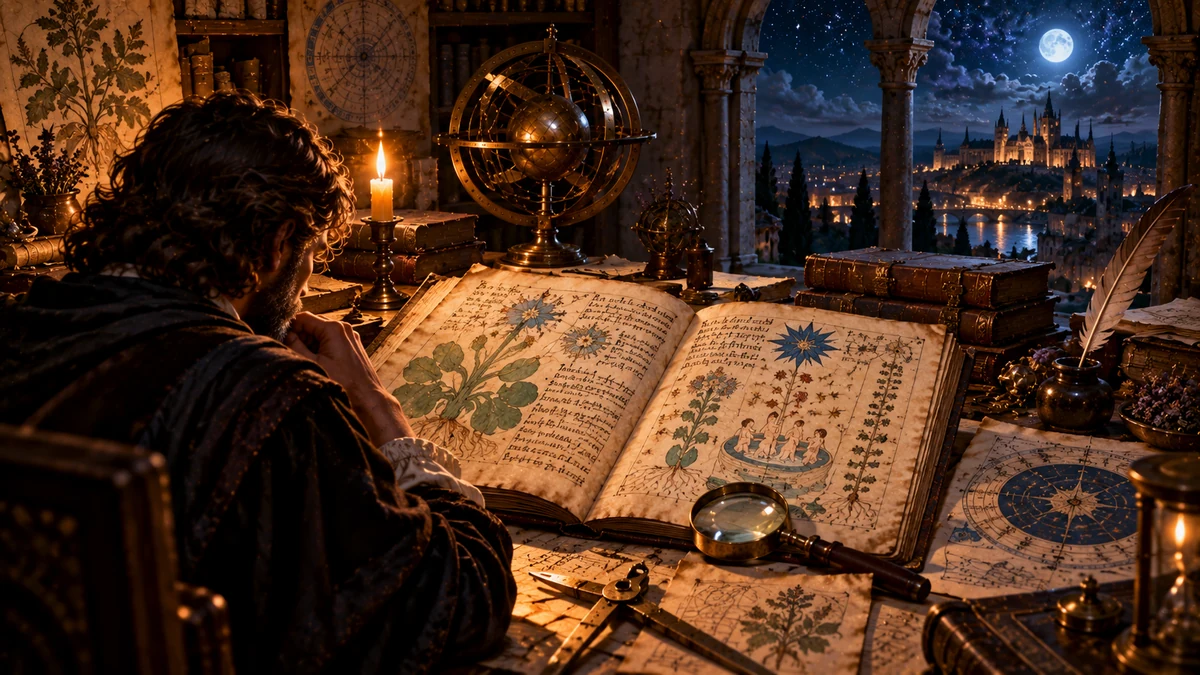
The Voynich Manuscript is one of those rare historical objects for which recent research has answered many questions without resolving the central one. We now know that its parchment belongs to the early fifteenth-century context, that its inks are materially consistent with historical scribal practice, that several scribal hands are present, and that the text has recurring internal structure. We still do not know what that writing means. [1][2][3][5]
The manuscript is therefore most interesting not as a blank surface for theories but as a case study in how far material analysis, palaeography, cryptology, and statistics can take us—and where those methods currently stop. This article follows that boundary: what can be established about the object, which features are actually measured, and which explanations remain hypotheses. [1][5][6][7][8]
A book that looks readable
The Voynich Manuscript, now Beinecke MS 408, is a parchment codex of more than two hundred pages written in an unidentified script and illustrated with plants, celestial or astrological diagrams, baths, cosmological schemes, and pharmaceutical motifs. That combination creates its peculiar tension: the pages are organized like a real book and the images often resemble recognizable genres of medieval knowledge, yet the text still cannot be read with confidence. The Beinecke Library divides the material into six broad illustrated or thematic sections. [1]
It is therefore useful to separate three questions that are often conflated: when and from what materials the book was made, how its writing is structured, and what that writing means. The first two can now be studied through material analysis, palaeography, and statistics. The third remains open. No generally accepted solution has yet produced a translation that works consistently across the codex and can be independently reproduced. [1][5]
Parchment: the early fifteenth century
Radiocarbon dating of parchment samples placed the material approximately in 1404–1438. This matters because it ruled out older theories attributing the manuscript to the thirteenth-century Roger Bacon and ruled out the simple possibility that the parchment itself was modern. The radiocarbon measurements were carried out at the NSF-Arizona AMS Laboratory; later research summarized by Yale identified the skins as calf parchment. [2][4]
Radiocarbon dating measures the age of the animal skin, not necessarily the exact moment when writing was placed on it. It therefore does not by itself identify an author, place, or language. Combined with codicology, ink materials, and the manuscript’s form, however, it anchors the physical object firmly in a late-medieval or early-Renaissance context. [2][3]
Ink and paint: no obvious modern marker
McCrone Associates analyzed samples of the inks and paints in 2009. Its report describes brownish-black writing made with a quill and materials consistent with traditional manuscript production. The analysis found no simple material marker that would push the book into modern times; Yale summarizes the composition as consistent with materials used by medieval scribes. [3][4]
This does not mean that chemistry has “proved” the meaning of the manuscript. It establishes a narrower but important point: the physical object fits its fifteenth-century historical setting. Hypotheses about the text—natural language, cipher, artificial system, or deliberately generated nonsense—must therefore explain a codex made with genuine medieval materials and techniques. [3]
Plants, zodiacs, baths, and recipes
The illustrations are not a random collection of ornaments. Beinecke distinguishes botanical, astronomical/astrological, balneological, cosmological, pharmaceutical, and mostly textual or “recipe” sections. Botanical folios place blocks of writing around large plants; astrological pages use circular forms, stars, and signs; the balneological section shows nude figures in greenish baths and tubes; and the pharmaceutical section depicts roots, plant parts, and vessels. [1][2]
These images suggest subject matter but do not provide a dictionary. Many plants cannot be identified securely as single species, while the diagrams combine familiar and unusual elements. The illustrations therefore provide context for hypotheses, not a direct key. The work may be medical, natural-philosophical, astrological, or some combination, but without readable text the relationship between image and writing remains part of the problem. [1]

Five scribes and multiple layers of production
Palaeographic work has changed the picture of the manuscript as the creation of one mysterious author. In 2025 Yale summarized the finding that five distinct scribal hands can be identified in the manuscript. That does not tell us whether five authors, copyists, or members of one workshop were involved, but it does indicate that production likely involved several people. [5]
Prescott Currier had already observed multiple handwriting styles in the 1970s, along with two statistically different forms of text that he called Currier A and Currier B. He used the word “language” cautiously: it referred to statistical differences in the frequency of characters and character groups, not proof of two actual spoken languages. Modern palaeography and statistics are therefore two distinct ways of exposing the internal structure of the codex. [6]
The text does not look like simple random noise
Computational analyses have shown that “Voynichese” is not simply a sequence of uniformly random characters. A 2013 information-theoretic study in PLOS ONE found that Voynich text follows several organizational patterns familiar from natural languages, including frequency and long-range distributions of words. [7]
The researchers also found words whose occurrences cluster in particular parts of the manuscript in ways comparable to content-bearing terms in ordinary texts. This is an interesting indication of internal organization. Yet statistical resemblance to language is not a translation and does not by itself decide whether we are looking at encrypted language, an artificial notation, or a skillfully generated system. [7]

Why statistics are not yet a solution
Natural languages have characteristic frequency patterns, but artificial procedures can reproduce some of them. Gordon Rugg and Gavin Taylor showed that tables, combinatorial rules, and a grille-like procedure can generate meaningless text reproducing several important qualitative and quantitative characteristics of Voynich text, including certain frequency distributions. [8]
The fair conclusion is therefore narrower: statistics can exclude some very simple explanations, but they cannot by themselves discriminate among every sophisticated possibility. The manuscript really is structured; the question of what process produced that structure remains open. [7][8]
Cipher, language, constructed system, or hoax?
The major hypotheses can be divided broadly into several families. The text might represent a natural language in an unknown script; it might be encrypted or encoded; it might be an artificial or purpose-built notation; or it might be deliberately generated text without ordinary linguistic meaning. Individual proposals have linked it to dozens of languages and historical figures, but none has achieved general acceptance. [1][5]
The hoax hypothesis is not the same as claiming that the physical object is a modern forgery. Rugg’s model, for example, asks whether a medieval or early-modern producer could have generated large amounts of language-like text with relatively simple tools. Conversely, statistical studies find properties compatible with organized linguistic material. Both lines of research matter because they impose testable constraints, not because either has already solved the manuscript. [7][8]
From Rudolf II to Wilfrid Voynich
A more secure provenance begins in the seventeenth century. A 1665 letter from the Prague physician Johannes Marcus Marci to Athanasius Kircher reports a tradition that Emperor Rudolf II had once bought the manuscript for 600 ducats and that Roger Bacon was believed to be its author. Radiocarbon dating later ruled out Bacon chronologically, but the letter remains a central document for the manuscript’s early provenance. [4]
The book was associated with Jacobus de Tepenec, then Georg Baresch and Marci, and ultimately reached Kircher. It then disappears from well-documented history until 1912, when bookseller Wilfrid M. Voynich acquired it among Jesuit books. After his death it passed through Anne Nill and dealer H. P. Kraus, who donated it to the Beinecke Library in 1969. [1][4]
A mystery reduced by research, not erased
We know much more about the Voynich Manuscript today than we did a century ago. We have an approximate age for its parchment, material analysis of its inks, knowledge of the codex’s organization, multiple scribal hands, statistical differences between textual regions, and part of its documented route through Europe. High-resolution digital images have also made the object available to researchers around the world. [1][2][3][5]
That progress makes the remaining mystery more precise. The question is no longer simply “what is this strange book?” but: what writing system can produce these regularities, who used it, and how does it relate to the illustrations? Until a proposed solution yields reproducible reading across a substantial portion of the manuscript while fitting its material history and internal statistics, the most reliable position is to keep several possibilities open. The Voynich Manuscript is therefore less a blank canvas for arbitrary mystery than an unusually well-constrained but still unsolved historical problem. [1][5][6][7][8]
Sources and further reading
- Official overview of MS 408, thematic sections, decipherment status, digital access, and its route into the Beinecke Library. Source
- Radiocarbon dating of the parchment to 1404–1438 and description of the NSF-Arizona AMS Laboratory measurements. Source
- Microscopic and chemical analysis of inks, pigments, and the physical condition of the codex. Source
- Provenance from Marci/Kircher/Rudolf II to Voynich and Kraus, calf parchment, and research history. Source
- Current research status; Claire Bowern on unknowns, linguistic patterns, and palaeographic identification of five scribes. Source
- Currier A and B, multiple hands, and the explicit caution that “language” denotes statistical distinction rather than proof of a spoken language. Source
- Zipf-like and long-range patterns, word co-occurrence, and information-theoretic organization of the text. Source
- A table-and-grille model reproducing several qualitative and quantitative features of Voynich text without an ordinary semantic message. Source