“The lamps are different, but the Light is the same” — Rumi: lamp, light, and the elephant in the dark
The familiar line about different lamps opens into a wider passage in Book III of the Masnavi: Moses and Pharaoh within the human being, the lamp and one light, differing viewpoints, and the elephant in the dark. The article centers Rumi’s original passage and its meaning.
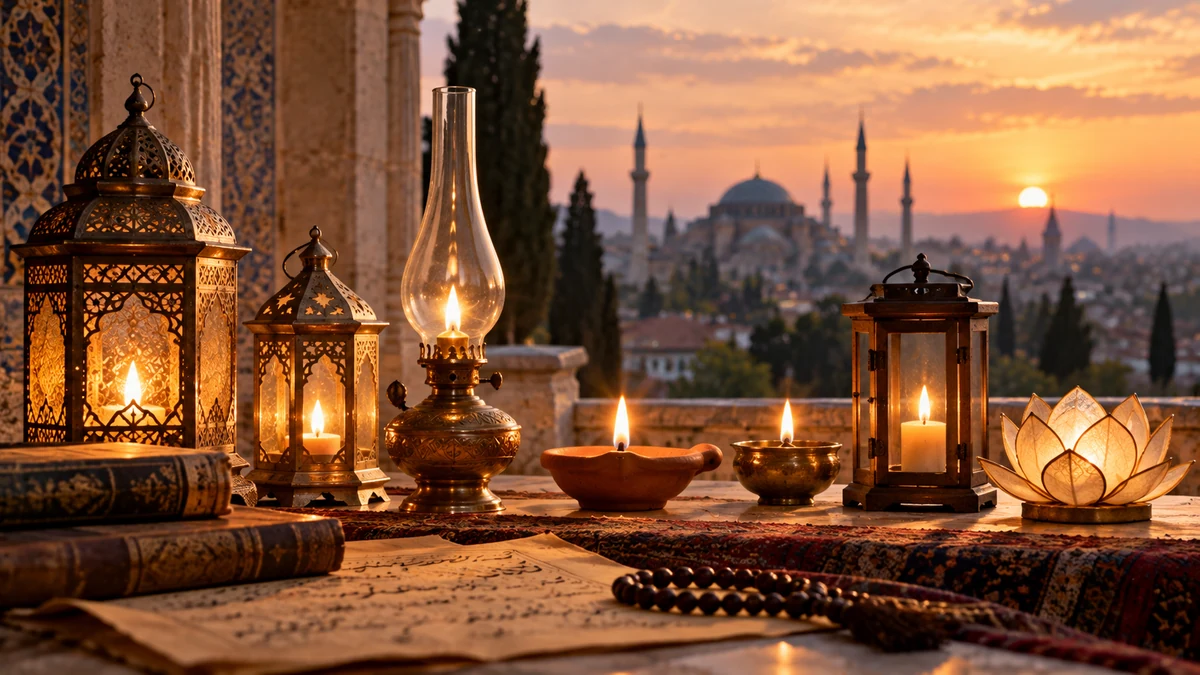
“The lamps are different, but the Light is the same.” Today the line often lives as a self-contained Rumi aphorism. In the Masnavi, however, the image does not stand alone. It belongs to a sequence in which Rumi begins with Moses and Pharaoh as forces to be sought within the human being, then distinguishes lamp from light, and from there moves into the story of the elephant in the dark. [1][2]
Read as a poetic whole, the emphasis falls less on the history of one English quotation and more on Rumi’s question: what happens when we look at the vessel instead of the light, the part instead of the whole, and our viewpoint instead of the reality that exceeds it?
Rumi’s passage: Moses, Pharaoh, lamp, and Light
The immediate arc of the metaphor in Masnavi III:1252–1261 is best read without interruption. The complete Persian passage appears first, followed by the complete THY-REALITY English translation. Commentary is deliberately kept outside the translation. [1][2]
Persian original — Masnavi III:1252–1261
1252 — ذکر موسی بهر روپوشست لیک ** نور موسی نقد تست ای مرد نیک
1253 — موسی و فرعون در هستی تست ** باید این دو خصم را در خویش جست
1254 — تا قیامت هست از موسی نتاج ** نور دیگر نیست دیگر شد سراج
1255 — این سفال و این پلیته دیگرست ** لیک نورش نیست دیگر زان سرست
1256 — گر نظر در شیشه داری گم شوی ** زانک از شیشهست اعداد دوی
1257 — ور نظر بر نور داری وا رهی ** از دوی واعداد جسم منتهی
1258 — از نظرگاهست ای مغز وجود ** اختلاف مومن و گبر و جهود
1259 — پیل اندر خانهی تاریک بود ** عرضه را آورده بودندش هنود
1260 — از برای دیدنش مردم بسی ** اندر آن ظلمت همیشد هر کسی
1261 — دیدنش با چشم چون ممکن نبود ** اندر آن تاریکیش کف میبسود
English translation
1252 — The mention of Moses is a veil; but Moses’ light is your immediate concern, O good person.
1253 — Moses and Pharaoh are within your own being; you must seek these two adversaries within yourself.
1254 — Moses’ lineage continues until the Resurrection; the light is not different, though the lamp has changed.
1255 — This clay lamp and this wick are different, but their light is not different; it comes from there.
1256 — If you look at the lamp-glass, you become lost, for from the glass arises the multiplicity of duality.
1257 — But if you keep your gaze on the light, you are released from duality and from the multiplicity of the limited body.
1258 — From the place or manner of seeing, O essence of being, arises the difference between believer, Zoroastrian, and Jew.
1259 — An elephant was in a dark house; Indians had brought it there to exhibit it.
1260 — To see it, many people, each in turn, entered that darkness.
1261 — Because it could not be seen with the eyes, each person felt it with the palm in the darkness.
Moses and Pharaoh are within the human being
The passage begins with a warning that the story of Moses is a kind of veil. The historical story matters, but Rumi immediately turns the reader inward: “Moses and Pharaoh are within your own being.” Their conflict is therefore not only a story about two figures from the past, but an image of an inner struggle between tendencies that pull a human being in different directions. [1][2][9][10]
That turn determines everything that follows. Moses’ “light” is not confined to one historical person. Rumi speaks of a lineage that continues even though the lamp changes. The individual person, time, and form may differ, while what the light symbolizes is not dependent on one vessel.
The lamp changes, the light remains
In verses 1254–1257 Rumi develops the central image. Lamp, clay, wick, and glass are forms through which light appears. The forms are many and transient; the light is what gives them meaning. If the gaze remains fixed on the glass, one becomes lost in multiplicity and duality. If the gaze moves toward the light, the limitation of the vessel is relativized. [1][2]
The metaphor therefore says more than that religions resemble one another. It concerns the distinction between form and source, appearance and meaning, vessel and that which shines through it. Rumi does not require the lamps to become identical. They remain different. Unity appears at another level — in the light that no single lamp exhausts.
The verse is therefore both mystical and epistemological. A person can divide reality according to visible forms and obtain a plurality of differences; or one can ask what carries those differences and what they share. Rumi’s image does not erase difference but shifts attention from the outer vessel toward a deeper source.
The elephant in the dark: a partial touch is not the whole
Immediately after the line about differing viewpoints begins the famous story of the elephant in the dark. People cannot see the elephant, so they touch it. Each reaches a different part and infers the nature of the whole from that limited contact. As the story continues, one person concludes one shape from touch and another a different one; conflict arises because each contact is real but incomplete. [1]
The transition from lamp to elephant is not accidental. Both images concern the limits of perspective. With the lamp, the vessel can mislead us; with the elephant, the part can mislead us. The problem is not necessarily that perception is wholly false. The problem is turning a partial perception into the whole.
Light therefore gains another function in the passage: it makes it possible for separate touches to become a shared picture. If the room were illuminated, the people would still stand in different places, but their individual perceptions would no longer compete as mutually exclusive descriptions of the entire elephant.

Believer, Zoroastrian, and Jew: difference from the place of seeing
Between the lamp and the elephant stands a short but important line: Rumi says that from the “place of seeing” arises the difference between believer, Zoroastrian, and Jew. In the immediate poetic sequence this line is tied to perspective. People see through different vessels and from different positions, so the reality they describe appears differently. [1][2]
Rumi’s language is rooted in his Islamic and Sufi world. The passage is not an abstract modern theory of religion, but mystical poetry that connects differences of form with the limits of human vision. That is precisely why the metaphor has remained so portable: it allows many forms to be spoken of without making multiplicity the final level of reality. [9][10]
Light in Rumi’s religious language
In an Islamic setting, lamp, glass, and light are not empty symbols. Qur'an 24:35 describes God as the “Light of the heavens and the earth” and speaks of a niche, a lamp, and glass — “light upon light.” [11] We do not need to claim that verses 1252–1261 are simply a commentary on that verse in order to notice that Rumi writes in a world where light carries deep theological and mystical weight.
When he speaks of a light that remains the same while the lamp changes, the image therefore goes beyond a simple comparison of objects. Light becomes a way of speaking about a reality that appears through limited forms without being limited to them. This also links the first half of the passage to the elephant in the dark: without light we remain with parts; with light the relation among them can become visible.
The same light, different forms
The core of the passage is therefore simple but wide-ranging: forms change, perspectives differ, and partial views can come into conflict, but this does not mean that reality itself is shattered into as many unrelated pieces as there are observers. Rumi’s response is not the erasure of form, but a movement of attention toward the light in which forms become visible at all.
The familiar line “The lamps are different, but the Light is the same” is a short poetic condensation of this motif and now often circulates as a self-contained Rumi aphorism. [3][4][6][7][8] For the meaning of the passage, it matters more to read it together with the verses about Moses and Pharaoh, glass and light, and the elephant in the dark — where it becomes part of a larger poetic thought rather than a detached slogan.
Sources and further reading
- Masnavi.net — Masnavi, III:1252–1261, Persian text and Nicholson translation. Source
- ZindeRood / Ganjoor — Persian text and verse-by-verse translation of the same passage. Source
- R. A. Nicholson, Rumi: Poet and Mystic (1950), Routledge bibliographic record. Source
- Ibrahim Gamard / Dar-al-Masnavi — “The lamp has become different,” textual note on Nicholson's rendering and citation. Source
- Rekhta — Rumi Poet And Mystic, Nicholson, 1950. Source
- Andrew Harvey, Light Upon Light: Inspirations from Rumi (1996). Source
- CiNii Books — Light upon light, “translated and adapted by Andrew Harvey.” Source
- Shambhala — The Rumi Collection, anthology metadata. Source
- Franklin D. Lewis, Rumi: Past and Present, East and West. Source
- William C. Chittick, The Sufi Path of Love. Source
- Qur'an 24:35, Verse of Light. Source