La Légende des siècles — Victor Hugo: Humanity from Darkness toward Light
In La Légende des siècles, Victor Hugo built a poetic mosaic of humanity from history, legend, war, conscience, mercy and visions of the future, tracing a difficult movement from darkness toward liberty and light.
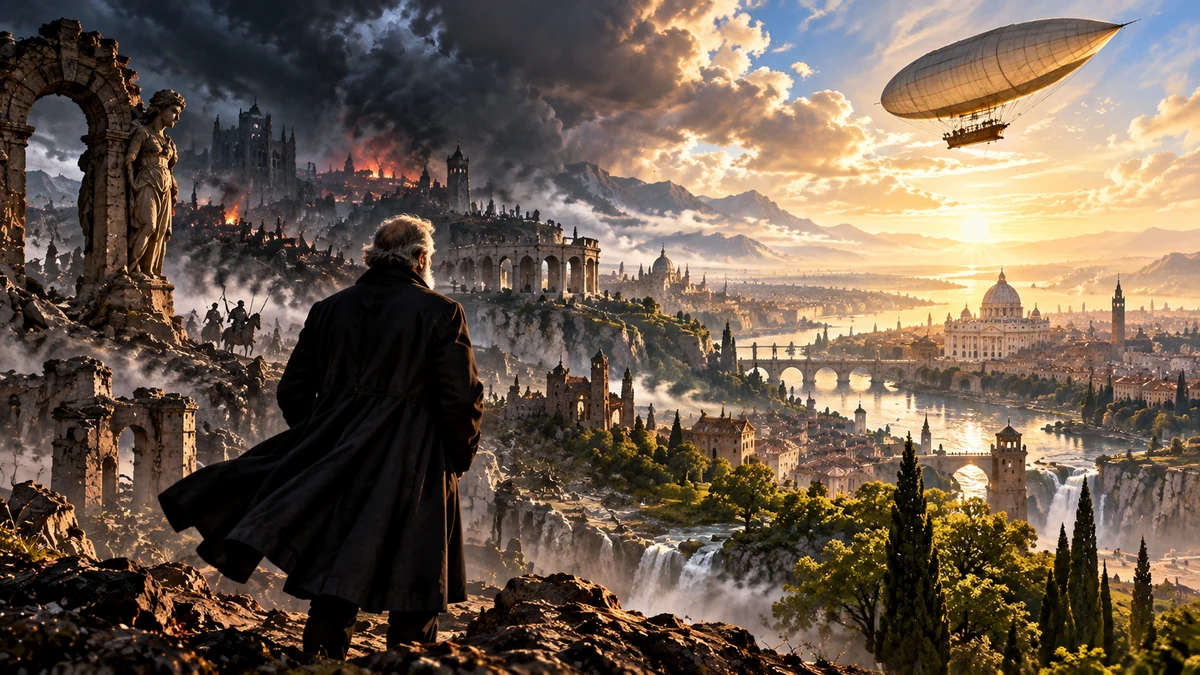
Victor Hugo did not want to write an ordinary history of the world. He did not want to assemble a textbook in which battles, kings, religions and revolutions followed one another in an orderly chronology. His plan was larger and at the same time more poetic: from individual scenes, legends, biblical stories, historical figures, wars, acts of mercy, myths and images of the future, he wanted to create something like a portrait of humanity.
La Légende des siècles is therefore not a single narrative. It is a mosaic. Cain, medieval knights, tyrants, the poor, the sea, machines, wonders of flight and visions of future centuries stand beside one another. In the preface to the First Series, Hugo wrote that he wanted to show humanity through history, legend, philosophy, religion and science, and that he saw all these layers as part of a vast upward movement toward light. [2]
But this light is not an easy victory. The path toward it is full of blood, guilt, returning barbarism and fallen civilisations. That is precisely why the work remains interesting today: Hugo believes in progress, yet his own scenes constantly show how difficult progress is and how quickly humanity can return to darkness.
A Book That Took Almost a Quarter of a Century to Emerge
La Légende des siècles did not appear as one finished book. The Bibliothèque nationale de France records it as a work spanning 1859 to 1883: the First Series appeared in 1859, the New Series in 1877 and the Last Series in 1883. [1]
This matters because Hugo did not simply sit down and arrange his vision of human history once and for all. The work grew with him. Between the first and final series, France, Europe and the author himself changed. Hugo lived through a long exile, the fall of the Second Empire, the Franco-Prussian War, the Paris Commune, his return to France and an old age in which he was already regarded as one of the century's central literary figures.
The BnF describes the First Series as “Histoire — les petites épopées”, history in small epics. Yet the phrase “small epics” does not imply modest scope. It describes a method of construction: instead of one continuous story, we receive a sequence of intense scenes, each intended for a moment to capture the face of a particular age. [1][4]
Hugo even warned in the preface that the First Series was both a self-contained whole and the beginning of a wider project. He compares the book to the beginning of a larger building, or to a tree that is complete in itself while at the same time announcing a forest. [2]
The work is therefore better understood as a map of human experience expanded over a lifetime than as a closed chronology.

Hauteville House: History Written from Exile
When the First Series appeared in 1859, Hugo was living on Guernsey. After Louis-Napoléon Bonaparte's coup d'état in 1851, he left France, then lived in Belgium and on Jersey, and in 1856 settled in Hauteville House, where he remained until 1870. The official Victor Hugo museum explicitly lists La Légende des siècles among the major works created there. [3]
This context matters, but it would be too narrow to read the work only as a political attack on Napoleon III. Hugo was a political exile, yet his perspective in La Légende des siècles reaches far beyond immediate French politics. He is interested in what power does to human beings, how tyrannies arise, how conscience works, how violence passes through generations, what science and technology can mean, and whether history has any direction at all.
The island's remoteness carried symbolic weight. Hugo looked toward France and at the same time outward, toward the sea, history and the future. Hauteville House was his home, workshop and observatory. There he wrote the First Series of the Legend as a man physically outside his country but attempting poetically to encompass humanity as a whole. [3]
This does not mean exile explains everything. It does mean that the project was not created from the comfortable centre of French political power, but from the position of a political exile who opposed the regime of Napoleon III and, from a distance, reflected on what remains in history after emperors, regimes and wars.
Humanity as One Great Collective Person
Hugo himself provided the clearest key to reading the book in his 1859 preface.
His ambition was to represent humanity in a kind of cyclical work and to show it through history, fable, philosophy, religion and science. All these layers were to converge in a vast movement of ascent toward light. He describes humanity as one yet multiple figure — dark and radiant, fatal and sacred. [2]
Even more important is his idea that the human race can be thought of as a great collective individual, carrying out actions on earth from one epoch to another. Individual centuries are changes in its face. The poems are imprints of that face at different moments. [2]
This is a very Hugolian idea. Instead of billions of separate lives, he imagines one immense human being that is born, sins, suffers, builds, destroys, discovers, believes, doubts and slowly changes.
The connection between the poems is, in his words, Progress. Yet progress for Hugo is not merely more machines, longer lives or richer cities. It is a moral, political, spiritual and intellectual horizon. In the same preface, he speaks of humanity rising from darkness toward the ideal and of the slow blossoming of liberty. [2]
Here the central tension of the book appears: Hugo sees a direction, yet in his scenes he also sees everything that opposes that direction.
Why a “Legend” and Not a Chronicle
The First Series begins with Eve and Jesus, continues through Rome, the Middle Ages, Islam, chivalric stories, the Renaissance, the Inquisition and the present, and then reaches even into an imagined twentieth century. [4]
This is not the arrangement of a historian attempting to cover every period evenly. Hugo leaps. Some centuries almost disappear, some events receive dozens of pages and others only a moment. A biblical scene can stand beside a historical figure, a legend beside a chronicle and the future beside the past.
Hugo does not hide this. In the preface he distinguishes between the historical and legendary faces of humanity and argues that legend carries its own kind of truth. He invokes the difference between Herodotus and Homer and describes his poems as a kind of historical reality compressed or poetically read from the traces of the past. [2]
Hugo’s “history” is deliberately poetic and legendary: he uses historical figures, myths, scenes, and symbols to build a moral and imaginative history of humanity rather than a chronological historical manual.
But this is precisely the point of the project. Hugo does not want merely to tell us what happened. He wants to select a scene that carries the meaning of a larger age.
His history is therefore often closer to a fresco than to an archive.
Cain and the Eye No Wall Can Block
One of the most powerful poems in the First Series is La Conscience — Conscience. Hugo takes the biblical story of Cain after the murder of Abel and turns it into an almost cinematic pursuit. [5]
Cain flees. Behind him is an eye that watches him. He tries to get farther away, then to hide. His family erects ever stronger barriers: first a tent, then a bronze wall, a fortified city, towers and finally an underground refuge. Technique advances. Protection becomes more massive. The city becomes almost superhuman.
But the eye remains.
In the end it is with him even in the grave. [5]
The poem can be read religiously as the gaze of God, morally as guilt, psychologically as conscience or metaphysically as the impossibility of escaping an act that has defined a person. There is no need to choose only one interpretation.
For La Légende des siècles as a whole, however, another layer matters. Cain's family develops architecture, metallurgy, walls and the city. Civilisational capacity grows. Yet technical growth does not resolve the moral problem.
Hugo thus introduces an early warning that he will later repeat in relation to industry and technology: power is not the same as progress.
Human beings can build a larger wall and still remain the same human beings behind it.
Centuries of Kings, Wars and Grandeur That Casts a Shadow
La Légende des siècles is full of kings, warriors, emperors, knights, armies and violent powers. Hugo loves the grand scene: a castle, a battle, a coronation, a dark throne, a wall, a crowd and a sudden act of courage.
But grandeur in his world is not automatically good. Power is often surrounded by violence, wealth by suffering, and military glory by the dead bodies left behind.
That is why the title “humanity from darkness toward light” does not mean that earlier centuries are simply darkness while the present has already become light. Hugo searches for both possibilities in every age. Justice can appear in a barbarous time, while cruelty can appear in a civilised one. His tyrants are interesting not simply because they are evil, but because they reveal how a system of power allows one person to extend his will over the lives of others.
Heroism therefore also gradually changes its form. Traditional epic celebrates the conqueror. Hugo increasingly asks whether greater strength might lie in restraining one's own power.
In this way the epic begins to move away from kings toward people who normally do not write history.
When Mercy Becomes an Epic Act
In the short poem Après la bataille, Hugo tells of his father on a battlefield. Among the dead he notices a wounded Spanish soldier asking for a drink. His father orders a hussar to give him water. As they approach, the wounded man grabs a pistol and fires at the man who had wanted to help him. The bullet misses. Hugo's father nevertheless orders that the wounded man be given water. [6]
The poem is very short, but its moral reversal says a great deal. The hero is not heroic because he defeated the enemy, but because after an attempted killing he does not withdraw mercy.
Les Pauvres Gens opens an even more ordinary world. A poor fishing family already struggles to support its own children. When the mother discovers that a poor neighbour has died and left two small children behind, the question becomes whether a family that has almost nothing can take on two more lives. [6]
Hugo does not turn this into a debate about economic systems. He creates a scene of human solidarity. Precisely in poverty, where withdrawal into oneself might be expected, there appears a willingness to share the little that remains.
This is an important shift in the meaning of epic. A great act no longer has to be the conquest of a city. It can be a glass of water. It can be taking two children into a poor home.
In this sense, Hugo's idea of progress is measured not only in centuries. It is also measured in the individual decision of a person who has the option to be cruel and chooses otherwise.
Myth and Nature Expand the Human Scale
Hugo's history is not only a history of people in a narrow sense. In the preface he explicitly says that he does not separate humanity from its earthly environment. Animals, landscapes, the sea, the sky, monsters, gods and mythological beings enter the work. [2]
This is especially visible in long mythological poems such as Le Satyre. [7] Hugo does not use antiquity as museum decoration. Myth allows him to speak about things larger than any single historical event: nature, the body, freedom, the power of the gods, the force of life and humanity's place in the world.
That is precisely why the word “legend” in the title is not accidental. Legend can take historical or cultural memory and enlarge it until it becomes a symbol. In such a space, what matters is not only who once ruled, but what power means; not only which battle was won, but what war is; not only which machine existed, but what kind of world that machine represents.
Hugo thus expands the scale from the individual state toward civilisation and from civilisation toward the cosmos.
When he reaches the future, it is therefore unsurprising that he chooses not a parliament or ministry, but the sea and the sky.
*Pleine mer* and *Plein ciel*: One Humanity, Two Futures of Technology
In the First Series of 1859, under the heading The Twentieth Century, Hugo placed two poems: Pleine mer and Plein ciel. [4]
In Pleine mer, a gigantic iron vessel named Léviathan decays on the ocean. Hugo connects it with the old world — a world of war, borders, hatred, slavery, ignorance and divided humanity. A magnificent machine that once demonstrated human technical power becomes a wreck. [8]
What matters is that the problem is not the machine as such. Hugo does not say that iron is evil or that technical progress is wrong. Léviathan is dark because it is embedded in a world of war and domination.
The answer comes in Plein ciel. There Hugo imagines an aerial vessel that overcomes borders, distance and gravity. This machine is not named after a monster, but after deliverance. Flight becomes a symbol of connected humanity and of the possibility that people might rise above old divisions. [8]
Hugo's technological optimism in Plein ciel is strikingly strong: he names the aerial vessel Délivrance and links it with the future, peace, fraternity and liberty. Yet the comparison with the warlike Léviathan of Pleine mer shows that in this pair of poems technical power alone is not yet a measure of moral progress; it gains meaning according to the world it serves. [8]
The same human creativity can build a warship or a means of connection. Progress is therefore not only a question of what humanity can make, but of what it subjects that ability to.
The Wall of the Centuries: When History Stops Being a Straight Line
When the New Series appeared in 1877, Hugo opened it with the long poem La Vision d’où est sorti ce livre — The Vision from Which This Book Emerged. [9]
The image is different from an orderly path toward light. The poet sees a wall of the centuries: an immense, almost living structure in which kings, gods, wars, faces, crowds, blood, stone and decay are intertwined. History is not a bookshelf. It is ruin and palace at once, a crowd turned to stone and a building collapsing. [9]
This vision matters because it prevents an overly simple reading of Hugo's progress.
If history in his work were only a smooth ascending line, such an image would not be necessary. The wall of the centuries is broken, full of holes and ruins. Achievements and catastrophes are stacked upon one another. The future is born from the remains of the past, not from a clean space.
The historical position of the New Series is also different. Between the first and second publication came the Franco-Prussian War of 1870–1871, the fall of the Second Empire, the siege of Paris and the Paris Commune. Scholarship on the New Series therefore rightly notes that Hugo's idea of progress in the work coexists with a much more fragmented, ruin-filled and conflict-ridden image of history. [9][10]
Light is therefore more a horizon for him than a description of the present condition.
Progress as Direction, Not Guarantee
Hugo uses the word Progress in the preface without hesitation. It is, in his words, the thread linking otherwise very different poems. [2]
But if we read only that statement and not the poems, we get the wrong Hugo.
His centuries do not improve evenly. Violence returns. Tyranny returns. Fanaticism returns. The victims change, but the mechanism can remain similar. Humanity advances and at the same time carries within itself the possibility of repetition.
Literary scholarship therefore points to discontinuity, breaks and deferred or difficult-to-see progress rather than a simple straight ascending line. The idea of progress remains, but its path is fractured. [10]
This also explains why individual moral moments are so important for Hugo. If progress were an automatic law of history, an act of mercy would not be especially significant. Humanity would reach its destination anyway.
For Hugo, it is not so. Light requires a human being who chooses it.
Technical power in Hugo's images can serve war or liberation. Power can become tyranny. Civilisation can build a city and still hide Cain within it. Material or technical growth therefore is not, for him, the same thing as moral progress. [5][8]
His optimism is therefore not the belief that everything will fix itself. It is faith that there is a direction that can be recognised — toward greater liberty, conscience, reason, compassion and connectedness — but that it can also be betrayed.
Conclusion: A Mosaic of Humanity Between Darkness and the Ideal
La Légende des siècles is too large and too varied to be reduced to a single sentence.
It is not a history textbook.
It is not merely a collection of legends.
It is not a simple political manifesto.
And it is not a naïve poem about the future automatically being better than the past.
Hugo wanted to do something unusual: to look at humanity as though looking at one immense person whose life lasts thousands of years. This person has a childhood, crimes, dreams, fears, inventions, guilt, gods, tyrants, the poor and hope.
Cain builds walls but does not escape conscience.
A soldier tries to kill the man giving him water, yet the water is given anyway.
A poor family takes in children even poorer than themselves.
A gigantic war machine becomes a wreck.
Another machine rises into the sky in the poet's future as an image of deliverance.
And the wall of the centuries remains full of ruins from which the future must repeatedly search for a path.
In the preface, Hugo summed up his ambition as humanity's rise from darkness toward the ideal and the slow blossoming of liberty. [2] This is the clearest axis of the entire project, but only the poems show what that axis means.
Darkness is not only the past.
Light is not only the future.
Both possibilities are present in humanity.
That is why Hugo's Legend of the Centuries is less a narrative about where history must necessarily go than a question about what humanity must become in order to move toward light at all.
Selected primary texts: French and Slovenian
A separate appendix provides direct access to the primary texts on which the article’s central reading rests: Victor Hugo — La Légende des siècles: selected primary texts in French + Slovenian translation. It contains the complete poems La Conscience and Après la bataille plus complete selected programmatic paragraphs from the preface on ascent toward light, Progress, and humanity rising from darkness toward the ideal. Longer works such as Pleine mer and Plein ciel are not reproduced in full because the article discusses only selected motifs from them. [2][5][6]
Sources and further reading
- Bibliothèque nationale de France — La Légende des siècles authority record; Gallica overview of Victor Hugo’s poetic work Source
- Victor Hugo — Préface, La Légende des siècles, Première série (1859) Source
- Maisons Victor Hugo — Hauteville House, Guernsey; official house history and exile context Source
- Victor Hugo — La Légende des siècles, Première série: Histoire — les petites épopées (1859) Source
- Victor Hugo — La Conscience (1859) Source
- Victor Hugo — Après la bataille; Les Pauvres Gens (1859) Source
- Victor Hugo — Le Satyre (1859) Source
- Victor Hugo — Pleine mer; Plein ciel (1859) Source
- Victor Hugo — La Vision d’où est sorti ce livre, Nouvelle série (1877) Source
- Scholarly checkpoint on progress, discontinuity and historical representation in La Légende des siècles — Persée / Groupe Hugo Source