Utopia and Anti-Utopia: From Thomas More to Contemporary Film and Television
From More’s Utopia to Black Mirror: how literature, film and television invent alternative societies to test the ideals, power structures, technologies and fears of their own time.
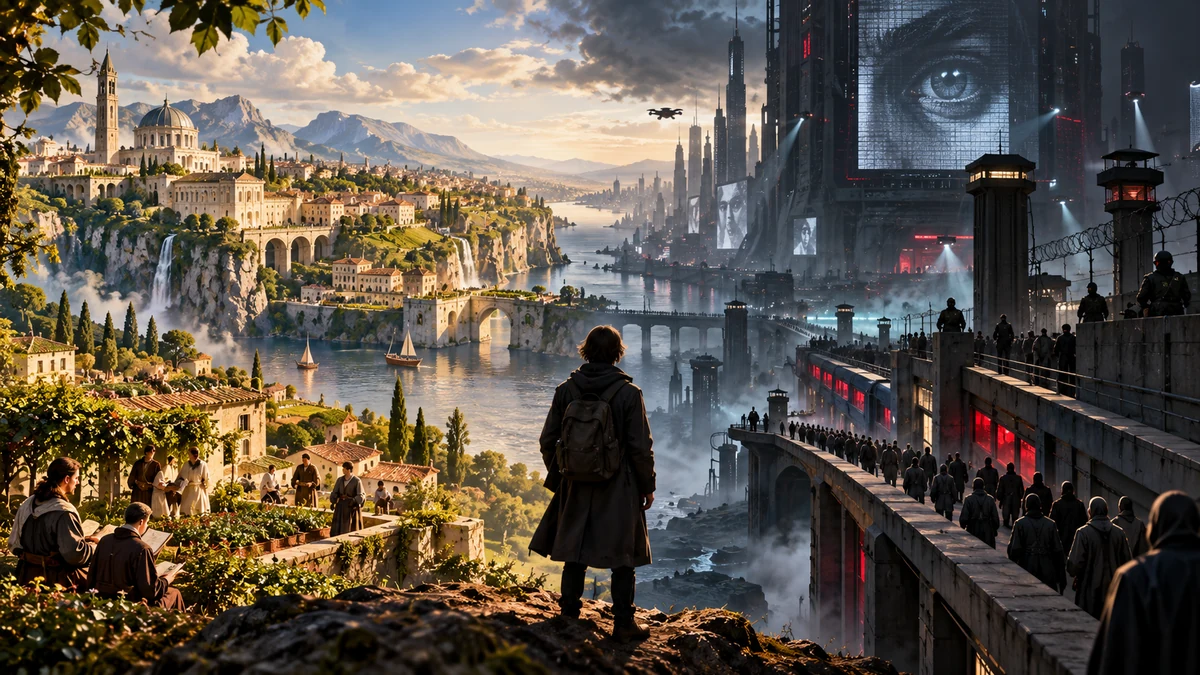
Human beings imagined places that do not exist long before we began calling them utopias. In them, we can remove poverty, private property, war, disease or political conflict. We can change family, work, education, money and power. Because an invented world has no obligation to reality, we can amplify a social principle to an extreme and observe what happens.
For precisely that reason, utopia is not merely a fantasy about a perfect world, and dystopia is not merely a story about a bad one. Both can function as thought experiments. One asks how life might be organised differently. The other asks what happens when an apparently good idea — order, security, health, equality, stability, purity or happiness — becomes a system that permits no deviation.
Across five centuries, this literary device moved from political dialogue into the novel, film and television. Technologies, ideologies and fears changed. Yet the basic procedure remained surprisingly similar: invent a society, make its rules visible and use it to test your own present.
Thomas More and the Place That Does Not Exist
In 1516 Thomas More published Utopia. The title itself plays with Greek: ou-topos means “no-place,” a place that does not exist, while later usage strongly associated the term with the idea of a good or ideal place. Today the word has become almost synonymous with a perfect society, but More’s text is far less unambiguous. [1]
Book I does not describe a distant island but stages a discussion of real European problems: poverty, punishment, property, power and the question of whether a philosopher should cooperate with rulers or remain outside power. Only Book II introduces Raphael Hythloday’s account of Utopia, a society with common property, organised labour, a different relationship to wealth and a series of institutions that seem at once attractive and strange to a European reader.
But Hythloday is not simply More’s spokesman. His name is part of the game: “Raphael” suggests healing, while “Hythloday” points toward talking nonsense. The fictionalised More at the end likewise does not accept everything he has heard. The Stanford Encyclopedia of Philosophy therefore stresses the dialogue, irony and the fact that scholars do not agree on Utopia’s final political position. [1]
That is an important beginning for the genre. Utopia does not have to be a programme someone should implement tomorrow. It can be a space in which an author temporarily removes the apparent inevitability of the reader’s own society.

Two Utopias, Two Almost Opposite Ideals
In the nineteenth century, utopian literature gained new energy. The Industrial Revolution showed that ways of life could change within a few generations more than they previously had across centuries. If industry could create new cities, new classes and new forms of wealth, then an entirely new social organisation could also be imagined.
In Looking Backward: 2000–1887 from 1888, Edward Bellamy transported a nineteenth-century man into the year 2000. There he encounters a strongly organised national economy, technological abundance and a society that has abolished much of competition and material insecurity. The book did not remain merely a literary curiosity; it inspired clubs and political discussion and became one of the most influential American utopian novels of its era. [2]
Two years later, William Morris offered an almost opposite vision in News from Nowhere. Private capitalist order disappears there as well, but Morris does not celebrate Bellamy’s centralised, mechanised organisation. His future is decentralised, craft-based and oriented toward meaningful work, local life and a restored connection between making things and satisfaction. [3]
The difference matters. Both writers can be counted among utopian authors, yet their answer to the question “what is a good life?” is not the same. For one, the solution approaches through organisation and technical abundance; for the other, through reducing alienation and restoring meaning to work.
Utopia therefore already shows something here that will remain important for dystopia as well: there is no neutral definition of the perfect society. One person’s ideal can look like a prison to another.
When the Utopian Promise Turns
The word dystopia now seems obvious, but its historical development is not that simple. In the British Parliament in 1868, John Stuart Mill spoke of proposals whose advocates would be better called “dys-topians, or cacotopians.” His point was witty: something is usually called utopian because it is too good to be practicable; these proposals, he suggested, were too bad to be practicable. [4]
Today dystopia is usually understood as an imagined society in which institutional rules, technology, power or social organisation have made life substantially worse. But the term is not simply the reverse of utopia.
The most interesting dystopias often do not begin with a desire for evil. They begin with a good.
Order becomes total control.
Security requires total control of movement.
Equality requires the erasure of difference.
Health requires reproductive selection.
Happiness requires chemical or psychological conditioning.
Purity requires removing those who do not fit the norm.
This is precisely where utopia and anti-utopia move close to one another. Dystopia often asks what remains of a good idea when a system allows no exit, doubt or plurality.
Zamyatin: Life Behind Glass
One of the most important early novels in this tradition is Yevgeny Zamyatin’s We, written in the early 1920s.
Its future state is radically rationalised. People are numbers. Life is mathematically organised. Transparent surfaces reduce privacy. Collective order and predictability are presented as higher values than individual spontaneity.
Zamyatin therefore does not build only a police state. He builds a society that wants to be rational all the way through — and in doing so opens the question of what is lost when human unpredictability is treated as an error in the system. [5]
His place in the history of the genre is also documentarily important. George Orwell read We and reviewed it in 1946, before completing Nineteen Eighty-Four. In the same review Orwell wrote that, in his view, Huxley’s Brave New World must have been partly derived from Zamyatin’s novel. [5]
Orwell’s opinion is not the same as independent proof that Huxley directly drew from Zamyatin. It is, however, clear evidence that Orwell knew We and regarded it as an important precursor of modern anti-utopia.
Huxley and Orwell: Two Different Machines of Power
In 1932, Aldous Huxley presented in Brave New World a society in which order does not depend primarily on everyday police terror. People are classified before birth. Their abilities, expectations and place in society are shaped through reproductive and psychological engineering. Stability is supported by entertainment, consumption, sexual permissiveness and the drug soma.
The system is effective partly because many people within it do not experience their position as a prison.
In 1949, George Orwell created a different mechanism in Nineteen Eighty-Four. Oceania uses surveillance, fear, torture, propaganda, the rewriting of history and intervention in language itself. Winston Smith does not live in a comfortable cage. He knows he is under power, but the system tries to destroy even the possibility of a private standard of reality. [6]
The comparison between Huxley and Orwell is therefore useful as long as it is not reduced to an internet meme in which one “predicted control through happiness” and the other “control through pain.”
Huxley’s world contains coercion, biological hierarchy and programmed life. Orwell’s world is not based only on cameras but on control of language, historical memory and the ability of an individual to say anything at all that contradicts power.
Both novels examine the stability of a system. But they reach it through different paths.
Atwood: When Power Enters the Body
In 1985, Margaret Atwood shifted the centre of gravity of dystopia toward gender, reproduction and the body with The Handmaid’s Tale.
The Republic of Gilead is an authoritarian theocratic order that divides women according to function, restricts their legal and economic autonomy and turns reproduction into a state- and religion-organised institution.
Atwood has repeatedly emphasised a particular rule she set for herself while writing: she did not want to include practices in Gilead for which human history offered no precedents or for which the necessary means had never existed. Among the precedents she herself has mentioned are forced childbearing, removal of children, class-coded clothing, bans on literacy, removal of property rights and public punishment. [7]
That does not mean Gilead is a historical document. It is a combination and intensification of different practices within one fictional state.
It would also be too narrow to describe the novel as making a general claim that “religion is the problem.” Atwood herself has cautioned against understanding Gilead as Christian in a simple theological sense. For this article, the more important mechanism is that power uses selected religious language to legitimise political hierarchy, especially over reproduction and the body. [7]
Dystopia thereby becomes more intimate. The state does not control only work or information. It controls pregnancy, sexuality, family and ownership of the body.
Metropolis: When Social Hierarchy Becomes Architecture
A novel can explain a society in paragraphs. Film can show it in a single frame.
In 1927, Fritz Lang created in Metropolis one of the most influential images of the future city: high towers and privileged spaces above, industrial machinery and workers deep below. Class structure is literally built into architecture. [8]
The film also matters because its politics are not entirely simple. The conflict between labour and management ends with the conciliatory idea that the “heart” must mediate between the “head” and the “hands.” Lang later described precisely this ending as a fairytale. [8]
For that reason, Metropolis is not most useful as a simple slogan for or against a particular economic system. Its enduring power is visual: the gigantic city, the machine as an almost religious object, masses of bodies moving to the rhythm of production, and a space that already tells us who has power.
Later science-fiction cities would continually rework that language.
When the Future Moves Closer to the Present
An older utopia can be a distant island. A classic dystopia can stand centuries in the future. Contemporary film often does something else: it moves the future only a few steps away from the viewer.
Children of Men from 2006 is a good example. Its world is broken by global infertility, but its power does not lie primarily in exotic technology. It shows a state that still uses television, trains, roads, police, advertising, refugees, administration and urban spaces we recognise. The difference lies in how those institutions have hardened under the pressure of fear and breakdown. [9]
Such a dystopia works differently from distant futurism. The viewer is not watching an entirely alien world. The viewer is watching a world similar enough to the present to ask what small shift would be required to make it possible.
That is one reason contemporary dystopia so often takes place in the near future. It does not need a new civilisation. It needs only a few existing tendencies pushed further.
Black Mirror: One Technology, One Social Experiment
The television anthology Black Mirror reduces that principle even further.
Instead of one large state with a complete political system, an individual episode can change just one thing: memory can be replayed, reputation becomes a numerical score, a digital copy of a person becomes a product, private actions can become material for public punishment, or technology can make it possible to continue a relationship with someone who has died.
At the beginning of the series, Charlie Brooker explained that the episodes are self-contained stories with a kind of technological core, but he explicitly rejected the interpretation that the series simply says “all technology is bad.” He described them as explorations of different “what if” scenarios. [10]
That distinction matters. Technology in Black Mirror often does not create the human desire. People already want status, revenge, memory, intimacy, entertainment, security or recognition. Technology changes the scale, speed or consequences of those desires.
The television format is therefore almost ideal for contemporary dystopia. Instead of one encyclopaedia of the future, each episode can isolate a single social mechanism and turn it into a laboratory for an hour.
Dystopia Is Not the Same as the End of the World
In everyday usage, the word “dystopian” often means almost any dark future. But post-apocalypse and dystopia are not necessarily the same thing.
A post-apocalyptic story can be primarily about a world after war, pandemic, climate collapse or another catastrophe. Its central question may be survival after institutions have broken down.
Dystopia usually requires something more: a way in which society is organised. Someone or something sets the rules, distributes power, controls behaviour or produces an undesirable order.
Of course, the genres can overlap. A new repressive state may emerge after catastrophe. But the existence of ruins alone does not create a dystopia.
Similarly, anti-utopia is not a perfectly uniform category. In this article, we use it for works that specifically reverse or destabilise a utopian promise: a system promises happiness, order, equality or perfection, while the story reveals the price of that promise.
Genre boundaries are not mathematical. They are tools for more precise reading.
When Political Language Swallows Literature
Few novels have had a linguistic impact comparable to Nineteen Eighty-Four. “Big Brother,” “Thought Police,” “doublethink” and “Newspeak” left the book and became part of everyday political vocabulary. The Orwell Foundation notes that the novel is continually used as a warning against surveillance and other forms of political power. [6]
Something similar happened with Gilead, Brave New World and the word “dystopia” itself. Different groups use them to describe very different policies, technologies and opponents.
That is part of the cultural life of these works, but it also carries a danger.
When every collection of data becomes “1984,” every biotechnology becomes Brave New World and every dispute over reproductive policy becomes Gilead, literary comparison can lose precision. Fiction becomes a label that replaces analysis.
A more useful question is: which specific mechanism from the story are we comparing with reality?
Is it surveillance?
Manipulation of the historical record?
Reproductive coercion?
Conditioning of desire?
Class architecture?
A reputation system?
Only then can the comparison say something more than that we dislike a particular political decision.
Utopia and Dystopia Are Not Predictions
When the real world begins to resemble an old novel, it is tempting to say that the author “predicted the future.”
Sometimes the resemblance really is striking. But literature does not function like a weather forecast.
An author can take a technology or institution that already exists, enlarge it and build a scenario around it. If a similar trend later continues, we get the impression of prophecy. That does not mean the novel proved where history must lead.
Ben Pimlott noted that Nineteen Eighty-Four was already widely read at publication as social commentary and even prophecy, although it emerged from a very concrete world of war, totalitarian regimes, propaganda and post-war scarcity. [6]
That may be a better way to read the genre as a whole.
Dystopia does not necessarily say:
“This is what will happen.”
More often it says:
“If this mechanism becomes powerful enough and its restraints are removed, look at what might follow.”
Conclusion: Societies That Do Not Exist Speak About the Society That Does
From Thomas More to Black Mirror, the form changed dramatically.
More used a distant island and philosophical dialogue.
Bellamy and Morris offered competing visions of a good future.
Zamyatin turned mathematical order into a problem of freedom.
Huxley asked what happens when stability is organised through conditioning and satisfaction.
Orwell showed a system that wants to control facts, language and inner loyalty.
Atwood brought power into reproduction and the body.
Metropolis turned social hierarchy into architecture.
Children of Men brought the future closer to everyday institutions.
Black Mirror broke one large future society into a series of small social experiments.
What they share is not one ideology, nor one prediction.
What they share is a question addressed to the present.
What do we consider good?
What are we willing to surrender in order to achieve that good?
Who sets the rules?
Who can leave?
What happens to the minority that does not fit the system?
And when does an arrangement created to improve life become more important than the people it was meant to serve?
That is why utopia and dystopia work best as mirrors.
Not because they show us the future.
But because they magnify something already present and force us to look at it without the usual scenery.
The invented society does not exist.
The question it asks may already exist today.
Sources and further reading
- Thomas More — Utopia (1516); Stanford Encyclopedia of Philosophy — Thomas More Source
- Edward Bellamy — Looking Backward: 2000–1887 (1888); Oxford scholarly overview of Bellamy and Morris Source
- William Morris — News from Nowhere (1890); William Morris Archive Source
- John Stuart Mill — House of Commons debate, 12 March 1868, documented use of “dys-topians, or cacotopians” Source
- Yevgeny Zamyatin — We; George Orwell — “Freedom and Happiness” review of We, Tribune, 4 January 1946 Source
- Aldous Huxley — Brave New World (1932); George Orwell — Nineteen Eighty-Four (1949); Orwell Foundation / Ben Pimlott introduction Source
- Margaret Atwood — The Handmaid’s Tale (1985); Atwood on historical precedents and Gilead Source
- British Film Institute — Metropolis (1927), historical and critical overview Source
- British Film Institute — Children of Men (2006), film record and critical overview Source
- Channel 4 — Charlie Brooker interview on Black Mirror, 2011 Source