Koan: a question that cannot be solved in the ordinary way
A kōan is not merely a paradoxical riddle. From the Chinese gōng’àn as a public case to Mu, Dahui’s huatou, and Hakuin’s Rinzai system, its role changed over centuries.
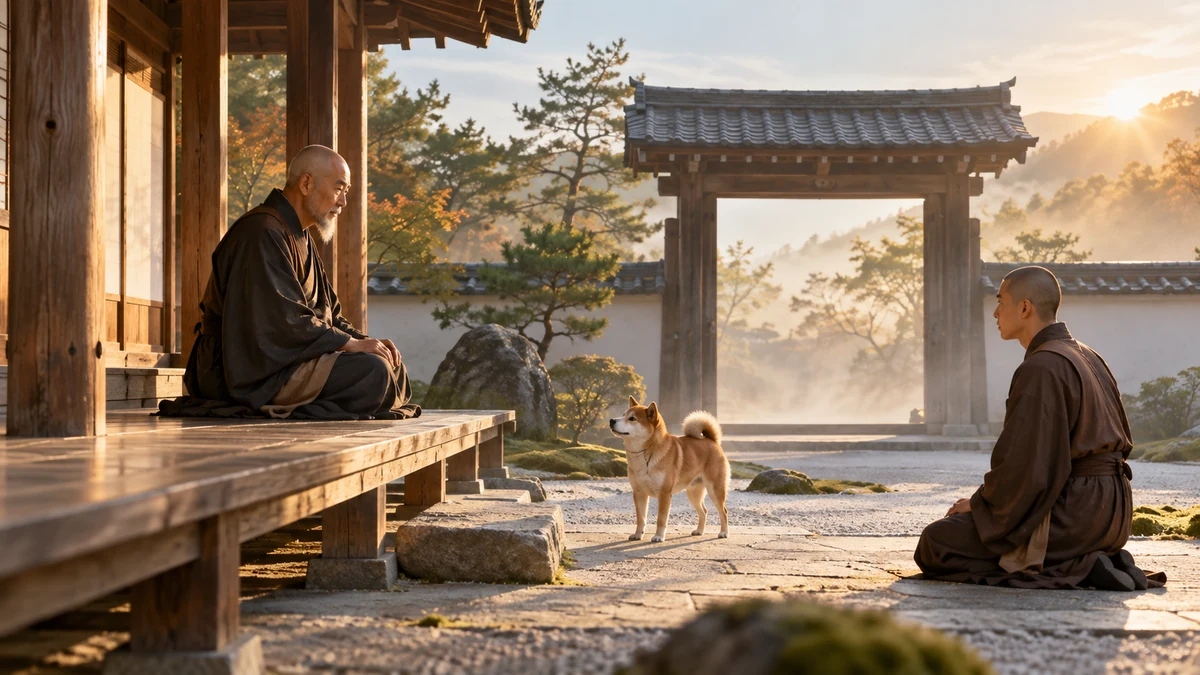
The word kōan has almost become synonymous in modern language with a paradoxical riddle: “What is the sound of one hand?” or “Does a dog have Buddha-nature?” There is some truth in this image, but historically it is too narrow. A kōan is not necessarily a question, and its original function was not to invent an illogical problem intended to short-circuit the student’s intellect. Before it became a meditative task, it was above all a case — a record of an act, dialogue, or saying of an earlier Chan master that later teachers quoted, commented on, reshaped, and used as a measure of understanding. [1][2]
The history of the kōan is therefore not the history of a single technique, but of movement between literature, ritual, the authority of the teacher, and meditative practice. Some cases are short and sharp; others carry extensive commentaries, verses, and subcommentaries. Some became the basis for concentrated meditation on a single phrase, while others functioned primarily as material for interpretation, teaching, or literary creation. If we reduce all of them to “questions with no logical answer,” we lose much of what they actually were. [1][6]
The “public case” is more than a metaphor
The Chinese term gōng’àn 公案, from which Japanese kōan derives, did not begin as a Buddhist technical term. Foulk shows that it comes from the legal world of medieval China: an referred to a magistrate’s desk or bench and, by extension, to a dossier or case before a judge; gong could mean public, official, or impartial. From this comes the now common translation “public case.” [1]
In the earliest Chan usages, the metaphor did not yet necessarily refer to a collection of old anecdotes. A master could function like a judge assessing a student’s spiritual understanding. Only gradually did records of earlier encounters between masters and disciples themselves begin to be treated as gōng’àn: cases that could be reopened, commented upon, and judged anew. By the time of Yuanwu’s Blue Cliff Record in the twelfth century, the term clearly referred as well to such textual “old cases.” [1][5][6]
The legal metaphor is therefore important, but it should not be translated too literally into the modern notion of legal precedent. A kōan is not a higher court ruling in the contemporary common-law sense. The idea is closer to an authoritative, publicly available case against which the quality of judgment becomes visible. When a Chan teacher comments on the act of an earlier master, the teacher symbolically takes the position of someone judging the case again — while his own understanding is simultaneously being judged. [1]
From story to practice
Many stories that later became kōans emerged from the tradition of so-called encounter dialogues — short narratives of meetings between disciples and masters in which the response often breaks ordinary expectation. Historical scholarship warns, however, against reading these texts naively as stenographic transcripts of spontaneous conversations from the Tang period. Collections were composed, edited, and literarily shaped in later institutional settings, especially during the Song. [1][8]
It was within this textual culture that the great classical collections emerged. The Blue Cliff Record contains one hundred cases associated with Xuedou’s verses and Yuanwu’s commentaries; it is a multilayered literary construction, not merely a list of meditation assignments. [5][6] The Wumen guan, compiled by Wumen Huikai in 1228, contains forty-eight cases, each followed by Wumen’s commentary and verse. [3][4][16]
The paradoxical quality of kōans is therefore not the opposite of language. The kōan tradition itself produced a vast amount of language: commentaries on commentaries, poems, allusions, striking phrases, and competing interpretations of the same case. Its critique of conceptual attachment is not simply a demand for silence. Often it is a transformation of the way language is used and of the way one clings to it. [1][6][13]
Mu: when “no” is not just an answer
The best-known case in the Wumen guan begins almost trivially. A monk asks master Zhaozhou whether a dog has Buddha-nature. Zhaozhou answers with a single character: wu 無, Japanese mu — roughly “no,” “not,” or “without.” [3][4] If the case is read as an ordinary theological question, a problem appears immediately: Mahāyāna teachings often speak of Buddha-nature in all sentient beings. Why would the master answer “no”?
Wumen’s way of using the case shows why a kōan is not a quiz. His commentary does not invite the student to search for a more sophisticated doctrinal explanation, but to penetrate the word Mu itself as though passing through a barrier. [3] In later practice this one word can become a huatou — a key phrase that the practitioner persistently observes and repeatedly returns to. In Dahui’s usage, the entire dialogue is the gōng’àn, while wu/mu is its huatou. [17]
Here too history prevents an overly simple interpretation. Steven Heine shows that other sources preserve versions of Zhaozhou’s exchange in which both “yes” and “no” appear, together with further dialogue. [15] The Mu kōan is therefore not necessarily a mysterious doctrine that the dog “lacks” Buddha-nature. Its later force comes precisely from the fact that one passage from a broader textual tradition was selected and transformed into an intensive practice.

Dahui and the major turn toward observing the key phrase
One decisive moment is associated with the twelfth-century master Dahui Zonggao. Dahui did not invent kōan literature, but he strongly influenced the development of kanhua Chan — the practice of “observing the key phrase.” Instead of extensive discussion of the entire case, the practitioner concentrated attention on the huatou, in Zhaozhou’s case on Wu/Mu. [7][8][17]
The point was not to compose a rational explanation that could be submitted to the teacher as the correct answer. Dahui sought to arouse a state of intense questioning or doubt in which ordinary conceptual solutions no longer sufficed. Later traditions came to speak of this as the “great doubt.” Yet this method too is historically specific: it is not evidence that all earlier kōans were originally designed as devices for stopping thought. Foulk therefore emphasizes that meditative introspection of the key phrase grew out of an older literary culture of collecting and commenting on cases. [1][7]
Dahui’s practice was also part of a broader dispute within Song Chan. Schlütter shows that Dahui sharply criticized what he called “silent illumination,” associated with his Caodong rivals, and emphasized kōan introspection against it. [8] The later difference between Rinzai and Sōtō Zen therefore has real historical roots, but the modern simplified formula “Rinzai = kōans, Sōtō = just sitting” is still too crude.
Hakuin, system, and one hand
In Japanese Rinzai Zen, kōan practice took on a particularly systematic form in the early modern period. Hakuin Ekaku decisively revitalized Rinzai practice in the eighteenth century and himself described the introduction of the “sound of one hand” as an especially effective device for arousing doubt. His successors developed graded curricula in which practitioners moved through different types of cases and tested their understanding in private encounters with a teacher. [9][10][14][18]
This matters because it shows that a “correct answer” in kōan practice is not necessarily a verbal solution one could read on the final page of a book. Traditional Rinzai training involves ways of presenting understanding, responses to follow-up questions, and in some systems suitable phrases and further cases. [9][14] The kōan is therefore embedded in the teacher–student relationship and in a broader curriculum; removed from that setting, it easily becomes only an exotic paradox.
At the same time it would be wrong to infer from this Rinzai systematization that the other major Japanese Zen tradition, Sōtō, had nothing to do with kōans. In the thirteenth century Dōgen made intensive use of Chinese Chan kōan literature and produced his own interpretations of numerous cases. Heine stresses that Dōgen’s approach is not simply an instrumental use of a kōan to produce a psychological breakdown; he often uses it as a linguistic and philosophical space in which realization is expressed and reinterpreted. [11][12][13]
Neither a meaningless riddle nor a secret coded answer
What, then, does it mean to say that a kōan “cannot be solved in the ordinary way”? It does not mean that reason is forbidden, that illogicality is sacred in itself, or that the student must guess a secret absurd sentence. The history of kōan literature is far too textually sophisticated for such an interpretation. Its masters wrote commentaries, compared different versions of cases, created poetry, and argued with one another about the proper use of these texts. [1][6]
More precisely, certain kōans destabilize a mode of questioning in which we assume that reality can be divided without remainder into two conceptual alternatives. In Mu, for example, the question “does it or does it not?” already establishes the frame that the practice then problematizes. The kōan does not necessarily replace the old theory with a new one; it can instead redirect the practitioner’s attention toward the way the practitioner produces the very problem he is trying to solve.
Even this should not be turned into a universal psychological theory of all kōans. Some work differently, some are closely tied to a specific doctrinal issue, and some to ritual or literary traditions. It is more accurate to speak of a family of practices and texts that changed over the centuries. [1][9][11]
The best correction to the popular definition is therefore simple: a kōan is not primarily a riddle with an impossible answer, but an authoritative Zen “case” that the tradition has used for commentary, judgment, meditation, and the transformation of perspective. At times it brings us to a question that ordinary logic does not resolve. But its power lies not in excluding logic, but in revealing the limits of the frame within which the question was posed in the first place.
Sources and further reading
- T. Griffith Foulk, “The Form and Function of Kōan Literature: A Historical Overview,” in The Kōan: Texts and Contexts in Zen Buddhism. Source
- Oxford Academic — Foulk chapter metadata. Source
- BDK America — Three Chan Classics, including Wumen’s Gate. Source
- Jimmy Yu, Readings of the Gateless Barrier. Source
- BDK America — The Blue Cliff Record. Source
- Steven Heine, Chan Rhetoric of Uncertainty in the Blue Cliff Record. Source
- Miriam Levering, “Dahui Zonggao (1089–1163).” Source
- Morten Schlütter, How Zen Became Zen. Source
- Michel Mohr, “Emerging From Nonduality: Kōan Practice in the Rinzai Tradition Since Hakuin.” Source
- Stanford Encyclopedia of Philosophy — Japanese Zen Buddhist Philosophy. Source
- Steven Heine, “Koans in the Dogen Tradition,” Philosophy East and West 54.1 (2004). Source
- Steven Heine, Dōgen and the Kōan Tradition. Source
- Steven Heine, “Just Sitting and Just Saying.” Source
- Isshū Miura and Ruth Fuller Sasaki, The Zen Koan: Its History and Use in Rinzai Zen. Source
- Steven Heine, Like Cats and Dogs: Contesting the Mu Koan in Zen Buddhism. Source
- Ishii Shūdō and Albert Welter, “The Wu-men kuan (J. Mumonkan): The Formation, Propagation, and Characteristics of a Classic Zen Kōan Text.” Source
- Steven Heine, “Does Even a Rat Have Buddha-Nature? Analyzing Key-Phrase (Huatou) Rhetoric for the Wu Gongan,” Journal of Chinese Philosophy 41 (2014). Source
- “Spiritual Exercises in the Rinzai Zen Tradition: Imminence and Disruption in Ikkyū Sōjun and Hakuin Ekaku,” Religions 15.2 (2024). Source