Pure Land Sutras — What Is Sukhāvatī, and Why Did Amitābha Become One of the Most Venerated Buddhas?
Imagine a Buddhist world in which the path to awakening is long, demanding, and stretched across innumerable lives. Meditation is difficult. Wisdom is difficult. Kleśas are powerful. Human life is short.
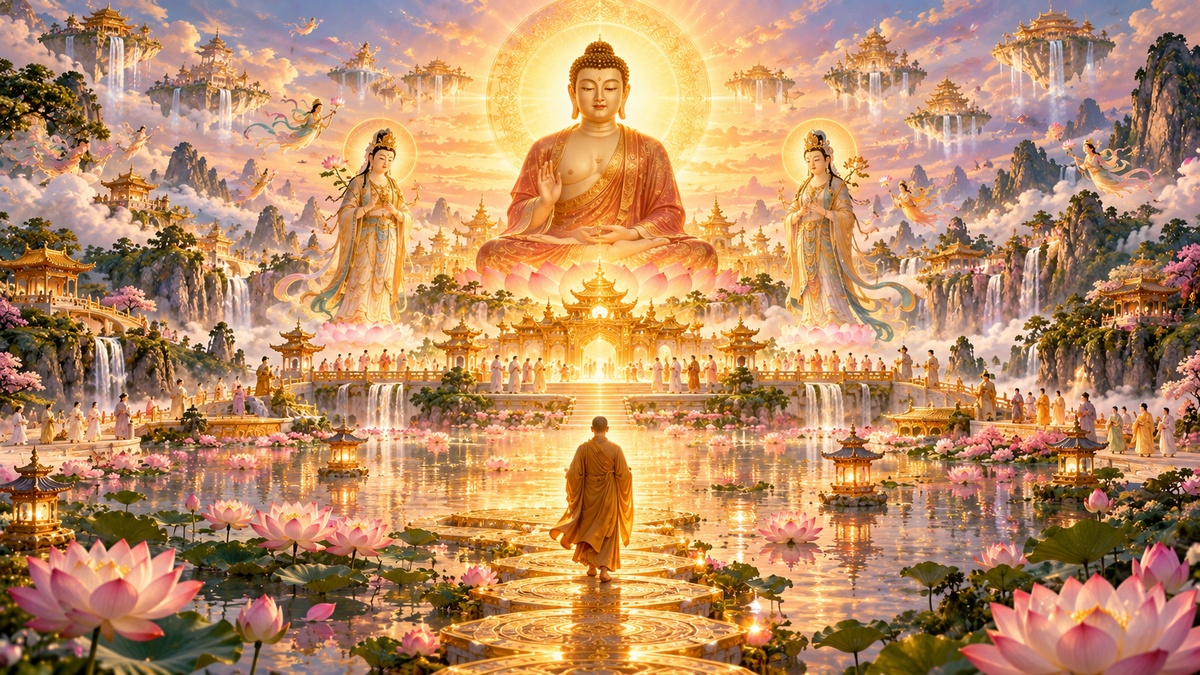
Imagine a Buddhist world in which the path to awakening is long, demanding, and stretched across innumerable lives. Meditation is difficult. Wisdom is difficult. Kleśas are powerful. Human life is short. What if there were a Buddha-field where the conditions for awakening were extraordinarily favorable? Where the Dharma was always present? Where rebirth was not an escape from practice but the best possible environment for continuing the path. This is Sukhāvatī.
What Does Sukhāvatī Mean?
In Sanskrit: Sukhāvatī — roughly, the land of bliss. In East Asian traditions it is often called the Pure Land. But that expression can mislead. Sukhāvatī is not an eternal heavenly reward bestowed by a creator, but a buddhakṣetra — a Buddha-field. It is a realm connected with a Buddha's vows, merit, wisdom, and activity for the benefit of beings. Rebirth there is therefore not the final goal but a soteriological means.
Who Is Amitābha?
In Sanskrit: Amitābha — Immeasurable Light. A related name is Amitāyus — Immeasurable Life. In China: Āmítuófó. In Japan: Amida. He became one of the most venerated Buddhas in East Asian Buddhism.
But the story begins with Dharmākara. In the Longer Sukhāvatīvyūha, Amitābha is initially Dharmākara. In some versions he is a former king who encounters the Buddha Lokeśvararāja. He renounces his worldly position, becomes a monk and bodhisattva, and formulates a great project for a Buddha-field.
His vows. Dharmākara makes a series of great vows. In the standard East Asian version used today there are 48, but this number is not universal. Surviving versions of the Longer Sukhāvatīvyūha preserve different numbers and arrangements of the vows. The earliest recensions contain 24 vows, while the later influential tradition has 48. It is therefore better to say: 48 is the standard of later East Asian tradition, not necessarily the original universal form of the text.
Five surviving Chinese translations. The Longer Sukhāvatīvyūha has five surviving Chinese translations. The first was produced already in the middle of the second century. The versions differ in titles, narrative, number of vows, and individual doctrinal emphases. This matters: the Pure Land corpus has its own long textual history.
The eighteenth vow. Later Pure Land traditions often treat
the eighteenth vow
as central. But here we must be careful. We will not write: “Amitābha promises that anyone who says his name ten times will automatically go to the Pure Land.” That is a later simplification. In the older textual language the issue involves trust, orientation of mind, the wish for birth in Sukhāvatī, recollection of the Buddha, and formulations about ten thoughts or moments of recollection. Later East Asian traditions will connect this ever more closely with the oral recitation of the name.
Buddhānusmṛti. This is a key term. In Sanskrit: buddhānusmṛti — recollection or contemplation of the Buddha. It does not necessarily mean only saying the name; it can mean recollecting the Buddha's qualities, mental focusing, visualization, contemplation, or meditation.
Nianfo
In Chinese: nianfo. This is a translation or development of the idea of buddhānusmṛti. In different periods it can mean mental recollection, visualization, contemplation of the Buddha, holding his name in mind, or oral recitation. It is therefore incorrect to project later Japanese nembutsu backward into the earliest Indian practice.
Nembutsu. In Japanese: nembutsu. In later Pure Land schools it becomes primarily the recitation of Amitābha's name. The best-known formula is Namu Amida Butsu. But only through historical development does verbal recitation become so central.
Hōnen. In the twelfth century Hōnen chooses nembutsu as the central practice. The emphasis is no longer on complex visualizations or a wide range of meditations but on calling Amitābha's name and trusting his vow. This is a later Japanese reformulation.
Shinran. Shinran shifts the emphasis even further, from one's own achievement toward shinjin — deep entrusting. For him nembutsu is not primarily a technique for accumulating merit. It becomes an expression of Amitābha's activity and of gratitude. But this is already Jōdo Shinshū theology, not the direct form of the early Indian sutras.
The Three Central Sutras
Later East Asian tradition often groups together three central sutras:
1. The Longer Sukhāvatīvyūha. Dharmākara, the vows, Amitābha, Sukhāvatī.
2. The Shorter Sukhāvatīvyūha. A condensed account of Amitābha, Sukhāvatī, and recollection of the Buddha.
3. The Sutra on the Visualization of the Buddha of Immeasurable Life. Vaidehī, Amitābha, and the sixteen contemplations.
But these three do not share the same textual history. The first two have Indian textual lineages. The third is a different case. No Sanskrit original of the Visualization Sutra survives. No Tibetan translation is known. Its structure and terminology strongly point to a Chinese or Central Asian–Chinese textual environment. Many modern scholars therefore treat it as a later composition outside India.
Traditional and Historical-Critical Perspectives
Traditional perspective: a discourse of the Buddha. Historical-critical perspective: a text with a complex Chinese or Central Asian formation. Our article will not replace one level with the other.
Vaidehī. The Visualization Sutra tells of Queen Vaidehī. A family tragedy drives her to despair with the world. She turns to the Buddha. The Buddha shows her various Buddha-fields. She chooses Sukhāvatī.
The sixteen contemplations. She then receives instructions for sixteen meditative visualizations. These include the setting sun, water, the ground of the Buddha-field, jeweled trees, the throne, Amitābha, Avalokiteśvara, Mahāsthāmaprāpta, and grades of rebirth. This shows that Pure Land practice was not only verbal recitation.
What Is Sukhāvatī Like?
The sutras describe it with lakes, lotuses, precious ground, trees, light, music, and beings or sounds that remind one of the Dharma. The entire environment is arranged to support practice.
This is the essence. In the ordinary saṃsāric world, conditions often nourish kleśas. In Sukhāvatī, conditions are supposed to nourish awakening.
Is Sukhāvatī literally a real place? Traditional schools answer differently. Some say yes — a real Buddha-field. Others speak of the Pure Land of the mind. Still others combine both perspectives. Our article therefore will not say it is proven to be a physical place in the universe. Nor will it say it is only a psychological metaphor. More honestly: the sutras present it as Amitābha's buddhakṣetra, while later traditions interpret its ontological status in different ways.
Is Sukhāvatī Nirvāṇa?
Not simply. Sukhāvatī is a Buddha-field. Rebirth there is an exceptionally favorable step on the path toward awakening, not merely eternal residence in bliss.
Why is the Pure Land approach so important? Because it changes the question. Instead of “Am I perfect enough for awakening?” it asks: “Can I enter conditions that allow me to continue the path?” This is a major shift.
Self-Power and Other-Power
Later Japanese Buddhism will speak of jiriki — self-power and tariki — other-power. But this is a later systematization. We should not present it as the original technical terminology of the earliest Sukhāvatī sutras.
What does “other-power” mean? In some Pure Land traditions, the path to liberation does not depend only on my meditative ability, my discipline, or my understanding. It is also connected with Amitābha's fulfilled vow. This is not the same as the theistic grace of a creator. It is a Mahāyāna framework of Buddha activity, merit, and bodhisattva vow.
Amitābha is not a creator. This is an important safeguard. Amitābha is not a creator God, did not create the universe, and is not the absolute ruler of all beings. He is a Buddha. Yet devotion to him can outwardly look highly theistic: prayers, the name, trust, aspiration for birth in his field. This is a Buddhist devotional form, not monotheism.
Why is Amitābha so popular? Because he brings together a clear image of a Buddha, a clear Buddha-field, clear vows, and a practice accessible to a very wide range of people. One need not be a monk, a philosopher, or a master of the most demanding meditation systems.
But this is not “easy Buddhism.” That would be a patronizing simplification. Pure Land traditions develop highly sophisticated teachings about trust, merit, Buddha bodies, emptiness, vows, karma, transfer of merit, and the relationship between one's own effort and Buddha activity.
Pure Land is not only a Japanese tradition. Before Hōnen and Shinran there is a long Chinese Pure Land history. Important figures include Huiyuan, Tanluan, Daochuo, Shandao, and others. The practice also spreads to Korea, Vietnam, Japan, and other Buddhist environments.
Nianfo changes over time. In earlier practices it can mean meditative recollection. Later, holding the name in mind. With Shandao, oral recitation becomes increasingly important as well. In Japan, nembutsu becomes the central practice of distinct Pure Land schools. This is historical development, not one unchanged practice from the beginning.
Chan and Pure Land. In China they are not necessarily opposing camps. Chan monks can practice nianfo. A Pure Land practitioner can meditate. Later Chinese tradition often develops combined practices. The equation Zen versus Pure Land is therefore not always historically appropriate.
The deepest theme: trust. In Prajñāpāramitā: wisdom. In the Avataṃsaka: a relational cosmos. In Pure Land teaching, trust comes strongly to the foreground. Not only trust in Amitābha, but also in the possibility that awakening is not the project of a completely self-sufficient individual.
This connects directly with anattā. If there is no self-subsisting self, why should liberation be exclusively my individual project? Pure Land can answer: the path itself is relational. Teachers. Vows. Buddha activity. Merit. Community. All participate.
But practice still exists. Trust does not mean passivity. Pure Land traditions can include ethics, nianfo, nembutsu, visualization, bodhicitta, meditation, transfer of merit, and vows.
Conclusion
The Pure Land sutras shape one of the most influential Mahāyāna traditions. Their basic narrative is simple. Dharmākara makes great bodhisattva vows. He attains Buddhahood as Amitābha. His Buddha-field is Sukhāvatī. Beings can turn toward him, recollect him, develop the wish to be born in his field, and there continue the path. But beneath this simplicity lies a long textual history: five Chinese versions of the Longer Sutra; different numbers of vows; development from buddhānusmṛti through nianfo to nembutsu; the Visualization Sutra with a different historical provenance; and later debates over self-power and other-power. Pure Land is therefore not best understood as “Buddhist heaven.” Sukhāvatī is not an eternal vacation destination but a Buddha-field intended for continuing the path to awakening. Amitābha's vow is not a cheap shortcut around Buddhist practice, but a Mahāyāna answer to a very human question: What happens to beings who desire awakening but know their own capacities are imperfect? The Pure Land answer is: the path does not depend only on your own power. A Buddha's vow, recollection, relationship, trust, and environment can also become part of the path.
Sources and Literature
Primary Texts and Reference Editions
- Inagaki, Hisao, with Harold Stewart, trans. The Three Pure Land Sutras. rev. 2nd ed. Numata Center / BDK, 2003.
Research and Verification Literature
- Inagaki, Hisao, with Harold Stewart, trans. The Three Pure Land Sutras. Revised 2nd ed. Numata Center for Buddhist Translation and Research, 2003. ISBN 9781886439184.
- Quinter, David. “Visualization/Contemplation Sutras.” Oxford Bibliographies in Buddhism. Published 2013; version 2018. DOI 10.1093/obo/9780195393521-0137.
Note: verification sources are part of the editorial apparatus. Where the original edition used during reconstruction was not preserved, a standard reference edition is not presented as the article's presumed original source.