Thirteenth Step: Replace the Human
When technology no longer merely helps the human being, but begins taking over their work, their decisions, their relationships — and finally redefining the human being itself
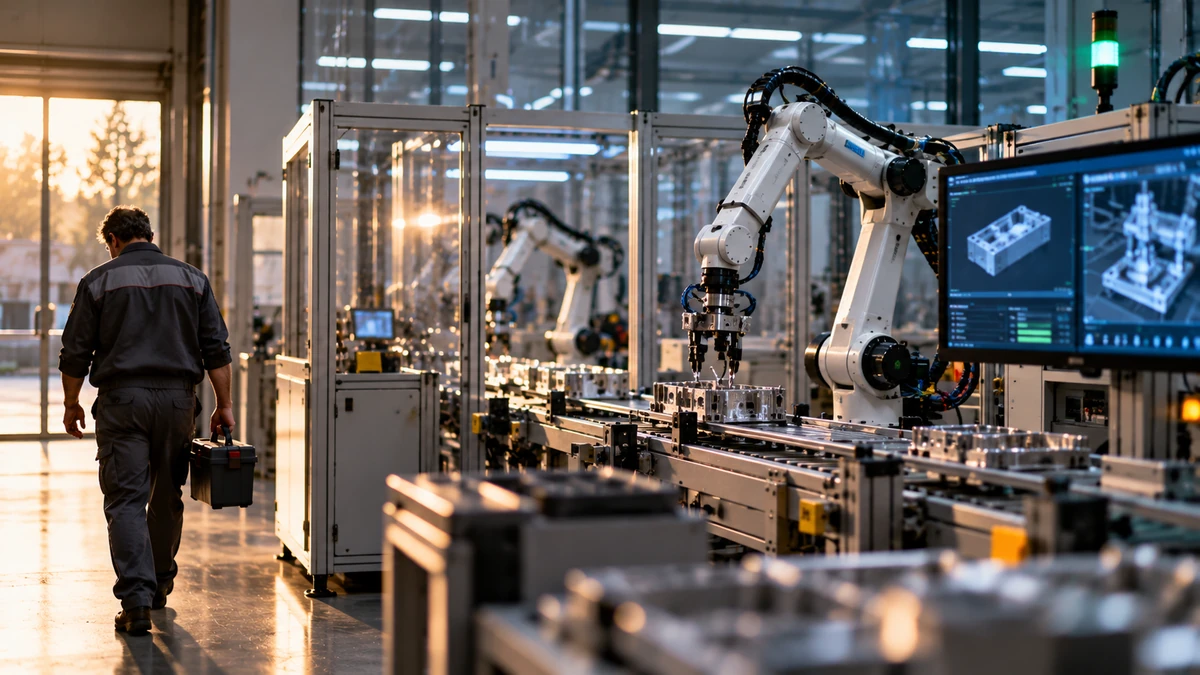
For a long time we built machines to help people. The plough increased human strength. The engine increased speed. The computer increased memory. The internet increased access to information. Artificial intelligence opens something different. It does not merely increase human capability. It is beginning to perform tasks that only yesterday we considered inseparably human. It writes. Translates. Programs. Analyses. Draws. Speaks. Diagnoses. Advises. Teaches. Plans.
It imitates empathy. And increasingly it no longer merely stands beside the human being. It stands in their place. This is the thirteenth step. Not the question of whether technology is good or bad. The question is:
What happens to the human being when the system discovers that it no longer needs a human at all for more and more human functions?
First it replaces the task
Every automation begins innocently. Why should a person spend eight hours copying data if a machine can process it in a second? Why should a driver plan a route manually if an algorithm calculates it better? Why should an accountant inspect thousands of rows if a model can check them faster? Why should someone write a routine report if AI can generate it? These are not unreasonable questions. That is precisely why the process is so powerful. Efficiency almost always defeats nostalgia. The World Economic Forum’s Future of Jobs Report 2025 likewise treats AI, robotics and automation as central forces reshaping jobs and required skills.[3]
But automation does not stop with boring tasks. In 2025 the International Labour Organization estimated that roughly one quarter of jobs worldwide are at least partly exposed to generative artificial intelligence. Its conclusion was not that a quarter of humanity would be unemployed tomorrow. Quite the opposite: the most likely short-term outcome is transformation of work rather than complete replacement.[1][3] But the direction is clear. More and more tasks that once required a human can be transferred to a machine.[1]
The IMF estimated even more broadly that almost 40% of global employment is exposed to AI, and around 60% in advanced economies. For some of these jobs AI is expected to augment the human worker. For others it may perform key tasks in their place, reduce demand for their labour, lower wages or reduce hiring. And in the most extreme cases, some jobs may disappear. This is not a prophecy from the edge of the internet. These are institutions that monitor the global labour market speaking.[2]

Then it replaces judgement
But work is not merely a physical task. Work is also a decision. Who receives credit? Who is a high-risk patient? Who needs further tests? Which candidate is suitable for a job? Which transaction is suspicious? Which pupil needs help? Which content is dangerous? Who presents a greater risk? When such decisions are handed to an algorithm, you have not automated only work. You have automated judgement. The World Health Organization warns, in the use of AI in healthcare, about so-called automation bias: a health worker or patient may overlook an error they would otherwise have noticed, or improperly defer a difficult decision to a model because they trust its answer too much. This is not an abstract detail.[4] Human beings have a strange tendency. If a system decides correctly for them ten times, on the eleventh they often stop checking. If the algorithm is good enough, human judgement gradually becomes a formality. And one day the human being remains “responsible” for a decision they did not really make.
Then it replaces the creator
For a long time we believed automation would mainly take over physical and routine work. The human being would retain what was truly theirs. Creativity. Language. Art. Ideas. Imagination. Then came systems that generate images. Music. Video. Text. Voices. Code. Advertising. Scripts. Illustrations. The human did not disappear. But their role changed. A creator can become a supervisor of the machine. A writer an editor of generated text. An illustrator an operator of a model.
A programmer becomes a reviewer of code. An expert becomes an approver of algorithmic proposals. This can be extraordinarily productive. But it can also change the measure of human value. If one person with AI can do the work of ten, the system will not necessarily ask: How do we give ten people more free time? It may ask: Why are we still paying ten people? And this is where efficiency changes from a tool into pressure.
Then it begins replacing the relationship
A human being does not need only work. They need another human being. A friend. A partner. A teacher. A therapist. A conversational partner. Someone who listens. But digital systems have begun entering here too. AI companions are designed to speak, listen, respond, remember context and create a sense of relationship. In 2025 UNESCO’s Ideas Lab published a contribution specifically warning about children’s parasocial attachment to AI chatbots and the danger that a child may begin experiencing the system as a person even though there is no person on the other side.[5]
This is not an argument for banning the technology. It is a warning about a new boundary. Because an artificial friend has certain advantages over a real person. It is never late. It does not get tired. It asks nothing for itself. It does not leave. It does not disagree, if designed to adapt. It is available at three in the morning. And it can be precisely optimised for the user. A real relationship is harder. Another person has a will of their own. They can disappoint you.
They can say no. They can demand compromise. That is precisely why relationships shape us. What happens if a generation of people begins meeting its deepest emotional needs through a system that can be programmed? And who defines the personality of that system? Who decides what it encourages? Who defines its boundaries? Who reads the data a person entrusts to a digital companion in their loneliest moments?
Then it no longer improves the tool, but the human
Until now the basic logic of technology was: the human remains human while the tool gets better. But there is another logic. If the human is too slow, improve the human. If memory is too limited, improve memory. If they are too weak, add an exoskeleton. If they cannot see enough, extend the senses. If they connect to computers too slowly, shorten the path between brain and machine. If biology is limited, alter biology. At the World Economic Forum’s Annual Meeting of the New Champions 2016, a session entitled “What If: We Become Superhuman?” directly asked what happens if human enhancements become necessary in order to compete for the best grades and the best jobs.[6]
Two years later the same platform hosted an author contribution asking an even more direct question: what happens when technology no longer restores lost function but enables a healthy person to exceed normal human abilities? Memory. Strength. Senses. Endurance. Cognitive ability. Then a problem appears that is more important than the technology itself. Competition. A WEF-hosted contribution from Nokia likewise discussed bio-digital interfaces and human augmentation as a direction for future connectivity.[8] If only one person has an enhancement, it is a choice. If most of your competitors have it, the same “choice” can become something entirely different. Similar discussions on the WEF platform have also described bio-digital interfaces and other forms of human augmentation, showing that the boundary between external tools and a technologically augmented body is no longer merely literary.[7][8]
If you cannot get a job without a cognitive enhancement, how voluntary is the decision to accept it? If enhanced soldiers outperform unenhanced ones, how long will an army tolerate the slower option? If an enhanced pupil always outperforms the natural one, does the natural human body eventually become merely an obsolete platform? Advocates and critics of human enhancement were asking this question long before today’s AI boom. It is no longer abstract.
The genome has already become something we know how to edit
In 2023 the U.S. FDA approved Casgevy, the first approved therapy using CRISPR genome-editing technology. Its purpose is to treat severe disease. That is an important medical breakthrough. For a person with sickle-cell disease, gene-edited therapy can change a life. But once a civilisation develops the ability to alter the human genome, the question does not end with disease. The question of the boundary begins. What is disease? What is an undesirable trait? What is enhancement?[9]
What is parental choice? What is social pressure? What is acceptable to change in a human being who has not yet been born? WHO has therefore long warned that heritable human genome editing belongs to an entirely different ethical category from treating somatic cells in an individual patient. In 2019 its expert committee said it would at that time be irresponsible to proceed with clinical applications of germline genome editing. Why? Because the change would not affect only the patient. It could pass to their descendants. At that point humanity is no longer merely changing itself. It is beginning to alter the future human lineage.[10]
Treatment and enhancement are not the same thing
The future will try to blur this distinction. If technology restores sight to a blind person, that is treatment. If it enables a healthy person to see infrared light, that is enhancement. If an implant enables a paralysed person to move a cursor, that is restoration of lost function. If it enables a healthy person to control a computer directly with thought, we are somewhere else. If gene therapy removes disease, the goal is clear. If genetics is used to select or increase intelligence, appearance, muscle mass or other traits, we are no longer treating disease.
We are designing the human being. Author contributions hosted by the World Economic Forum have warned, in debates on human enhancement, that such developments could create a society of enhanced and unenhanced humans, and that something beginning as free choice may become a new normal under competitive pressure. That matters. The greatest danger of future augmentation may not be state coercion at all. It may be the market. An employer will not say: You must enhance yourself. They will say: We selected the more productive candidate.
A school will not say: You must use cognitive enhancement. It is simply that all the top students will. An army will not say: Your natural body is not good enough. The standard will simply become one that can no longer be reached without technology. The coercion of the future can be entirely voluntary. As long as the price of refusal is high enough.
And then the question reverses
At first we asked: How can technology serve the human being? Then: How can the human being become better with technology? The next question is much more uncomfortable:
How must the human being change in order to remain useful in a world run by machines?
This is the turning point. If a person has to increase cognitive capacity because AI works faster; if they must monitor their body because an algorithm demands data; if they must accept an implant because direct connection is more efficient; if they must genetically optimise the next generation because others do it; then the human being is no longer master of technological development. The human begins adapting to the machine. And this may be the deepest inversion of the entire path. The tool we created for our own use begins setting the standards by which we judge ourselves.
What if the goal is not to replace every human?
Perhaps the word “replacement” misleads. Perhaps the system does not need to remove the human being. Perhaps it only needs to reshape them. A person can remain biological. Have a name. A family. Memories. A personality. And yet so many of their functions can be delegated to systems that they can no longer live normally without them. AI decides what they see. AI helps decide where they work. AI writes their documents. AI selects information. AI advises on health. AI communicates on their behalf.
AI becomes their conversational partner. Digital identity proves who they are. Digital money enables exchange. Sensors monitor the body. An implant connects the nervous system. Genetics begins altering biology. On paper they are still human. Functionally they have become a node in the system. Perhaps transhumanism does not arrive at the moment a human becomes a metal robot. Perhaps it arrives much more quietly. When it becomes completely normal that a person must be technologically supplemented in order to participate normally in society.
The most dangerous sentence will be: “It is only an enhancement”
As with every previous step, no one will need to sell this through dystopia. The sales pitch will be positive. Better memory. Longer life. Less disease. Greater productivity. Better concentration. Direct access to information. Better senses. Faster communication. Greater physical strength. Why would a person say no? And that is precisely why the question has to come before the technology becomes necessary. Not: Is the enhancement useful? But: Can a person remain unenhanced and still participate in society as an equal? That is the real boundary of freedom. If the answer is no, we are no longer dealing with personal choice. We are dealing with a new human standard.
The human being is not an error we need to fix
Technology can heal. It can restore sight. It can enable a person to communicate when they otherwise could not. It can reduce suffering. It can remove genetic disease. It can do dangerous or degrading work instead of a human being. All of that is worth developing. But somewhere a boundary must remain between technology that serves the human being and a human being who must become technologically compatible in order to serve the system. If we do not set that boundary ourselves, it will be set by the market, the military, competition, platforms, algorithms and those who own the technology.
A newer discussion on the WEF platform explicitly frames the same dilemma as a choice between augmentation and substitution of human cognition.[11] Then the final question will no longer be: What can we do with the machine? It will be:
What else can we do to the human being?
And if the answer is always only “whatever is technically possible”, we may one day discover that, in trying to improve the human being, we first forgot why the human was worth preserving at all. That is the thirteenth step. Not the death of the human. Something quieter. The moment the human ceases to be the measure of technology — and technology becomes the measure of the human.
Sources and further reading
- ILO: generative AI and jobs. International Labour Organization, One in four jobs at risk of being transformed by GenAI, new ILO–NASK Global Index shows, 20 May 2025 Source
- IMF: almost 40% of global employment is exposed to AI. International Monetary Fund, Kristalina Georgieva, AI Will Transform the Global Economy. Let’s Make Sure It Benefits Humanity, 14 January 2024 Source
- WEF: Future of Jobs / broader automation. World Economic Forum, The Future of Jobs Report 2025 — Jobs outlook Source
- WHO: risks of automated judgement in healthcare. World Health Organization, WHO releases AI ethics and governance guidance for large multi-modal models, 18 January 2024 Source
- UNESCO Ideas Lab: emotional attachment to AI chatbots. UNESCO Ideas Lab, Ghost in the Chatbot: The perils of parasocial attachment, 9 July 2025 Source
- WEF 2016: official session “What If: We Become Superhuman?” + accompanying author contribution. World Economic Forum, Annual Meeting of the New Champions 2016 — Programme and What if: we become superhuman? Source 1 Source 2
- WEF-hosted author contribution: technology for enhancing healthy humans. World Economic Forum, Here are five things to know about the future of being human, 24 May 2018 Source
- WEF-hosted contribution / Nokia: bio-digital interfaces and human augmentation. World Economic Forum, 2 tech trends that will shape networks and the future of connectivity, 2022 Source
- FDA: first approved CRISPR gene-editing therapy. U.S. Food and Drug Administration, FDA Approves First Gene Therapies to Treat Patients with Sickle Cell Disease, 8 December 2023 Source
- WHO: human genome editing and the boundary of heritable changes. World Health Organization, Human genome editing: recommendations, 12 July 2021 Source
- WEF: AI as augmentation or substitution of human cognition. World Economic Forum, As AI becomes more capable, how can we ensure people become more capable too?, 21 September 2026 Source