Twelfth Step: Enter the Body
When the system no longer tracks only what you do, but begins to read — and perhaps one day also alter — the signals of your body
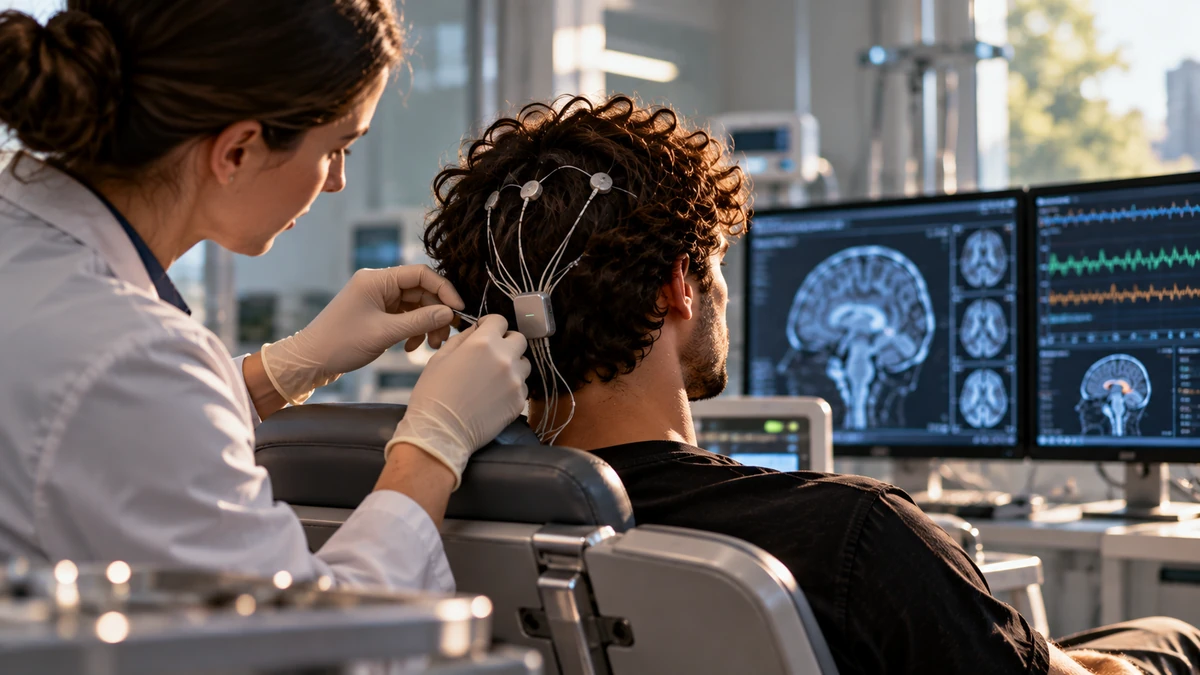
Up to this point the boundary was still clear. The phone was outside the body. The camera was on the wall. The card was in the wallet. Digital identity was in an app. The smart watch was on the wrist. The system knew where you went, what you bought, what you read, whom you spoke to and how you used your devices. But there was still a boundary. Skin. The twelfth step crosses that boundary. Not because every technological movement towards the body is evil.
Quite the opposite. The strongest reason for technology to enter the body is often one of the most human reasons imaginable: to restore movement to someone who has lost it; enable a paralysed person to communicate; restore hearing; treat neurological disease; monitor the heart; prevent an epileptic seizure; deliver medicine more precisely. And that is precisely why this step matters so much. Because technology that can heal a person can also measure them. Technology that can read a signal can, in some systems, also write back to it.
Technology that is a medical device today may tomorrow become a tool for enhancing a healthy person’s abilities. And once the connection between body and network becomes normal, the question will no longer be only: Can technology enter the body? It already does. The question will be:
Who controls the connection, the data and the right to disconnect?
The internet no longer stops at objects
First we connected computers. Then phones. Then televisions, cars, thermostats, cameras, locks and refrigerators. We called this the Internet of Things. The next phrase sounds considerably more uncomfortable: Internet of Bodies. This is not a term from an anonymous blog. In 2020 the World Economic Forum published a report entitled The Internet of Bodies Is Here that directly described a new generation of connected devices and sensors that can be worn, attached to the body, implanted or ingested.[1]
The report discusses the enormous amounts of biometric and behavioural data such devices can generate. Healthcare. The workplace. Entertainment. Finance. Insurance. It also discusses risks. Privacy. Autonomy. Discrimination. The possibility that data from the body could affect employment, education, financial services or access to health insurance. This is the key moment. Because the body is no longer only a body. It is becoming a source of data.
And bodily data are not like a history of watched videos. They can reveal health. Sleep. Stress. Heart rhythm. Movement. Disease. Nervous-system responses. One day perhaps far deeper states as well. The internet has therefore acquired a new door. Not into the house. Into the person.
First came the watch
The transition is almost imperceptible. A smart watch measures steps. Then heart rate. Then sleep. Then blood oxygen. Then temperature. Then it warns of an irregular rhythm. For the user this can be extraordinarily useful. But at the same time it changes a fundamental cultural assumption. Once, the body was something a person primarily felt. Today it is increasingly something a person reads through a data dashboard. How long did I sleep? How well did I sleep?
How much did I move? Is my stress too high? Was I active enough today? Is my heart rate normal? Measurement itself is not the problem. The problem begins when the measurement no longer remains only information for the person. When it becomes information for a provider. A doctor. An employer. An insurer. An algorithm. A risk-scoring system. Then the body is no longer only your biological life. It becomes a profile.
Then you swallow the device
The Internet of Bodies is not limited to watches. As an early example, the WEF also described so-called digital pills or medicines containing ingestible sensors. In 2017 the U.S. FDA approved the first medicine with an embedded digital sensor capable of detecting an ingestion event and transmitting that information onward into a system. The medical logic is understandable. If a doctor does not know whether a patient takes their medicine, treatment is harder.[2]
If the system knows, it can help. But again the boundary changes. Once, whether you swallowed a tablet was an event between you and your body. Now it can become a digitally recorded event. And here the same question of this series returns again and again:
What happens when the ability to measure becomes the expectation of measurement?
What happens if an insurer one day says: if you want a lower premium, share the data? If an employer says: if you want a particular job, show your health profile? If a social-benefit system says: if you want the benefit, prove compliance? There is no need to claim that such a system has already been universally implemented. The point is different. The technical boundary has been crossed. The body can be connected to a data network.
Then comes the implant
The next step is much more direct. Not a watch on the wrist. Not a pill in the stomach. A device in the brain. In September 2023 Neuralink officially opened recruitment for its first human clinical study, PRIME. The initial study has a medical and very specific purpose: to enable people with paralysis to control a computer cursor or keyboard using brain signals alone. The N1 implant is fully implanted, wireless and records brain activity. In January 2024 the first human received a Neuralink implant.[3][4][5]
By February 2025 the company reported three people with paralysis who had received implants; in January 2026 Neuralink said it already had 21 clinical-trial participants. This is no longer a futuristic animation. A person with an implant can intentionally move a cursor, use a computer and communicate with the digital world. For someone who cannot move their arms or legs, this can be an extraordinary gain in freedom. But Neuralink itself does not limit its long-term goal to moving a cursor. In an official PRIME update, the company wrote that its ultimate objective is to create a generalised input/output platform capable of interfacing with every aspect of the human brain.[3][4][5]
Read that again. Not only input. Input and output. Not one signal. A general platform. Not one narrow function. Every aspect of the human brain. Today’s clinical trials do not yet enable this. But the direction of development is not secret. It is written into the company’s own vision.
.jpg)
The military went a step further
If brain-computer technology were interesting only for patients, this article could remain almost entirely medical. But it is not. In its N3 programme — Next-Generation Nonsurgical Neurotechnology — DARPA funded the development of high-performance bidirectional brain-machine interface systems for healthy service members. Not people with paralysis. Not rehabilitation after injury. Healthy people. DARPA listed possible purposes including control of unmanned systems, active cyber defence and collaboration between humans and computer systems during demanding military tasks.[6]
The goal was to develop a non-invasive or minimally invasive system capable of both reading from and writing to the brain with high precision. The programme is now complete. But its significance remains. When someone says the idea of a bidirectional digital interface with a healthy human brain is pure science fiction, there is an official document from the U.S. defence research agency saying otherwise. This does not prove secret mass deployment. It proves something important enough:
the development of technology for directly linking healthy human brains with digital systems has already been an official military research objective.
And that changes the discussion.
The most dangerous phrase is “read and write”
Reading brain signals alone raises a privacy question unlike anything humanity has known before. But the real boundary lies elsewhere. Write. Write back. Alter activity. Modulate. Stimulate. In 2025 the World Health Organization included brain-computer interfaces, neuromodulation and data, security and dual-use risks in its review of neurotechnology. UNESCO, meanwhile, explicitly addresses cognitive liberty, mental privacy, cerebral and mental integrity, autonomy and freedom of thought in its neuroethics framework.[7][8][9]
Those warnings include the possibility of malicious use of neurotechnology and brain data. These are not phrases from people panicking about the future, but issues serious enough for international institutions to build dedicated rules around them. When an official ethical framework begins speaking about protecting mental privacy and the integrity of the human mind, it means we have technologically reached a point where the interior of the human mind itself is becoming an object of political and legal protection. That is a historic shift.
UNESCO had to draw a boundary around the mind
In November 2025 UNESCO adopted the first global recommendation on the ethics of neurotechnology. Why? Because the technology is no longer confined to hospitals. UNESCO warns that neurotechnology can directly measure, access, monitor, analyse, predict or modulate the nervous system. It particularly highlights mental privacy, autonomy, dignity and the dangers of use outside healthcare — for example in education, employment, commercial settings and other social domains. UNESCO speaks of the inviolability of the human mind. You do not need such a principle because nothing is happening.
You need it because technology is opening a possibility that previously scarcely existed. Until now, a government could read your letter. Listen to a telephone call. Inspect your bank account. Track your location. Analyse your internet history. Now humanity has to think about another question: can someone access neural data too? And even more importantly: can someone influence the system in the other direction?
Treatment is the most beautiful doorway
That is why criticism at this step must be especially precise. Neurotechnology can give people back something that disease or injury took from them. That is worth defending. The problem is not giving a paralysed person the ability to communicate again. The problem is the possibility that, after successful medical normalisation, the technology gradually moves into other spheres. First: treat disease. Then: restore lost function. Then: enhance healthy function. Then: competitive advantage.
Then: expected standard. And in the end something may happen that happens again and again with technology: a voluntary advantage becomes a practical necessity. If one day a worker with neurotechnological augmentation reacts faster, learns faster or operates more systems simultaneously, how long will the decision not to use the technology remain entirely free? If a soldier with an interface controls a swarm of drones faster than a soldier without one, which army will choose the slower option in the long run?
If a company discovers that it can measure an employee’s cognitive fatigue, how long before that measurement is presented as a safety standard? What if all of this really is sold as protection of the person? It probably will be. The most invasive systems almost never need a sinister slogan. They need utility.
First voluntary, then normal, then expected
This is the pattern we need to understand. The smartphone was once a luxury. Today it is practically a condition for a large part of social life. Online banking was an option. Today physical branches are closing. Apps were an additional route. Today some services become awkward or inaccessible without them. Technology often does not become mandatory because the law declares it mandatory. It becomes mandatory because the world around it stops maintaining an alternative.
That is why the real question about neurotechnology is much larger than whether someone will one day forcibly implant chips into people’s brains. That is almost too primitive a scenario. A softer path is much more plausible. First the technology solves a real problem. Then it gets better. Then safer. Then cheaper. Then more convenient. Then useful to healthy people too. Then the most successful begin using it. Then those without it fall behind. And one day a person still formally has the right to say no. But the price of that “no” becomes ever higher. This is not coercion at gunpoint. It is coercion by a system without an alternative.
The brain is not just another user account
With data we have already made one great mistake. For years we treated them as something abstract. A click. A cookie. A location. Purchase history. Then we realised they could be assembled into an extraordinarily precise portrait of a person. We cannot afford the same mistake with brain data. A brain signal is not just another category of data in a privacy policy. It may be directly connected to intention, response, attention, perception or other internal states of a person.
That is why WHO already addresses risks involving brain data, bidirectional neurotechnologies and their potential misuse, while UNESCO explicitly speaks about cognitive liberty, mental privacy, autonomy and the inviolability or integrity of the mind. This is the essence of the twelfth step. When the system reaches the body, control no longer needs only data about your life. It can begin collecting data from life itself. And if the technology develops far enough, the question will no longer be only: what does the system know about me? It will become:[8][9]
where do I end and where does the system begin?
What if this is the transition?
What if a transhumanist future does not arrive with a grand manifesto? What if it arrives as treatment? Help for the paralysed. Prevention of disease. Better hearing. Faster computer control. Assistance for a worker. Improved safety for soldiers. Better concentration. Optimisation of the human being. What if every individual step looks reasonable? And what if only at the end we realise that we have changed the definition of the human being itself?
That a human is no longer a being who uses technology, but a platform into which technology is integrated. Then the Internet of Bodies is no longer a metaphor. It becomes infrastructure. And the body is no longer the final boundary of privacy. It becomes the next market. The next data source. The next user interface. The next access point. When the system enters the body, the path into the abyss no longer runs only through the institutions around the human being. It runs through the human being themselves. The next step is therefore almost inevitable.
If the body can be measured, connected and enhanced, sooner or later someone will ask: Why stop at treating the human being if we can begin redesigning them? That is the next station. Thirteenth Step: Replace the Human.
Sources and further reading
- World Economic Forum: Internet of Bodies. World Economic Forum, The Internet of Bodies Is Here: Tackling new challenges of technology governance, 6 August 2020 Source
- Digital pills / ingestible sensors. World Economic Forum, The Internet of Bodies is here. This is how it will change our lives, 4 June 2020 Source
- Neuralink PRIME: first human clinical trial. Neuralink, Neuralink’s First-in-Human Clinical Trial is Open for Recruitment, 19 September 2023 Source
- Neuralink: first humans with implants and the long-term vision. Neuralink, A Year of Telepathy, 5 February 2025 Source
- Neuralink: expansion of clinical trials. Neuralink, GB-PRIME Study Launch, 31 July 2025 Source
- DARPA N3: bidirectional brain-machine interface for healthy service members. DARPA, N3: Next-Generation Nonsurgical Neurotechnology Source
- WHO: neurotechnology, brain data and dual use. World Health Organization, Landscape analysis of the opportunities and challenges for neurotechnology in global health, 30 June 2025 Source
- UNESCO 2025: first global recommendation on the ethics of neurotechnology. UNESCO, Recommendation on the Ethics of Neurotechnology, adopted 11 November 2025 Source
- UNESCO: definition and domains of neurotechnology. UNESCO, materials for the Recommendation on the Ethics of Neurotechnology Source