Fourteenth Step: Normalise Unfreedom
The most dangerous restriction is not the one people rebel against. It is the one a new generation no longer even recognises as a restriction.
Convenience prepares a person to accept the new system. Normalisation does something deeper: it ensures that the next generation no longer even feels that anything was surrendered. That is the difference between the eleventh and fourteenth steps — the first sells the change, the second erases the memory of the alternative.
Every system of control has a problem. A person compares the present with the past. Remembers a time when they did not have to show a document. Remembers a time before the camera. A time when they could buy something with cash without a digital trace of the transaction. A time when an employer did not know every second of their productivity. A time when a phone did not know their location. A time when identity was a piece of plastic or paper shown only when it was genuinely necessary.
As long as the memory of a different world exists, comparison exists. And as long as comparison exists, the question exists:
Why is something necessary today that we lived perfectly normally without yesterday?
That is why the final phase of normalisation is not technical. It is generational. You do not need to convince every adult that a new restriction is freedom. It is enough to wait for a generation to grow up knowing nothing else. This is the fourteenth step. Do not merely introduce the new system. Make it normal.
What was once exceptional becomes procedure
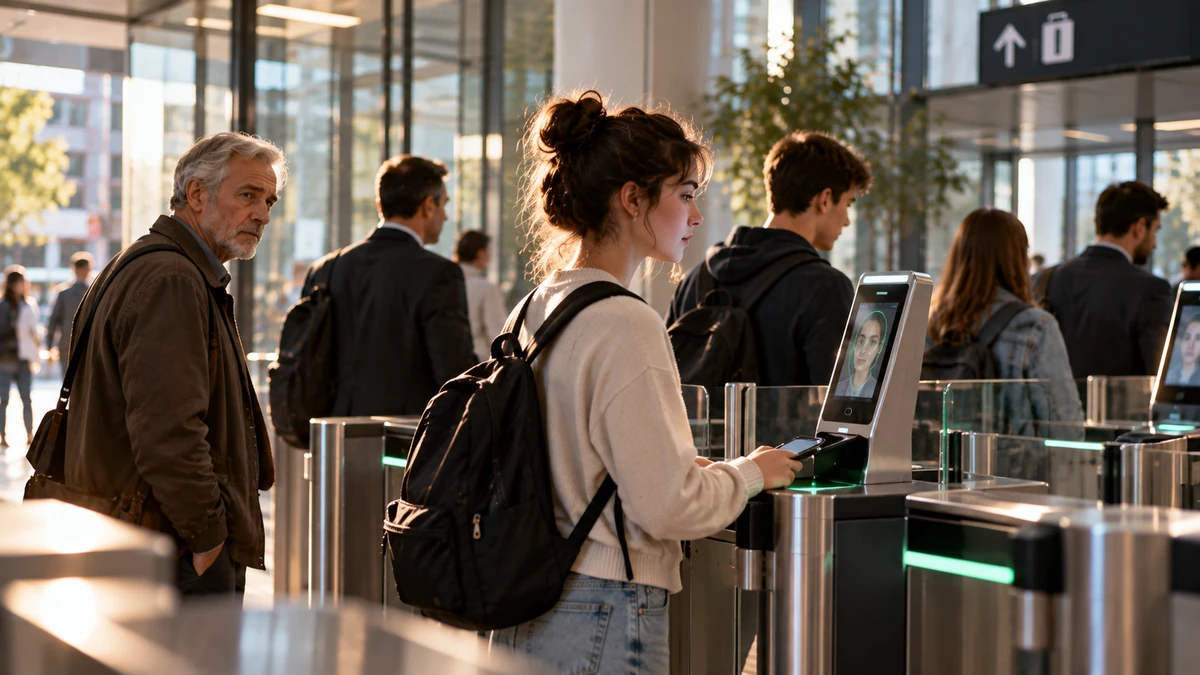
Borders are a good example. Once, the symbol of crossing a border was a physical stamp in a passport. Today the European Union uses the Entry/Exit System — EES — for third-country nationals making short visits. Since 10 April 2026, the system has been fully operational at the external Schengen borders. Instead of a stamp, the system digitally records travel-document data, the date and place of entry or exit and biometric data, including a facial image and fingerprints.[1][2]
By the end of July 2026 more than 145 million entries and exits had already been registered through the system. The European Commission explains the rationale clearly: faster procedures, better detection of overstays, prevention of identity fraud and greater security. These are real functions of the system. But something else matters for our path. Within a few months, millions of people entered a regime in which biometric registration at the border was simply procedure.
Not an emergency experiment. Not a futuristic idea. Procedure. A child travelling alone through such a border for the first time a decade from now may not even ask why the system needs to capture their face or fingerprints. Their question may be different: Where do I put my finger? That is the power of normalisation. It does not necessarily persuade you that something is good. It makes you stop thinking about it.
_LCCN2007678049.jpg)
Surveillance does not disappear. It becomes part of the user experience
At almost every previous step in this series, the same word appeared: convenience. EES is also described as a way to make border procedures faster, more automated and more convenient. Digital identity is intended to reduce repeated document checks. Biometrics remove passwords. A smart shop removes the checkout. An algorithm removes the wait for a human decision. The system becomes pleasant precisely when the user stops feeling it as a system. Once, a person had to consciously step in front of an official.
Today verification can happen in the background. Once, someone had to physically supervise a worker. Today software can automatically record their output. Once, a seller had to estimate how much a customer might be willing to pay. Today a system can use data to do it. The psychological boundary changes with this. Surveillance is no longer the person standing behind you. Surveillance becomes a system function. And we do not experience system functions in the same way as a human being watching us.
Even the boss can become an algorithm
The International Labour Organization uses the term algorithmic management for systems that use data to organise, allocate, monitor, supervise and evaluate work. This is not limited to delivery riders or platform drivers. The ILO describes the spread of such management into logistics, banking, healthcare, customer support and ordinary workplaces as well. A system can assign a task. Monitor execution. Measure speed. Compare results. Score the worker. Perhaps recommend the next decision to a manager. Perhaps one day make it itself.[3]
The ILO also warns of reduced worker autonomy, more invasive monitoring and psychosocial risks. But again the core of our path lies elsewhere. Imagine someone who has spent thirty years working in an environment where a human supervisor evaluates them. Then imagine someone entering the labour market in 2035 who, from the first day, knows only a system that measures their performance in real time. The first can say:
This is different from before.
The second has no “before”. To them it is simply a job. And precisely for that reason the boundary can move much further without a single law changing.
First they personalise the advertisement. Then the price too.
For years we became accustomed to the idea that the web knows our interests. You click on shoes. The next day you see an advertisement for shoes. Once that seemed almost eerie. Today many people barely notice. But the logic of personalisation does not end with the advertisement. The U.S. Federal Trade Commission found in its surveillance pricing study that precise location, demographics, browsing history, purchase history and even on-site behaviour such as mouse movements or items left in a basket can be used to shape different prices or offers.[4]
Think how great a change is hidden inside a single word: personalised. A personalised advertisement means the system chooses what you will see. A personalised offer means the system chooses what it will offer you. A personalised price means the system may choose how much you will pay. If people grow accustomed to different digital treatment of different individuals as normal, the next question will be asked less and less often:
Why is the system treating us differently at all?
Instead we will ask:
Is my offer good enough?
Normalisation changes language too. Something we would yesterday have called profiling may tomorrow be called personalisation. Something we would yesterday have called monitoring may be called optimisation. Something we would yesterday have called permission may be called eligibility verification. Something we would yesterday have called a restriction may be called a security feature. Words are not trivial. Words shape how the system feels.
Digital identity has to become ordinary if it is to achieve its purpose
The European Digital Identity Wallet is today legally designed as voluntary. That matters and should not be hidden. The European Commission explicitly says that citizens will not be required to use the wallet. At the same time, it is building it as infrastructure for a broad range of everyday activities. Banking. Loans. Diplomas. Driving licences. Renting. Travel. Employment. Public services. Payments. The Commission’s programme for bringing in so-called relying parties has a very clear objective: more service providers, more use cases, more utility and therefore more adoption.[5][6]
The Commission itself describes this as an effect in which more useful services generate greater adoption and demand for the wallet. This is a normal way to build a technology ecosystem. But again, look at the path. Obligation is not the only way infrastructure becomes almost universal. Sometimes it is enough that life without it becomes slower. More complicated. More expensive. Full of extra steps. If the digital path is fast and the analogue path inconvenient, most people do not need an order.
They choose the easier route. And once almost everyone chooses it, the question changes over time. We no longer ask: Do we want digital identity? We ask: Why would anyone use anything else? That is the moment a free society should watch very carefully. Because voluntariness on paper is not necessarily the same as a practical ability to live differently.
Safeguards exist precisely because the danger is not imaginary
It would be a serious mistake to claim nobody sees the problem. Legislators see it too. The European AI Act prohibits certain forms of biometric categorisation and heavily restricts the use of real-time remote biometric identification in public spaces for law-enforcement purposes. At the same time, most biometric identity verification is not prohibited. The system itself is therefore already drawing a boundary between useful biometrics and biometrics that can intrude too deeply on human rights. The European Data Protection Board has similarly developed specific guidelines for the use of facial recognition technology in law enforcement.[7][8]
That matters. But the existence of a safeguard does not mean the debate is over. It means the danger is real enough that a boundary had to be drawn. And every boundary needs people who remember why it was drawn. If, twenty years from now, no one remembers a world without constant biometric verification, the political cost of moving that boundary will also be lower. This is the quiet problem of normalisation. It does not merely change technology. It changes the expectations of the population.
First you say: “You can always refuse.”
This is one of the most important moments on the entire path. When new infrastructure is introduced, the response to criticism is often: It is voluntary. And perhaps it really is. But there are different forms of voluntariness. You can choose an analogue ticket if the digital one is not mandatory. But what if the digital route is immediate while the analogue route requires a visit to an office? You can refuse to use a particular platform. But what if all your friends, customers or employers are on it?
You can pay with cash. But what if more and more providers accept only electronic payments? You can refuse to use a smartphone. But what if tickets, registration, banking, work and identification increasingly assume that you have one? The legal ability to refuse something is important. But real freedom requires more. It requires the alternative not only to be formally permitted but practically viable. Otherwise “you can refuse” slowly becomes something like:
Of course you can walk. The motorway is not mandatory.
Formally true. In practice, the society around you already operates according to another model.
The strongest power is the power we no longer experience as power
A child does not need to be persuaded that a smartphone is normal. They were born into a world of smartphones. They do not need to be persuaded that a camera on every phone is normal. That is the world they found at birth. They do not need to be persuaded that a platform knows their interests. To them, that is a basic property of the internet. If they grow up with biometric gates, digital wallets, algorithmic recommendations, smart devices and constant data profiling, they will not necessarily experience these things as changes either.
It will simply be the world. And here the danger is greater than with any single law. A law can be repealed. A habit is harder. A culture harder still. A generation that can no longer imagine an alternative is the hardest of all.
Unfreedom does not need a hostile face
When we say “unfreedom”, we imagine a prohibition. A police officer. A prison. A censor. A criminal provision. But future unfreedom can be much softer. It can mean that you have the right to do something but can hardly do it without the system. It can mean that you have a right to remain anonymous but almost no service is designed for anonymity anymore. It can mean that you have a right to privacy while the business model of almost everything around you is built on data.
It can mean that digital identity is not mandatory but everything works faster with it. It can mean that you do not have to follow the algorithm but almost no one knows how to find information without it. It can mean that no one prohibits human contact but the machine is cheaper, faster and always available. It can mean that you are free to disconnect. But the price of disconnection keeps rising. Such a system does not need brutal coercion. Practical inevitability is enough.
And then a generation arrives that asks a different question
The first generation asks: Why do you need my data? The second asks: How will my data be protected? The third may ask only: Why is the app not working? The first asks: Why should I prove my identity for this service? The second asks: Which digital identity do you accept? The third may no longer even understand the question of how the service could work without digital identity. The first asks: Why are you tracking me? The second asks: Where can I change my privacy settings?
The third may simply expect the system to know them. This is not a prediction that the world must develop exactly this way. It is a warning about how social boundaries move. Every generation begins its debate where the previous one ended. What was controversial yesterday is a compromise today. What is a compromise today becomes infrastructure tomorrow. What becomes infrastructure tomorrow is, for the next generation, the natural state of things.
That is why memory is a political and personal defence
Freedom needs something very simple: memory. Memory that convenience is not the same as freedom. That legality is not the same as justice. That security is not an absolute value. That privacy is not suspicious behaviour. That anonymity is not a crime. That a person is not a data profile. That a job is not a laboratory for measuring every second of a life. That money is not permission. That identity is not a list of rights somebody can remotely switch on or off.
Memory that technology exists to serve human beings — not human beings to be optimally compatible with technology. If we lose that memory, the final steps on the path no longer require persuasion. They become self-evident.
This is the final preparation before the terminal station
By now we have frightened the person. Divided them. Isolated them. Broken their trust. Made them dependent. Taken much of their privacy. Turned identity into a key for access. Brought money closer to an infrastructure of permission. Measured their behaviour. Replaced ownership with access. Made control comfortable. Entered the body. And begun redefining the human being itself. But all of this remains unstable for as long as the person still feels that something has been lost. That is why the fourteenth step matters so much. Make sure the loss no longer feels like a loss.
Make the new boundary feel normal. Make the alternative seem old-fashioned. Make privacy impractical. Make anonymity suspicious. Make direct human contact too slow. Make life without the app awkward. Make the person who wants to remain outside the system look like someone creating their own problems. Then you no longer need to take away their freedom. It is enough that they forget what freedom looked like. At that point the path is ready for the terminal station.
Not a human being in chains. Something far more efficient. A human being with no visible chains who can sincerely feel free while almost every important part of life runs through infrastructure they do not control. That is the next station. Terminal Station: The Human Without Chains.
Sources and further reading
- EU Entry/Exit System: the digital and biometric border. European Commission, Migration and Home Affairs, Entry-Exit System Source
- EES became mass infrastructure within months. European Commission, The Entry Exit System is fully operational since 10 April 2026. Who is exempt?, 27 July 2026 Source
- ILO: algorithmic management and worker monitoring. International Labour Organization, Algorithmic management in the workplace Source
- FTC: data can also be used for individualised prices. Federal Trade Commission, FTC Surveillance Pricing Study Indicates Wide Range of Personal Data Used to Set Individualized Consumer Prices, January 2025 Source
- EUDI Wallet: from infrastructure to an everyday ecosystem. European Commission, European Digital Identity (EUDI) Regulation Source
- The Commission is actively building everyday use of EUDI. European Commission, Relying Party Engagement Programme, updated September 2026 Source
- EU AI Act: some biometric uses are prohibited, others permitted. European Commission AI Act Service Desk, Article 5: Prohibited AI practices Source
- EDPB: specific rules for facial recognition in law enforcement. European Data Protection Board, Guidelines 05/2022 on the use of facial recognition technology in the area of law enforcement, final version 17 May 2023 Source