How Columbus Was Made a Hero: Monuments, Schools, and the Politics of Historical Memory
How did Columbus become a national and cultural hero? Holidays, monuments, and school narratives reveal how his historical myth was constructed.
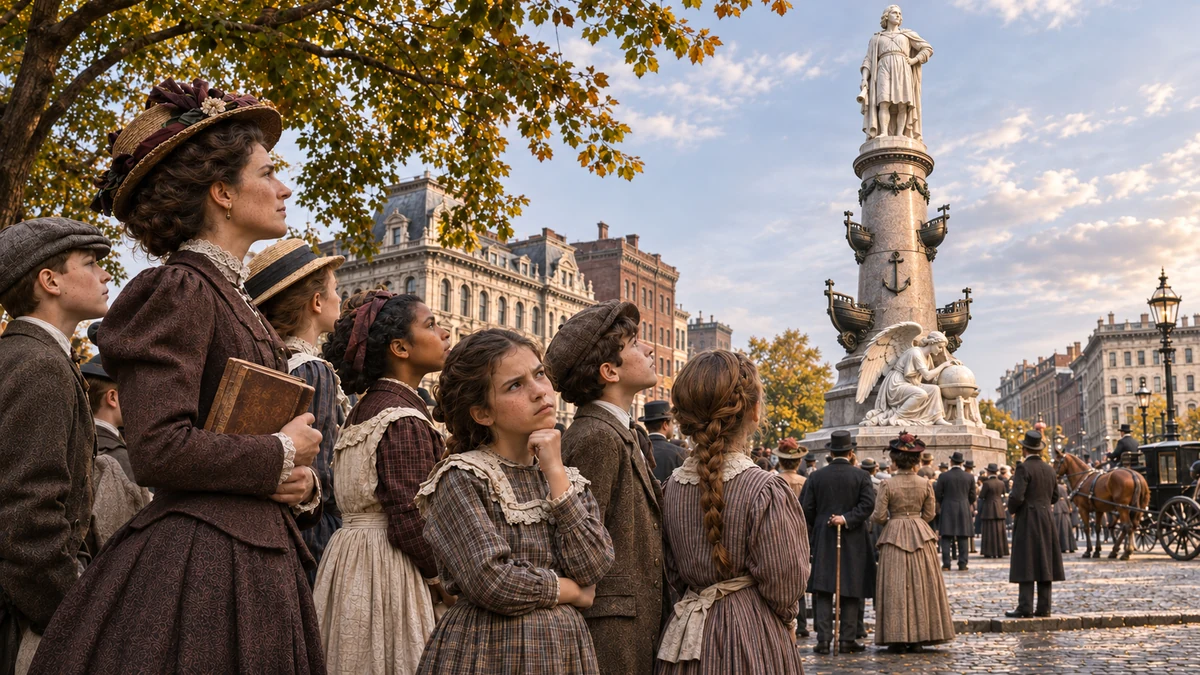
Artistic interpretation of the public commemoration of Christopher Columbus in New York around 1892. The monument and schoolchildren symbolize the formation of historical memory through public monuments and education. Not a documentary photograph of a particular ceremony.
How Is a Historical Hero Created?
In 1492, Christopher Columbus arrived in the Caribbean islands, where Indigenous peoples had lived for centuries. His voyages had far-reaching consequences for world history. They helped establish lasting transatlantic connections, while also ushering in a new era of European conquest and colonial subjugation in the Caribbean.
Historical sources also document the abduction, enslavement, and violent treatment of Indigenous people. How, then, did the same man become a symbol of freedom, progress, courage, and American patriotism? The answer cannot be found solely in the events of 1492. It lies above all in how later generations chose to remember and recount those events.
Columbus's heroic image took shape through books, speeches, monuments, national holidays, and school textbooks. Different communities selected the episodes and qualities from his life that best suited their needs. For the early American republic, he became a symbol of a new beginning. For Romantic writers, he was a determined individual who overcame opposition and misunderstanding. For some Italian immigrants, he represented belonging in a country where they faced discrimination. Government institutions incorporated his image into patriotic education.
But historical memory is not the same as historical fact. A monument can tell us a great deal about the society that erected it. It does not, however, prove that the person it portrays was truly as the monument presents them. The same applies to holidays and textbooks. Through them, societies do more than pass on knowledge of the past. They also shape ideas about which values deserve to be honored in the present.
We must therefore ask who glorified Columbus, which events they emphasized, which they left out, and whom their narrative was intended to reach.
The heroic myth of Columbus is not merely the story of one man. It is also the story of societies that needed him to be a hero.
In 1792, America Needs Its Own Columbus
In 1792, the United States was still a young republic. Its political symbols were only beginning to take root. The leaders of the American Revolution were becoming associated with emerging partisan divisions, prompting some supporters of the republic to seek a historical figure who could symbolize a shared American beginning. One answer was Christopher Columbus.
An important role was played by John Pintard, a New York merchant and amateur historian associated with the Tammany Society, also known as the Columbian Order. The society organized patriotic ceremonies, parades, and speeches. Although its identity was also linked to Tamanend, a Lenape leader, it used Indigenous freedom primarily as a symbol of American republicanism.
In doing so, it overlooked numerous contradictions between those ideals and the actual treatment of Indigenous peoples by European settlers.[1] On October 12, 1792, the three-hundredth anniversary of Columbus's arrival, the society unveiled a wooden monument in New York, painted to resemble stone. It featured allegorical figures representing science, history, and liberty.
Its scenes portrayed Columbus as a man of reason and courage, accompanied by the ideals of the Enlightenment. One image depicted the landing on Guanahaní. Columbus's men bowed before their leader while Indigenous people looked on. Another scene portrayed Columbus as a victim of ungrateful European monarchs. Indigenous figures also appeared on the monument, but chiefly as part of an idealized symbolic narrative. This was not a historical examination of colonial violence. Columbus had been recast as a forerunner of American liberty.
The Contradiction at the Heart of Early Commemoration
The Smithsonian's National Museum of American History highlights an important contradiction. The society that glorified Columbus was also associated with anti-Catholic attitudes and distrust of immigrants. Yet Columbus was a Catholic from Genoa who served the Spanish monarchy. Such a man could hardly fit the image of American republican liberty without substantial reinterpretation. But the public monument did not present these contradictions.
Instead, it selected the qualities that allowed Columbus to become part of the nation's symbolic identity.
Two Monuments, Two Different Initiatives
The New York monument was not the oldest known monument to Columbus in the United States. By August 1792, the French consul Charles Francis Adrian le Paulmier Chevalier d'Anmour had already erected a private stone obelisk on his estate north of Baltimore. The Tammany Society's New York monument came later, but it was publicly displayed and intended for patriotic ceremonies. This distinction matters. The first emerged from a private initiative; the second was a public political and symbolic act.
The commemoration of Columbus did not begin with a single government decision. It developed through different initiatives that adapted the past to the needs of the present.
Washington Irving and the Birth of the Romantic Myth
In 1828, the American writer Washington Irving published A History of the Life and Voyages of Christopher Columbus.[2] His biography significantly influenced the popular image of Columbus. Irving did not simply produce a dry historical chronicle. His account bore the hallmarks of a Romantic biography, with a central hero who perseveres in his vision despite the opposition of those around him. Columbus became a symbol of determination, courage, and confidence in his own judgment.
Historian William L. Hedges observed that Irving made use of historical material but also reconstructed and dramatized certain scenes beyond what the surviving sources could fully substantiate.[3] That does not mean his book was entirely fictional. It does mean that a compelling literary narrative is not necessarily an accurate historical account.
Columbus and the Flat-Earth Myth
One of the most persistent myths claims that Columbus had to convince scholars that the Earth was not flat. According to this version, nearly all his contemporaries supposedly believed that a ship sailing westward would eventually approach the edge of the world. Columbus was portrayed as a solitary voice of reason who overcame medieval ignorance. But the historical picture was very different.
Educated European scholars had long known that the Earth was spherical. Ancient thinkers had discussed its shape, and that knowledge was preserved and developed in medieval European and Islamic scholarship. The controversy surrounding Columbus's plans concerned primarily geographical distances and estimates of the Earth's size.
His proposed westward route to Asia depended on an overly optimistic estimate of the distance involved. His critics, therefore, were not necessarily ignorant opponents of science. Some had compelling reasons to question whether the voyage was feasible. Irving helped popularize a romanticized version of this dispute, but he was not the only author who shaped the later flat-Earth myth. Other writers and history textbooks contributed to its spread.[3] What matters is understanding why the simplified story proved so appealing.
A narrative about one man overcoming supposedly universal ignorance offers a clear hero and clearly defined opponents. A historical debate over miscalculated geographical distances provides no such dramatic division.
In this way, a literary narrative helped establish an image of Columbus that was simpler and more heroic than the historical man himself.
In 1892, the State Brings Columbus into the Classroom
Documentary source: Benjamin Harrison, Proclamation No. 335, 21 July 1892
On the four-hundredth anniversary of Columbus's arrival, his image assumed a new role. It became part of organized national and school-based patriotic education. On July 21, 1892, U.S. President Benjamin Harrison issued Proclamation No. 335, calling on Americans to celebrate the four-hundredth anniversary of Columbus's arrival.[4]
He designated Friday, October 21, 1892, for the national ceremonies, even though the anniversary of the landing itself fell on October 12. The proclamation placed particular emphasis on schools. The president called for American flags to be displayed and for ceremonies that would impress upon pupils their patriotic duties as citizens. This was more than a historical commemoration. The story of Columbus became a means of connecting the past to American national identity.
Francis Bellamy and the Pledge of Allegiance
Documentary source: Badge from the National Public School Celebration of Columbus Day, circa 1892
Francis Bellamy played an important role in preparing the national school celebration. Together with other organizers associated with The Youth's Companion magazine, he helped develop a program that included a special pledge of allegiance to the American flag. The original pledge, published in September 1892, differed from the version used today.[5] The organizers intended pupils across the country to recite it together during school ceremonies.
The program was initially associated with October 12. Organizational changes, including preparations for the Columbian Exposition in Chicago, led to the broader national celebration being moved to October 21. In New York, however, schoolchildren participated in some ceremonies as early as October 12. This chronology shows that the celebration was not a single event observed on one uniform date throughout the country. Its shared purpose mattered more. Columbus, the American flag, and the school pledge were brought together in a patriotic ritual.
Children encountered Columbus within a ceremony whose primary aim was not to critically examine every aspect of his life.
Chicago, 1893: Columbus as a Symbol of Progress

The following year, on May 1, 1893, the World's Columbian Exposition opened in Chicago.[6] The exposition commemorated the four-hundredth anniversary of Columbus's voyage while showcasing achievements in commerce, art, and technology. Its grand exhibition halls, monumental architecture, electric lighting, and industrial displays projected the image of a society proud of its progress.
Columbus's name came to symbolize a narrative linking the European arrival in the Americas to the development of the United States. Yet that narrative centered the perspective of the society celebrating its own achievements. For Indigenous peoples, the arrival of European conquerors also marked the beginning of violent encroachment upon their communities, lands, and ways of life. The exposition itself does not establish that every visitor understood the past in the same way.
It does demonstrate, however, that Columbus's name was used to represent a sweeping national narrative of progress.
What Did Children Read About Columbus?
Monuments and holidays are highly visible. Textbooks, however, often exert a more enduring influence. They do more than teach children which events took place. Through their choice of starting points and historical figures, they also shape whose past is presented as most important. One concrete example is John Bach McMaster's 1897 textbook, A School History of the United States.[7]
In his preface, McMaster explains that he begins American history with the arrival of Columbus, treating the colonial period as the childhood of the nation that would later emerge. This approach is understandable from the perspective of the formation of the United States, but it also has consequences. The peoples who inhabited the Americas before European arrival are not placed at the center of the opening narrative.
Two Verifiable Errors
Documentary source: McMaster, A School History of the United States (1897)
McMaster's textbook contains two particularly revealing claims. The first is that people in Columbus's time generally did not believe the Earth was round. The second is that Magellan's expedition proved its roundness. Both claims convey a misleading picture of the history of geographical knowledge. The spherical shape of the Earth had been known long before Columbus.
Magellan's expedition, completed by Juan Sebastián Elcano after Magellan's death, accomplished the first circumnavigation of the globe. This was an extraordinary navigational achievement, not the first discovery that the Earth was spherical. McMaster's example is valuable precisely because it is verifiable: we have a specific textbook, published in a specific year, containing identifiable claims. There is no need to suggest that every American textbook taught the same story.
What Happens When the Story Begins with “Discovery”?
The opening sections of McMaster's textbook focus on European trade routes, maritime exploration, Columbus's determination, and the voyages that followed. Indigenous peoples appear mainly in the context of European arrival and the development of later colonies. This does not mean the textbook never mentions them.
But its account is organized primarily around European explorers and the formation of a nation that would emerge centuries later. Compare that account with Columbus's letter of 1493. In it, Columbus reported claiming islands inhabited by large populations for the Spanish monarchs.[8] The letter is an important document of colonial appropriation.
In later celebratory narratives, however, the same arrival could be presented primarily as a discovery, an act of courage, and the beginning of progress. The difference does not necessarily involve inventing events outright. More often, it lies in deciding which events deserve attention and which should remain at the margins.
A historical myth can emerge even when a narrative tells part of the truth but omits what would change its moral meaning.
McMaster's textbook provides one example of such selective historical storytelling. On its own, however, it does not establish that every American school curriculum in every period treated Columbus in the same way.
Columbus as a Symbol of Italian-American Recognition
The commemoration of Columbus acquired another important meaning in the United States. For some Italian-American communities, it became a symbol of their historical presence and their right to social recognition. During the second half of the nineteenth century, Italian immigrants often encountered prejudice, religious intolerance, and discrimination. In some cases, anti-Italian violence proved deadly. In New Orleans in March 1891, a mob killed eleven people of Italian origin.[9]
Against this background, Columbus offered some members of the immigrant community a way to connect their identity with a figure already widely recognized in the United States.
Columbus Circle, 1892
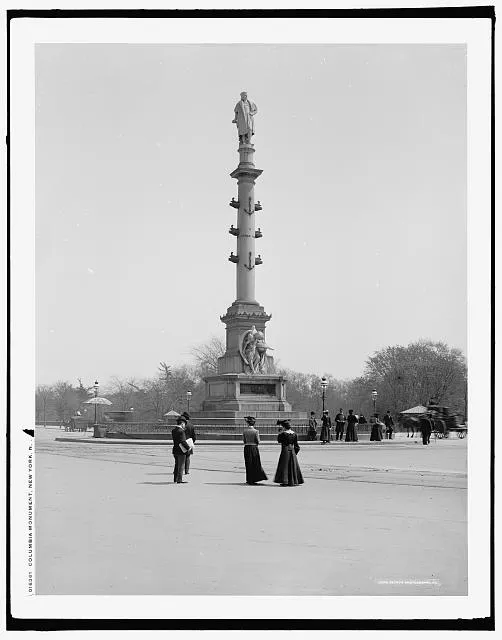
On October 12, 1892, a monument to Columbus was dedicated in New York at what is now Columbus Circle. The fundraising campaign was led by Carlo Barsotti, publisher of the Italian-language newspaper Il Progresso Italo-Americano. Italian immigrants contributed both money and labor to its construction.[10] The monument expressed more than admiration for Columbus. It also represented the immigrant community's desire to be recognized as part of American society.
Inscriptions on the monument drew parallels between Columbus's supposed hardships and the experiences of Italians in their new country. For many, this association carried deep personal meaning. Yet another contradiction emerges here. A community's struggle for dignity and recognition became associated with the glorification of a man whose voyages marked the beginning of violent colonial subjugation in the Caribbean. Both histories must be understood. The discrimination experienced by Italian immigrants is a historical fact.
So are the colonial injustices associated with Columbus's actions.
Understanding why a monument was erected does not mean accepting everything that the monument glorifies.
Nor should Italian Americans be portrayed as a community holding a single, uniform view of Columbus. Their attitudes toward monuments, historical responsibility, and public memory differ.
From a National Holiday to Disputes over Monuments
The commemoration of Columbus gradually became embedded in American law. In 1934, the U.S. Congress adopted a joint resolution calling on the president to proclaim an annual observance of Columbus Day. This was not equivalent to establishing the permanent federal holiday recognized today. In 1968, Congress passed the Uniform Monday Holiday Act, making Columbus Day a federal holiday.
The new arrangement took effect in 1971, when the holiday began to be observed on the second Monday in October.[11] These dates therefore represent distinct legislative steps. | Year | Significance | |---|---| | 1892 | Special national observance of the four-hundredth anniversary | | 1934 | Congressional initiative calling for annual presidential proclamations | | 1968 | Legal establishment of the federal holiday | | 1971 | Implementation of the new holiday arrangement | Columbus's image thus became part of the official national calendar.
An Indigenous Perspective on “Discovery”
For many Indigenous communities, 1492 does not mark the beginning of their history. Their history reaches back thousands of years. Columbus's arrival marked the beginning of a period in which many peoples faced conquest, disease, violent dispossession, enslavement, and the destruction of social structures. The Smithsonian's National Museum of the American Indian has therefore emphasized that traditional school narratives about Columbus often center Europeans, while treating Indigenous history as secondary.[12]
Opposition to the celebration of Columbus is not necessarily opposition to the study of history. Often, it is a demand that public memory should no longer focus exclusively on conquerors.
Indigenous Peoples' Day
The observance of Indigenous Peoples' Day gradually spread across the United States. On October 8, 2021, President Joe Biden issued an official proclamation designating October 11 of that year as Indigenous Peoples' Day.[13] The proclamation highlighted the history, contributions, and continued existence of Indigenous nations. It did not, however, abolish Columbus Day as a federal holiday. Different ways of commemorating the past therefore coexisted in American public life. One emphasized the European explorer and his symbolic place in American history.
The other placed Indigenous peoples, who had inhabited these lands before European arrival, and their descendants at the center.
In 2026, Historical Memory Remains a Political Choice
Documentary source: Presidential Proclamation 11073: Columbus Day, 2026
The historical dispute continues into the present. On March 22, 2026, a replica of a Columbus monument from Baltimore was installed near the Eisenhower Executive Office Building, adjacent to the White House. The original statue, unveiled in 1984, had been pulled down by protesters and thrown into the harbor in 2020.
The replica was installed with the involvement of Italian-American organizations and the administration of President Donald Trump.[14] Supporters presented the installation as a restoration of Italian-American historical pride. Critics pointed to Columbus's association with colonial conquest and the oppression of Indigenous peoples.
On October 7, 2026, President Trump issued Proclamation No. 11073, designating October 12 as Columbus Day. In it, he elevated Columbus to the status of an American national hero and linked his voyage to Western civilization, courage, and the emergence of the American nation.[15] The proclamation is an important primary historical source.
Its significance, however, lies primarily in what it reveals about the views of the American executive branch in 2026. It cannot serve as independent evidence of what actually happened in 1492.
A presidential proclamation from 2026 documents the politics of historical memory in 2026, not the historical facts of 1492.
What Does It Mean to Preserve a Monument?
Supporters of Columbus monuments emphasize their significance for immigrant heritage, public history, and community identity. Critics point out that placing a monument in a position of honor does more than preserve a historical fact. It also confers public recognition on a particular person and the values associated with them. There is no single inevitable solution to this dispute.
A monument can be preserved with additional historical interpretation, relocated to a museum, or incorporated into a redesigned public space that presents multiple historical perspectives. Each choice carries its own meaning and consequences. But none should rest on invented historical claims or the justification of violence against people. The central question is not whether Columbus should be erased from history.
It is whether public spaces should continue to present him as an unquestioned hero.
Who Has the Right to Tell the Story?
The history of Columbus's commemoration reveals how a historical figure becomes a symbol. John Pintard and the Tammany Society saw Columbus as a representative of American republicanism. Washington Irving helped shape his Romantic literary image. Benjamin Harrison brought the story of Columbus into a national school celebration. Textbooks passed it on to new generations. For some Italian immigrants, Columbus became a symbol of belonging and dignity. Later political authorities used his image to express their own visions of national identity.
But history does not belong only to those who have the power to erect monuments and proclaim holidays. It also belongs to the people whose ancestors lived on lands that European conquerors declared their own. Their experience is not a marginal addition to the story of European voyages. It is an essential part of that story.
Columbus's voyages had profound consequences for world history. We can acknowledge this without excusing abduction, enslavement, or colonial violence. We can also understand the historical reasons why later communities saw Columbus as a symbol of freedom or immigrant recognition. But we must never confuse the historical reasons for honoring him with a moral justification of his actions.
Understanding why a society created a hero does not mean accepting its image of him as historically true.
The task of responsible historiography is not to replace one uncritical myth with another. It is to examine sources, distinguish facts from symbols, and restore a place in the historical narrative to those who were excluded from it. Columbus does not need history to be erased. He needs a history from which his victims have not been erased. And this raises another question.
If European and American narratives placed Columbus at the center of history for centuries, while frequently portraying the Taíno as an extinct people, what do their descendants say today? That will be the central subject of the next article.
Historical memory belongs not only to conquerors and their monuments. It also belongs to those who survived and demand the right to tell their own history.
Sources and further reading
- Timothy Winkle, “The Monument That Created Columbus,” Smithsonian Institution, National Museum of American History, October 12, 2020. Research on the Tammany Society, John Pintard, and the two Columbus monuments of 1792 Source
- Washington Irving, A History of the Life and Voyages of Christopher Columbus, London, John Murray, 1828 Source
- William L. Hedges, “Irving's Columbus: The Problem of Romantic Biography,” The Americas, 13(2), 1957, pp. 127–140. Jeffrey Burton Russell, Inventing the Flat Earth: Columbus and Modern Historians, 1991 Source
- Benjamin Harrison, “Proclamation 335—400th Anniversary of the Discovery of America by Columbus,” July 21, 1892. The proclamation concerns the national celebration of October 21, 1892 Source
- Smithsonian Institution, National Museum of American History, “I Pledge Allegiance”; museum materials concerning Francis Bellamy, The Youth's Companion, and the national school celebration of 1892 Source
- Smithsonian Institution Archives, World's Columbian Exposition (Chicago, 1893), Record Unit 70. The exposition was open from May 1 to October 31, 1893 Source
- John Bach McMaster, A School History of the United States, 1897, preface, first chapter, and the summary concerning Magellan's expedition Source
- Library of Congress, “Columbus and the Taíno,” Exploring the Early Americas exhibition. The sources displayed include early printed editions of Columbus's 1493 letter Source
- Library of Congress, “Under Attack,” Immigration and Relocation in U.S. History. Examines anti-Italian violence, including the events in New Orleans in 1891 Source
- Central Park Conservancy, “Columbus Circle Monument”; New-York Historical Society, documentation of the monument's dedication on October 12, 1892, and Carlo Barsotti's role Source 1 Source 2
- Congressional Research Service, Columbus Day: Fact Sheet, Report R44218; National Archives, When Will You Be in the Office (1959)?; 5 U.S.C. § 6103. Chronology of 1934, 1968, and 1971 Source 1 Source 2 Source 3
- Smithsonian Institution, National Museum of the American Indian, “Unlearning Columbus Day Myths: Celebrating Indigenous Peoples' Day,” Native Knowledge 360° Source
- Joseph R. Biden Jr., “Proclamation 10283—Indigenous Peoples' Day, 2021,” October 8, 2021, official U.S. government publication Source
- Associated Press, report on the installation of a replica Columbus statue near the White House in March 2026; Conference of Presidents of Major Italian American Organizations, official statement dated March 22, 2026. The organizational statement reflects the perspective of the initiative's supporters Source 1 Source 2
- Donald J. Trump, “Proclamation 11073—Columbus Day, 2026,” October 7, 2026, Federal Register, October 13, 2026, pp. 65075–65076. Primary source for contemporary presidential politics of historical memory Source
Research Limitations: This article focuses primarily on examples from the United States and does not present them as a comprehensive worldwide history of Columbus's commemoration. McMaster's textbook is a verifiable case study, not evidence of all educational practices. Presidential proclamations, public monuments, and political speeches are primary sources for studying historical memory in the periods in which they were created, not independent evidence of events that took place in 1492