The Genocide of the Taíno: What Do Historical Sources Prove?
Do the historical sources support the term genocide? The article distinguishes documented violence, questions of intent, and modern legal definitions.
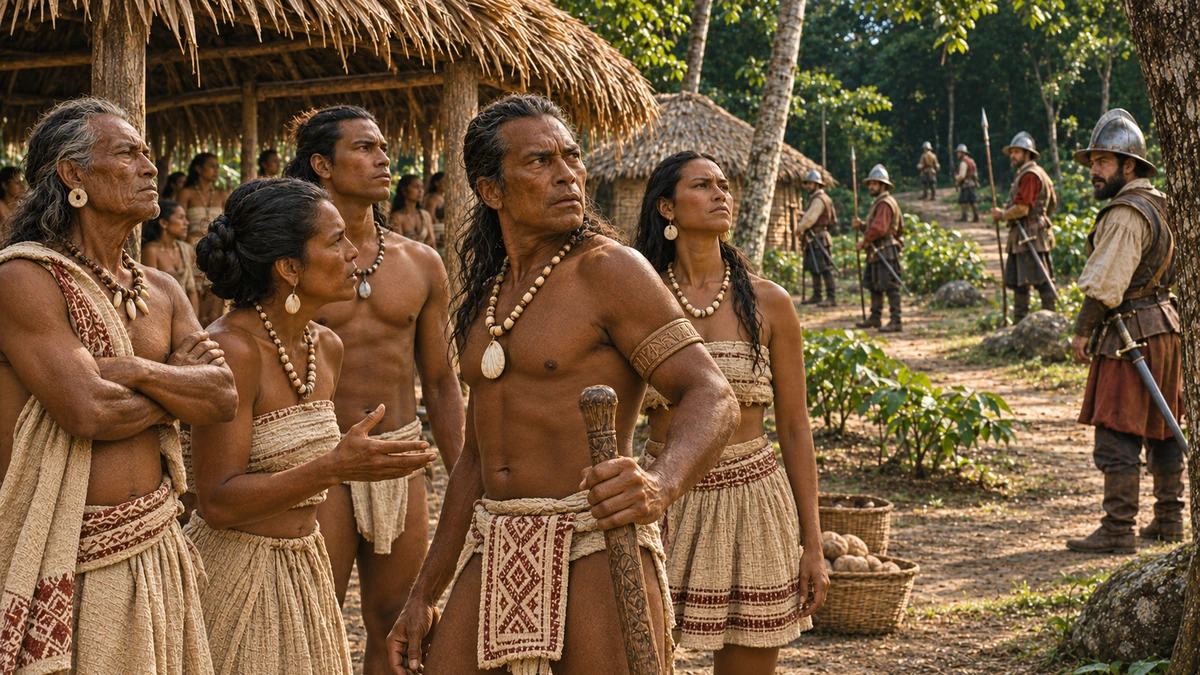
Artistic interpretation of organized colonial violence at Xaraguá in 1503, inspired by historical accounts. It does not reconstruct a documented exact moment.
Can We Speak of Genocide Five Centuries Later?
Was the violence inflicted on the Taíno by the Spanish a genocide? The question matters, but it demands more than a simple yes or no. Historical sources document organized massacres, enslavement, forced labor, displacement, and the violent subjugation of Indigenous communities. The consequences were catastrophic.
Yet genocide is not simply another word for mass killing or extreme cruelty. It refers to a particular form of violence directed against a human group as such. We must therefore distinguish between three questions. What happened? What intentions can be attributed to the perpetrators? And how should we classify their actions today?
This distinction is especially important because the Spanish conquest of Hispaniola began in 1492, while the term genocide was not coined until 1944. The international convention establishing its legal definition was adopted in 1948. That does not mean earlier events cannot be examined as genocidal. Historians regularly use modern concepts to interpret the past. But they must make clear whether they are offering a historical interpretation, comparing an event with later legal standards, or referring to an actual judicial finding.
Nor is a catastrophic population decline, by itself, enough to establish the existence of a unified plan of physical extermination. The number of deaths, critically examined in KT-09, does not in itself reveal the perpetrators' intentions. Those intentions must be investigated through historical accounts, the organization of violence, the selection of victims, and the ways in which conquerors explained and justified their actions.
Historical accuracy is not an obstacle to moral condemnation. It is what allows that condemnation to rest on evidence.
Raphael Lemkin: When the Destruction of Peoples Acquired a Name
In 1944, the jurist Raphael Lemkin introduced the term genocide in his book Axis Rule in Occupied Europe.[1] He formed the word from the Greek genos, referring to a people or group, and the Latin-derived suffix -cide, associated with killing. Yet Lemkin intended the concept to encompass far more than mass killing. His understanding of genocide was broader.
He described it as a coordinated process directed against the foundations of life of a national or ethnic group. Such a process could involve attacks on political and social institutions, culture, language, religion, economic life, security, health, freedom, and the lives of the group's members. Lemkin emphasized that the destruction of a group did not necessarily involve the immediate killing of every member.
It could unfold gradually, through the dismantling of institutions and living conditions that sustained the group's existence. He distinguished among several techniques of genocide: political, social, cultural, economic, biological, physical, religious, and moral. He also identified two interconnected processes. The first was the destruction of the oppressed group's existing social order. The second was the imposition of the conquerors' social order. This distinction is particularly important when examining colonialism.
A colonial power can deprive a community of political autonomy, land, control over its labor, and the right to preserve its own institutions. It can disrupt social relationships and force people to live according to rules imposed by conquerors. Such processes were central to Lemkin's broader understanding of genocide.
Yet the historical question remains: was the destruction of a particular community a consequence of subjugation, an intended objective, or a combination of both? These possibilities must not automatically be treated as equivalent. Lemkin's original framework allows us to examine the wider destruction of communal life. The legal definition adopted in 1948, however, is narrower.
Lemkin's understanding of genocide in 1944 and the legal definition established by the 1948 United Nations Convention are not entirely identical.
The former helps us understand different historical forms of group destruction. The latter requires specific legal conditions to be met, above all the special intent to destroy a protected group.

What Does the UN Convention Actually Require?
Documentary source: UN Genocide Convention (1948)
On December 9, 1948, the United Nations General Assembly adopted the Convention on the Prevention and Punishment of the Crime of Genocide. It entered into force on January 12, 1951.[2] Article II defines genocide through certain acts committed with the intent to destroy, in whole or in part, a national, ethnic, racial, or religious group as such. The Convention identifies five categories of acts:
- Killing members of the group.
- Causing serious bodily or mental harm to members of the group.
- Deliberately inflicting conditions of life calculated to bring about the group's physical destruction, in whole or in part.
- Imposing measures intended to prevent births within the group.
- Forcibly transferring children of the group to another group.
But evidence that one of these acts occurred does not automatically establish genocide. A further legal element is decisive: dolus specialis, or specific intent. This means an intention to destroy a protected group, in whole or in part, precisely as a group. When assessing the destruction of part of a group, international jurisprudence considers whether that part constitutes a substantial portion of the group.
This requirement matters because genocide is defined not only by the suffering inflicted but also by the objective pursued by the perpetrators. A mass killing may be committed to seize territory, suppress a rebellion, exact political revenge, or terrorize a population. Such actions can constitute exceptionally grave crimes even when specific genocidal intent cannot be established.
In other circumstances, however, the physical destruction of a protected group may itself be the objective of the violence, whether pursued directly or indirectly.
Is a Written Order Necessary?
No. Specific genocidal intent need not be established solely through a written order or a perpetrator's confession. The selection of victims, repeated acts, statements by those responsible, the organization of attacks, and the broader circumstances may all be relevant. Nevertheless, the standard of proof must be rigorous.
In its 2015 judgment in Croatia v. Serbia, the International Court of Justice explained that genocidal intent may be inferred from a pattern of conduct. Where direct evidence is absent, an intent to destroy the group must be the only reasonable inference from the established acts.[3] This judicial standard does not mean that the 1948 Convention can simply be applied retroactively as criminal law to events that took place in 1503. It does, however, show how modern legal principles can clarify the evidentiary questions involved.
Another distinction is equally important. Political subjugation, cultural destruction, and the loss of autonomy can constitute grave historical injustices. They may also contribute to evidence of a broader genocidal process. But they do not, by themselves, establish the specific intent to bring about the physical or biological destruction of a protected group under the Convention. We will apply this distinction to a concrete historical case: the massacre at Xaraguá in 1503.
Xaraguá, 1503: What Do the Conflicting Chronicles Reveal?
In 1503, an organized massacre of Indigenous leaders took place in Xaraguá, in western Hispaniola. The event is associated with the colonial governor Nicolás de Ovando and the Indigenous leader Anacaona. Its broader historical background has already been examined in KT-05. Here, our primary concern is what the sources reveal about the planning and purpose of the violence.
Two accounts are especially important: those of Bartolomé de las Casas and Gonzalo Fernández de Oviedo. Both authors wrote from within the Spanish colonial world. Their works were composed after the event, and each interpreted it from a different ideological and political position.
Las Casas: An Attack on Assembled Leaders

In Brevísima relación de la destrucción de las Indias, first printed in 1552, Bartolomé de las Casas describes the governor's arrival in Xaraguá.[4] According to his account, more than three hundred Indigenous leaders gathered at the governor's invitation. The Spaniards allegedly lured many of them into a large building, locked them inside, and set it on fire. Las Casas also describes the killing of others who were present and the execution of Anacaona. His account is a forceful condemnation of colonial cruelty.
But it is not a neutral administrative record. It was written as part of his efforts to expose and end abuses against Indigenous populations. His numbers and individual details must therefore be compared with other sources. It is also important to recognize that his reference to more than three hundred assembled leaders is not, in itself, an independently verified list of everyone who was executed.
Oviedo: The Suppression of an Alleged Conspiracy
Documentary source: Oviedo’s chronicle: Book III, Chapter XII
Gonzalo Fernández de Oviedo presents the event very differently. In Historia general y natural de las Indias, Book III, Chapter XII, he portrays Ovando as a capable, just, and devout governor.[5] He explains the massacre at Xaraguá as a response to an alleged conspiracy involving Anacaona and other Indigenous leaders. Yet Oviedo's own account reveals significant details.
He describes how the governor prepared Spanish soldiers in advance for a possible attack and then used a public gathering as the occasion on which Indigenous leaders would be assembled. He records that the leaders were seized, bound, and confined inside a building that was subsequently set on fire. He reports that more than forty leaders were killed. According to his account, Anacaona was hanged approximately three months later.
Of particular importance is Oviedo's description of the Spanish captains Diego Velázquez and Rodrigo Mexía Treillo, who were already aware of the governor's intentions. This is not an account of a sudden, uncontrolled confrontation. It describes the organized capture of people who had gathered in circumstances that appeared peaceful.
Did the Conspiracy Really Exist?
Oviedo presents the alleged conspiracy as justification for the violence. But his account is not independent proof that such a conspiracy actually existed in the form he describes. Nor does Las Casas's condemnation, on its own, resolve every question about political relationships in Xaraguá. Historians must therefore distinguish between what the chroniclers describe and how they explain the reasons for it.
Both accounts attest to essential elements of organized violence, even though they differ over its justification and the number of victims. Neither, however, is a surviving firsthand testimony given by the victims themselves.
We do not currently have a surviving account from an Indigenous eyewitness or survivor that can be directly compared with these two Spanish chronicles.
This is an important limitation of the historical record.
Massacre as a Means of Intimidation
Oviedo's account contains another particularly revealing detail. After describing the executions, he claims that the punishment of Anacaona and her associates frightened the Indigenous population so thoroughly that they ceased resisting. This claim does not prove that resistance actually ended permanently. It does, however, reveal how the colonial chronicler understood and justified the significance of the violence. The massacre is presented not merely as the punishment of particular individuals.
It is also depicted as a warning to the wider population and as a means of consolidating Spanish rule.
What Is Recorded, What Can Be Inferred, and What Remains Unproven?
What is recorded: Las Casas and Oviedo describe the organized capture and killing of Indigenous leaders at Xaraguá. Their accounts differ concerning the numbers involved, the causes, and the justification for the attack. What can be inferred: the violence targeted an important part of the Indigenous political leadership and served a broader purpose of intimidation.
What these accounts alone cannot establish: the existence of a unified plan to physically destroy all the Taíno or the specific genocidal intent of every individual participant. These limitations do not diminish the reality of the organized massacre. They mean that the question of genocide must be examined with particular attention to the perpetrators' intentions.
Genocidal Massacre: Braun's Historical Interpretation
In 2023, historian Harald E. Braun published a study of three massacres during the early Spanish conquest of the Americas in the first volume of The Cambridge World History of Genocide.[6] He examined Xaraguá in 1503, Cholula in 1519, and Toxcatl in 1520. His purpose was not simply to compare the numbers of people killed.
He was interested in how conquerors used planned mass violence to transform political relationships and send an intimidating message to wider Indigenous populations. For such events, he uses the term genocidal massacre. In doing so, he draws on the work of sociologist Leo Kuper, who examined the destruction of part of a larger group as a warning to its surviving members.
In Braun's interpretation, particular individuals or communities were targeted because of their place within a broader group. Their killing also demonstrated what could happen to others who refused to submit.
Subjugation and Destruction Are Not Always the Same Objective
Braun's research must be read carefully on this point. He distinguishes between a dynamic of subjugating a population and a dynamic of eliminating it. In the early Spanish massacres he examines, he places particular emphasis on the former. Through mass violence, the conquerors sought to break the political and military power of particular communities, remove their leadership, and intimidate survivors. This distinction matters.
If the purpose of the violence was to subjugate a community, that is not automatically the same as an intention to physically destroy an entire protected group under the legal definition adopted in 1948. But Braun does not therefore treat these massacres as ordinary military confrontations. On the contrary. He identifies them as an especially extreme form of mass violence against communities selected because of their membership in a wider Indigenous population.
His use of the term genocidal massacre is thus a scholarly historical classification based on a particular analytical framework. It is not a judicial finding.
Xaraguá as an Example of Organized Intimidation
In his discussion of Xaraguá, Braun emphasizes that the violence targeted Indigenous leadership and the wider community. The massacre removed an important part of the political and military structure and contributed to the further Spanish subjugation of the region. He also draws attention to the use of alleged Indigenous conspiracies to justify preventive attacks. This corresponds to the way Oviedo presents the event.
But Braun's analysis adds another important dimension: political relations among Indigenous communities involved more than the Spaniards alone. In the pre-publication version of his chapter, he also discusses the participation of Indigenous warriors from rival communities on the conquerors' side. This must not be used to diminish Spanish responsibility for organizing the massacre.
It does, however, remind us that historical relationships cannot be reduced to two entirely homogeneous groups. Indigenous communities had different political interests, relationships, and conflicts, which the conquerors could exploit. The details of such participation remain dependent on a limited body of colonial evidence.
What Does Braun's Research Establish?
Braun's analysis provides an important scholarly basis for applying the term genocidal massacre to Xaraguá. It connects organized killing, the targeting of Indigenous leadership, the intimidation of survivors, and the consolidation of colonial rule. It does not, by itself, establish the existence of a unified, predetermined plan to physically exterminate all the Taíno. That distinction is essential.
Classifying an event historically as a genocidal massacre is significant and has a scholarly basis. It is not, however, a substitute for separately establishing every element of the modern legal definition of genocide.
Between Protection and Exploitation: The Contradiction of Colonial Rule
The study of violence against the Taíno reveals a profound contradiction. In an important part of its official policy, the Spanish Crown regarded Indigenous people as subjects who were supposed to be protected, converted to Christianity, and incorporated into the colonial order. At the same time, the colonial system subordinated their labor and economic resources to the interests of the conquerors. How could the promise of protection coexist with actual violence?
Historian Eitan Ginzberg examined this question in his 2020 study Genocide and the Hispanic-American Dilemma.[7] He draws attention to the contradiction between the official recognition of Indigenous people as rational subjects and their actual exploitation for the needs of the Spanish Empire. The policy of preserving the population was intertwined with the policy of exploiting it economically.
A system ostensibly intended to provide protection thus enabled conditions that became extraordinarily destructive in practice. Ginzberg also examines Lemkin's unpublished research into Spanish colonization, in which Lemkin regarded its consequences as genocidal. This raises an important question of historical responsibility.
Do Protective Laws Prove That Genocide Was Absent?
No. The fact that royal policy formally provided for the protection of Indigenous populations does not prove that such protection was effective or that colonial authorities did not commit extreme acts of violence. Actual practice is essential to any historical assessment. But the opposite conclusion would also be premature.
Not every labor regulation, act of violent subjugation, or expression of colonial economic interest automatically establishes an intention to physically destroy an entire ethnic group. The motives of colonial actors may have differed. Gold extraction, political domination, Christianization, the prevention of rebellion, and personal enrichment were distinct objectives that could overlap in practice.
Their consequences could be catastrophic without every individual perpetrator necessarily sharing the same intentions.
Does Economic Exploitation Exclude Genocidal Intent?
It does not. A colonial power could seek to exploit the labor of a wider population while deliberately killing particular communities or their leaders. The objectives of subjugation and physical destruction can overlap. But their relationship cannot be determined solely from a general account of colonialism. We need evidence concerning particular actions, their purposes, and their circumstances.
It is also important to distinguish between the responsibility of a broader system and the intentions of individual perpetrators. A colonial system can cause mass suffering and death, and bear clear historical responsibility, even when the specific genocidal intent of every one of its officials cannot be established. Making this distinction does not diminish responsibility. It prevents different historical phenomena from being forced into a single explanation.
Where Are the Limits of Historical and Legal Inference?
What can we establish after examining the sources? First, the Spanish conquest of Hispaniola involved documented, organized violence against Indigenous communities. Second, the massacre at Xaraguá in 1503 was a planned act carried out under the authority of Nicolás de Ovando. Third, the violence targeted an important part of the Indigenous political leadership, while a colonial chronicler emphasized its intimidating effect.
Fourth, Harald E. Braun's modern historical research explicitly classifies the event as a genocidal massacre. These are significant findings. But they do not automatically amount to a definitive judicial determination of genocide against the entire Taíno people under the standards of the 1948 Convention.
The Number of Dead Does Not Establish Legal Intent
A large number of victims may be important evidence of the scale of violence. But it does not, by itself, establish specific genocidal intent. Even a smaller massacre may form part of a genocidal process when the relevant conditions concerning intent and the targeted group are met. The legal question is therefore not simply how many people died. What matters is why the victims were selected and what objective the perpetrators pursued.
Political Leadership and the Protected Group
The organized destruction of political leadership can be a means of subjugating a wider population. Under certain circumstances, it may also form part of a process directed against the continued existence of a protected group. But these possibilities cannot be treated as equivalent without further evidence. At Xaraguá, we have strong evidence of a planned attack on Indigenous leaders.
A broader conclusion about an intention to physically destroy all the Taíno, however, would require additional evidence extending beyond this single event.
Why Do We Not Call It the First Genocide in History?
The claim that the Spanish conquest of Hispaniola was the first genocide in history is not supported by the historical record. The mass destruction of groups occurred long before the conquest. Historians of genocide also examine events from antiquity, the medieval period, and the early modern era. The same scholarly collection that includes Braun's research contains a separate study of Spanish violence in the Canary Islands before the conquest of the Caribbean.[6] Nor should the massacre at Xaraguá be attributed directly to Christopher Columbus.
In 1503, colonial authority on Hispaniola was exercised by Nicolás de Ovando. Columbus's earlier actions require their own historical assessment. But he must not be presented without evidence as the direct organizer of an event that occurred under a later governor.
Has Genocide Been Legally Established?
There is no international judicial ruling on the massacre at Xaraguá establishing the individual criminal responsibility of its perpetrators for genocide under the 1948 Convention. The Convention did not exist when the massacre occurred. This does not prevent historians from analyzing the event through modern concepts.
It means they must consistently distinguish between a scholarly classification and judicially established responsibility.
Legal caution is not an excuse for historical violence. Nor does moral condemnation justify inventing judicial verdicts.
Both principles must be upheld.
Without Historical Excuses
Was the violence inflicted on the Taíno by the Spanish a genocide? We cannot answer this responsibly by merging every event from 1492 onward into a single, undifferentiated claim. Individual massacres, colonial policies, and the broader process of subjugation must be examined in light of the available evidence and the intentions involved.
For the massacre at Xaraguá in 1503, there is a strong historical basis for establishing that organized mass violence was directed against Indigenous leadership. Historian Harald E. Braun explicitly examines it as a genocidal massacre. His interpretation is significant and supported by scholarly argument, but it must not be presented as an international judicial ruling.
Nor can it automatically establish the existence of a unified plan to physically exterminate all the Taíno. Yet these evidentiary limitations offer no reason to minimize colonial responsibility. Organized massacres, forced labor, enslavement, and the violent subjugation of communities remain historical injustices regardless of which legal or scholarly category best describes them.
It is revealing that even Oviedo, who portrayed Ovando as a just governor, described the planned capture and execution of Indigenous leaders. His attempt to justify the attack does not erase the evidence of violence. It reveals how the colonial world sought to portray that violence as a necessary means of establishing authority.
The Spanish conquest cannot be justified by claims of civilizational superiority, religious mission, or the economic interests of an empire. The Taíno were not an obstacle without rights standing in the path of European expansion. They were human beings with families, communities, political leaders, and the right to live independently.
Historical accuracy does not require a softer condemnation of colonial violence. It requires us to ground that condemnation in actions supported by evidence.
Where historians have sound grounds for identifying a genocidal massacre, we must present their interpretation. Where evidence of specific intent remains inconclusive, we must acknowledge that limitation. And where colonial sources reveal organized killing and violent subjugation, we must not minimize those facts by invoking legal uncertainty. The victims' lives were not worth less because the word genocide emerged only centuries later.
We do not need an invented judicial verdict to condemn documented injustices. We need an accurate understanding of what happened, who was responsible, and what intentions and consequences can be established from historical evidence.
Sources and further reading
- Raphael Lemkin, Axis Rule in Occupied Europe: Laws of Occupation, Analysis of Government, Proposals for Redress, Carnegie Endowment for International Peace, 1944, Chapter IX, “Genocide,” pp. 79–95 Source
- United Nations, Convention on the Prevention and Punishment of the Crime of Genocide, adopted December 9, 1948; entered into force January 12, 1951; particularly Article II Source 1 Source 2
- International Court of Justice, Application of the Convention on the Prevention and Punishment of the Crime of Genocide (Croatia v. Serbia), judgment of February 3, 2015. In particular, the discussion of specific genocidal intent and its inference from a pattern of conduct Source
- Bartolomé de las Casas, Brevísima relación de la destrucción de las Indias, manuscript completed in 1542, first printed in Seville in 1552. Section “Los reinos que había en la isla Española,” concerning Xaraguá and Anacaona Source
- Gonzalo Fernández de Oviedo y Valdés, Historia general y natural de las Indias, Book III, Chapter XII, “De la gobernación del comendador mayor de Alcántara…”. Digital transcription of the historical text, Early Modern Spain project, King's College London Source
- Harald E. Braun, “Genocidal Massacres in the Spanish Conquest of the Americas: Xaragua, Cholula and Toxcatl, 1503–1519,” in The Cambridge World History of Genocide, Vol. I, Cambridge University Press, 2023, pp. 622–647 A pre-publication version of the complete chapter is available through the University of Liverpool repository: Source 1 Source 2
- Eitan Ginzberg, “Genocide and the Hispanic-American Dilemma,” Genocide Studies and Prevention: An International Journal, 14(2), 2020, pp. 122–152. Discussion of the contradiction between the protection and exploitation of Indigenous populations and Lemkin's interpretation of colonialism Source
The author distinguishes between dynamics of subjugation and elimination. He uses the term genocidal massacre in connection with the work of Leo Kuper. The pre-publication version is not necessarily identical in every respect to the final published edition
Bibliographic note: The chapter title specifies the period 1503–1519, although the text correctly dates the Toxcatl massacre to 1520. The original title is therefore preserved