How Many Taíno Died? Demographic Catastrophe and the Limits of Historical Numbers
How many Taíno died after 1492? A review of historical estimates and incomplete records explains why no single reliable figure is available.
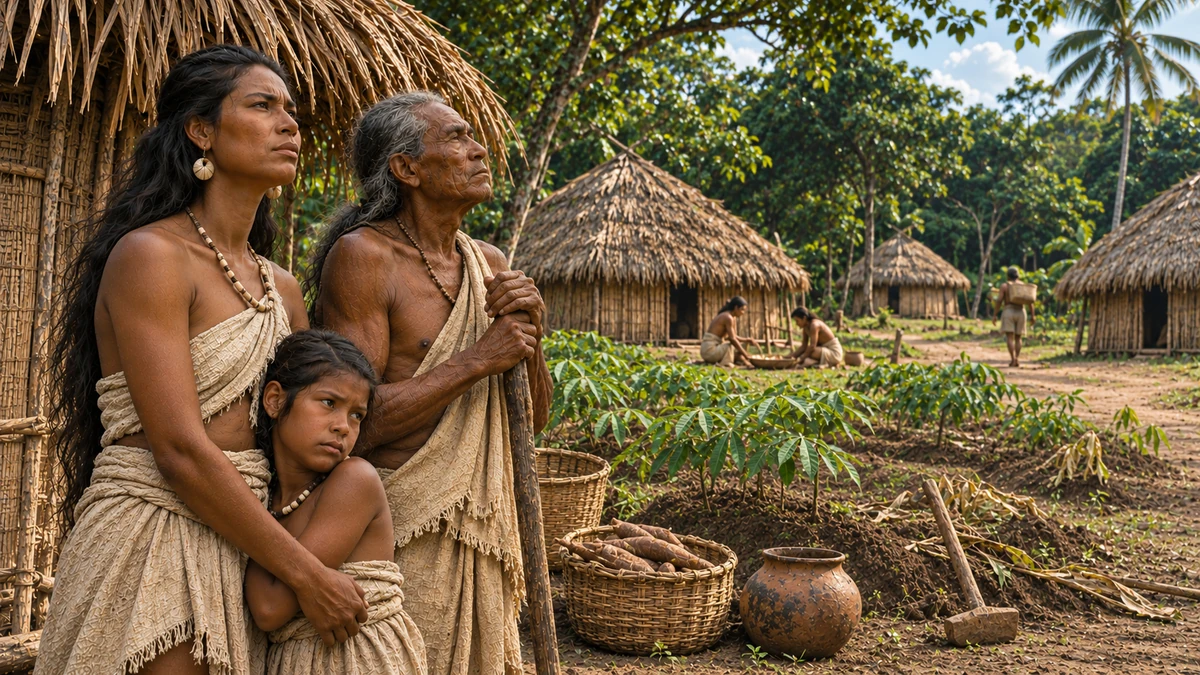
Artistic historical reconstruction of a Taíno community on Hispaniola around 1514–1515. It does not depict a specific documented event.
How Many People Disappeared from Colonial Records?
How many Taíno died after Christopher Columbus arrived on Hispaniola in 1492? It seems like a question that should have a numerical answer. Perhaps an approximate figure that would convey the scale of the tragedy caused by the Spanish conquest. Yet the historical evidence does not allow for such a simple answer.
We do not know the exact population of the island before the Europeans arrived. Colonial registers are incomplete and were frequently compiled to serve the interests of the authorities. Historians, archaeologists, and geneticists also use different methods that do not necessarily measure the same things. We must therefore distinguish between the population before colonization, the number of people recorded in later colonial documents, demographic decline, and the number of people who actually died.
These are not interchangeable figures.
If a later colonial register contains far fewer people than the estimated precolonial population, we cannot automatically treat the difference as the number of people killed. In the intervening years, people died, children were born, communities migrated, individuals escaped colonial control, and others disappeared from particular records for reasons unrelated to death. But this methodological caution does not diminish the catastrophe itself.
After 1492, the Indigenous population of Hispaniola experienced an extraordinarily severe demographic collapse. The Spanish conquest brought violence, forced labor, displacement, the loss of economic independence, and the disruption of family life and food production. Epidemics made the disaster even worse. Demographer Massimo Livi-Bacci has demonstrated why such a process cannot be adequately explained by the spread of disease alone.[1][2]
We must also consider what happens when people lose the ability to grow their own food, sustain their families, and make decisions about their own lives. The question, then, is not merely how many people died. It is also how the colonial system created conditions in which people died and in which sustaining future generations became increasingly difficult.
Hispaniola Before 1492: The Dispute Over the Original Population
Hispaniola, the island now shared by Haiti and the Dominican Republic, was home to numerous Indigenous communities before the Spanish arrived. Today, these populations are often associated with the name Taíno. But the island's inhabitants should not be portrayed as a single, politically and culturally uniform community.
Their settlements, local leadership, kinship networks, and economic relationships formed a diverse social world that had existed long before European contact. How many people lived there? No reliable comprehensive census from 1492 exists. Historical estimates have ranged from approximately 60,000 to almost eight million inhabitants of Hispaniola. The range is extraordinary, but that does not mean all these estimates are equally well supported.
Some researchers began with early colonial records and assumed particular rates of population decline. Others considered the island's agricultural capacity, economic resources, settlement sizes, and geographical distribution of its inhabitants. In his 2003 study Return to Hispaniola, Massimo Livi-Bacci critically reassessed these calculations.
In a subsequent discussion published in 2006, he explained that his reconstruction placed the population at approximately 200,000 to 300,000. Within his model, the probability of an estimate falls sharply below 100,000 or above 400,000.[1][2] This does not prove that exactly that many people lived on the island in 1492. It is a demographic reconstruction based on specific historical and economic assumptions.
Different methods may produce substantially different results. More recent genetic research, discussed later in this article, is particularly important in this regard. But why does the original population matter so much? If we assume that one million people lived on the island, the subsequent decline will appear very different from a reconstruction beginning with 200,000 inhabitants. The starting figure therefore has a profound influence on how the catastrophe is measured.
At the same time, we must avoid a false conclusion: even if the original population were known precisely, its subsequent decline would not be equivalent to the number of people directly killed. Demographic decline involves several distinct processes. People may die from violence, disease, malnutrition, or exhaustion. Birth rates may fall. Inhabitants may migrate or lose the status that had previously led to their inclusion in a particular register.
We can therefore approach historical truth only by first understanding what each figure actually represents. The highest estimate is not necessarily the best. But neither does the lowest estimate automatically imply the least historical responsibility.
The Year 1514: When People Were Counted to Be Allocated
Documentary source: The repartimiento of Indigenous people on Hispaniola (1515)
One of the most important documents for studying early colonial Hispaniola is the repartimiento of 1514–1515. It concerns the allocation of Indigenous people for colonial labor. The record is preserved in Spain's Archivo General de Indias under the archival reference PATRONATO,172,R.4.[3] The document is important because it is not merely a later historical estimate. It was produced as an administrative record by the Spanish colonial authorities. Its purpose, however, was not to provide an impartial count of every inhabitant of Hispaniola.
The colonial administration classified and allocated Indigenous people within a system associated with the encomienda. Under this institution, Spanish beneficiaries could demand labor and certain other obligations from designated Indigenous groups. In legal terms, the system also imposed duties of protection and religious instruction. In practice, however, it enabled extensive exploitation and forced labor. The document must therefore be understood within the circumstances in which it was created.
Indigenous people were classified primarily according to the needs of colonial administration. In a study of Taíno social categories, historian Francisco Moscoso published the following table: | Category | Number | |---|---:| | Cacical | 409 | | Naborías | 6,948 | | Indios de servicio | 14,840 | | Children | 1,592 | | Elderly people | 1,504 | | Published total | 25,302 |
The terms cacical, naborías, and indios de servicio have been retained in Spanish because they refer to historical social or colonial administrative categories whose meanings cannot adequately be reduced to a single modern English equivalent.[4] However, a problem emerges within the table itself. Adding the five listed categories produces a total of 25,293 people, while the published table gives 25,302. The discrepancy amounts to nine people.
In a 2007 study, historian Ida Altman cites a different total of 26,334 people for the repartimiento of 1514, drawing on scholarship concerning early colonial Hispaniola.[5] These discrepancies cannot be conclusively explained without examining the original tabulations and the categories used. But a more important point remains.
None of these figures proves that only that number of Taíno people were alive throughout Hispaniola in 1514.
The repartimiento was not a comprehensive population census in the modern sense. People outside particular colonial labor allocations, inhabitants who had withdrawn from colonial control, and those not covered by the criteria used may be absent from these records. Nor can the register tell us directly how many people were killed between 1492 and 1514, how many died from other causes, or how many were simply missing because the records were incomplete.
What Is Recorded, What Can We Infer, and What Does It Not Prove?
What is recorded: In 1514–1515, colonial authorities registered tens of thousands of Indigenous people as part of the system for allocating labor. What we can infer: The document offers insight into the organization of colonial exploitation, the classification of the population, and certain consequences of the conquest.
What it does not prove: It establishes neither the exact number of all living inhabitants of Hispaniola nor the total number of people who died after 1492. The colonial register is an invaluable historical source. But we must preserve the distinction between the history of the people themselves and what the authorities who controlled their labor chose to record about them.
Colonial Rule and the Destruction of the Conditions Necessary for Life
When we speak of violence during the conquest, we often think first of armed attacks, killings, punishment, and enslavement. Such forms of violence are a documented part of the Spanish conquest of the Caribbean. But a demographic catastrophe cannot be understood simply by counting those who died directly as a result of armed violence.
A community also depends on food, families, children, economic independence, and the ability to organize its life from one generation to the next. The Spanish conquest struck at these very foundations.
When Labor for the Colonists Displaced Labor for Survival
Before European arrival, the Indigenous communities of Hispaniola sustained their own systems of agriculture, fishing, gathering, and other economic activities. Colonial authorities increasingly diverted their labor toward gold extraction, transportation, construction, and supplying Spanish settlers. This meant that people were required to work for the colonial economy while less time and labor remained available to sustain their own communities.
Livi-Bacci emphasizes that this diversion of labor increased workloads, reduced access to resources, and worsened living conditions.[2] The consequences reinforced one another. Food shortages could lead to exhaustion. Exhausted people were more vulnerable to disease. Illness and death then reduced the number of people able to care for families and produce food. A process developed in which one consequence intensified the next. This was not simply an accidental economic crisis.
It was a system of coercive subordination in which colonial authorities controlled people's labor and, in doing so, interfered with the very conditions necessary for their survival.
Displacement and the Breakdown of Family Ties
The consequences for family life were equally significant. Livi-Bacci reports that Indigenous people assigned to mining labor could be separated from their families for eight months or more each year.[2] Such prolonged absences could seriously disrupt relationships between partners, childcare, and the cohesion of communities.
Forced transfers from one place to another, together with the allocation of groups among different colonial beneficiaries, further weakened existing social ties. People lost control over their time, their labor, and often their ability to live with those closest to them. These conditions could have consequences that a count of direct deaths alone could never capture.
What Does the Ratio of Women to Children Tell Us?
Livi-Bacci also examined a limited sample of colonial records from the districts of Concepción and Puerto Plata. The sample included 1,077 men, 894 women, and 251 children. The ratio of recorded children to women was approximately 0.281. But this figure cannot be used as a direct measure of fertility across Hispaniola.
The table includes only selected groups for which the numbers of men and women were recorded and at least one child was mentioned. Nor is it possible to determine reliably how much of the observed ratio resulted from reduced fertility, increased child mortality, or the characteristics of colonial recordkeeping.[2] The figure is therefore not a definitive answer.
It is, however, a significant indication that must be considered alongside other historical evidence of family separation and deteriorating living conditions. Demographic collapse can result from increased mortality, declining fertility, and the interaction between them. When people are forcibly displaced, exhausted, and deprived of security, sustaining families and ensuring children's survival becomes more difficult. This does not mean that children who were never born can be counted among the dead.
It means that the consequences of the colonial system cannot be measured solely by the number of people directly killed.
Forced labor disrupted the present lives of Indigenous communities. The breakdown of families and living conditions also threatened their future.
The Epidemic That Came After the Catastrophe Had Already Begun
Documentary source: Hieronymite letter on smallpox in Hispaniola (January 10, 1519)
Epidemics were an important factor in the catastrophic decline of Indigenous populations throughout the Americas. After the arrival of Europeans, pathogens spread with which many Indigenous communities had no previous experience. But in the case of Hispaniola, the chronology is particularly important. The first well-documented major outbreak of smallpox occurred in late 1518.
On January 10, 1519, two Hieronymite friars, Luis de Figueroa and Alonso de Santo Domingo, sent a letter to the Spanish king describing an epidemic affecting the Indigenous population. The document is preserved in the Archivo General de Indias under the reference PATRONATO,174,R.11.[6] According to the published historical transcription of the letter, its authors reported that almost one-third of the Indigenous people referred to in their account had died or were dying as a result of the epidemic. This is a grave historical testimony.
However, their statement must not be presented as a mortality rate independently verified by modern research for the entire population of Hispaniola.[2] It is also important to recognize that approximately twenty-six years had passed between Columbus's first arrival in 1492 and the major epidemic. During those years, conquest, forced labor, displacement, and the economic disruption of Indigenous communities had already been taking place.
The epidemic of 1518 therefore cannot, by itself, explain the demographic collapse that had begun before it. This does not prove, of course, that no other diseases or poorly documented outbreaks occurred before 1518. Livi-Bacci specifically points to the weakness of the evidence for an earlier major smallpox epidemic, while allowing for the possibility of other infections and their demographic consequences.[2] Both simplifications must therefore be rejected. It would be wrong to claim that smallpox caused every death.
It would also be wrong to claim that disease played no role before 1518. The essential point is that disease and colonial exploitation did not necessarily affect people independently of one another. People who were exhausted, poorly nourished, or displaced may have been living under conditions that made them even more vulnerable.
The Epidemic as a Colonial Labor Problem
The letter of January 1519 reveals another disturbing detail. In response to the consequences of the epidemic, its authors also requested measures to facilitate the arrival of enslaved African men and women without certain duties, together with concessions for colonial residents.[6] The mass death of Indigenous people was thus also treated as an economic problem for the colony. The document alone does not explain the entire subsequent development of Atlantic slavery.
It does, however, show that colonial administrators were considering how to replace lost labor with the labor of other enslaved people. Human catastrophe had become part of the calculations of the colonial economy. This is one of the most troubling features of such a system. People were not merely losing their lives and freedom. Their suffering could become primarily an administrative concern, tied to the continuation of production and exploitation.
What Ancient DNA Reveals — and What It Cannot Tell Us
In recent decades, research into ancient DNA has added an important new dimension to historical population estimates. In 2021, the journal Nature published a study by Daniel M. Fernandes and colleagues that analyzed genomic data from 174 newly studied ancient individuals alongside data from 89 previously published individuals.[7]
The researchers examined the genetic history of Caribbean communities, their kinship connections, and population movements before European arrival. Of particular importance to the question of population size is their estimate of effective population size. This is not a direct count of the people who lived in a particular place.
It is a statistical quantity derived from genetic evidence and the assumptions of a population model. The researchers used two forms of genetic analysis to estimate lower and upper bounds on effective population size. Comparing two major genetic groups associated with Hispaniola and Puerto Rico, they obtained a central estimate of Nₑ = 3,082, with a 95% confidence interval ranging from 1,530 to 8,150.
The authors interpret this result as an upper-bound estimate of the recent effective size of the connected population across both islands.[7]
This does not mean that only 3,082 people lived on Hispaniola in 1492.
The model concerns genetic connections formed over several generations before the individuals analyzed lived. To derive an approximate number of actual inhabitants, the researchers applied additional assumptions about the relationship between effective population size and census population size. On that basis, they argue that certain older estimates of hundreds of thousands or millions of inhabitants on individual large Caribbean islands were too high. This is an important scientific argument. But the model also has limitations.
It depends on the individuals whose remains were preserved and analyzed, their genetic relationships, the period being studied, and the statistical assumptions employed. It cannot simply be treated as a historical census conducted before European arrival. Nor can it determine the exact number of people who died during colonization.
The differences between genetic estimates and older historical reconstructions raise serious research questions that require further examination. We must not select whichever figure best supports a predetermined narrative. At the same time, it would be wrong to use lower genetic estimates as evidence that colonial violence was limited or historically insignificant.
The authors of the study explicitly acknowledge the devastating effects of European colonization, land dispossession, and the systematic killing of Indigenous populations.[7] The size of the precolonial population and historical responsibility for documented violence are related, but distinct questions. The first asks how many people lived. The second asks what colonial authorities did to them.
No Exact Death Toll, but No Escape from Responsibility
How many Taíno died? On the basis of the available historical, archaeological, and genetic evidence, we cannot provide a single reliable figure. We do not know the exact size of Hispaniola's precolonial population. Colonial labor registers are not comprehensive censuses. Genetic studies employ different methods and measure different population quantities.
Nor can we reliably determine what proportion of the demographic decline resulted from direct violence, forced labor, hunger, disease, reduced fertility, and other interconnected processes. But this does not mean that the causes of the catastrophe are unknown. We know about the colonial system of forced labor. We know about the violence of conquest. We know about the displacement and economic subjugation of Indigenous people.
We have evidence of deteriorating living conditions and historical testimony concerning an epidemic that struck communities after decades of colonial exploitation. These facts must not be erased by the simplistic explanation that people merely died of disease. Disease is no justification for forced labor, the deprivation of freedom, or the destruction of living conditions. At the same time, moral condemnation cannot replace historical accuracy.
An invented death toll would not demonstrate greater respect for the victims. It would make for poorer history. We must therefore remain consistent. Where documents exist, we present them. Where estimates are used, we explain their methods and limitations. Where serious disagreements remain, we do not conceal them. And where historical sources establish violence and exploitation, we condemn them unequivocally.
Nor should demographic collapse be confused with the complete disappearance of every descendant of Indigenous communities. Such a claim would once again erase people whose history continued beyond the colonial catastrophe. The Spanish conquest cannot be justified as the inevitable price of European geographical discoveries. For the people who already lived on Hispaniola, it was not the discovery of a new world.
It was the arrival of a foreign power that forcibly intervened in their communities, their freedom, and the conditions necessary for their survival.
We may never know the exact number of all those who died. But uncertainty about the historical figures is no reason to doubt the reality of documented colonial violence.
Their lives were not worth less because colonial records could not, or would not, fully count them.
Sources and further reading
- Massimo Livi-Bacci, “Return to Hispaniola: Reassessing a Demographic Catastrophe,” Hispanic American Historical Review, 83(1), 2003, pp. 3–51 Source
- Massimo Livi-Bacci, “The Depopulation of Hispanic America after the Conquest,” Population and Development Review, 32(2), 2006, pp. 199–232. Particularly the sections on Hispaniola, the epidemic, and disruptions to reproduction and family life Accessible author's version: Source 1 Source 2
- Archivo General de Indias, Relación del repartimiento, 1515, PATRONATO,172,R.4 Source
- Francisco Moscoso, “Parentesco y clase en los cacicazgos taínos: el caso de los naborías,” originally published in 1983; subsequently expanded version available through the Rutgers Puerto Rico Archival Collaboration. Table 1: published total 25,302; sum of the listed categories 25,293 Source
- Ida Altman, “The Revolt of Enriquillo and the Historiography of Early Spanish America,” The Americas, 63(4), 2007, pp. 587–614. Note 15 cites 26,334 Indigenous people in the repartimiento of 1514. This figure is not established as a comprehensive census of the island's population Source
- Archivo General de Indias, letter by the Hieronymite friars Luis de Figueroa and Alonso de Santo Domingo, January 10, 1519, PATRONATO,174,R.11. The archival catalogue confirms the date, authors, smallpox epidemic, and request concerning enslaved labor Source
- Daniel M. Fernandes et al., “A genetic history of the pre-contact Caribbean,” Nature, 590, 2021, pp. 103–110. Published online December 23, 2020. Particularly the section “Social structure and population size estimates.” Full text: Source 1 Source 2
The statement concerning approximately one-third of the Indigenous people affected is based on the published historical transcription discussed by Livi-Bacci [2]. The complete original manuscript has not yet undergone direct textual verification for this article