The Crown, the Church, and the Law: Who Lent Legitimacy to Colonial Conquest?
Papal decrees, royal orders, and the law helped shape colonial rule. Whom did they empower, whose freedom did they restrict, and who challenged them?
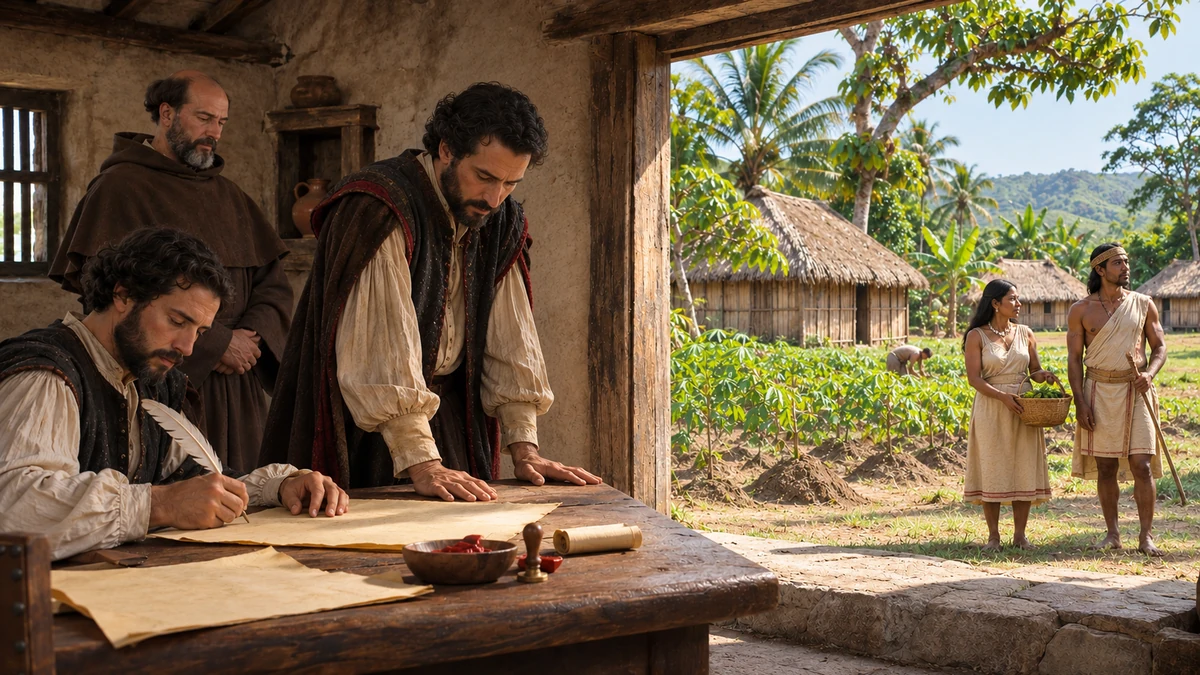
Historically informed reconstruction of a colonial office on Hispaniola, circa 1510–1513. The scene symbolizes European claims to authority made without Indigenous participation; it does not depict a documented meeting or the signing of an actual charter.
The Spanish conquest of the Caribbean was not merely the work of soldiers, navigators, and colonial administrators. It was accompanied by documents invoking God's will, royal authority, legality, and the protection of Indigenous peoples. Papal decrees supported European territorial claims, royal orders regulated forced labor, and jurists devised procedures intended to justify the subjugation of already inhabited lands. Yet opponents of such practices also emerged from within that same European world. The historical problem, therefore, is not simply whether laws existed. It is whom those laws empowered, whose freedom they restricted, and whether a legal framework could ever justify violence against people who had not consented to foreign rule.
Who Can Give Away Land Without the Consent of Those Who Live There?
In 1492, the Caribbean was not an empty space waiting for European rulers. Hispaniola, Cuba, Jamaica, and other islands were home to communities with their own political leaders, kinship networks, settlements, economic activities, and understandings of the world. Their political systems were not identical everywhere. Some communities belonged to larger chiefdoms, while others had different forms of local decision-making. But the absence of a European king did not mean the absence of political order.
When European rulers began discussing their rights to these territories, they did not begin with the consent of the people who lived there. They began with their own ideas about monarchical authority, Christianity, maritime discoveries, and relations between European states. This is where the central problem of colonial legitimation begins.
How could a document issued in Europe grant rights over lands and peoples who had played no part in its adoption?
For European rulers, the essential question was whether their claims complied with papal authorization, treaties, and the legal principles of their time. For Indigenous inhabitants, the questions were more immediate: who would decide how they lived, what happened to their land and labor, and what their future would be? These were not equivalent starting points.
An agreement between two European crowns was not the same as a free decision made by the inhabitants of the territory under discussion. Nor did a legal justification considered acceptable by conquerors demonstrate that conquest itself was just. We must therefore distinguish between what European documents authorized those acting under them to claim and what authority those claimants actually possessed over Indigenous communities.
The Papal Grant of 1493
Documentary source: Certified 1515 copy of Inter caetera (PARES)
Papal involvement in European overseas expansion did not begin with Columbus. In 1435, Pope Eugene IV issued Sicut dudum, condemning the capture and enslavement of inhabitants of the Canary Islands. He ordered the release of captured islanders and explicitly prohibited the further enslavement of baptized inhabitants and those who freely sought baptism. [1]
The document represented an important intervention against particular forms of violence. Yet it concerned specific islanders and circumstances. It did not amount to the general abolition of slavery or a universal prohibition of European wars of conquest. A different approach appeared in two papal decrees issued by Nicholas V: Dum diversas in 1452 and Romanus Pontifex in 1455.
They provided the Portuguese crown with extensive religious and political support for warfare against certain non-Christian adversaries, their subjugation, and the expansion of Portuguese territorial and commercial claims. [2] This demonstrates that papal documents before 1492 did not express a single, unchanging position on enslavement and European expansion.
Some demanded the release of particular captives, while others permitted the violent subjugation of people and territories. Following Columbus's first voyage, the question of legitimizing new Castilian claims became even more significant. Pope Alexander VI issued several decrees in 1493 relating to the Castilian crown's overseas expansion.
It is particularly important to recognize that two distinct decrees begin with the words Inter caetera. The first bears the date May 3, 1493, and the second May 4, 1493. Their contents are not identical. The first supported Castilian claims to territories not under the authority of Christian rulers. The second introduced a line of demarcation 100 leagues west of the Azores or Cape Verde Islands. [3]

There is also an important distinction between the date appearing on a document and the date when it was actually issued. According to the historical analysis of Frances Gardiner Davenport, the second Inter caetera, although dated May 4, was in fact issued later, most likely in June 1493. It is therefore more accurate to refer to the decree dated May 4, 1493, rather than state without qualification that it was actually issued on that day. Its provisions were distinctly favorable to Castile.
Papal authority supported the Castilian crown's exclusive rights to acquire territories and conduct trade on a specified side of the demarcation line, subject to restrictions concerning lands already under the authority of Christian rulers. Evangelization was presented as an important purpose of this expansion. Yet the political significance of the decree was equally clear.
The pope participated in establishing European territorial claims over lands whose inhabitants had not been consulted. In assessing responsibility, we must remain precise. Inter caetera does not contain a direct order for every subsequent massacre, abduction, or other specific act of violence committed by the conquerors. We must not attribute such instructions to the document without evidence.
Nevertheless, the decree formed part of an institutional framework that presented the European acquisition of power over non-European communities as legitimate.
Papal recognition of Castilian claims was not the same as the free consent of the people who already lived in those territories.
Tordesillas: A European Line Across an Inhabited World
The papal demarcation of 1493 did not settle relations between Castile and Portugal. Both crowns sought to protect their maritime routes, commercial interests, and future territorial claims. Their representatives therefore concluded a new treaty at Tordesillas on June 7, 1494. The treaty established a line of demarcation intended to run from the North Pole to the South Pole, 370 leagues west of the Cape Verde Islands. [4]

This was a different line from the one specified in the papal decree dated May 4, 1493. The treaty was subsequently ratified: the Castilian crown confirmed it on July 2, 1494, and the Portuguese crown on September 5 of the same year. The agreement thereby acquired the force agreed upon between the two crowns.
But this did not mean that the signatories already exercised actual control over every land to which they laid claim. A political claim and the actual exercise of authority are different things. Equally important is who did not participate in the treaty. Indigenous communities were not parties to the agreement.
Their leaders did not participate in the negotiations, did not determine the demarcation line, and did not consent to others making decisions about their territories on their behalf. Tordesillas was therefore an agreement between two European monarchies concerning their respective claims. It was not an agreement between European conquerors and all the inhabitants of the territories concerned.
Its implementation was not straightforward either. Different understandings of the length of a league, the measurement of distances, and the line's geographical position allowed for differing practical interpretations. This further demonstrates that the demarcation was primarily a legal and diplomatic arrangement, rather than a precisely established boundary between territories already under effective control.
A line on a map could divide the claims of European crowns. It could not erase the political rights of the people living on either side of that line.
Royal Protection and Forced Labor
Papal decrees and European treaties established a framework for territorial claims. Royal instructions then determined how authority was to be exercised in the colonies. On September 16, 1501, Ferdinand and Isabella issued instructions to Nicolás de Ovando, the new governor of Hispaniola. They called for the organization of colonial administration, Christian instruction, and the protection of Indigenous inhabitants against certain abuses. The instructions also specifically addressed the forcible taking of women and other property.
Yet the same document envisaged economic obligations for Indigenous inhabitants, including work in gold extraction and other colonial activities, with payment determined by the authorities. [5] Two years later, this contradiction was expressed even more directly. On December 20, 1503, Isabella issued an order to Ovando from Medina del Campo requiring Indigenous inhabitants to be compelled to work.
The order referred to reports that many Indigenous people were unwilling to work for Spaniards, even when payment was supposedly offered. The queen therefore instructed the governor to compel them to work in construction, gold extraction, agriculture, and other activities important to the colonial economy. [6]
Indigenous leaders also played an important role in organizing the workforce, as they were expected to provide a specified number of laborers. Payment and provisions were envisaged, but the decision whether an individual would work for the colonists was not left to that person's free choice. Most revealingly, the order simultaneously described these people as free. It did not formally declare them all to be slaves.
Yet recognition of that legal status did not mean they could refuse work demanded by a foreign authority without consequences. This distinction is essential. The legal status of a free subject did not automatically guarantee genuine freedom to make decisions about one's life, labor, or political community. Nor did the existence of payment, by itself, turn compulsory labor into a voluntary contractual relationship.
The Crown could call a person free while denying that person the right to decide how their own labor would be used.
This contradiction reveals the institutional character of colonial subjugation. It was not simply a matter of individual colonists abusing their power in defiance of official rules. Coercion, in certain forms, was also envisaged in royal instructions themselves.
Montesinos: An Indictment from His Own Century
In December 1511, the Dominican preacher Antón de Montesinos publicly condemned the treatment of Indigenous inhabitants by colonists in Santo Domingo. His sermon directly addressed violence, excessive labor, inadequate food, and the suffering of people on Hispaniola. According to the account later preserved by Bartolomé de las Casas, Montesinos asked the colonists by what right they held Indigenous people in such cruel bondage and by what authority they waged wars against them.
He then posed a question that became one of the most significant moral testimonies of the early colonial period:
"Are these not human beings?" [7]
But it matters how the sermon has survived. We do not possess an original transcript of Montesinos's words. The familiar text comes from Las Casas's later historical account. It is therefore impossible to prove that every word quoted today is identical to what the preacher actually said. Nevertheless, the event remains historically significant despite this limitation. The sermon was delivered while Spanish colonial rule was becoming firmly established on Hispaniola.
Its condemnation was not a modern interpretation imposed retrospectively upon the past. It was an early criticism emerging from within the colonial world itself. It demonstrated that some contemporaries recognized a profound contradiction between Christian teachings about love of one's neighbor and the treatment of people subjected to forced labor and violence.
It also demonstrated that the Church did not act as a completely unified institution without internal differences. Some of its representatives supported colonial political claims, while others publicly condemned violence and the conduct of colonists. Montesinos's criticism contributed to debates that led to a legislative response from the Crown. Yet one question remained unresolved:
Can restrictions on particular abuses make a system just when its foundations require people to submit to foreign rule against their will?
Burgos: Regulation and Its Limits
Documentary source: Laws of Burgos (1512), archival copy from January 1513
In December 1512, the Castilian authorities adopted regulations known as the Laws of Burgos. The original legislation comprised 35 provisions addressing housing, food, labor, religious instruction, and the obligations of colonists. [8] Some provisions attempted to limit violence and improve living conditions. Others regulated a system that allowed colonists to demand labor from Indigenous inhabitants.
The laws also envisaged relocating people closer to Spanish settlements, where work and religious instruction could be organized more easily. Supporters of this arrangement presented relocation as beneficial for education, protection, and administration. Yet changing one's place of residence was not a free decision when colonial authorities imposed it.
Here we must distinguish the original Laws of Burgos, dated December 27, 1512, from their subsequent amendments or clarifications adopted at Valladolid on July 28, 1513. The documents are related, but they are not the same legal instrument. An earlier article in this series examined provisions affecting motherhood and the upbringing of children from chiefly families. Here, the broader legal issue matters more.
What did these laws mean for the colonial authorities' claimed right to determine the labor, residence, and everyday lives of other communities? The Laws of Burgos did not abolish the encomienda system. They sought to regulate it, restrict certain consequences, and establish obligations for colonists. It would therefore be historically inaccurate to claim that the laws contained no protective measures whatsoever.
But it would be equally inaccurate to claim that their existence eliminated forced labor or guaranteed genuine equality.
A protective provision can restrict an abuse without dismantling the power relationship that makes the abuse possible.
This was the fundamental contradiction within the Laws of Burgos.
Requerimiento: Submission or War
Documentary source: Requerimiento — archival authority record (PARES)
In 1513, the jurist Juan López de Palacios Rubios drafted a text known as the Requerimiento. It was a legal proclamation intended to be delivered to Indigenous inhabitants in the course of Spanish expeditions of conquest. The document was based on a religious and legal interpretation according to which papal authority justified the Spanish crown's political claims in the Americas. [9]
The inhabitants were instructed to recognize the supreme authority of the Church and the pope, accept the rule of the Castilian monarchs, and permit Christian preaching. If these demands were accepted, the document promised protection for individuals, families, and property. It also explicitly stated that accepting political submission did not, in itself, require compulsory baptism.
It would therefore be incorrect to claim that the Requerimiento directly demanded the immediate forced conversion of every inhabitant. But this does not diminish its coercive nature. If the inhabitants did not recognize the authority being demanded, or if, in the conquerors' judgment, they delayed doing so, the document threatened war.
The Spaniards claimed the right to enter their territory by force, compel obedience, seize property, and enslave men, women, and children. The text sought to place responsibility for deaths, destruction, and other harm upon the people who refused the required submission. This was the central contradiction in its legal reasoning. The conqueror first proclaimed a right to rule. The rejection of that claimed authority was then presented as grounds for justifying violence.
In this way, the legal procedure could serve to shift responsibility from the conqueror to the population being subjugated. The question of language and comprehension is also important. A proclamation delivered in a language its recipients did not understand could not provide a basis for an informed decision. Yet even a comprehensible translation would not, by itself, have resolved the fundamental problem.
A person required to choose between submitting to foreign rule and facing the threat of war and the enslavement of their family does not decide on the same terms as a free and equal party to an agreement.
A choice made under threat of violence is not the same as voluntary consent to political authority.
We must also preserve the correct chronology. The Requerimiento was drafted in 1513. Columbus could not have used it in 1492. Nor is there sufficient evidence to claim that it was read in exactly the same manner during every subsequent conquest or that all those addressed were familiar with its contents. Nevertheless, the very existence of the document demonstrates how colonial law could be used to construct a procedure through which conquerors sought to portray violence as the consequence of refusing an allegedly lawful demand.
Internal Opposition: Vitoria, Las Casas, and 1537–1538
Questions concerning the legitimacy of conquest did not end with the Laws of Burgos or the Requerimiento. In the following decades, debates continued over freedom, property, religion, and the right to exercise political authority. An important place in these debates belongs to the papal bull Sublimis Deus, issued by Pope Paul III in 1537.

The document rejected the idea that Indigenous inhabitants lacked rights to freedom and property because of their non-Christian religion or supposed irrationality. It emphasized that they were human beings capable of receiving the Christian faith and that their freedom or property must not be taken from them merely because of their religious status. It associated conversion with preaching and example rather than violent compulsion. [10] But here, too, the historical account does not end with a single document.
A related document, Pastorale officium, was also issued in 1537, providing for ecclesiastical penalties for certain acts of enslavement. In 1538, Paul III revoked this punitive measure through Non indecens videtur. The legal-historical study by Manuel Leal Lobón explicitly distinguishes the revocation of Pastorale officium from the teaching contained in Sublimis Deus. [11]
According to his interpretation, the revocation removed the prescribed sanctions, rather than the underlying position that Indigenous inhabitants possessed rights to freedom and property. It would therefore be incorrect to say that the entire protective declaration was simply revoked. Nor would it be correct to conclude that the declaration itself definitively ended enslavement or forced labor in the Spanish colonies. The contradiction between principle and practice remained.
An important continuation of these debates is associated with Francisco de Vitoria. In his university lectures De indis in 1539, he considered whether Indigenous inhabitants had possessed genuine property rights and political authority before the arrival of the Spaniards. His answer was affirmative. He recognized the legitimacy of their leaders, political communities, and property rights.
He rejected the notion that the pope could simply grant European monarchs political authority over non-Christian peoples by virtue of his spiritual authority alone. [12] Yet his theory was not without limitations. Vitoria also developed arguments concerning the rights to travel, trade, preach Christianity, and protect certain rights. Under some circumstances, he allowed coercive intervention or war.
He must therefore not be presented as an advocate of an entirely modern conception of Indigenous self-determination. His work was both an important criticism of certain justifications for conquest and an example of European legal thought that permitted other forms of interference in foreign political communities. Debates over the justification of conquest reached another peak at Valladolid in 1550–1551. There, Bartolomé de las Casas and Juan Ginés de Sepúlveda developed opposing positions.
Sepúlveda defended arguments that, under certain conditions, permitted coercive subjugation and war. Las Casas strongly opposed such justifications, defending the rights of Indigenous communities and peaceful evangelization. [13] But we must not turn the history of this debate into a simple story of two speakers who faced one another in a single contest, after which an impartial tribunal declared a definitive winner.
The proceedings involved written arguments, discussions, and evaluations by theologians and jurists. No single definitive judgment survives that unequivocally resolved the entire question of the legality of Spanish conquest. The significance of the debate lies elsewhere. It demonstrates that questions of colonial violence, political authority, and human dignity became subjects of open dispute within some of Europe's highest institutions.
Colonial injustice was not invisible to everyone in the sixteenth century.
Opposition existed. Yet its presence did not automatically dismantle the institutions and power relationships that made subjugation possible.
Legal Justification Is No Moral Excuse
When we examine the documents from the first decades of Caribbean colonization, it becomes clear that conquest was not simply the result of arbitrary decisions made by individuals. Papal decrees supported European territorial claims. Royal orders regulated the lives and labor of people under Spanish rule. The Treaty of Tordesillas divided the interests of European crowns.
The Laws of Burgos contained certain protective measures, but they did not abolish the colonial system of compulsory labor. The Requerimiento presented submission as a legal demand, with refusal linked to the threat of war. Yet these documents did not all have the same meaning, nor did they emerge from identical political circumstances. Nor were they supported by every contemporary.
Montesinos, Las Casas, Vitoria, and others raised questions that challenged the very foundations of colonial authority. Their criticism mattered, even though it remained connected to the limitations of their own age. We should therefore not present this history as the story of a completely unified Church, a unified Crown, or unchanging attitudes shared by all Europeans. Responsibility must be connected to specific documents, decisions, institutions, and actions.
It must not be attributed indiscriminately to all believers, clergy, or members of a particular society. But historical precision does not require moral indifference.
Legal formalities do not turn coercion into free consent. A religious purpose does not justify enslavement. An agreement between European monarchs does not erase the political rights of people whose fate those monarchs decided without their participation.
Colonial authorities could restrict certain abuses while preserving a system that made the subjugation of entire communities possible. This contradiction is the central finding of the article. The second part of this series has examined violence against Indigenous leaders, the expansion of colonial rule across the Caribbean, and the intrusion of that rule into the lives of women and children.
This concluding article reveals how such practices acquired a political, legal, and religious framework. Violence did not become just because the authorities knew how to incorporate it into a regulation, treaty, or official declaration. And people did not lose their dignity because someone else proclaimed the right to their land, their labor, and their future.
Sources and further reading
- Pope Eugene IV (January 13, 1435). Sicut dudum. Document concerning the liberation of captured inhabitants of the Canary Islands and the prohibition of certain forms of further enslavement. An English translation from a later documentary collection has been used Source
- Pope Nicholas V (1452, 1455). Dum diversas and Romanus Pontifex. Papal decrees concerning Portuguese expansion, the subjugation of non-Christian adversaries, and territorial and commercial claims. A Latin text with a Slovenian translation is available for the first, and an English translation from Davenport's edition for the second Source 1 Source 2
- Pope Alexander VI (1493). Inter caetera, the two decrees dated May 3 and May 4, 1493. Frances Gardiner Davenport, ed., European Treaties Bearing on the History of the United States and Its Dependencies to 1648, Washington: Carnegie Institution of Washington, 1917. Of particular importance are the differences between the decrees and the discussion of the actual date of issue of the second Source
- Treaty of Tordesillas (June 7, 1494). Agreement between Castile and Portugal establishing a demarcation line 370 leagues west of the Cape Verde Islands, with separate ratifications Source 1 Source 2
- Ferdinand and Isabella (September 16, 1501). Instructions to Nicolás de Ovando for the administration of Hispaniola. A primary document concerning the protection of Indigenous people, colonial governance, and economic obligations. Translated excerpts are available Source
- Isabella of Castile (December 20, 1503). Royal order to Nicolás de Ovando, issued at Medina del Campo, concerning compulsory labor by Indigenous inhabitants alongside formal recognition of personal freedom and provision for payment Source
- Bartolomé de las Casas. Historia de las Indias. A later chronicle account preserving the sermon delivered by Antón de Montesinos in December 1511. The transcription published by the Dominican Order has been used for comparison Source
- Laws of Burgos (December 27, 1512) and the amendments adopted at Valladolid (July 28, 1513). Ordenanzas reales para el buen regimiento y tratamiento de los indios. The sources used include a transcription of the original provisions, bibliographic information from Spanish archives, and a scholarly study by Rafael Sánchez Domingo (2012), “Las leyes de Burgos de 1512 y la doctrina jurídica de la conquista,” Revista Jurídica de Castilla y León, no. 28 Source 1 Source 2
- Juan López de Palacios Rubios (1513). Requerimiento. Proclamation concerning recognition of papal and royal authority, permission for Christian preaching, and the consequences of refusal Source
- Pope Paul III (1537). Sublimis Deus, also entitled Sublimus Dei in some editions. Statement concerning the dignity, freedom, and property of Indigenous inhabitants. The transcribed editions consulted differ in their precise dates; the article therefore uses the year 1537 Source
- Manuel Leal Lobón (2008). “¿Existió en España una controversia sobre la racionalidad-irracionalidad de los indios americanos?” Isidorianum, 17(34), pp. 107–137, especially pp. 135–136. Study of Sublimis Deus, Pastorale officium, and Non indecens videtur Source
- Francisco de Vitoria (1539). De indis. Lectures concerning Indigenous property rights, political authority, papal jurisdiction, and permissible and impermissible justifications for conquest. A contemporary scholarly analysis of trade rights and legitimate intervention has also been used for context Source 1 Source 2
- Luke Glanville, David Lupher, and Maya Feile Tomes, eds. (2023). Sepúlveda on the Spanish Invasion of the Americas: Defending Empire, Debating Las Casas. Oxford: Oxford University Press. A critical edition of sources concerning Sepúlveda's arguments and the debates associated with Valladolid in 1550–1551 Source
Methodological Note
This article draws on papal decrees, royal instructions, international treaties, colonial legal regulations, chronicle accounts, and modern historical and legal-historical scholarship
Regarding the two Inter caetera decrees, we distinguish between the documents dated May 3 and May 4, 1493, and between the date appearing on a document and the date of its actual issue. Papal legitimation of European claims is not direct evidence that the pope ordered every subsequent act of violence
The Treaty of Tordesillas regulated relations between two European crowns. It does not establish the consent of Indigenous communities or actual control over all territories claimed by those crowns
The instructions to Ovando of 1501 and the royal order of 1503 demonstrate that formal personal freedom and compulsory labor obligations could exist simultaneously. Legal status cannot be treated as direct evidence of people's actual freedom
Montesinos's sermon is known primarily through Las Casas's later account, not through a surviving original transcript. The Laws of Burgos of 1512 and the amendments adopted at Valladolid in 1513 are related but distinct documents
The Requerimiento demanded political submission under threat of war and enslavement. It did not directly order immediate forced baptism, nor can it be attributed to Columbus's arrival in 1492
Regarding the documents of 1537–1538, a distinction must be maintained between the protective teaching of Sublimis Deus, the punitive provisions of Pastorale officium, and the subsequent revocation of the punitive measure. The interpretation of the scope of that revocation is attributed to the legal-historical study consulted
Francisco de Vitoria is not presented as an advocate of an entirely modern understanding of Indigenous self-determination. Nor is the Valladolid debate of 1550–1551 portrayed as an event that produced a single, definitive, and universally binding judgment on colonization
Moral condemnation of colonial violence is not a substitute for historical evidence. The article distinguishes documented legal provisions, their political purposes, their actual implementation, later interpretations, and questions for which definitive historical certainty is not possible