Women and Children Under Colonial Rule: Abductions, Sexual Violence, and the Breaking Apart of Families
Colonial violence disrupted the lives of women and children and tore families apart. The article also explores women’s role in their communities’ survival.
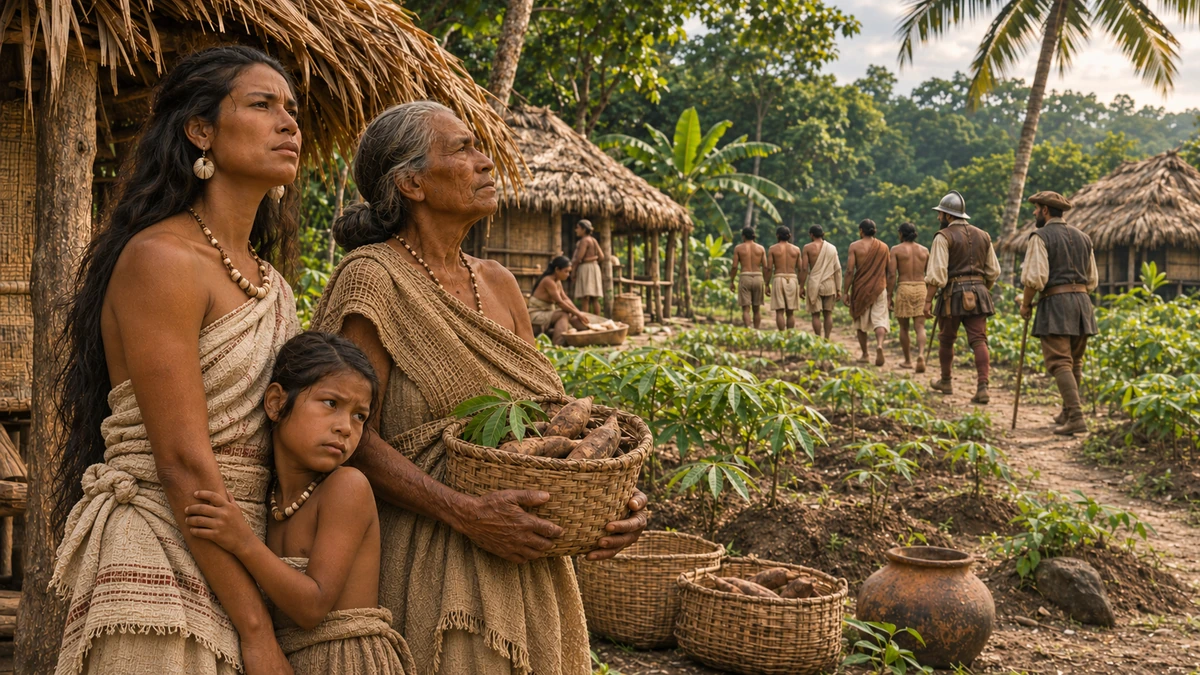
Artistic historical reconstruction of a Taíno family in a Hispaniola settlement, c. 1510–1515, with colonial coercion shown in the background. An interpretation, not a documented incident or authentic portraits.
The Spanish colonization of the Caribbean affected far more than the political authority, lands, and economies of Indigenous communities. It also reached into the lives of women and children, disrupting family ties, intimate relationships, motherhood, and child-rearing. Abduction, sexual violence, and forced labor transformed societies that had existed long before the arrival of the conquerors. Royal instructions prohibited certain abuses, but they did not dismantle the colonial system of subjugation. Yet Indigenous women were not merely victims. They were also political leaders, custodians of knowledge, and active participants in their communities' struggle to survive.
Women Were Not Spoils of War
Before the Spanish arrived, Hispaniola was home to communities with their own settlements, economies, kinship networks, and political institutions. Women took part in growing and preparing food, making tools and other objects, managing households, and passing knowledge from one generation to the next. Some belonged to influential families, while others held significant political responsibilities.
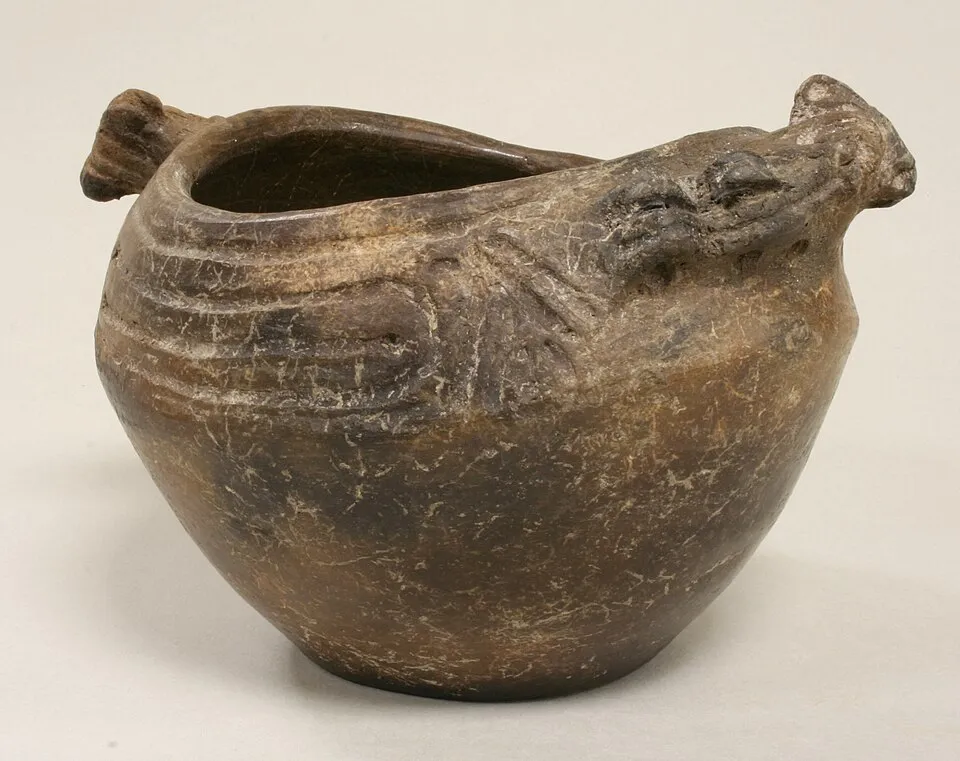
Their position cannot be reduced to a single generalization. It varied according to social standing, kinship ties, age, and local circumstances. Nor is there sufficient evidence to support an idealized picture of complete equality between women and men in every precolonial community. None of this, however, diminished their right to personal freedom, bodily autonomy, and family life.
As European expeditions began capturing Indigenous inhabitants, conquest reached into aspects of life that military chronicles often mentioned only in passing. Abducting a woman could separate her from her partner, children, parents, and relatives. Removing someone from her community could disrupt relationships essential to work, food production, child-rearing, and mutual support. Sexual coercion violated a person's body and freedom directly.
The history of colonization therefore cannot be understood solely through battles, military campaigns, and the political decisions of European rulers. We must also ask what happened to those whose everyday lives came under the control of a foreign power.
Captivity and the Trade in Human Beings: The Primary Documents
During Columbus's expeditions, Spanish parties were already capturing Indigenous inhabitants and treating them as people who could be transported, distributed, or handed over to others. One important account comes from Michele da Cuneo, a participant in Columbus's second expedition. After returning from the Caribbean, Cuneo composed a report in the form of a letter to Gerolamo Aimari between October 15 and 28, 1495. The text survives in a later manuscript copy rather than in Cuneo's original. [1][2]
Cuneo describes an episode associated with preparations for ships departing for Spain in February 1495. According to his account, the Spanish assembled approximately 1,600 Indigenous captives. Of these, around 550 were selected for transport to Spain, while other members of the colonial community were allowed to take possession of those who remained. Cuneo states that approximately 400 people were eventually permitted to leave.
These figures matter, but they must be understood as numbers reported by a participant, not as an independently verified count of everyone captured. The essential point is that the captives were denied the freedom to decide where they would go. They could not choose whether to remain in their homes, cross the ocean, or be handed over to someone else.
Cuneo also describes women with infants who, while fleeing the possibility of renewed captivity, acted under conditions of extreme fear. His account is deeply biased and cannot reliably reveal their personal motives or decisions. We must not judge these women through the mocking or condemnatory language of a man who participated in their subjugation.
The source documents the violent capture of human beings. It does not give us direct access to the thoughts and feelings of individual mothers and children. A geographical distinction is also necessary. Cuneo's report describes events across the wider Caribbean, not Hispaniola alone. Moreover, his labels for different Indigenous groups do not always correspond to reliable modern ethnic identifications. Yet these limitations do not diminish the significance of his testimony. Human beings were captured and distributed as spoils.
Among them were women whose family ties and personal freedom did not prevent the conquerors from treating them as possessions.
When the Rapist Told His Own Story
One of the most disturbing passages in Cuneo's account describes sexual violence against an abducted Indigenous woman. Cuneo states that he captured a woman during the expedition, referring to her with the term Camballa, and that Columbus gave her to him. He then took her into his cabin. When he attempted to have sexual intercourse with her, she resisted. By his own account, he used a rope to beat her into submission. He ended the episode with a degrading insinuation, attempting to portray her subsequent behavior as a form of consent. [1][2]
His portrayal does not change what the account reveals. The woman was a captive. She resisted sexual intercourse. Cuneo used physical violence against her.
His account is evidence of sexual violence, not of freely given consent.
There is no need to reproduce every graphic and humiliating detail of his description. More important is the attitude of the man who wrote it. Cuneo did not present his violence as something for which he should be held accountable. He wrote as though he had the right to do as he wished with an abducted woman, treating her resistance primarily as an obstacle to his desires.
In his critical analysis, Giuseppe Bellini drew attention to precisely this treatment of Indigenous people as objects over which the conquerors believed they could exercise unrestricted power. [2] When examining Columbus's responsibility, however, we must distinguish between what is documented and what remains unproven. Cuneo claims that Columbus gave the abducted woman to him. This is a significant statement about Columbus's role in the treatment of a captive. It does not, however, prove that Columbus personally ordered the rape.
Inventing such an order would not strengthen the historical argument. It would obscure the difference between documented conduct and an allegation for which the source provides no direct evidence. We also do not know the woman's name, her precise origins, or what happened to her afterward. Cuneo's designation Camballa is insufficient to establish that she was Taíno. This absence of information is among the most painful features of surviving colonial accounts.
A perpetrator could describe his own actions in detail without preserving the name of the person he assaulted. Yet the woman has not disappeared from the historical record entirely. Cuneo himself recorded her resistance. Even a source written from the perpetrator's perspective thus preserves evidence that the abducted woman did not submit willingly.
A Royal Prohibition Did Not Mean Safety
The Castilian Crown was not unaware of colonial violence against Indigenous women. Instructions issued by Ferdinand and Isabella to Nicolás de Ovando, the new governor of Hispaniola, on September 16, 1501, make this clear. The instructions explicitly acknowledge that some Spanish settlers had taken Indigenous men's wives and other property against their will.
Ovando was ordered to ensure that what had been taken was returned. The instructions also required marriages between Spanish men and Indigenous women to be entered into voluntarily rather than through coercion. [3] This is an exceptionally important document. It demonstrates that the royal authorities knew of these abuses and addressed them explicitly. But issuing a prohibition was not the same as enforcing it effectively.
The document alone cannot establish that all abducted women were returned, that perpetrators were punished, or that sexual violence came to an end. Even more revealing is the contradiction within the instructions themselves. The same Crown that demanded protection for Indigenous inhabitants against certain abuses also required them to provide tribute and labor in support of colonial economic objectives.
Ovando was instructed to organize Indigenous labor in gold mining and other activities serving the Crown, with payment set at a rate the colonial authorities considered fair. This was not an agreement negotiated on equal terms between independent communities. The Crown regarded Indigenous inhabitants as its subjects, although they had not been under Castilian authority before the conquerors arrived. It also sought to regulate marriage, labor, and other aspects of social life.
Requiring voluntary marriage was an important restriction on settlers' arbitrary conduct. It did not, however, eliminate the wider structures of coercion.
Prohibiting abduction was not the same as recognizing the full personal and political freedom of Indigenous people.
The instructions of 1501 therefore reveal two dimensions of colonial rule: the acknowledgment of particular abuses and the simultaneous strengthening of a system that subordinated human beings.
Burgos: Protecting Pregnancy Within a System of Forced Labor
In December 1512, a set of regulations known as the Laws of Burgos was adopted.

These laws governed housing, labor, food, clothing, religious instruction, and other aspects of Indigenous life under Spanish authority. Provisions XVII and XVIII are particularly important for understanding colonial intervention in family life, childhood, and motherhood. [4] Provision XVII required the sons of Indigenous chiefs, around thirteen years of age, to be placed in the care of Franciscan friars. There, they were to spend four years learning to read, write, and understand the Christian faith.
After completing their education, they were to return to the existing colonial arrangements. They were expected to help communicate Christian teachings to Indigenous communities, on the assumption that those communities would be more willing to accept such instruction from them. The provision was therefore concerned with more than education.
It sought to shape future members of Indigenous leadership families according to colonial expectations. The text of the law does not tell us how many boys were actually placed with the Franciscans or how individual children experienced that education. It does, however, make the authorities' intention to intervene in their upbringing unmistakable. Provision XVIII addressed pregnant women.
After the fourth month of pregnancy, women were not to be sent into mines or assigned certain forms of heavy agricultural work. Following childbirth, similar restrictions applied while a mother cared for her child, until the child reached the age of three. These provisions acknowledged that physically demanding labor could harm pregnant women and their children. They did not, however, provide a general exemption from work.
Pregnant women could still be required to perform household tasks, including preparing food. Colonial authorities thus continued to determine which activities settlers could demand of them. The law also prescribed penalties for violations. For repeated offenses, a settler could lose the right to command the labor of the woman concerned, her husband, or other Indigenous people assigned to him. The structure of these penalties reveals the underlying contradiction.
Protection from particular forms of labor did not abolish the institution that allowed settlers to control Indigenous workers.
Colonial authorities acknowledged the need to protect pregnant women and children without ending the coercive system governing their labor.
It would be historically inaccurate to claim that the Laws of Burgos contained no protective provisions. But neither can those provisions be taken as proof that the colonial system was just. There is a fundamental difference between being protected from certain dangerous tasks and being free to decide how to live one's own life.
Anacaona and Mencía: Authority, Resistance, and Bodily Integrity
The history of Indigenous women is not solely the history of violence committed against them by the conquerors. Some women occupied important political positions and participated directly in decisions shaping the future of their communities. Among them was Anacaona, a leader of Xaraguá. Her story is examined in greater detail in the preceding article in this series. What matters here is that she held a recognized political role in relations among Indigenous communities and with the Spanish.
Roberto Valcárcel-Rojas cautions against interpreting such leadership solely through European conceptions of political power. [5] Anacaona's position does not prove that every political institution in precolonial Hispaniola was equally open to women. It does demonstrate that women's political agency cannot simply be dismissed. Another important figure is Mencía, the wife of the Indigenous leader Enriquillo. Her story survives in sources that do not agree on every detail.
In Historia de las Indias, Bartolomé de las Casas calls Enriquillo's wife Doña Lucía. Other contemporary sources identify her as Doña Mencía. Historian Ida Altman draws attention to the conflicting historical traditions and to the fact that Las Casas was not on Hispaniola when Enriquillo's revolt began. [6][7] The discrepancy between the names should therefore be acknowledged rather than concealed.
Las Casas reports that a younger settler named Valenzuela took a mare belonging to Enriquillo and subsequently attempted to force himself sexually on Enriquillo's wife. Enriquillo complained, but received no effective protection from the local representative of colonial authority. According to the chronicle, he instead encountered threats and humiliation. When he sought justice from the higher colonial court in Santo Domingo, he received a response directing him back to the local authorities. The account nevertheless requires careful reading.
Las Casas describes an attempt at sexual coercion. Some later interpretations present the episode as a completed sexual assault. The differences between the accounts do not justify claiming, without further evidence, that the precise sequence of events is known. Altman also cautions against explaining Enriquillo's revolt through a single episode. Long-standing disputes with local authorities and the broader conditions of subjugation were also significant. This does not diminish the seriousness of the reported violence against his wife.
Rather, it means that a historical explanation must distinguish between the chronicler's account and the more complex development of the revolt. Nor should Mencía's story end with that episode. After Enriquillo's death in 1535, Castilian authorities received a report that he had designated his wife, Doña Mencía, and a relative, Martín de Alfaro, as his successors. Martín de Alfaro petitioned the colonial court to recognize their position as leaders. [7][8] Enriquillo's will has not survived. The information comes from a report by colonial officials.
This does not establish that Mencía subsequently ruled independently or actually exercised all the powers associated with the position. It does demonstrate that she was explicitly named as an intended successor whose status became the subject of official proceedings. That is significant historical evidence. Mencía appears in the surviving sources not only as the wife of a rebel leader or as someone subjected to violence. She also appears in connection with political succession.
Anacaona and Mencía thus reveal the limitations of any history that describes Indigenous women solely through the actions of European men. Their roles, decisions, and political positions formed part of the history of communities confronting colonial domination.
Cultural Continuity Through Families
Colonial rule disrupted family life far beyond the battlefield. Labor demands removed people from their communities and sent them to mines, estates, and other colonial workplaces. These absences could last for extended periods. The consequences affected not only the workers but also those who remained at home.
They changed how families could live together, prepare food, care for children, maintain households, and pass knowledge from one generation to the next.

Yet these conditions cannot be reduced to a simple picture in which all men were taken away while women remained in their villages. Women, too, were drawn into various forms of colonial labor. Individual circumstances varied according to social status, local conditions, and the demands imposed by colonial authorities. Archaeology offers particularly valuable evidence of Indigenous community life.
Kathleen Deagan studied En Bas Saline, in present-day Haiti, a settlement occupied before the arrival of the Spanish and during the early period of colonial contact. In a 2004 study, she compared archaeological evidence from different household contexts, examining how social status, gender, and colonial change shaped everyday activities. [9]
The research suggests that many traditional household practices did not disappear immediately after European arrival. Substantial continuity can be seen in cassava processing, pottery production, shellfish gathering, and other everyday activities. More noticeable changes appeared in certain activities that researchers, drawing on broader evidence, associate primarily with non-elite men. One possible explanation is the removal of some Indigenous inhabitants to colonial workplaces.
Archaeological evidence, however, cannot establish the sex of every person who made or used an individual object. Material findings must therefore be distinguished from interpretations of the social roles associated with them. Deagan also suggests that gender divisions within Taíno households may not have been so rigid that other community members could not perform particular tasks.
This flexibility may have helped people sustain everyday life as colonial demands disrupted household composition and reduced the available labor force. The archaeology does not reveal a society that remained entirely unchanged. Instead, it reveals transformation, adaptation, and the persistence of many cultural practices. Children grew up in these circumstances.
Their lives could be affected by changing labor arrangements, the absence of family members, religious instruction, and different ways of preserving knowledge within their communities. But we lack sufficient direct testimony about individual children's feelings and decisions to present imagined personal experiences as established facts.
Cultural survival does not mean that colonial violence was any less devastating. It also reveals people's determination to preserve essential aspects of their lives despite subjugation.
Colonial Rule Reached Beyond the Battlefield
The history of the Spanish conquest of the Caribbean is often told through ships, military expeditions, weapons, and political leaders. Yet colonial rule also entered the lives of people who never participated in a battle. It affected their homes, work, intimate relationships, motherhood, childhood, and everyday upbringing.
Cuneo's account showed how a conqueror could treat an abducted woman as though she had no right to determine what happened to her own body. The royal instructions of 1501 demonstrated that certain abuses were known to the highest authorities and explicitly prohibited. Yet those same authorities continued to demand labor and tribute from Indigenous communities.
The Laws of Burgos of 1512 restricted certain dangerous forms of work for pregnant women and intervened in the education of children from chiefly families. But they remained part of a colonial order in which others made decisions about the labor and lives of subordinated people. Anacaona and Mencía demonstrated that women were not merely the objects of the conquerors' actions.
They could hold political responsibilities and recognized positions even amid profound social upheaval. Archaeological evidence from En Bas Saline reminds us that colonial violence did not immediately erase every form of Indigenous knowledge and household practice. Together, these accounts reveal a history that resists simple generalizations.
We cannot claim that every colonial encounter was identical, that all Indigenous women occupied the same position, or that every legal protection was entirely without effect. But historical complexity does not justify a coercive system. Nor does it diminish the personal responsibility of those who abducted people, committed sexual violence, or subjected others to their will by force.
Women were not spoils of war. Children were not the property of colonial authorities. Families were not economic resources for conquerors to dispose of as they pleased.
Colonial violence did not become just because it was accompanied by royal regulations or religious instruction. Nor can the history of Indigenous communities be reduced to their suffering. It also endured through political action, mutual care, everyday practices, and knowledge passed down through generations.
Sources and further reading
- Michele da Cuneo (1495). Letter to Gerolamo Aimari concerning Columbus's second expedition, composed in October 1495. A primary account describing the capture of Indigenous people and sexual violence, preserved in a later manuscript copy
- Giuseppe Bellini. “L'antiparadiso di Michele da Cuneo.” A critical analysis of Cuneo's letter, his treatment of Indigenous inhabitants, and his account of sexual violence Source
- Ferdinand and Isabella (September 16, 1501). Instructions to Nicolás de Ovando. A primary document addressing the forced taking of Indigenous wives, voluntary marriage, tribute, and colonial labor. Translated excerpts are available Source
- Laws of Burgos (1512). Ordenanzas reales para el buen regimiento y tratamiento de los indios. Particularly provisions XVII and XVIII, concerning the sons of Indigenous chiefs, pregnant women, and labor Source
- Roberto Valcárcel-Rojas (2023). “Mujeres indígenas en tiempos de conquista y colonización. La isla de La Española.” Revista de Arqueología Americana, no. 41, pp. 115–142. A study of Indigenous women's experiences, political leadership, colonial violence, and cultural continuity Source
- Bartolomé de las Casas. Historia de las Indias, Book III, Chapter CXXV. A chronicle account of Enriquillo, his wife Doña Lucía, Valenzuela, and the pursuit of legal protection Source
- Ida Altman (2007). “The Revolt of Enriquillo and the Historiography of Early Spanish America.” The Americas, 63(4), pp. 587–614. A critical examination of Enriquillo's revolt, discrepancies in accounts of his wife, and the documentary evidence concerning succession in 1535 Source
- Juan Daniel Balcácer (2022). Enriquillo: historia y leyenda. A historical examination of Enriquillo, his wife Mencía, and documents from the final years of his life Source
- Kathleen Deagan (2004). “Reconsidering Taíno Social Dynamics after Spanish Conquest: Gender and Class in Culture Contact Studies.” American Antiquity, 69(4), pp. 597–626. An archaeological study of En Bas Saline, household organization, social differences, and the continuity of cultural practices Source
- Dizionario Biografico degli Italiani — Treccani. “Michele de Cuneo.” A biographical account of the composition of Cuneo's letter, its surviving manuscript copy, and the identity of its recipient, Gerolamo Aimari Source
Methodological Note
This article draws on primary colonial documents, chronicle accounts, and modern historical and archaeological scholarship
Cuneo's report establishes how he himself described the capture of Indigenous people and his own acts of sexual violence. His claim that Columbus handed an abducted woman over to him does not prove that Columbus ordered the rape. The woman's ethnic identity has not been reliably established
The royal instructions of 1501 and the Laws of Burgos of 1512 establish the existence of legal requirements, not their consistent enforcement
Las Casas names Enriquillo's wife Lucía, while other contemporary sources call her Mencía. His account describes an attempt at sexual coercion; the precise sequence of events has not been independently established. Evidence of Mencía's intended succession comes from a report dating to 1535, not from a surviving will by Enriquillo, and does not itself prove that she subsequently exercised political authority
Archaeological interpretations of the gendered division of labor rest on broader patterns of material evidence and comparative research. Individual objects cannot be attributed to a particular woman or man without additional evidence
A clear moral condemnation of colonial violence is fully compatible with distinguishing between documented actions, claims made by historical witnesses, scholarly interpretations, and details that cannot be verified