Cuba and Jamaica: How Violent Colonization Spread Across the Caribbean
Conquest spread from Hispaniola to Cuba and Jamaica. Hatuey’s resistance, the massacre at Caonao, and forced labor reveal the consequences of colonization.
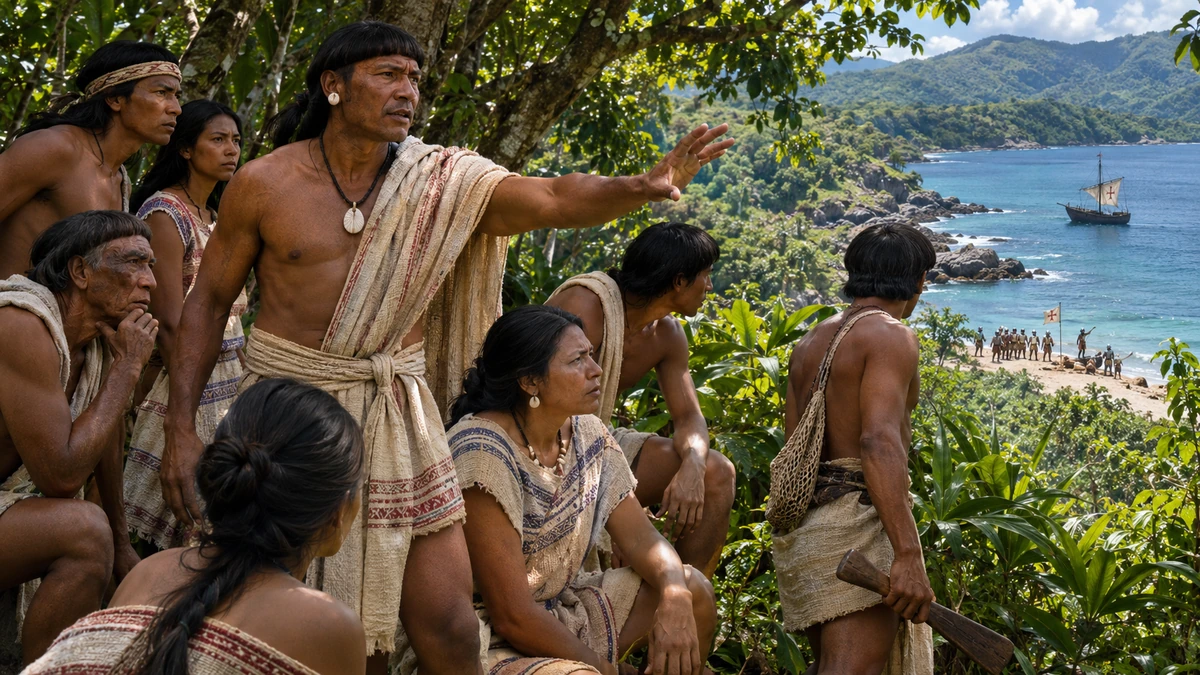
Artistic historical reconstruction of Hatuey with his community as Spanish conquerors approach eastern Cuba, c. 1511–1512. Not a documentary record, a verified specific event, or an authentic portrait of Hatuey.
The Spanish conquest of the Caribbean did not end on Hispaniola. Colonial rule expanded to Cuba and Jamaica, where Indigenous communities had long maintained their own settlements, economies, and political relationships. On both islands, the conquerors sought control over the land, its inhabitants, and their labor. In Cuba, Hatuey's resistance and the massacre at Caonao exposed the brutality of this process. In Jamaica, forced labor and colonial settlement transformed the lives of Indigenous communities. Yet the history of these islands is not solely a history of violence. It is also the history of people who resisted, adapted to changing circumstances, and struggled to survive.
The Conquest Did Not End on One Island
As the Spanish consolidated colonial rule on Hispaniola, a system took shape that would soon extend to other islands across the Caribbean. The conquerors brought more than weapons, soldiers, and European political demands. They also brought methods of subjugation already employed elsewhere: demands for recognition of the Crown's authority, the collection of tribute, control over Indigenous labor, and military force against communities that refused to submit. For European rulers, this represented the expansion of their authority.
For the people who already lived on these islands, however, it meant the arrival of a foreign power that began deciding the fate of their land, their labor, and their future. Conquest did not unfold in the same way everywhere. Jamaica did not occupy the same economic position as Hispaniola. Cuba was much larger and politically diverse, and bringing it under colonial control required a series of military operations.
Indigenous communities were not a single political entity either. Their decisions differed, and their relationships with European newcomers developed under varying circumstances. Nevertheless, a common pattern can be identified. Spanish rule spread across already inhabited territories, demanded recognition of its supremacy, and increasingly drew Indigenous populations into coercive economic relationships. Resistance was then frequently portrayed as a threat that had to be suppressed. This development was not inevitable.
It resulted from specific political decisions, economic interests, and the actions of those who established and maintained the colonial system.
Jamaica: From Supplying Sailors to Forced Colonial Rule
When Christopher Columbus arrived in Jamaica in 1494, the island had already been inhabited for centuries. Its Indigenous communities had developed methods of food production, settlement construction, and adaptation to the natural environment. Today, their lives are documented by more than European chronicles. Archaeology provides crucial evidence.
Research at Maima, in northern Jamaica, has shown that its inhabitants were deliberately reshaping the hillsides as early as the thirteenth and fourteenth centuries. They built terraces and leveled platforms for dwellings, using substantial quantities of limestone and fill. The settlement remained occupied until the period of Spanish contact. In several important respects, its layout differed from settlements elsewhere in the Greater Antilles. [4] This matters.
Indigenous communities were not merely inhabitants of a landscape that Europeans would later begin to explore. They had already been shaping that landscape through their labor for centuries. When Columbus became stranded in Jamaica in 1503 with ships no longer seaworthy, he depended on supplies obtained from the local population. Maima played an important role in providing them.
European sailors did not survive because they had arrived in an empty land and created the economic foundations necessary for their survival. They survived in part because an Indigenous economy already existed. In 1509, more permanent Spanish colonial settlement began under the leadership of Juan de Esquivel. Near an area already familiar to Columbus, the Spanish began establishing Sevilla la Nueva. But the founding of a European settlement did not mark the beginning of that place's history. It marked the beginning of a new relationship of power.
The Spanish took control of land, demanded labor, and interfered with existing economic relationships. Initially, the hope of finding gold was among the motives drawing them to Jamaica. When the island failed to become a major center of gold production, agriculture, livestock raising, and the provisioning of other settlements became increasingly important to its colonial economy.
Yet the relatively small European population did not make the colonial system less coercive toward the island's Indigenous inhabitants. Forced labor, dispossession, disease, and displacement severely affected Indigenous communities. The repartimiento and encomienda arrangements enabled colonial authorities and settlers to allocate labor and demand tribute. The legal form of these arrangements did not mean that Indigenous people could freely decide how their labor would be used. [5][6] The consequences were prolonged and devastating.
Their significance, however, need not rest on uncertain population estimates presented with false precision. The documented coercive transformation of relationships between people, land, and labor already reveals what colonial rule meant for Jamaica's Indigenous communities.

Cuba: A New Expedition, the Same Logic of Subjugation
While the Spanish consolidated their settlement in Jamaica, they were also preparing to conquer Cuba. In 1511, Diego Velázquez de Cuéllar led an expedition from Hispaniola. Las Casas gives a figure of approximately 300 men, but this should be understood as a chronicler's estimate rather than a definitive list of every participant. [1]
Cuba was a large and diverse island, home to different Indigenous communities, settlements, and cultural traditions. Its inhabitants therefore cannot be portrayed as a single politically unified population making one collective decision about war or cooperation. Velázquez's expedition, however, had a clear political objective. It sought to establish Spanish authority.
That meant demanding the submission of local leaders, seeking economic resources, and organizing control over the population. Experience gained on Hispaniola played an important role. The colonial administration was already familiar with demands for gold, the allocation of Indigenous labor, and punitive military expeditions. Individual conquerors also moved between the islands. Pánfilo de Narváez, who would later command an important military force in Cuba, came from Jamaica. This is significant.
More than ideas about conquest were spreading between the islands. People experienced in military subjugation were moving as well, along with the practices used to impose colonial rule. For Cuba's inhabitants, the arrival of Velázquez's expedition was therefore more than an encounter with unfamiliar foreigners. It meant the arrival of armed men demanding authority over their communities. Among those who resisted that authority was Hatuey.
Hatuey Recognized the Danger
According to Las Casas, Hatuey came to Cuba from Hispaniola. He had already experienced the consequences of Spanish colonization there and had attempted to escape its expansion by withdrawing to another island. But the Spanish military presence reached him there as well. Las Casas describes Hatuey warning the inhabitants of Cuba about the conquerors, particularly their desire for gold. His chronicle includes the famous scene in which Hatuey supposedly displayed gold before an assembled group and presented it as the object of the conquerors' desire.
The account carries powerful symbolic meaning. Its details, however, cannot be treated as a direct record of Hatuey's speech. Las Casas was not personally present at the beginning of Velázquez's expedition. He arrived in Cuba later. We must therefore distinguish historically supported resistance from the way events were shaped into a narrative in a later chronicle. Hatuey organized opposition to the Spanish conquest of eastern Cuba.
According to the chroniclers' accounts, his followers avoided direct confrontations when Spanish forces held an overwhelming advantage. Nevertheless, the conquerors pursued him, captured him, and executed him by burning. His death is usually dated to 1512, although the chronology of this early phase of the conquest must be treated with caution.
Las Casas's account of a conversation between Hatuey and a religious representative before the execution is particularly well known. According to the story, Hatuey asked whether Christians would also be in heaven. When told that they would, he reportedly rejected the prospect of spending the afterlife with them. The message is clear.
The chronicler sought to expose the profound moral contradiction between the conquerors' violence and their invocation of the Christian faith. But this famous exchange cannot be independently verified as a verbatim historical conversation. Its symbolic power must not be confused with historical certainty. Hatuey's significance does not depend on whether he spoke those exact words. He was an Indigenous leader who resisted the Spanish conquest.
His capture and violent execution reveal the methods by which conquerors removed people who opposed their demands.
The defense of one's own community did not become illegitimate simply because a foreign power declared it rebellion.
Hatuey's death, however, did not end colonial violence in Cuba.
Caonao: The People Prepared Food, and the Soldiers Came
During the conquest of Cuba, probably around 1513, Spanish forces carried out a mass killing of Indigenous inhabitants at Caonao. The event is particularly important because conflicting colonial accounts have survived. Bartolomé de las Casas states that he was present in Caonao when the massacre took place. At the time, he was accompanying a Spanish military force commanded by Pánfilo de Narváez.
In his Historia de las Indias, he describes the soldiers arriving at a settlement where the inhabitants had prepared food for the newcomers. Cassava bread, fish, and other provisions were available. According to his account, approximately 2,000 people were sitting in an open area, watching the Spanish horses. In a nearby large building, he claimed, more than 500 other inhabitants were gathered, too frightened to come outside. [1] These figures must be interpreted carefully.
They describe the people the chronicler reported as assembled at the scene, not an independently verified death toll. Then, according to the account, one of the Spanish soldiers suddenly drew his sword. Others followed. The soldiers began killing the assembled inhabitants. Las Casas describes women, children, and elderly people among the victims. The violence spread into the nearby large building.
In his shorter Brevísima relación de la destrucción de las Indias, Las Casas reports more than 3,000 people killed. None of these figures, however, can be treated as a conclusively established death toll. The question of military command is equally important. Las Casas does not claim that Narváez personally began the killing.
He does, however, accuse him of watching the massacre unfold and failing to stop it, despite being the commander. His narrative thus draws a clear distinction between soldiers who directly used their weapons and the commander who had the authority to intervene. This distinction is essential. Responsibility for mass violence does not end with the person who first uses a weapon.
It also extends to those who command the perpetrators, tolerate their actions, and subsequently shield those responsible from the consequences. Las Casas's account remains a later testimony that requires critical examination. Nevertheless, his presence at the settlement and his account of the events must be evaluated differently from a report written by someone who was not at the scene. And this is where the second surviving account becomes crucial.
Two Versions of the Same Massacre
On April 1, 1514, Diego Velázquez prepared a report for the Castilian king describing the conquest of Cuba and his actions as a representative of the Crown. The original document has not survived. Its text is known through later copies and versions, including a transcription made by Juan Bautista Muñoz in 1781.
Historian Raúl Marrero-Fente notes that these versions differ in important details and therefore cannot be treated as completely identical documents. [3] Velázquez's report presents the event that Marrero-Fente identifies with the massacre at Caonao as the consequence of an alleged Indigenous ambush. According to Velázquez, the Spanish were forced into a confrontation in which they killed approximately 100 Indigenous people. This account differs fundamentally from that of Las Casas. Velázquez speaks of danger, military necessity, and punishment.
Las Casas describes people who had prepared food, inhabitants who were not presenting an immediate military threat, and a sudden outbreak of killing. The difference is not merely one of numbers. It concerns the very nature of the event. Was this a confrontation with attackers, or the killing of people who posed no immediate danger to the soldiers? We do not have independent evidence sufficient to reconstruct every circumstance conclusively.
But Velázquez's allegation of an ambush cannot be accepted as fact simply because it appears in an official report. The report had a clear political purpose. The governor needed to explain to the king why his soldiers had killed inhabitants of a territory he was attempting to bring under the Crown's control. Marrero-Fente draws particular attention to Velázquez's failure to name Narváez as the commander of the force.
This is a significant omission, since Las Casas identifies Narváez as the commander of the soldiers involved in the massacre. Through his explanation, Velázquez emphasizes the supposed necessity of military action while diminishing the responsibility of the conquerors. At the same time, he claims that the soldiers acted contrary to his instructions, yet presents their killing of Indigenous people as an understandable response to danger.
This raises an important question: if the soldiers had violated orders, why did the same report portray their actions as justified punishment? Historians therefore examine more than what a document describes. They also ask what it seeks to justify and whose responsibility it attempts to diminish. Velázquez acknowledges another significant consequence of the violence.
Indigenous inhabitants withdrew into the mountains with their families and possessions. According to Marrero-Fente, further resistance by communities in the Camagüey region followed. [3] A report intended to present military action as a means of establishing order thus also documents displacement and continued opposition to colonial authority. Las Casas, however, must also be read critically.
His works were not written as neutral transcripts of a judicial investigation. They were composed later, in the context of his increasingly forceful condemnation of colonial abuses. Marrero-Fente observes that Las Casas's shorter and longer accounts of Caonao differ in how they explain responsibility. In the Brevísima relación, the horror of the violence takes center stage.
In the Historia de las Indias, Las Casas considers in greater detail who began the killing, why it began, and why the commander failed to stop it. Such a comparison does not automatically confirm every detail in Las Casas's account. It does, however, support an important historical conclusion.
Caonao was not only an episode of colonial violence. It also became part of a struggle over how that violence would be explained.
The conquerors could control territory and military force. Through their reports, they also sought to shape judgments about whether their conduct had been justified.

Different Islands, a Shared System of Subjugation
Jamaica and Cuba occupied different positions within the early colonial system. Jamaica was important for food production, livestock raising, and supplying other colonial centers. In Cuba, the conquest of a larger territory was accompanied by the search for gold, the establishment of Spanish settlements, and the allocation of Indigenous labor. Yet on both islands, colonial rule disrupted existing political and economic relationships.
The Spanish demanded that people recognize the authority of a Crown to which they had not previously been subject. They also sought to gain control over their labor. Colonial institutions responsible for allocating labor and enforcing tribute obligations played an important role in this process. The encomienda system did not simply constitute private ownership of everyone placed under it.
It did, however, establish a legal and political arrangement under which colonists could demand labor and tribute from Indigenous communities. Those communities did not participate as equal parties to a freely negotiated agreement. This distinction matters. A legal framework for subjugation does not erase its coercive character. Nor can the violence be explained solely by the personal cruelty of individual soldiers.
Military expeditions enabled the expansion of colonial authority. The colonial administration then translated that authority into control over land, production, and labor. For commanders and administrators, these processes created opportunities to acquire influence, official positions, and economic benefits. This does not mean that every individual act of violence was planned in advance in the same way.
It does mean that violence operated within a system that enabled and rewarded the subjugation of other people. The personal responsibility of the conquerors and the systemic character of colonial rule are therefore not mutually exclusive. They reinforce one another.
Communities the Colonial Chronicles Did Not Erase
The history of Cuba and Jamaica is often told as a history of the rapid destruction of their Indigenous populations. Colonization did cause catastrophic losses, forced labor, displacement, and the breakdown of numerous political and social relationships. But this catastrophe must not be confused with the assumption that every Indigenous inhabitant simply disappeared. Archaeology provides an important complement to the colonial chronicles.
In Jamaica, Maima documents a developed community that had shaped its landscape for centuries before the Spanish arrived and remained inhabited until the period of contact. [4] This is more than evidence of a settlement that existed before European arrival. It is a reminder that Jamaica's history cannot begin with the founding of Sevilla la Nueva. In Cuba, El Chorro de Maíta is particularly important.
Research by Roberto Valcárcel Rojas shows that the local Indigenous community continued to live there during the early colonial period. Archaeologists have found Indigenous and European objects, changes in material culture, and evidence of the continuation of local practices. Occupation extended from the precolonial period into the middle of the sixteenth century. [7] The site therefore reveals more than a single encounter between two worlds.
It reveals the lives of a community incorporated into a colonial system, whose members had to find ways to survive within it. Such survival did not mean complete freedom. An Indigenous community could continue to exist even while subjected to forced labor and foreign political authority. Likewise, the presence of European objects does not automatically demonstrate voluntary or equal cultural exchange. Material remains can also testify to life under conditions of subjugation.
Yet the presence of these objects alongside continuing Indigenous cultural practices shows that colonial transformations did not erase every form of Indigenous agency. This is essential to understanding the history of both islands. Hatuey's resistance and the massacre at Caonao reveal the violence through which the conquerors imposed their authority.
Jamaica's history reveals the economic subjugation of communities upon which European newcomers had initially depended. Archaeological sites remind us that those subjected to colonial rule continued to live, act, and make decisions. The Spanish conquest was not merely the expansion of a European presence across a map. It was the imposition of authority over a world that already existed before the conquerors arrived.
The conquerors did not create the world they entered. They sought to subjugate it.
When they used killing, enslavement, and dispossession to achieve that goal, those actions cannot be justified by appeals to civilization or the establishment of order. Violence did not become just because it was carried out in the name of the Crown. Indigenous resistance did not become illegitimate because the conquerors called it rebellion. And communities that survived colonial subjugation did not lose their right to their own history.

Sources and further reading
- Bartolomé de las Casas. Historia de las Indias, Book III, particularly Chapters XXV–XXX, in Historia de las Indias, Volume IV, Madrid, 1876. A primary chronicle source for the conquest of Cuba, Hatuey, and the massacre at Caonao Source
- Bartolomé de las Casas. Brevísima relación de la destrucción de las Indias. Seville, 1552. Particularly the passages concerning Cuba and the massacre at Caonao
- Raúl Marrero-Fente (2021). “La matanza de Caonao en La Carta de relación de Diego Velázquez: una retórica de exculpación.” Telar, No. 27, pp. 113–130. A critical comparison of Velázquez's report with Las Casas's writings, particularly concerning the justification of violence and command responsibility Source
- David V. Burley, Robyn P. Woodward, Shea Henry, and Ivor C. Conolley (2017). “Jamaican Taíno Settlement Configuration at the Time of Christopher Columbus.” Latin American Antiquity, 28(3), pp. 337–352. An archaeological study of the Maima settlement Source
- National Library of Jamaica. “History Notes: Information on Jamaica's Culture & Heritage.” An institutional historical overview of the Spanish colonization of Jamaica Source
- Kenneth Morgan (2023). “Spanish Jamaica, 1509–1655.” In A Concise History of Jamaica, pp. 44–76. Cambridge University Press. Historical context for Spanish settlement, forced labor, and the colonial economy Source
- Roberto Valcárcel Rojas (2016). Archaeology of Early Colonial Interaction at El Chorro de Maíta, Cuba. Gainesville: University Press of Florida. An archaeological study of Indigenous community life during the early colonial period Source
Methodological Note
Las Casas participated in the early colonization of Cuba and stated that he was present at Caonao when the massacre took place. His accounts were written later and therefore require a critical distinction between events he directly observed, narrative details, and moral interpretation
Velázquez's report of April 1, 1514, was written to justify the colonial conquest before the Crown. The original has not survived, but later copies and versions are known, differing in certain details
The precise number of victims of the Caonao massacre, the circumstances of the alleged Indigenous ambush, and the verbatim accuracy of Hatuey's final words have not been independently established
Archaeological evidence of the survival of Indigenous communities does not diminish the gravity of colonial violence. It does, however, allow for a historical interpretation that considers not only destruction but also the survival, adaptation, and agency of Indigenous peoples