The Taíno Resist: Caonabo, Anacaona, and the Massacre at Xaraguá
Caonabo, Anacaona, and other Taíno leaders responded differently to conquest. The massacre at Xaraguá exposes the brutality of Spanish colonial rule.
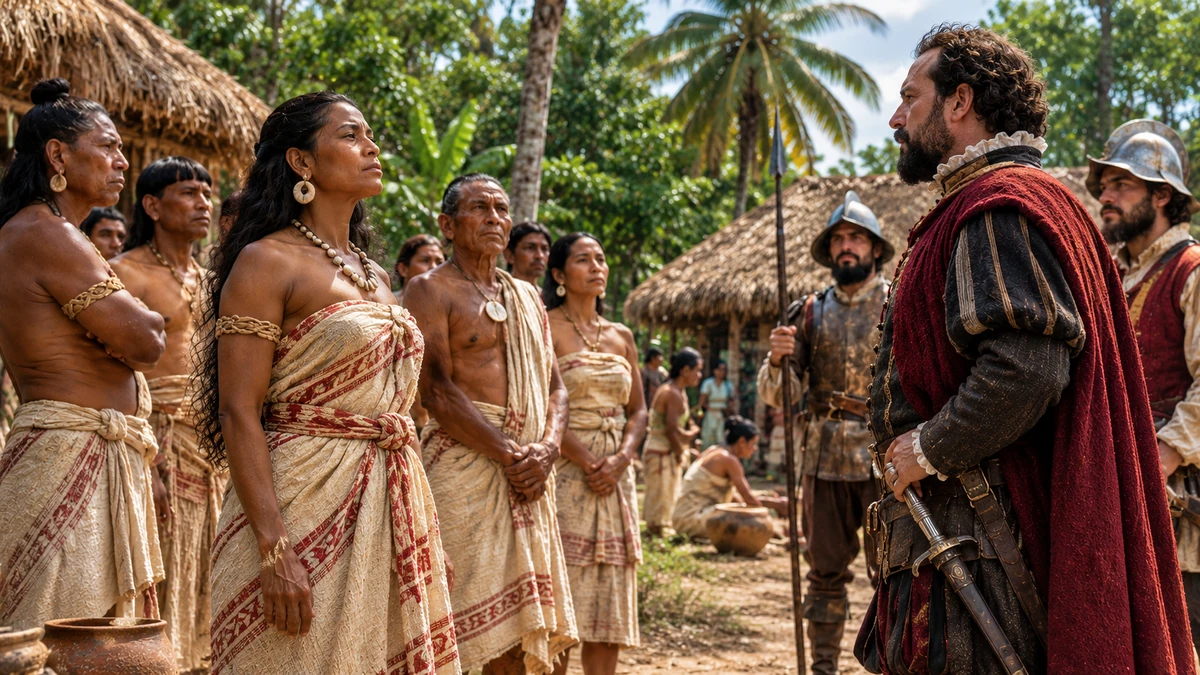
Artistic historical reconstruction of Anacaona and Ovando meeting in Xaraguá around 1503; not a documentary record or an authentic portrait of Anacaona.
When the Spanish conquerors arrived on Hispaniola, they did not encounter a people without political agency. Taíno communities had their own leaders, territories, alliances, and systems of decision-making. Some cooperated with the newcomers, others resisted, and still others sought survival by withdrawing from their reach. Yet colonial rule gradually turned diplomacy into subjugation, exchange into compulsory tribute, and resistance into a pretext for military punishment. In 1503, Governor Nicolás de Ovando ordered a massacre of Indigenous leaders in Xaraguá. Among the victims of colonial violence was Anacaona, the region's political leader. But her death did not bring resistance to an end.
Who Has the Right to Call the Defense of One's Homeland a Rebellion?
When the Spanish began conquering Hispaniola in the late fifteenth century, they did not arrive on an empty island waiting for European rulers. The island was already home to communities with their own political institutions, economies, cultural traditions, and established relationships. Their leaders negotiated alliances, managed communal resources, and represented the interests of their people. The arrival of the Spanish profoundly disrupted this world.
The Crown of Castile began asserting sovereignty over territory that had never belonged to it. Its representatives demanded submission, tribute, food, gold, and labor. Those who refused were frequently described in colonial accounts as rebels. But the word rebellion is not politically neutral. To the conquerors, it meant defiance of royal authority. To Indigenous communities, however, resistance could mean defending their land, political independence, and right to determine their own future.
The Spanish did not enter a world without legitimate authority. They entered a world in which political authority already existed and began imposing their own rule upon it. This does not mean that Hispaniola's inhabitants acted as a single political force. They had no unified state, common military command, or shared policy toward the European newcomers. Their responses varied. Some formed alliances. Others took up arms. Still others sought to avoid direct confrontation. Yet none of these choices suggests that Indigenous people lacked political agency.
On the contrary. Their actions demonstrate that they were active participants in a history too often told almost exclusively through the deeds of European conquerors.
Different Communities, Different Choices
Political life on Hispaniola was organized around distinct communities led by chiefs, both women and men. Spanish chroniclers referred to these leaders as caciques. Their authority did not correspond precisely to European monarchy. It rested on local political relationships, kinship networks, economic cooperation, and personal prestige. At the beginning of colonization, some leaders chose to cooperate with the Spanish.
Guacanagarí helped the survivors after Columbus's ship Santa María ran aground in December 1492. He subsequently maintained an alliance with the newcomers. That decision should not automatically be treated as a betrayal. Guacanagarí acted at a time when the long-term consequences of European arrival were not yet apparent. An alliance might have offered protection for his community, strengthened his political position, or provided an advantage within existing regional relationships. But his decision did not speak for everyone on the island.
Caonabo, an influential leader of Maguana, became associated with a very different response. When the Spanish returned to Hispaniola in 1493, they discovered that the settlement of La Navidad had been destroyed and its inhabitants killed. Spanish chronicle tradition links Caonabo to the destruction. The exact circumstances remain known primarily through colonial accounts. Nevertheless, the destruction of the settlement demonstrates that Spanish expansion encountered violent opposition from its earliest stages.
Caonabo became one of the conquerors' principal adversaries. He was eventually captured. According to a well-known chronicle account, Alonso de Ojeda deceived him by presenting metal restraints as valuable ornaments, persuading Caonabo to accept what were actually shackles. The details of this episode must be treated as a chronicle narrative rather than an independently verified scene.
What is historically secure is that Caonabo was captured and forcibly removed from his political community. Sources also differ over the circumstances of his death. Modern historians often place it in 1496, during his attempted transportation to Spain, while Las Casas connects it to a shipwreck. Whatever the precise circumstances, his capture deprived an Indigenous community of an important political leader. Guarionex, the leader of Maguá, faced similar pressures.
Spanish demands for gold and other forms of tribute undermined his authority. The conquerors expected him to assist in bringing under colonial control people who had previously lived within different political and economic relationships. At different stages, Guarionex accommodated Spanish demands, became involved in resistance, and attempted to escape direct colonial control. He, too, was eventually captured. These examples reveal a defining feature of the early conquest.
Cooperation offered no guarantee of lasting freedom. Armed resistance exposed entire communities to punitive expeditions. Withdrawal did not necessarily provide safety. Indigenous leaders were not making choices on equal terms. They were navigating a world in which growing colonial power was backed by the threat of increasingly severe violence. [3][7]
When Diplomacy Gives Way to Coercion
During the first years of Spanish settlement, the colonists depended heavily on Hispaniola's Indigenous population. They needed food, local knowledge, assistance in traveling across the island, and access to established systems of production and exchange. Yet relationships that had initially involved hospitality, exchange, or political cooperation increasingly became relationships of coercion.
Spanish authorities demanded gold, cotton, food, and labor. Tribute obligations were enforced through threats, punishment, and military force. These were no longer relations between political equals. Colonial officials increasingly claimed the right to control how people worked and how the products of their labor were distributed, even though those communities had never previously been subject to Spanish rule. Different regions of Hispaniola held considerable economic importance.
Historian Esteban Mira Caballos notes that Higüey was an important source of cassava bread for Santo Domingo, while Xaraguá was valued for its cotton. [3] These economic interests help explain why colonial authorities were determined to control those territories. But beyond food, cotton, and gold lay a more fundamental question. Who had the right to make decisions?
If Indigenous communities retained the freedom to reject colonial demands, the conquerors' authority would remain incomplete. Economic exploitation and political subjugation were therefore closely intertwined. Spanish documents and chronicles frequently described military campaigns using terms such as pacification, subjugation, and restoration of order. Such language could obscure what those campaigns meant for the people subjected to them.
For communities losing control over their own labor and lives, colonial order did not necessarily bring peace. It could mean the destruction of their freedom. In Xaraguá, this process reached one of its most brutal expressions in 1503.
Anacaona — The Political Leader of Xaraguá
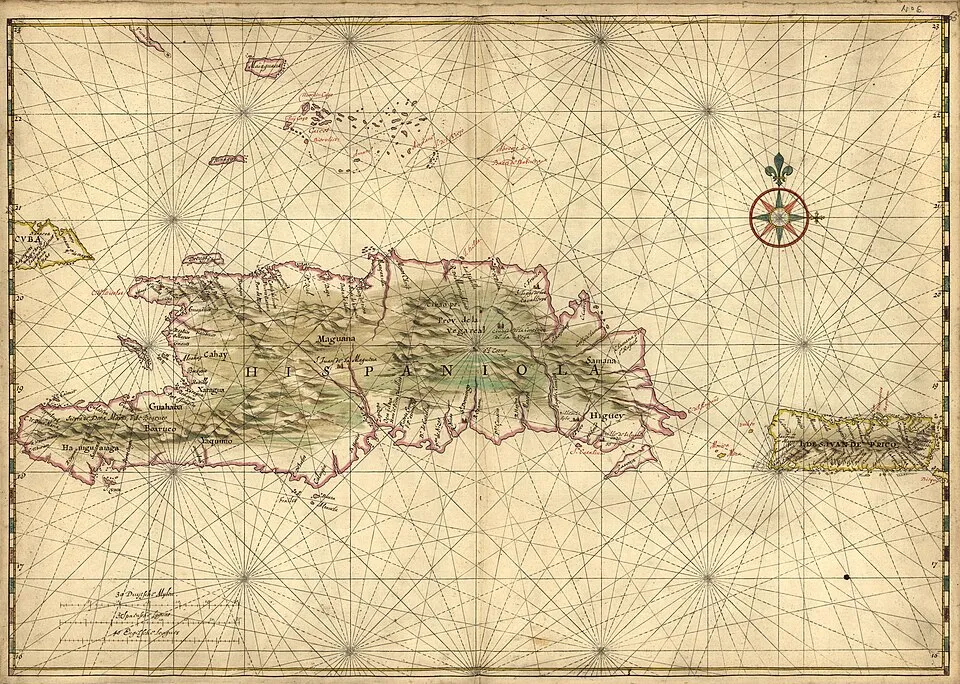
Anacaona remains one of the most significant figures in the early colonial history of Hispaniola. Later accounts often portray her as a beautiful queen, a poet, or a tragic victim. But such portrayals tell only part of her story. Anacaona was a political leader who exercised authority in her own right. She was married to Caonabo, the leader of Maguana, and was the sister of Behechio, the leader of Xaraguá. According to Las Casas, she assumed responsibility for governing Xaraguá after Behechio's death. This distinction matters.
Anacaona did not become historically significant only because the Spanish executed her. She was already an important political figure, governing a community and shaping relations with other Indigenous leaders and European newcomers. Las Casas describes her ability to summon chiefs, organize gatherings, and receive Spanish representatives. [1] His testimony, however, must be read critically.
Las Casas wrote years after the events, within the broader context of his condemnation of colonial abuses. His narrative includes judgments and details that cannot all be independently verified. Even so, Anacaona's political role was not simply a romantic invention of later generations. The chronicles identify her as a central figure in the political life of Xaraguá.
When Ovando traveled to the region in 1503, Anacaona reportedly organized a reception for the governor. She brought local leaders together and prepared a gathering to receive the Spanish delegation. This was a political act. In a society where relations between communities were expressed through public ceremonies, gifts, and hospitality, welcoming a foreign representative was more than an act of personal kindness. It was an exercise of political authority. That makes the events that followed particularly significant.
The attack on Xaraguá was not merely an attack on Anacaona as an individual. It struck at the leadership of an entire political community.
1503: An Organized Massacre
Nicolás de Ovando became governor of Hispaniola in 1502. By then, Christopher Columbus no longer governed the colony. He had been removed from office in 1500. This distinction is essential to establishing historical responsibility. Columbus was not the governor who ordered the massacre at Xaraguá in 1503. Responsibility for that operation lay with Ovando and the colonial military forces acting under his command. According to early Spanish chronicles, Ovando arrived in Xaraguá accompanied by an armed force.
Las Casas describes a reception organized by Anacaona and other leaders. The visit involved ceremonial gatherings, food, and hospitality. Then came the attack. In Las Casas's account, the Spanish soldiers had been prepared in advance. At an agreed signal, they seized the assembled Indigenous leaders, confined them inside a large building, and set it on fire. Las Casas places 80 leaders inside the building.
Oviedo also describes the deliberate capture and burning of chiefs but gives a figure of more than 40. Mira Caballos draws attention to another account: Diego Méndez reportedly stated in his will that 82 chiefs had been burned during the massacre. [3] The figures differ. There is therefore no sound basis for presenting a single exact number of executed leaders as conclusively established. Nor should these figures be mistaken for the total number of people killed.
Las Casas describes further violence against those gathered outside the building. According to his narrative, Spanish cavalry and infantry attacked inhabitants who had come to attend the governor's reception. No reliable overall death toll has been established. Anacaona was captured and executed by hanging. The chroniclers also disagree about the timing of her execution.
Las Casas describes it immediately after his account of the massacre, whereas Oviedo claims that she was hanged approximately three months later. Yet disagreements over numbers and chronology do not change the central historical fact.
Under Ovando's command, Spanish colonial forces carried out a planned massacre of captured Indigenous leaders.
This was not a sudden clash between opposing armies on a battlefield. Even the chronicler who defended Ovando acknowledged that the capture and burning had been deliberately prepared. The massacre had consequences beyond the immediate loss of life. By eliminating numerous leaders, the Spanish struck at the political organization of Xaraguá.
Those killed were not simply individuals of elevated social standing. They represented communities, maintained relationships between settlements, and participated in collective decisions. Their removal weakened the capacity of Indigenous communities to exercise political authority in an organized manner. The massacre also served as a warning.
It demonstrated that colonial authorities were prepared to respond to resistance, or even suspected disobedience, with devastating force. But colonial subjugation did not end with the killings. Spanish military campaigns also involved the capture and enslavement of Indigenous people. Mira Caballos cites colonial accounting records concerning proceeds from the sale of enslaved people and other spoils associated with the campaign in Xaraguá.
He reports a figure of 14,370 gold pesos and a further accounting entry of 2,840 pesos corresponding to the Crown's royal fifth. The exact relationship between these figures requires examination of the underlying records. [3] The historical importance of this evidence lies not simply in the amounts involved. It lies in the documented connection between enslavement and the economic proceeds of colonial violence. People taken captive could be sold. The destruction of their freedom generated wealth for others.
In Xaraguá, political subjugation, intimidation, enslavement, and economic exploitation formed parts of the same violent process.
The Alleged Conspiracy and Colonial Justifications
Why did Ovando order the massacre? The Spanish chroniclers offer conflicting explanations. Fernández de Oviedo alleges that Anacaona and other leaders were preparing an attack against the Spanish. In his account, the governor learned of the conspiracy and acted before the supposed uprising could take place. Las Casas firmly rejects that interpretation.
He points to abuses committed by Spanish settlers and to the colonists' readiness to characterize even limited Indigenous opposition as a dangerous rebellion. But historians cannot simply accept whichever chronicler expresses a moral position closer to their own. They must distinguish what a source alleges from what the surviving evidence can establish. Oviedo's accusation does not independently demonstrate that Anacaona was preparing an attack.
Equally, Las Casas's rejection of the charge does not allow us to reconstruct every motive or intention of the Indigenous leaders. The firmest historical ground lies elsewhere. Both chroniclers describe the organized killing of the leaders. Oviedo's language is especially revealing. At the beginning of his account of Ovando's administration, he presents the governor as a just, mild, and capable ruler. He then describes Ovando ordering the confinement and burning of more than 40 chiefs.
This is a striking example of the way colonial narratives could frame extreme violence as the legitimate restoration of order. The action itself does not change. What changes is the moral justification offered to the reader. Las Casas, by contrast, unequivocally condemns the massacre. Yet he cannot be treated as someone entirely outside the colonial system he later criticized.
In his own account, he acknowledges having held an Indigenous person who had escaped the massacre and was subsequently enslaved. His later opposition to colonial abuses does not erase his earlier involvement in a system of coercion and enslavement. [1] Historian Harald E. Braun examined the Xaraguá massacre in his 2023 study Genocidal Massacres in the Spanish Conquest of the Americas.
He characterizes Xaraguá as a genocidal massacre and compares it with the later massacres at Cholula and Toxcatl during the Spanish conquest of Mesoamerica. Braun emphasizes violence directed against Indigenous communities, its political purpose, and the intimidation of survivors. [4] In this context, genocidal massacre is a scholarly historical characterization, not a judicial finding. But even without resolving questions of legal classification, the moral issue remains unmistakable.
The organized killing of captured political leaders cannot be justified merely because a conquering authority declared them dangerous.
The massacre at Xaraguá was not an ordinary act of government. It was organized colonial violence directed against a political community that Spanish rule sought to subjugate.
Armed Resistance, Withdrawal, and Survival in the Mountains
Anacaona's execution did not bring Indigenous resistance on Hispaniola to an end. Armed conflict continued in the eastern part of the island, particularly in Higüey. One of the region's prominent leaders was Cotubanamá. Ovando's administration organized military campaigns to consolidate control over territories important to the supply of colonial settlements.
These campaigns were accompanied by the destruction of communities, the capture of inhabitants, and enslavement. According to chronicle accounts, Cotubanamá was eventually captured and executed. Yet armed confrontation was not the only form of Indigenous resistance. As Spanish military power increased and Indigenous communities lost population and economic resources, open confrontation became increasingly dangerous. Some people withdrew into the mountains. Others avoided forced labor and colonial settlements.
Historical sources also describe communities deliberately destroying crops to deprive the conquerors of supplies. [3] Such strategies carried severe risks for those who adopted them. Food shortages could devastate Indigenous communities as well. These events should not be romanticized. Not every retreat was part of an organized resistance movement. Sometimes withdrawal was primarily an attempt to survive. But survival under coercion is itself an essential part of the history of colonial subjugation.
People were not always choosing simply between resistance and surrender. Sometimes they tried to preserve their lives and freedom by remaining beyond the reach of authorities that demanded their labor and obedience. Such actions did not produce major battles that chroniclers could easily celebrate or condemn. They did, however, reveal the limits of Spanish control.
Despite their military superiority, colonial authorities could not bring every community and individual completely under their command. In the following decades, that reality became especially evident in the resistance led by Enriquillo.
Enriquillo: Colonial Rule Never Achieved Complete Submission
Around 1519, an Indigenous leader known as Enriquillo, also called Enrique in Spanish sources, withdrew from the area under direct colonial control. Together with his followers, he retreated into the rugged Bahoruco mountains. Historical accounts connect the beginning of his resistance with abuses committed under the colonial system and his unsuccessful attempts to obtain justice. They specifically mention a dispute involving his encomendero, Andrés de Valenzuela. Enriquillo did not immediately turn to armed resistance.
According to chronicle tradition, he first attempted to obtain redress from representatives of the colonial authorities. Yet the institutions from which he sought protection were part of the very system that enabled the abuses he challenged. In Bahoruco, Enriquillo and his followers used their knowledge of the mountainous terrain to establish refuges and avoid direct confrontation with stronger Spanish forces. For years, colonial expeditions failed to bring them permanently under control. The resistance continued until negotiations in 1533.
But Enriquillo's story should not be reduced to a simple tale of a victorious national hero. His followers did not represent every Taíno community, and other groups of fugitives and subjected people did not necessarily share the same interests. Historian Ida Altman draws attention to the distinction between the historical Enriquillo and the literary and national symbolism that later developed around him. [6]
This caution also matters when interpreting the agreement that brought his prolonged resistance to an end. In 1533, following years of unsuccessful military operations, the Spanish authorities sent Francisco de Barrionuevo to negotiate. Mira Caballos describes 9 September 1533 as the occasion on which peace between Enriquillo and the colonial representative was publicly affirmed. However, the final agreement had not yet been formally concluded.
According to his reconstruction, formalization followed in June 1534. The original text of the agreement has not survived. [3] This distinction is important. Enriquillo's followers did not obtain complete political independence. The settlement involved a return to the authority of the Spanish Crown in exchange for certain guarantees and recognition of the community's particular position.
Indirect documentary evidence also indicates that colonial officials expected Enriquillo to cooperate in pursuing other fugitives. Mira Caballos cites documents suggesting that such obligations were demanded. Because the original agreement is lost, however, a distinction must be maintained between documented colonial demands, later accounts of the settlement, and the precise terms that were formally agreed upon. This exposes a difficult contradiction.
A leader who had resisted colonial subjugation for years might, in order to preserve his community, accept cooperation with the very authorities he had opposed. Such a decision cannot be understood apart from the conditions under which it was made. Enriquillo was not negotiating with an equal power. He faced an authority with far greater military and economic resources, one that demanded recognition of the Crown's sovereignty. The settlement therefore did not liberate all the Indigenous inhabitants of Hispaniola.
Nor did it end every other form of resistance. But it demonstrated something important. Military superiority did not guarantee complete colonial control. Through years of persistence, Enriquillo and his followers secured a position in which the authorities chose to negotiate. Their achievement was limited. It was nevertheless significant.
Resistance Did Not Disappear from History
For centuries, the Spanish conquest of the Caribbean was narrated primarily through the actions of European conquerors. Columbus arrived. The Spanish founded settlements. Governors established authority. Indigenous communities rebelled and were subdued. Such accounts place the conquerors at the center of the historical narrative. Indigenous people become little more than those upon whom history was imposed. Yet the evidence tells a more complicated story. Guacanagarí formed alliances. Caonabo opposed the Spanish presence.
Guarionex sought ways to act under growing colonial pressure. Anacaona governed Xaraguá and exercised political authority. Decades later, Enriquillo demonstrated that resistance could continue even in territories the conquerors had already declared their own. These leaders did not make identical choices. Nor can their actions be neatly combined into the history of a single, unified political movement. But their experiences reveal a fundamental truth. The Taíno were not merely people subjected to colonial rule.
They were people who responded to its expansion, made political decisions, and resisted subjugation in different ways. The 1503 massacre at Xaraguá stands among the most devastating examples of the brutality of that process. Historical sources disagree about the number of victims, certain circumstances of the attack, and the timing of Anacaona's execution.
They agree, however, on the central fact that Ovando's administration captured and executed numerous Indigenous leaders. Even the most sympathetic colonial justification cannot erase the nature of those acts.
The organized killing of captured leaders did not become just because it was carried out in the name of the Crown.
Enslavement did not become acceptable because it generated economic profit. And the defense of an existing political community did not lose its legitimacy because the conquerors called it rebellion. Anacaona's execution did not erase her political leadership. Caonabo's capture did not erase his resistance. Enriquillo's agreement with the Crown did not erase the years his community spent beyond direct colonial control. The history of the Taíno must therefore be more than a record of suffering.
It is also a history of political choices, resistance, adaptation, and the determination to survive. Their political autonomy was violently shattered. But their communities had their own histories before the arrival of European conquerors, and the decisions they made in the face of conquest continue to matter.
The Taíno did not need the conquerors' permission to defend their land, their communities, and their freedom.
Sources and further reading
- Bartolomé de las Casas. Historia de las Indias, Book II, Chapter IX, pp. 50–55. Madrid: Imprenta de Miguel Ginesta, 1875, Volume III. A chronicle account of Anacaona's political authority, Ovando's arrival, the organized massacre, and her execution Source
- Gonzalo Fernández de Oviedo y Valdés. Historia general y natural de las Indias, Part I, Book III, Chapter XII. A chronicle account of Ovando's campaign, the alleged conspiracy, the burning of Indigenous chiefs, and Anacaona's execution Source 1 Source 2
- Esteban Mira Caballos (2022). “La resistencia a la dominación de los indígenas de La Española (1492–1533).” Ciencia y Sociedad, 47(3), pp. 9–34. A study of Indigenous resistance, military campaigns, the economic consequences of the Xaraguá massacre, and Enriquillo's movement Source
- Harald E. Braun (2023). “Genocidal Massacres in the Spanish Conquest of the Americas: Xaragua, Cholula and Toxcatl, 1503–1519.” In The Cambridge World History of Genocide, Volume I, edited by Ben Kiernan, T. M. Lemos, and Tristan S. Taylor, pp. 622–647. Cambridge University Press Source
- Antonio Espino López (2012). “Granada, Canarias, América: el uso de prácticas aterrorizantes en la praxis de tres conquistas, 1482–1557.” Historia, 45(2), pp. 369–398 Source
- Ida Altman (2007). “The Revolt of Enriquillo and the Historiography of Early Spanish America.” The Americas, 63(4), pp. 587–614 Source
- Irving Rouse (1992). The Tainos: Rise and Decline of the People Who Greeted Columbus. New Haven: Yale University Press
Methodological Note
The chronicles of Las Casas and Fernández de Oviedo were produced within the Spanish colonial world. They are important historical sources, but their accounts do not independently establish every motive, figure, or detail they describe
The precise number of victims at Xaraguá, the truth of the alleged conspiracy involving Anacaona, certain details surrounding the capture of early Indigenous leaders, and the exact provisions of Enriquillo's agreement remain subject to evidentiary limitations
Disputed details are therefore attributed to the sources that report them. Modern historical interpretations are explicitly credited to their authors. No invented dialogue or imagined private thoughts have been attributed to historical individuals