Columbus's Colony: Gold, Enslavement, and Violent Rule
On Hispaniola, Columbus’s rule linked the search for gold with captivity, forced tribute, and violence. What do the historical sources reveal about these practices?
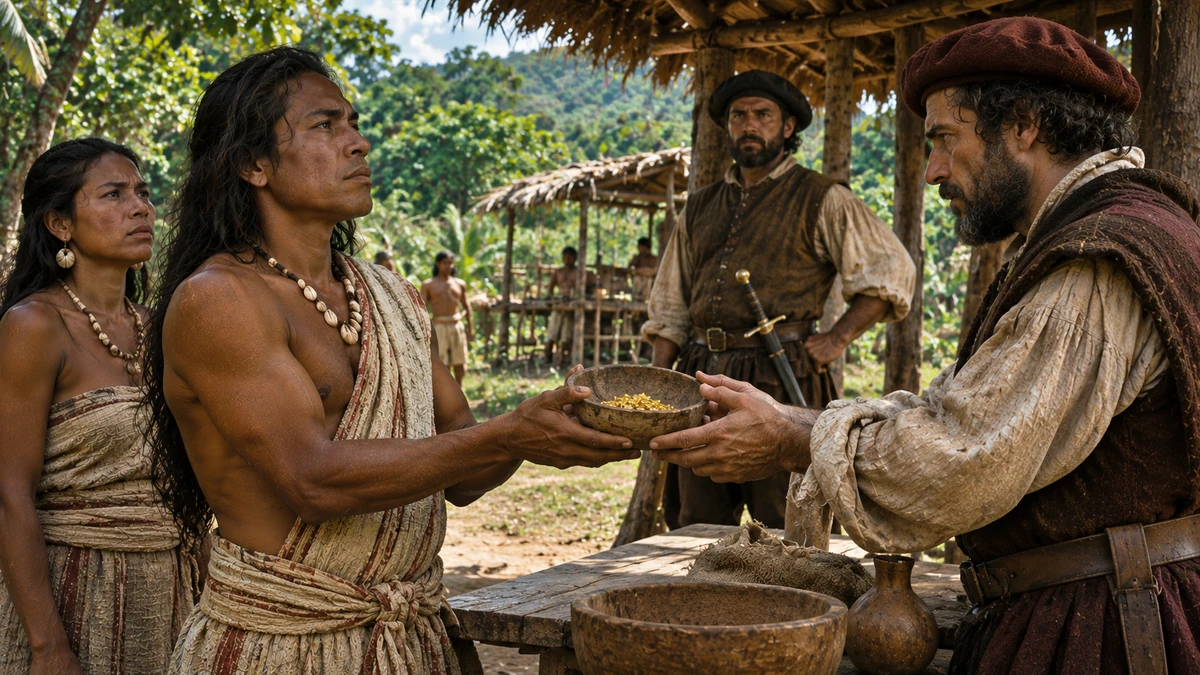
After 1493, Spanish ships arriving on Hispaniola signaled more than a brief visit. The newcomers built a settlement and storehouses, searched for gold, and sought to establish permanent rule. But the island was already home to communities, leaders, and longstanding relationships. The colony did not rise on empty land. It took shape through intrusions into the lives of people who had never chosen Spanish rule.
Over the seven years of Columbus's administration, promises of wealth became entangled with the seizure of people, their forced transportation across the Atlantic, military subjugation, and demands for tribute. The evidence comes from different kinds of sources: Columbus's own economic proposal, the testimony of a member of his expedition, later chronicles, and modern archaeological research. These sources differ in immediacy and reliability. Read together, however, they show that colonial coercion was not simply a consequence that followed “discovery” years later: it was taking shape under Columbus himself.
A Colony That Had to Be Supplied
When Columbus returned to the Caribbean in 1493, he was no longer leading a small voyage chiefly devoted to exploring coastlines. According to historical and archaeological accounts, his second expedition arrived with seventeen ships, more than a thousand colonists, and supplies that included animals, seeds, and tools. Estimates of the newcomers vary; roughly 1,500 is an estimate, not a figure established by a surviving census. [6] [7]

The outpost of La Navidad, where Spaniards were left after the first voyage, was not the same as the new settlement of La Isabela. Work on La Isabela began on Hispaniola’s northern coast in late 1493 and early 1494. Its name asserted loyalty to the Spanish Crown; its purpose was to establish a base for a lasting European presence, colonial administration, and further incursions inland. [6] [7]
Archaeological remains reveal a fortified masonry core, storage facilities, living quarters, and work areas. The Florida Museum also describes numerous simpler dwellings with roofs made from plant materials. These finds show that La Isabela was more than a settlement imagined on paper. The newcomers erected buildings, stored and used supplies, and tried to impose a European pattern of settlement on the island. [7]
The colony soon struggled with disease, hunger, exhaustion, internal conflict, and resistance. Within a few years, La Isabela had lost its central role as a more important colonial center emerged near Santo Domingo. The hardships endured by the colonists did not mean their settlement was harmless to the island's inhabitants. On the contrary, mounting hardship increased the pressure to draw food, wealth, and the resources needed to sustain the colony from the island and the labor of its inhabitants. [6] [7]
Keeping the colony supplied therefore became a question of power. Who would feed the colonists? Who would work? And how would ships be paid for if gold proved insufficient? Columbus’s proposals show that people themselves soon appeared among the proposed means of payment.
Gold as a Promise to the Crown
Gold had featured in Columbus’s account of his first voyage. On the second expedition, however, the promise of gold also helped him justify the cost of colonization. Ships, tools, livestock, and provisions all had to be financed. To the Spanish authorities, the settlement had to prove that its promised rewards were more than an illusion. [1] [6]
Searching for deposits and speaking of gold were therefore not merely parts of the commander’s personal adventure. They were bound up with organizing the settlement, seeking resources from the Crown, and managing the expectations of the expedition’s participants. As disease, scarcity, and discontent took hold, the gap between promised riches and the realities of settlement became a political problem. [6] [7]
Three distinctions matter here. Columbus's promise of gold does not establish how much the colony actually obtained. A plan to supply the colony does not prove that every measure it proposed was implemented. And later testimony about compulsory tribute does not mean that every economic scheme had already been consolidated into a single tax system by 1493. Keeping these matters separate helps explain how colonial power evolved. [1] [4]
This pursuit of wealth had direct consequences for Indigenous communities. Gold, which could hold different meanings within their own world, increasingly became, in the newcomers’ eyes, a measure of the economic worth of both the island and its people. When those in power began to regard people primarily as a means of producing wealth, the line between exchange and coercion quickly began to disappear.
One document reveals this economic thinking particularly clearly, moving beyond the search for gold: a proposal to pay for the colony's supplies with enslaved people.
The Memorandum of 1494: People as Payment
On January 30, 1494, Columbus drafted a memorandum at La Isabela for Antonio de Torres to convey to Ferdinand and Isabella. It addressed supplies, ships, livestock, settlement, and finance. One proposal called for ships to bring livestock and other essentials to the colony; those providing transport would be paid in enslaved people carried to Spain. [1]
Columbus described the people he proposed to enslave as Caribbees and alleged that they practiced cannibalism. The label was part of a colonial justification for taking away their freedom, not independent proof of the behavior imputed to them. In the same document, he invoked conversion and language learning, as though religious or educational claims could justify allowing others to determine their fate. [1]
The proposal went further. Columbus proposed that the Crown collect duties when enslaved people arrived in Spain. Within this single scheme, human beings became cargo, a form of payment, and objects of taxation. This was not a legend invented later about Columbus’s intentions: the proposal appears in the text addressed to the monarchs. [1]
But a proposal is not the same as approval. R. H. Major’s historical edition also records the royal reply: the decision was deferred pending further reports, and Columbus was asked for additional views. It would be inaccurate to say that Ferdinand and Isabella approved this scheme unconditionally in January 1494. Equally, the delay does not prove that the trade was permanently forbidden, or that captives were not later taken and transported. [1]
The source itself also demands care. We know the memorandum through the surviving documentary tradition and a nineteenth-century historical edition, rather than a modern critical edition encompassing every original document. Nevertheless, the key distinction remains visible: Columbus explicitly proposed the scheme, while the Crown deferred its decision on it. [1]
The following year, a member of the expedition wrote about people being captured, selected for transport, and put aboard ships.
The Year 1495: People Captured for the Ships
Michele da Cuneo, a member of Columbus's second expedition, wrote in the autumn of 1495 about events he had witnessed or taken part in across the Caribbean. His letter, dated to October 15–28, survives in a later manuscript copy rather than in his original hand. As testimony from a participant, it is valuable but far from impartial. [2] [3]
Documentary source: Michele da Cuneo and his account of the second voyage — Treccani
Cuneo describes some 1,600 captive men and women being assembled. Of these, he says, 550 were chosen for ships sailing to Spain, scheduled to depart on February 17, 1495. He writes of other captives being made available for colonists to take. He also claims that around 400 others were eventually permitted to leave. These are Cuneo's claims, not a verified official register of individuals. [2] [3]
Cuneo’s account classifies people by who would transport or retain them; their family ties and wishes scarcely enter the picture. He describes people fleeing, and women with small children afraid of being captured again. We do not know their names, cannot verify every scene, and must not invent their thoughts. Yet even his manner of telling the story exposes the extent to which people were deprived of freedom. [2]
Cuneo further reports that approximately 200 Indigenous captives died on the return voyage to Spain and that their bodies were thrown overboard. His explanation of why they died is a witness’s interpretation, not a medical determination. The figure must not be presented as the colony’s verified total death toll or used to speculate about the fate of other captives. [2]
The three figures — 1,600 captured, 550 selected for transport, and approximately 200 reportedly dead on that voyage — all come from the same testimony. None has been independently verified as an official statistic. Nor can we arbitrarily add together people from different groups when his text does not allow a complete reconstruction. [2] [3]
These limitations do not nullify the testimony’s central account: a participant in the expedition describes people being captured and sent away without the freedom to decide their own future. A year after Columbus’s economic proposal, the treatment of human freedom as something others could dispose of emerged in a report of actual transport. This was not voluntary migration.
A Captive Woman as a “Gift”
Cuneo also recounts an incident in which he disregarded a captive woman’s wishes entirely. In his account, Columbus handed him an Indigenous woman whom Cuneo had captured while sailing among the Caribbean islands. Cuneo goes on to describe her refusal of sexual contact and his use of force against her. [2]
The responsibilities here must be kept distinct. According to Cuneo's testimony, Columbus participated in handing a captive woman over to another person, as though she were someone whose fate others could determine. Cuneo himself, however, was the perpetrator of the sexual violence described. The testimony does not, on its own, show that Columbus ordered this rape. [2]
The woman’s name, age, later fate, and the exact date of the assault are unknown. Nor can we place it at La Isabela without further evidence. Her refusal is clear even in the perpetrator’s account, though he ignored it. The fact that he could boast about the act in a letter also reveals his attitude toward Indigenous freedom and dignity.
No graphic description is needed to condemn what happened. A person is not a gift, and captivity is not consent. The episode illustrates how colonial power enabled abuse beyond the reach of formal orders and economic schemes. A broader examination of sexual violence belongs in a separate article in the series; here, the incident demonstrates that the loss of freedom was also a danger in everyday personal life.
Military Force and Tribute
Colonial rule relied on more than ships and economic plans. Later chronicles recount organized military campaigns against communities on Hispaniola. Bartolomé de las Casas states that on March 24, 1495, Columbus set out on a campaign with infantry, cavalry, and dogs. He gives figures of roughly 200 infantrymen, 20 mounted soldiers, and 20 dogs. These are figures reported by a chronicler, not a surviving military roll. Las Casas was not himself an eyewitness to the campaign. [4] [5]

Horses, weapons, and dogs were instruments of military superiority. Las Casas depicts their use in stark terms, but his very high estimates of the opposing forces cannot be treated as reliable counts. We do not need to invent a death toll in order to condemn the military subjugation of a population that had not consented to the authority of a foreign commander. [4] [5]
The chronicle also preserves a complicating detail: Guacanagarí, an Indigenous leader who maintained contact with the Spaniards, joined the expedition. This does not mean that Indigenous communities voluntarily accepted the conquest. It does show, however, that they did not all take the same political position. Their leaders faced different pressures and pursued different interests; the precise reasons behind individual alliances cannot be securely reconstructed from the sources. [4] [8]
Military force went hand in hand with demands for tribute. In his Historia de las Indias, Las Casas says that people in gold-producing districts aged fourteen or older were required to deliver gold every three months, in a quantity measured by the capacity of a small bell. For communities elsewhere, he describes a tribute of one arroba of cotton. These details come from a later chronicle, not a surviving register of every tribute payment actually collected. [4]
Tribute imposed by force is not voluntary exchange. The demand for gold rested on the assumption that a foreign ruler could dictate what communities had to surrender. Where gold was scarce, the demand could not conjure more of it from the ground; it could only increase the pressure on people. Las Casas also describes Guarionex, who supposedly offered to cultivate extensive fields to provision the colony instead of supplying unattainable quantities of gold. Taken as the chronicler’s account, his response suggests an attempt to negotiate those demands, not passive submission. [4]
A widely repeated image needs a further qualification. Las Casas mentions proposed copper or brass tokens that those who had paid tribute would wear around their necks as proof of payment. Yet he also says that the arrangement did not become established, having been disrupted by unrest. We must therefore not claim that all Indigenous people wore such tokens under Columbus, or that they constituted a permanent, universally enforced system. [4]
It is equally important to distinguish capture, enslavement, forced labor, and tribute. Each of these mechanisms could interfere with people's freedom, but they were not the same legal or economic institution. Later forms of the encomienda system cannot simply be projected back onto 1495 without explanation. Making these distinctions does not soften the violence; it makes the workings of coercion easier to understand.
Indigenous Responses and the Colonists' Rebellion
Indigenous communities on Hispaniola were not passive in the face of subjugation. Chronicles and later research describe negotiation, withdrawal, resistance, shifting alliances, and attempts to maintain control over their own lives. Guacanagarí's cooperation with the Spaniards and Guarionex's opposition cannot be reduced to a single island-wide response. Each leader acted within circumstances we understand only in part. [4] [8]
Although European sources often describe Indigenous responses with words such as “rebellion” or “disobedience,” we must ask whose authority the people were rejecting. Resistance to foreign demands for gold, labor, or obedience is not in itself evidence of aggression. Nor should every encounter be recast as an identical tale of heroic resistance. People's responses were more varied than the labels applied by colonial writers.
Conflict also divided the Spaniards themselves. Columbus’s administration faced Francisco Roldán’s rebellion, dated by modern scholarship to 1497–1499. The rebel colonists challenged Columbus’s rule, sought better terms for themselves, and bargained over the division of rewards. Negotiations in 1498 and 1499 were also connected with land and access to Indigenous labor. Because the available material consists largely of research summaries, we cannot claim to know the precise wording of each agreement. [10] [11]
Disputes between colonists did not make either Spanish faction a defender of Indigenous freedom. Those who opposed Columbus could also want a larger share of land, authority, and labor. Resistance to a colonial governor is not necessarily resistance to colonialism. It would therefore be wrong to describe Roldán's rebellion as the liberation of oppressed Indigenous people. [10]
By the decade’s end, two crises had become intertwined. Indigenous communities faced demands for submission, while Spanish settlers fought over who would make decisions and who would benefit. Columbus's authority became increasingly contested, but this did not in itself mean that the goals of colonization had been abandoned.
The Year 1500: Bobadilla's Investigation
In 1500, Francisco de Bobadilla arrived on Hispaniola empowered by the Crown to intervene in colonial affairs. Research sources date his arrival at Santo Domingo to August 23. An investigation of Columbus’s administration followed, as did his removal from office. Columbus returned to Spain in chains. This marked a significant political turning point in the history of the island's first Spanish colony. [12]
Documentary source: La caída de Cristóbal Colón: El juicio de Bobadilla (Varela and Aguirre)

An important source is La caída de Cristóbal Colón: El juicio de Bobadilla, published through the research of Consuelo Varela and the transcription by Isabel Aguirre. According to the publisher's description, it contains 22 witnesses, including Ramón Pané. Their statements add the perspectives of participants in the investigation to Columbus’s own defense. [12]
An investigative file, however, is neither a complete nor an impartial chronicle. The testimony was gathered amid political disputes, so each specific accusation must be examined on its own merits. The material available for this article included the publication details, table of contents, and selected passages from the edition, not all 22 testimonies in full. That limited access does not support a definitive list of specific acts established against Columbus. [12]
It is essential to distinguish removal from office, statements gathered in an investigation, and a final court conviction. Columbus was not convicted of genocide by a court as a result of this episode; claiming otherwise would be historically and legally misleading. His return in chains nevertheless underscores how far his authority had fallen, even among institutions backing the colonial project.
Bobadilla's arrival therefore did not mean that the Crown had renounced the subjugation of the island. The colony's administration changed. Removing Columbus did not undo what colonial rule had already inflicted on those subjected to it.
The End of Columbus's Rule, Not the End of Subjugation
Between 1493 and 1500, the effort to secure a permanent Spanish presence on Hispaniola became inseparable from economic demands and coercion. Columbus's memorandum of 1494 documents a plan to trade in enslaved people; Cuneo's testimony from 1495 describes captures and transport; later chronicles recount armed campaigns and tribute; and Bobadilla's investigation reveals a crisis of governance. They do not carry equal evidentiary weight, but each sheds light on a different facet of early colonial rule.
Historical accountability demands precision. Recognizing Columbus’s part in establishing a system that treated human beings as sources of wealth, labor, and disposable property does not require attributing every colonist’s actions to him. Cuneo's personal responsibility remains his own; the wider colonial context does not erase it.
Depriving people of their freedom, enslaving them, and extracting tribute by coercion are not acceptable prices for a colonial project. The settlers’ illnesses and hardships do not excuse these acts. Still less can they be justified by the claim that someone had “discovered” land where people already lived.
Columbus’s administration ended in 1500. The subjugation of Hispaniola did not. We will not attribute subsequent acts — particularly violence under Nicolás de Ovando in 1503 — to Columbus personally. They belong to the continuation of this series, where we will also examine the responsibility of his successors. Part I therefore ends not simply with one man’s removal from power, but with the question of how the colonial system outlasted him.
Sources and further reading
- Christopher Columbus, Memorial to Antonio de Torres, January 30, 1494, and the recorded royal responses. In R. H. Major (ed. and trans.), Select Letters of Christopher Columbus (Hakluyt Society, 1870), full historical text. Limitation: a nineteenth-century historical edition, not a modern critical edition of all the original documents Source
- Giuseppe Bellini, L'antiparadiso di Michele da Cuneo. A study containing lengthy excerpts of Cuneo's testimony; not the original autograph manuscript Source
- Gabriella Airaldi, Michele de Cuneo, Dizionario Biografico degli Italiani (2010). Dating and history of manuscript transmission Source 1 Source 2
- Bartolomé de las Casas, Historia de las Indias , vol. II, especially chapters CIV–CVI, Madrid, 1875. Limitation: a later chronicle; the author did not witness the 1495 campaign Source
- From hunters to hell hounds: the dogs of Columbus and transformations of the human-canine relationship in the early Spanish Caribbean (2022). Accessible abstracts were consulted for the research basis, not the full article Source
- Kathleen Deagan and José M. Cruxent, Columbus's Outpost among the Taínos: Spain and America at La Isabela, 1493–1498 (Yale University Press, 2002). Publisher information and partial descriptions; the monograph was not reviewed in full Source
- Florida Museum of Natural History, La Isabela — Historical Archaeology. Archaeological overview of the settlement Source
- Florida Museum of Natural History, Christopher Columbus — Caribbean Archaeology Program. Historical context and Indigenous alliances Source
- The roots of the Columbian Exchange: an entanglement and network approach to early Caribbean encounter transactions (2020). An accessible abstract, not the full article; supplementary research background Source
- Alfredo Bueno Jiménez, La rebelión de Francisco Roldán en la isla de La Española, 1497–1499, Ciencia y Sociedad 49(4), 2024. Abstract and bibliographic details consulted Source
- Kathleen Deagan and José M. Cruxent, Aftermath, a chapter from the monograph on La Isabela. Abstract consulted Source
- Consuelo Varela; edition and transcription by Isabel Aguirre, La caída de Cristóbal Colón: El juicio de Bobadilla (Marcial Pons, 2006). Publisher description, table of contents, and accessible excerpts; the complete book and all 22 statements were not reviewed Source
Methodological Note
Columbus's memorandum is evidence of the proposal he expressed, while the royal response documents the deferral of a decision. Cuneo was a participant in the events, but his text survives in a later copy, and his figures for captives and deaths are not an independent census. Las Casas was a later chronicler, not an eyewitness to the 1495 campaign. Archaeological research establishes the development of La Isabela but cannot, by itself, confirm every act attributed to individuals. The discussion of Bobadilla's investigation rests on its documented existence and a limited examination of the published edition, not on a systematic reading of all 22 testimonies. Likewise, the terms capture, enslavement, forced labor, tribute, and the later encomienda must not be treated as wholly interchangeable