1492: First Contacts, Abductions, and the Beginning of Subjugation
Columbus’s arrival in 1492 brought encounters and exchanges, but also abductions and claims of authority. The sources reveal the beginnings of colonial subjugation.
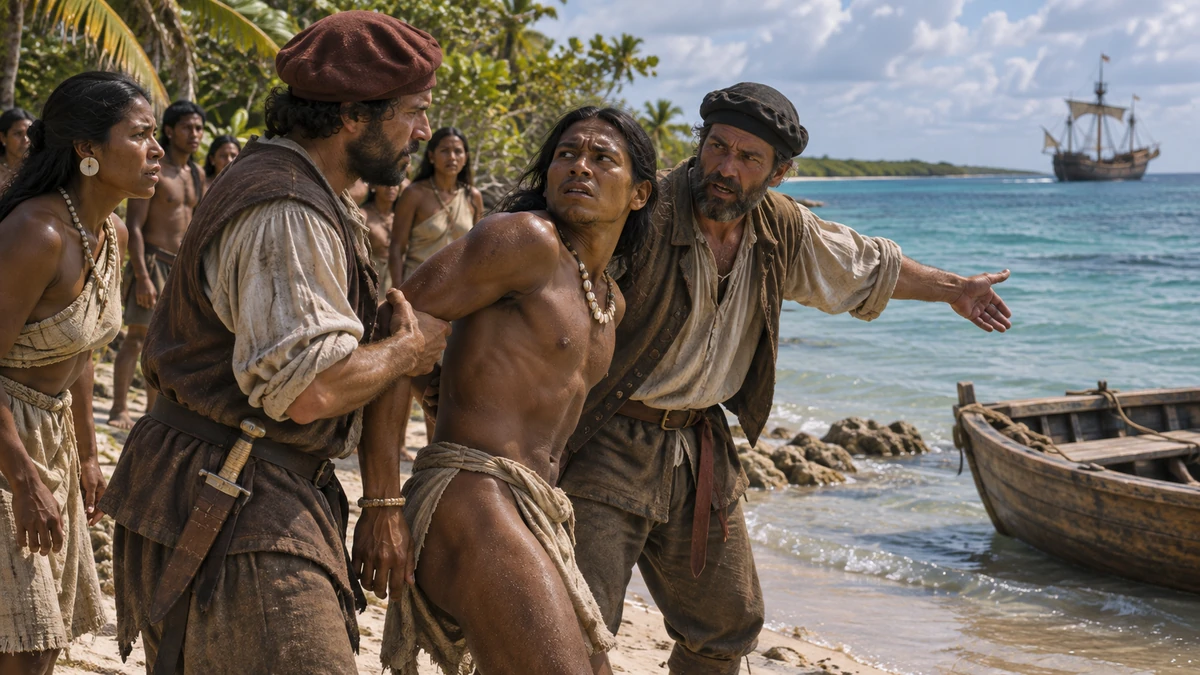
Artistic interpretation of the capture of Indigenous islanders on Guanahaní in October 1492. Columbus’s journal, preserved through a later account, reports the capture of seven people, but the precise circumstances are unknown.
When Christopher Columbus landed on the Caribbean island of Guanahaní on October 12, 1492, he declared that he was taking possession of it for the Spanish Crown. The island, however, was already inhabited, and the account of the ceremony makes no mention of its people giving consent. In the days that followed, the islanders and the newcomers met, exchanged objects, and tried to understand one another. Yet on October 14, Columbus recorded having ordered the seizure of seven islanders.
The first encounters were not all alike. They also involved curiosity, exchange, and hospitality. But the help some islanders gave the newcomers cannot erase the deprivation of freedom imposed on others. The seizure of people and plans for their forced subjugation did not emerge only with the later colonial administration. They are documented on the very first voyage. [1] [2] [3]
The Island Was Not Empty
Guanahaní had a name and inhabitants of its own long before Columbus renamed it San Salvador. Which present-day Bahamian island was the site of the first landing remains a subject of historical and geographical debate. That uncertainty does not alter the central fact: this was not uninhabited land.
Documentary source: Bartolomé de las Casas, later digest of Columbus’s first voyage (BNE VITR/6/7)
In the surviving summary of Columbus's journal, the landing is described in the entry for October 11, which continues into the following morning, October 12. Columbus carried the royal standard, two of his companions unfurled flags, and he called on the Spanish officials present to witness his formal taking of possession of the island for the Crown. The account establishes that the expedition performed a formal ceremony claiming possession. It does not establish that the islanders recognized Spanish rule, much less that they understood the newcomers' legal claims. [1] [2]
The nature of this source is crucial. Columbus's original journal has not survived. Our most extensive account of the first voyage comes from a later summary by Bartolomé de las Casas, who at times reproduced Columbus's words and at others paraphrased them in the third person. Historian B. W. Ife therefore cautions us to distinguish the event itself from Columbus's account and from the process by which that account reached us. The journal is an exceptional historical source, but it does not record Indigenous voices directly. [3]
Raising the flag expressed a Spanish claim; it did not establish authority over the island's inhabitants. Nor could the ceremony constitute their consent to someone else deciding the fate of their land and freedom.
Gifts, First Impressions, and the Search for Gold
We should not reduce the first encounters to violence alone. The journal describes islanders swimming or paddling out to the ships with parrots, cotton yarn, and other objects. They exchanged them for glass beads, small bells, and other inexpensive European objects. They approached the strangers, observed them, and took part in exchanges of their own accord. They were not silent extras in a story of European “discovery.” [1] [2]

At the same time, Columbus viewed them in terms of what they might offer the Spanish Crown. He wondered about gold, their language, religious conversion, and the possibility of using them as a labor force. Already in an early entry he considered taking some people to Spain so they could learn the newcomers' language. Behind the proposal to teach them a language lay a decision Columbus intended to make himself, without any evidence that those taken would consent. [2]
Columbus believed that the islanders regarded the newcomers as beings from heaven. Yet their encounters depended on gestures and words understood only in part. This was his interpretation of other people's behavior, not a surviving account by the islanders of their own beliefs. Likewise, his assertion that they had no religion cannot stand in for knowledge of their spiritual world. [2] [8]
Exchanging gifts did not, however, make the relationship an equal one. While people sought ways to communicate, Columbus was thinking about gold, conversion, and subjugation. Soon that difference was reflected in deeds as well as intentions.
Seven People Deprived of Their Freedom
In the entry for October 14, 1492, Columbus reports that he had ordered seven people seized, intending to take them with him, teach them the expedition's language, and then return them. In the same passage, he also considers keeping them captive or taking them to Castile. His thinking about coercive power was even more explicit: in his view, fifty men could subjugate the inhabitants and compel them to do as the conquerors wished. [1] [2]
Documentary source: Critical edition / transcription of the first voyage Journal, B. W. Ife
We must distinguish two kinds of evidence here. The capture of seven people is presented in the source as an act already carried out. The subjugation of the entire population by fifty soldiers is Columbus's assessment or intention, not an account of a conquest already completed. We must condemn the documented act without treating a stated intention as a conquest already achieved.
But the moral judgment of the captures does not depend on whether the later plan was feasible. Removing someone from their community and holding them aboard a foreign ship is not made voluntary by the need for interpreters. The source does not say that the seven captives were free to choose whether to go. Their fate was being decided by the commander of the expedition.
The captives, however, did not simply submit. The journal entry for October 15 describes one of them jumping from the ship into the sea and escaping in a canoe, followed by a second person who also jumped into the water. What happened to them afterward remains unknown, but the account of their escape contradicts any portrayal of them as wholly willing companions. [2]
Thus, less than a week after the first landing, the European commander was already treating people as means to his own ends: gathering information, learning languages, finding gold, and laying the groundwork for future rule.
Women and Children Held Captive
The seizures continued in Cuba. In the journal entry for November 12, 1492, Columbus explains that the previous day he had ordered five young men, who had boarded the ship from a canoe, to be detained aboard. He then sent his men to a house by the river, from which they brought back seven women and three children. The account does not describe their departure as a free choice: Columbus's expedition ordered their capture and detention. [1] [2]
Columbus justified the decision by referring to his earlier experiences with people from Guinea. He believed the men would cooperate more readily in Spain if women from their own society accompanied them. The women were also expected to help with language learning. The logic was ruthless: ties to familiar people were to become a means of securing the captives' obedience and cooperation. [2]
That evening, a man paddled out to the ship. According to Columbus's account, he was the husband of one of the captive women and the father of three children. He asked permission to remain with them. Columbus agreed and claimed that the group was reassured afterward. But even if the man himself wanted to stay with his family, this does not mean that his wife, the children, and the other captives had consented to their original loss of freedom. His request reveals how directly the seizure of people disrupted family ties. [2]
We do not know the names of the captive women and children, what they experienced, or what became of each individual afterward. Nor can we simply add the numbers from separate journal entries and treat the total as the definitive number of distinct captives taken during the voyage; groups moved from place to place, and some individuals escaped.
Such uncertainty does not diminish the gravity of what happened. The deprivation of freedom of women and children is documented. To describe it merely as “recruiting interpreters” would erase the people forced to bear the consequences of someone else's decision.
Hispaniola: Hospitality and Expectations
In early December 1492, the expedition reached Hispaniola. There it encountered different settlements and local leaders, not one community speaking with a single voice. Indigenous responses were not a simple choice between friendship and hostility toward strangers. Some people traded, others withdrew, and certain leaders established contact. [2]

Guacanagarí, a leader with whom the expedition developed a closer relationship, occupies a particular place in the account. The journal describes visits, gifts, conversations conducted through signs, and the preparation of food. Such encounters could serve different interests. The European expedition sought gold and a secure position; the islanders acted within their own long-established social and political relationships. The sources do not allow us to assign the same motives to every islander or leader. [2]
Columbus's praise of the islanders also requires careful reading. When he describes people as peaceful, generous, and easy to convert, he frequently judges them by how useful or controllable they appear to his expedition. His expressions of approval could thus coexist with a desire to control them.
Offering a guest food or assistance is not the same as consenting to that guest's rule. Nor does contact with the Spaniards mean that the island's population as a whole accepted their demands. These relationships became especially important when disaster struck Columbus's ship in late December.
La Navidad: From Shipwreck to Fort
On the night of December 24–25, 1492, the Santa María ran aground off the coast of Hispaniola. The journal describes how local people came to the rescue. Guacanagarí reportedly sent canoes, while his relatives also helped salvage the cargo. Columbus himself praised their care and honesty in guarding the recovered belongings. Their assistance is an essential part of the event, not a footnote to the story of a European expedition. [2]
Columbus then used the shipwreck as an opportunity to establish a more lasting Spanish presence. A fortified outpost called La Navidad was built near a settlement, and approximately 39 men stayed behind when Columbus departed. Columbus intended to supply them with provisions and equipment, and he also expected them to search for gold. His explanation for wanting the fort is especially revealing: the islanders were to see the power of the monarchs' men and obey them out of affection and fear. [2]
La Navidad was thus more than a shelter for the shipwrecked. It became a base for further Spanish claims and plans for subjugation. The hospitality of the community that helped after the shipwreck cannot be treated as evidence of consent to unlimited foreign rule. Columbus chose to establish the fort as part of his own project of conquest.
On the northern coast of present-day Haiti, archaeologists are investigating the large Taíno settlement of En Bas Saline, which may have been connected to Guacanagarí's center and the area around La Navidad. But that proposed connection remains a hypothesis, not a conclusively established identification of the fort. Archaeology documents an important Indigenous settlement with a long history; it does not establish beyond doubt that La Navidad has been located. [6] [7] [8]
In this way, an episode in which islanders helped strangers developed into the presence of armed men who stayed on the island to pursue Spanish objectives. The decision to build the fort came from the expedition, not from the community that had helped the shipwreck survivors.
The First Bloody Clash and the Language of the Enemy
On January 13, 1493, members of the expedition clashed with a group of Indigenous people on the northeastern coast of Hispaniola. Before the clash, according to the journal, the two groups had spoken and traded bows and arrows. The account then reports that the Spaniards attacked and wounded two people: one suffered a cut, the other an arrow wound. [1] [2]
Our account of the event comes from the expedition's perspective. It claims that the islanders first showed an intention to attack, but we cannot independently verify every circumstance, possible threat, or intention on either side. We therefore cannot state with certainty which side intended to begin the confrontation. What the account does clearly report is that two Indigenous people were wounded.
Columbus associated the people in this part of the island with the “Caribs” and attributed cannibalism to them. Such labels, however, belong to a colonial account; they are not neutral ethnographic evidence. Communication was limited, while Columbus interpreted unfamiliar people through pre-existing notions of a dangerous enemy. A historical article must not repeat those accusations as established fact. [2] [8]
The following day, Columbus considered seizing additional people from the area. Again, this was an intention, not evidence that further captures actually took place the next day. The journal also describes subsequent meetings and exchanges. Neither encounters nor violence took the same form everywhere. [2]
The January clash shows how portraying inhabitants as “dangerous” could be used to justify force. The injuries reported in the source remain significant, even though the expedition's account is our only detailed description of the event.
The Letter of 1493: Subjugation as a Plan
Toward the end of the first voyage, Columbus presented the expedition as a major opportunity for the Spanish Crown. In a letter from 1493, traditionally known as the letter to Luis de Santángel, he described islands that he had claimed as royal possessions and promised future benefits: gold, spices, cotton, and even enslaved people, should the Crown want them. In that letter, religious language is intertwined with economic ambitions that extended to treating human beings as commodities. [4] [5]

The letter is known through several textual versions and translations. We therefore cannot treat it as a single, indisputably preserved manuscript whose transmission is understood in every detail. Even so, the meaning of the passage is clear: enslavement was not an idea later attributed to Columbus by outsiders, but a possibility he offered to those in power. A promise of a future supply of people, however, is not evidence that mass trafficking in enslaved people had already been established during the first voyage. [4] [5]
The expedition returned to Spain in March 1493, leaving La Navidad behind and opening the way for a second voyage. When the second expedition returned to Hispaniola later that year, it found the outpost destroyed and its garrison dead. Questions about responsibility and the circumstances of the outpost's destruction are left open here; they belong to the next article in the series. [6] [7]
By the end of the first voyage, the colonial administration that emerged in later years did not yet exist in its fully developed form. But there were already reports of abductions, explicit plans for forced subjugation, a fortified Spanish outpost, and a proposal to treat people as merchandise. Neither these acts nor these intentions can be justified by calling the voyage a “discovery.” For the Indigenous peoples of the Caribbean, a period had begun in which outsiders sought to determine the fate of their land, freedom, and future.
Sources and further reading
- Christopher Columbus, Diario de 1492, Spanish text of the surviving summary by Las Casas, critical electronic edition by B. W. Ife, Early Modern Spain: Scope consulted: entries for October 11–14, November 12, December 25–26, and January 13–14 Source
- Columbus's journal of the first voyage, English translation in B. W. Ife's critical edition: Note: the translation accompanies source [1]; it is not a second, independent testimony Source
- B. W. Ife, Introduction to Christopher Columbus, Journal of the First Voyage, on the lost original and Las Casas's summary: Source
- B. W. Ife, Introduction to the Letters from America, on the textual tradition of the letter to Santángel, its variants, and recipients: Source
- Columbus's 1493 letter, historical English translation: Note: the substantive reference to enslaved people has been checked; the Slovenian original avoids presenting a verbatim translation that might conceal differences among versions Source
- Florida Museum of Natural History, En Bas Saline: Note: a possible connection with La Navidad, not a confirmed identification Source
- Kathleen Deagan, En Bas Saline: A Taíno Town before and after Columbus (University Press of Florida, 2023), chapter on Columbus, Guacanagarí, and La Navidad: Limitation: bibliographic details, the introduction, and descriptions were checked; the full monograph has not been represented as read Source 1 Source 2
- Margarita Zamora, Reading Columbus (University of California Press, 1993), Purpose: a critical examination of Columbus's descriptions of other people and the language he used Source
- José R. Oliver, review of Deagan's monograph (2024), Limitation: a secondary scholarly assessment, not independent archaeological confirmation of the site's identification Source
Methodological Note
All journal testimony derives from Columbus's indirectly preserved text and reflects his point of view. Stated intentions are not the same as actions carried out; the friendliness of individual communities does not constitute consent to colonial rule; and the archaeological connection between En Bas Saline and La Navidad is not conclusively established. A historical assessment of the documented abductions does not require invented details about the captives' later fates