The Taíno Before 1492: People, Society, and a World That Was Not Waiting to Be Discovered
What was Taíno society like before Columbus arrived? Explore its settlements, economy, political ties, and a cultural world that was not waiting to be discovered.
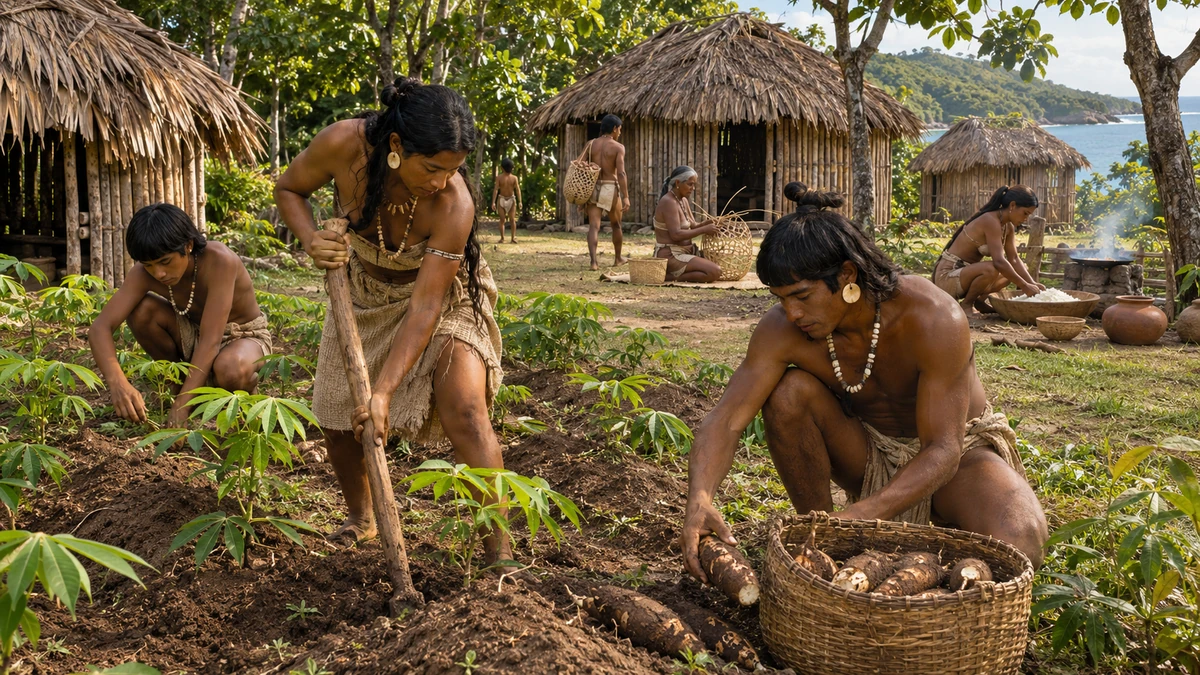
Artistic reconstruction of everyday life in a Taíno community on Hispaniola before 1492. The image is not a historical photograph or an exact reconstruction of a particular archaeological site.
Before the close of the fifteenth century, people on Hispaniola lived in coastal settlements, along rivers, and amid cultivated fields. They knew the sea routes, the seasons, and the plants they relied on for food. Children grew up in their communities, craftspeople made vessels and tools, leaders forged alliances, and storytellers kept the memory of their ancestors alive. This world had its tensions and differences. Yet it was theirs — and it had taken shape long before European ships arrived.
The year 1492 became one of the best-known dates in European history. Yet for people already living in the Caribbean, it did not mark the “discovery” of their homeland. If we begin the story with Columbus, we erase from view thousands of years of settlement, work, creativity, and political life. Archaeological sites, artifacts, and research into earlier migrations now reveal traces of that history.
How was this world connected? Who made decisions within its settlements? How did people grow their food and understand their relationships with their ancestors? And how can we reconstruct that life when the most extensive early written accounts were left by outsiders? To answer these questions, we must first look at life before that encounter.
A World That Was Not Waiting for Columbus
Hispaniola, the island now shared by Haiti and the Dominican Republic, belonged to a much wider Caribbean world. The Greater and Lesser Antilles and the Bahamas were not isolated places separated by impassable waters. The sea presented dangers, but it also offered routes of connection. Maritime knowledge enabled people to visit one another, exchange objects, and maintain relationships between coasts and islands. The nature of these connections varied from place to place and changed over time.
Many of the earliest written accounts were composed only after Europeans arrived. Their authors described Indigenous communities through their own religious, economic, and political assumptions, often shaped by the interests of conquest. This makes the physical evidence — settlements, hearths, food remains, pottery, tools, and ceremonial objects — especially important. Where these remains are found, and how they relate to one another, can tell us far more than an artifact removed from its context.
The name Taíno also requires explanation. Today it is widely used for related but diverse Indigenous communities of the late precolonial period, particularly on Hispaniola, Puerto Rico, and parts of the other Greater Antilles and the Bahamas. Its use as a broad ethnic label became established in later scholarship; we cannot assume that all these people understood themselves as one people using the same name everywhere. Nor can we retrospectively call every earlier inhabitant of the Caribbean Taíno. [1] [2]
Before Columbus arrived, then, there were communities with histories of their own — not a single society waiting for Europeans to name it. A chronicle may preserve the name of a chief; archaeological traces show where people lived, ate, and worked. Read together, these different forms of evidence bring their lives into clearer focus.
Islands, Peoples, and Thousands of Years of Connections
Archaeological evidence places the beginnings of human settlement in the Caribbean islands roughly six thousand years ago. Over the centuries, new groups arrived, existing communities changed, and different traditions of craft production, food preparation, and settlement emerged. This long history cannot be reduced to a single migration. [3]
Archaeologists use labels such as the Saladoid and Ostionoid traditions to distinguish patterns in pottery, settlements, and other finds. These labels do not designate clearly bounded states, nor are they necessarily the names of peoples. Similar methods of making pottery may indicate contact and shared knowledge, but they do not in themselves prove a common language or political authority.
Some of these later changes were linked to the spread of groups with ancestral ties to populations in northeastern South America. A study of ancient DNA published in Nature in 2021 combined data from 174 newly analyzed individuals with 89 previously published samples from different periods and locations. It found a major shift in genetic ancestry between the earliest island populations and later communities related to people from northeastern South America. It also revealed connections between islands and genetic continuity despite some changes in pottery styles. Cultural change, in other words, cannot always be explained by new arrivals. [3]
Genetic relatedness alone, however, does not tell us what languages people spoke, how they understood their identity, or whose authority they recognized. Nor should estimates of effective population size be mistaken for the actual number of people living on the islands.
During the final centuries before European arrival, larger settlements, more pronounced social differences, and distinctive ceremonial objects appeared in parts of the Greater Antilles. Settlement history was not simply a story of growth: people used spaces differently, centers of importance could shift, and established connections took on new roles. The archaeological record does not yield a single timeline for all the islands, but several interconnected regional histories. Elsewhere, different forms of organization existed. This was not one unchanging culture, but a region of many contacts and local paths of development. [2] [3]
Communities, Families, and Chiefs
A settlement was more than a collection of houses. Families, shared work and food, ceremonial obligations, and ties to neighboring communities held it together. Leaders might coordinate labor and exchange, maintain political alliances, and command particular prestige. Some communities belonged to wider hierarchical networks; others had different arrangements of power. [1] [4]
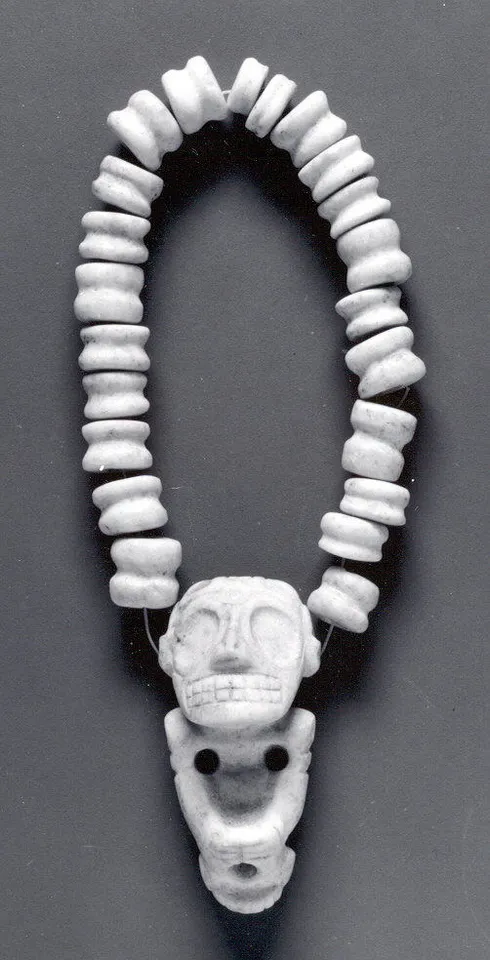
Early Spanish sources use the term cacique for leaders. Rendering it simply as “king” would be misleading: European ideas of kingship do not capture every way authority and belonging worked in these communities. Authority could be bound up with kinship, ceremonial prestige, the distribution of goods, and relationships among settlements. The reach of any one leader’s influence is often difficult to establish.
The chronicles also record the terms nitaíno, behíque, and naboría. The first is associated with higher social standing; the second with ceremonial and healing specialists. The meaning of the third changed over time: early descriptions associate it with dependent forms of labor, while the later Spanish colonial administration used the word for various groups of Indigenous workers. That later administrative usage cannot be treated as a direct map of precolonial social relationships. Nor should these categories automatically be equated with European nobility, clergy, and subjects. [4] [10]
Nor was political authority necessarily confined to men. Early sources mention women leaders, while researchers examine kinship and inheritance arrangements in which the maternal line may have played an important role. This does not imply that rights were equal everywhere; it does show the limits of assuming an exclusively male model of political authority. [4] [10]
Trade and contact did not make every political relationship harmonious. Alliances could provide mutual support, while leaders also competed for prestige, labor, and access to goods. Understanding kinship, ceremonies, and exchange is therefore essential to understanding power.
Archaeological evidence helps us assess whether differences in prestige were also visible in everyday life. A larger house, rarer objects, or a more varied diet may indicate unequal access to resources. Such evidence tells us little about any one individual’s precise authority, but it suggests that political inequalities were not simply inventions of the chroniclers.
Hispaniola and the Question of Five Chiefdoms
Many historical overviews divide Hispaniola into five great chiefdoms: Marién, Maguá, Maguana, Jaragua or Xaragua, and Higüey. These names belong to a longstanding historical reconstruction. The problem begins when a map creates the impression of five states with permanent, precisely known borders.
Political connections on the island certainly existed, and early writers recognized leaders with differing degrees of influence. Yet their accounts cannot simply be turned into borders resembling those of modern states. Different settlements could retain their own leaders, alliances could change, and influence did not necessarily follow a neatly bounded territory. [1] [5]
A particularly revealing example is Andrés de Morales's map of 1516, which divided the island into five geographical regions. As archaeologist Eduardo Herrera Malatesta points out, the map does not delineate the borders of five chiefdoms. Peter Martyr d'Anghiera described the areas as geographical regions; the interpretation that they were political territories became established later. [5]
This is more than a technical correction to a map. Treating presumed borders as facts creates a false impression of political unity and obscures the diversity of communities. We can retain the traditional names, but must present them as part of historical accounts and subsequent reconstruction, not as a definitive map of power before 1492.
Life Between Fields, Rivers, and the Sea
Farming demanded more than knowing when to plant. People had to understand which soils retained water, how plants responded to rain, and when crops were ready for use. Cassava was a major cultivated crop. In many areas it was grown in raised beds or mounds known as conucos. It was part of a body of agricultural knowledge adapted to local conditions. Alongside cassava, people cultivated other root crops, beans, peppers, peanuts, and various other plants. [4]

Harvests then had to be prepared for eating. Flat ceramic griddles, pots, and tools bear witness to the steps involved in preparing food. Each object preserves a trace of the knowledge of those who made and used it.
Rivers and the sea supplied another substantial part of the diet. Fishing, shellfish gathering, and other sources of animal food complemented agriculture. Along the coast, people had to understand shallows and the seabed; inland, they needed to know river routes and seasonal changes. Archaeologists identify these activities through animal bones, shells, fishing weights, and other remains. At some sites, the finds also reveal differences between the diets of different households. [4] [8]
Craftspeople shaped pottery, carved bone, shell, and stone, worked fibers, and made ornaments. Growing and processing cotton made it possible to produce textiles. Some objects were intended for work, others for exchange, while still others may have carried personal or ceremonial significance. Their functions must be inferred from context; an unusual form is not in itself proof that an object was exclusively ceremonial.
The sea connected economic and family networks. Canoes made transport possible, while similarities among finds and the distribution of certain materials point to contacts between islands. We cannot determine exactly how often these journeys took place, or why people undertook each one. What is clear is that island communities were not cut off from one another. [2] [6]
These skills had to be passed from one generation to the next. Archaeology does not preserve conversations between teachers and learners, but recurring techniques in pottery, fiber work, and food preparation reveal traditions of knowledge and learning.
These economies also varied from place to place. A settlement on a resource-rich coast had different opportunities from one inland; access to goods could also depend on social position. Everyday life, then, was inseparable from politics. Who could organize labor, and who received particular goods or foods, were also questions of power.
Cemí, Ceremonies, and the World of the Ancestors
In Taíno communities, beliefs about ancestors and nonhuman beings were closely entwined with relationships among people. The term cemí carried meanings far beyond those suggested by the old European label “idol.” It could refer to particular beings and powers, and to objects through which such relationships took form in community life. José R. Oliver has shown that cemí were part of the connections linking leaders, kinship, belonging, and exchange. [6]

Representations in stone, wood, shell, and other materials have survived, including distinctive three-pointed stones. Their variety does not mean that every object served the same purpose. What matters is where an object was found, what it was associated with, and what life around it looked like.
Early records mention collective singing and dancing associated with the term areíto, alongside ceremonial practices involving cohoba. Such gatherings may have sustained collective memory and reinforced the standing of leaders. Because the accounts arose in particular places and circumstances, however, we cannot attribute these practices to every island community. [4] [7]
One of the most important early accounts comes from the friar Ramón Pané, who collected narratives on Hispaniola after 1492. His text preserves stories about the origins of people, ancestors, nature, and ceremonial relationships. Yet his original manuscript has not survived. The most extensive version is known through a work by Ferdinand Columbus, published in 1571 in an Italian translation by Alfonso de Ulloa. That complex chain of transmission matters, not least for how Indigenous names and terms were recorded. [7]
Ceremonies could also be associated with open spaces in settlements. Archaeologists interpret some prepared areas as places for gathering, dancing, or games, although their use cannot always be determined unambiguously. We should therefore look for spiritual life not only in individual objects, but also in spaces and relationships among people. [2] [9]
Pané's narrative is valuable, but it does not mean we are hearing the unfiltered voices of all Hispaniola’s inhabitants. It was recorded in a colonial setting, filtered through one European listener’s understanding and subsequent translation. Read alongside archaeology and critical scholarship, it allows us to say more — and to speak more carefully — about a world where memory, ancestors, power, and community were bound together.
En Bas Saline — A Settlement That Speaks Through Archaeology
On the northern coast of present-day Haiti, archaeologists have investigated En Bas Saline, a large Taíno settlement whose archaeological record spans the years before and after 1492. Kathleen Deagan examined the site's archaeological record in her 2023 monograph, covering approximately 1250–1520. The site is particularly valuable because it allows researchers to compare different parts of the same settlement over time. [1]
Documentary source: En Bas Saline archaeological site dossier
The site revealed a curved raised earthwork, an open central space that may have served for gatherings, ceremonies, or games, and larger mounds containing the remains of buildings. The distribution of pottery, food remains, and tools makes it possible to compare everyday activities in different parts of the settlement. Interpretations begin with the actual distribution of remains, rather than a preconceived image of a “typical” Taíno village. [9]
The Florida Museum of Natural History reports 119,169 excavated artifacts, of which 73,303 came from archaeological contexts beneath a cultivated layer disturbed in later periods. More than 98 percent of the artifacts are associated with the preparation or consumption of food; most are fragments of ceramic vessels. Other finds include ornaments, fishing weights, flat griddles, and tools made from bone and shell. These numbers describe the extent and character of the archaeological material, not the number of people who lived there. [8]
Differences between the central part of the settlement and other dwellings are particularly revealing. In and around the central building, researchers found a greater variety and concentration of artifacts and food remains. Analyses indicate that people associated with this area also ate larger fish and a wider range of animal foods. This supports the interpretation that those associated with the community’s leadership had different access to resources. At the same time, it cannot provide a complete account of rights or a precise political hierarchy. [8]
The site contains remains of cassava, maize, peppers, beans, and other plants. In two large pits in the central area, researchers found pottery fragments, broken griddles, charred cassava, animal bones, shells, and ash. Researchers interpret them as possible traces of communal feasting. The museum’s description does not establish whether both pits date exclusively to before 1492; occupation at the site continued after Europeans arrived. The finds should not be presented as definitive evidence of precolonial feasting. Instead, they illuminate the site’s longer, layered history. [8] [9]
Haitian institutions and residents of present-day En Bas Saline also took part in the research. The Florida Museum holds the collections on behalf of the Haitian state under an agreement between institutions. The work of archaeology also carries responsibilities to the heritage of a place and to the people connected to it. [8] [9]
Researchers also associate En Bas Saline with the area of the chief Guacanagarí and with the possible location of the early Spanish outpost of La Navidad. That identification remains a hypothesis, not an established fact. What matters for this article is something else: the settlement had a life of its own before Europeans arrived, and its archaeological deposits also attest to a continuing Indigenous presence after the first encounter. The events after 1492 belong to the next article. [1] [9]
En Bas Saline cannot serve as a template for every Caribbean community. But it is a place where abstract words such as “society,” “power,” and “economy” acquire tangible traces. Someone prepared food there, repaired tools, took part in ceremonies, and cared for people close to them. Such traces bring into focus people whom European accounts so often leave in the background.
The Year 1492 — A Moment Before Change
By the close of the fifteenth century, the communities of Hispaniola and the other Caribbean islands had histories stretching back many generations. Their inhabitants knew how to connect islands, cultivate land, build settlements, and create objects that could be useful, beautiful, or ceremonially important. They maintained networks of kinship and political ties; some people wielded more influence than others. Diversity is not a weakness in this history, but an essential part of it.
Many of their names and stories have not survived. No extensive collections of their own writings survive from this period. Yet the richness of their history cannot be measured by the existence of archives in the European sense. Traces of work, food, buildings, and ceremonies bear witness to people who shaped their own world before European newcomers began to describe it.
In October 1492, Columbus's expedition reached the Bahamas and then continued through the Caribbean. It arrived on Hispaniola later that year. For the people who lived there, this did not mark the beginning of their world. It was the beginning of a new and unequal encounter from which conquest and colonial violence would emerge. To understand what followed, we must first know what had existed before — and who had built that world.
Sources and further reading
- Kathleen Deagan, En Bas Saline: A Taíno Town before and after Columbus (University Press of Florida, 2023), publisher's presentation and table of contents. Limitation: the description, summaries, and museum materials have been consulted; the monograph has not been read in full Source
- Florida Museum of Natural History, Taíno Culture History; L. Antonio Curet, “The Taíno: Phenomena, Concepts, and Terms”, Ethnohistory 61, no. 3 (2014), 467–495. The scholarly abstract and bibliographic record were consulted for the terminological discussion Source 1 Source 2
- Daniel M. Fernandes et al., “A genetic history of the pre-contact Caribbean”, Nature 590 (2021), 103–110; published online December 23, 2020. Analysis of 174 newly studied and 89 previously published ancient individuals; genetic estimates must not be equated with a population census Source
- Florida Museum of Natural History, Taíno Society Source
- Eduardo Herrera Malatesta, “The Transformation of Indigenous Landscape in the First Colonized Region of the Caribbean”, Land 11, no. 4 (2022), 509 Source
- José R. Oliver, Caciques and Cemí Idols: The Web Spun by Taíno Rulers between Hispaniola and Puerto Rico (University of Alabama Press, 2009). Limitation: the publisher's description and table of contents, not the complete text, were consulted for the claims cited Source
- Ramón Pané, Relación acerca de las antigüedades de los indios. On the history of the text's transmission: La ausencia de los dioses taínos. Sobre el fracaso hermenéutico de la obra de Ramón Pané; José Juan Arrom's critical edition, An Account of the Antiquities of the Indians Source 1 Source 2
- Florida Museum of Natural History, Material Remains — En Bas Saline Source
- Florida Museum of Natural History, Taíno Archaeology — En Bas Saline; En Bas Saline Source 1 Source 2
- Kathleen Deagan, “Reconsidering Taíno Social Dynamics after Spanish Conquest: Gender and Class in Culture Contact Studies”, American Antiquity 69, no. 4 (2004), 597–626. For the discussion of social position and differences in the roles of women and men, the research argument and a verified scholarly abstract were used Source