Balboa and the Conquistadors' Dogs — A Bloody Image of the Spanish Conquest of the Americas
An engraving by Theodor de Bry depicts violence during Balboa’s 1513 expedition. The article distinguishes early chronicles from the later artistic image.
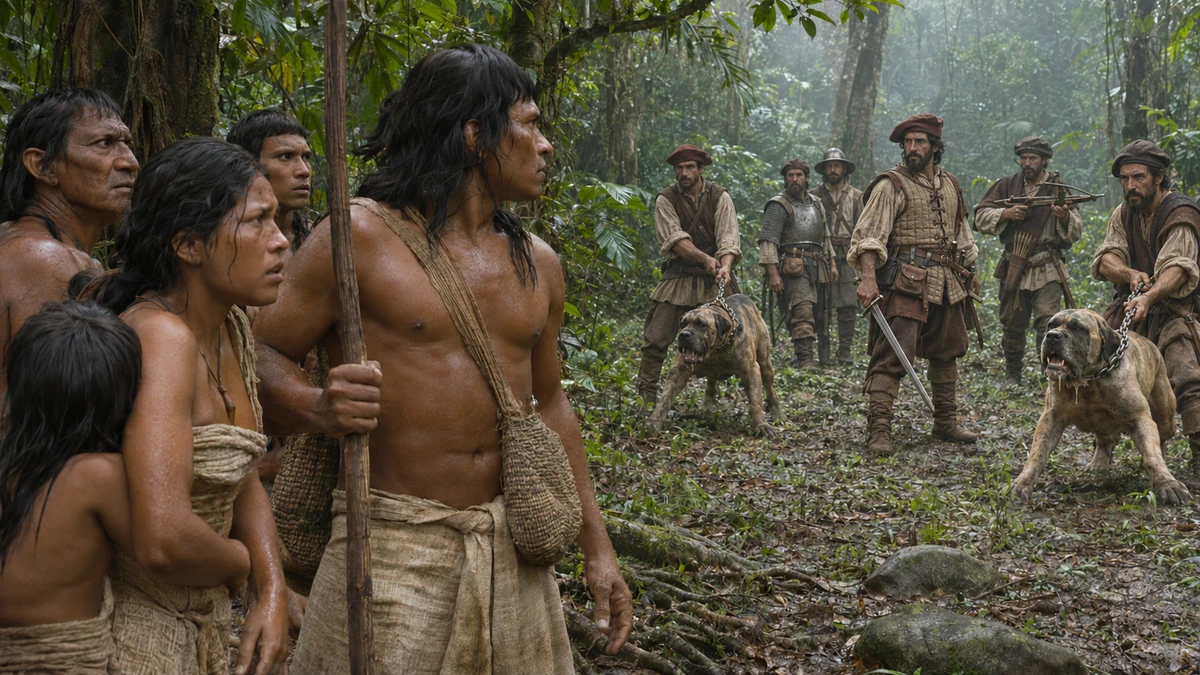
Artistic reconstruction of the threat of colonial violence in Panama in 1513; not an eyewitness record of the events at Quarequa.
Panama, 1513. The massacre at Quarequa, Indigenous people condemned to be torn apart by dogs, and a historical engraving that reveals how colonial violence could be portrayed as an act of justice.
An Image of Violence That Survived the Centuries
A group of Spanish conquistadors stands in formation. Armed and dressed in European clothing, they dominate the scene.

Before them, large dogs attack Indigenous people lying on the ground. Some appear to be struggling to defend themselves; others are depicted as motionless bodies. The soldiers stand watching. The engraving conveys an extreme imbalance of power. On one side are armed conquerors exercising authority over life and death. On the other are people subjected to that authority.
The image was published in 1594 by the Flemish engraver and publisher Theodor de Bry in the fourth volume of his celebrated collection America, also known as the Grand Voyages. It depicts an episode associated with the Spanish conquistador Vasco Núñez de Balboa and his expedition across the Isthmus of Panama in 1513.
But de Bry was not there. The engraving appeared more than eighty years after the events it purported to represent, drawing on an earlier European narrative tradition. It cannot be regarded as eyewitness evidence of what happened. It can, however, reveal something equally important about the history of conquest: how European writers and artists represented colonial violence, how they portrayed its victims, and how acts of extraordinary cruelty could be given a language of moral justification.
To understand the engraving, we must leave de Bry's workshop behind and return to Panama in 1513.
Balboa — The Conquistador Who Marched toward the Pacific
Vasco Núñez de Balboa was among the Spanish conquistadors who extended Castilian rule into the territories of present-day Panama and Colombia in the early sixteenth century. His activities were closely associated with the Spanish settlement of Santa María la Antigua del Darién, founded in 1510. Balboa sought gold, political recognition, and control over new territories. His expeditions involved geographical exploration, but they were also military campaigns intended to expand Spanish power.
In September 1513, he set out across the Isthmus of Panama with approximately 190 Spaniards, heading toward the sea on its southern side. In European historical accounts, this expedition became famous for Balboa's arrival at the Pacific Ocean. Yet there was nothing unknown about that ocean to the people who already lived along its shores.
Indigenous communities knew the landscape, rivers, routes, coastlines, and local networks of trade. They possessed their own political institutions, leaders, economic interests, alliances, and rivalries. Balboa's expedition depended heavily on their knowledge. He required information, guides, food, and assistance with transporting equipment. He formed alliances with some local leaders, while other communities resisted his advance.
Peter Martyr d'Anghiera, a humanist and chronicler at the Spanish court, recorded the expedition in his work De orbe novo. According to Martyr, Balboa reached the territory of Quarequa, where a local leader, also identified in the chronicle as Quarequa, attempted to prevent the Spaniards from continuing their march. The leader demanded that they withdraw. Balboa refused.
What followed was a confrontation that the European chronicler described in exceptionally brutal terms.
Quarequa, 1513 — A Massacre in the Historical Record
Peter Martyr describes the Indigenous warriors as armed with bows, arrows, wooden weapons, and other arms suited to their surroundings. The Spaniards possessed a military advantage through their metal weapons and firearms. According to the chronicler, the defenders began to retreat when they heard gunfire. Spanish soldiers pursued them and continued killing.
Martyr's account is strikingly graphic. He compares the soldiers to butchers cutting apart animals, describing severed limbs and heads. He states that six hundred people were killed, including the local leader. Such a report is deeply disturbing. But historical accuracy requires us to distinguish between what a source records and what can be independently established.
The figure of six hundred comes from Martyr's chronicle. It is not supported by an independently verified register of the dead. Nor was Martyr himself present at Quarequa. His account relied on reports associated with the Spanish expedition. We cannot therefore confirm the precise number of victims or reconstruct every circumstance of their deaths.
We can establish, however, that an early European chronicle describes extensive killing during Balboa's advance through Quarequa. And the account does not end with the battle. Martyr goes on to describe a second episode. This time, the victims were not presented as armed defenders resisting the Spanish advance, but as people whom Balboa reportedly ordered to be killed by dogs.
Forty People Condemned to Be Torn Apart by Dogs
After the Spaniards had taken Quarequa, Balboa reportedly encountered the local leader's brother and others whom the European accounts described as wearing women's clothing.
Documentary source: De orbe novo decades, Third Decade, Book I
Martyr also used language that carried sexual and moral condemnation. He then recorded an order attributed to Balboa: approximately forty people were to be handed over to dogs and torn apart. The Latin edition of De orbe novo, published in 1516, contains the following sentence:
Iussit a canibus circiter quadraginta lacerari.
In English:
"He ordered approximately forty to be torn apart by dogs."
The chronicler was not describing an accident or an uncontrolled attack by animals. He was reporting an order issued by a Spanish commander. Martyr also explains that the Spaniards used dogs against Indigenous people in warfare. These animals were instruments of military violence, capable of inflicting devastating injuries and death. It is essential to distinguish between the two episodes in his account. The first was the battle at Quarequa, in which he reported six hundred deaths.
The second was the subsequent execution of approximately forty people who, according to the chronicle, were condemned to be torn apart by dogs. Both numbers come from the same historical source. Neither can be independently verified as an exact death toll. That limitation matters. It does not mean the testimony should be dismissed.
This is an early account, written within the world of Spanish colonial power, that attributes an intentional act of exceptional cruelty to a conquistador commander. But another question is equally important. Why were these particular people selected for execution? The answer offered by European writers tells us as much about the prejudices and moral assumptions of the conquerors as it does about those they condemned.
The Victims Behind the Colonial Accusations
Much is known about Balboa: his expeditions, political ambitions, conflicts, and eventual fate. Far less is known about the people whom he reportedly ordered to be killed by dogs. Most of their names have been lost. Their own testimonies have not survived. Nor do we know what words they used to describe their identities, social roles, or ways of life. What remains are descriptions written by Europeans.
Martyr's Latin account refers to people wearing women's clothing and employs language marked by sexual and moral condemnation. He describes the local leader's household in terms associated with behaviour condemned by European sexual norms. Yet he provides no direct eyewitness testimony of a specific sexual act that can be independently verified. That distinction is crucial.
A moral accusation made by a European chronicler does not prove that the victims committed the acts attributed to them. Nor does a person's clothing, appearance, or social position establish their sexual behaviour. In 1555, Richard Eden published an English translation of Martyr's work. Through translation and subsequent retellings, some of the sexual accusations became more explicit.
In a study published in Gender & History in 2024, historian Jamey Jesperson examines precisely this problem. Jesperson argues that the Quarequa episode should also be understood through the history of colonial violence against people whose gender expression did not conform to European expectations of masculinity and femininity.
Her research brings the concept of trans femininity into the discussion, seeking to recover the historical significance of people whose lives have too often been reduced to colonial allegations of prohibited sexual conduct. This interpretation raises an important question about the lives that European records obscure. Yet the surviving evidence cannot establish the personal identity of every individual involved.
We must also be cautious about imposing contemporary categories on an Indigenous society of the early sixteenth century. The historical record tells us more about how European observers described these people than about how they understood themselves. But the limits of our knowledge do not weaken the moral issue at the centre of the episode.
The victims' human worth did not depend on whether they conformed to Spanish religious, social, or sexual norms. Even if every allegation made by the European chroniclers had been true, none would have justified their execution. History must not condemn these people a second time by accepting the accusations of their persecutors as established fact.
When Colonial Violence Is Presented as Justice
Martyr's account contains another revealing passage. He claims that some local inhabitants approved of Balboa's actions and even demanded punishment for others accused of similar behaviour. He also reports a belief that such alleged transgressions were responsible for natural disasters, disease, and famine. But these claims have not survived as direct testimony from the people of Quarequa.
They reach us through a European chronicler who did not witness the events, did not possess firsthand knowledge of every local custom, and wrote for an audience shaped by European religious and political assumptions. The narrative could serve an important ideological purpose. If the victims were portrayed as sinners, and even members of their own community supposedly approved of their deaths, the conqueror could be presented as an agent of justice. Violence would no longer appear merely as violence. It would become punishment.
That does not prove that Martyr invented every detail of his account. It does, however, mean that his explanation of events must be examined separately from his report of the executions. Here we encounter one of the central mechanisms through which colonial violence could be legitimised. First, a group of people is portrayed as dangerous, sinful, or inferior. Their punishment is then described as necessary, beneficial, or morally righteous.
In this way, violence inflicted by a foreign military power acquires the appearance of legitimate authority. But a religious accusation cannot erase the responsibility of those who order or carry out an execution. The lives of the people at Quarequa were not worth less because European writers labelled them transgressors.
Theodor de Bry — Art, Propaganda, and Historical Memory
In 1594, Theodor de Bry transformed the earlier account of Balboa's violence into an engraving. The image appeared as Plate 22 in the fourth volume of his America collection. The series introduced European readers to the lands and peoples of the Americas, as well as to episodes from the European conquest. Its illustrations helped shape the way audiences imagined places most would never see. De Bry had not witnessed Balboa's expedition. Nor can the engraving be regarded as an exact reconstruction of the event.
Its composition, the placement of the figures, the depiction of the dogs, and the treatment of the violence were artistic decisions. Those decisions matter. The Spanish soldiers stand in an orderly formation. In the foreground, extraordinary violence is inflicted upon Indigenous people depicted as defenceless.
The image draws the viewer's attention to the contrast between those who wield power and those against whom it is used. Yet the illustration's meaning cannot be separated from its accompanying words. The original German title states that Balboa handed Indigenous people over to dogs because they had allegedly committed the "terrible sin of sodomy." This was a European moral accusation, not an independently established fact about the victims.
It is the relationship between the title and the image that opens the engraving to different interpretations. A viewer may recognise the brutality of the Spanish conquest. At the same time, the title offers a narrative in which the violence appears as punishment for a supposedly grave sin. The engraving should therefore not automatically be interpreted solely as a condemnation of the conquistadors.
In his 2025 master's thesis, Joel Thomas Bowers proposes that de Bry's combination of image, title, and accompanying narrative could also have served to justify the executions on moral grounds. In Bowers's interpretation, the scene could be understood as a form of religiously sanctioned punishment, comparable to European practices of persecuting people accused of prohibited sexual behaviour. This is a scholarly interpretation, not a documented declaration of de Bry's personal intentions. The broader historical context is important.
De Bry's engravings have often been associated with Protestant criticism of Catholic Spain and its conquest of the Americas. But that does not mean every image conveyed a single, straightforward political message. An illustration can expose an atrocity while the accompanying text encourages the viewer to regard that same atrocity as justified.
That is why historical images must be examined together with their titles, captions, accompanying narratives, and the circumstances of their production. De Bry's 1594 composition continued to circulate in later editions. The Denver Art Museum preserves a print dating from 1655, produced in a subsequent edition of the work. To understand the engraving, we must therefore keep three historical layers distinct: 1513 — The event: The violence at Quarequa described in early historical accounts.
1516 — The written account: The printed Latin edition of Peter Martyr's chronicle, recounting events through a European perspective. 1594 — The image: De Bry's engraving, which transformed earlier narratives into a visual representation for European audiences. Later editions, including the print from 1655, demonstrate the continued circulation of the image.
The difference between an event, an account of that event, and a later depiction is not merely a matter of bibliography. Without that distinction, an artistic interpretation can easily be mistaken for direct historical evidence.
The Atrocity and Its Legacy
Balboa's crossing of the Isthmus of Panama became a celebrated episode in European historical memory because of his arrival at the Pacific Ocean. Yet a chronicle describing that same expedition also records military subjugation, extensive killing, and the reported use of dogs to execute human beings. These events are not an insignificant footnote to a great geographical achievement. They belong to the same history. Balboa did not cross an empty territory waiting to be claimed by Europeans.
He crossed lands inhabited by communities with their own leaders, relationships, knowledge, and political choices. Some formed alliances with him. Others resisted his advance. At Quarequa, according to the chronicler, that resistance ended with the killing of a large number of people. Another group was subsequently condemned to death, its members described by European writers as morally unacceptable. This episode reveals that colonial domination was exercised through more than weapons.
It was also sustained by language, accusations, and images that could present acts of violence as necessary or righteous. But no religious condemnation, difference in customs, or claim of moral superiority could justify ordering human beings to be torn apart by dogs. Nor does uncertainty about the precise number of victims remove responsibility for the violence described in an early historical source. On the contrary.
Distinguishing carefully between what sources establish, what they report, and how later generations have interpreted them allows us to confront the past without inventing evidence or excusing those responsible. De Bry's engraving is therefore more than a disturbing image from an old book. It reveals how Europe represented the conquest of the Americas — and how even an atrocity could be incorporated into a narrative of faith, morality, and power. Yet the people depicted were not merely victims in a European story of conquest.
They had their own lives, their own communities, and their own histories, none of which began with the arrival of the Spaniards. To understand the true dimensions of colonisation, we must also learn about the societies whose worlds it transformed. Among them were the Taíno of the Caribbean, whose history is directly connected to Columbus's arrival in 1492.
Balboa's story in Panama is not the story of the Taíno on Hispaniola. It concerns a different region, different communities, and a different historical event. What connects them is the broader history of Spanish colonial expansion. Before turning to Columbus's first encounters and the colonial rule that followed, we must therefore ask a fundamental question:
Who were the Taíno — and what was their world like before 1492?
Sources and further reading
- University of Houston Libraries. Theodor de Bry, Valboa wirfft etliche Indianer ..., 1594. Catalogue record and digital reproduction of the historical engraving Source
- Peter Martyr d'Anghiera. De orbe novo decades, Alcalá de Henares, 1516, Third Decade, Book One. Original Latin edition, preserved in digitised historical collections Source
- Richard Eden. The Decades of the Newe Worlde, London, 1555, Third Decade, Book One. English translation of Martyr's work Source
- Francis Augustus MacNutt (trans.). De Orbe Novo: The Eight Decades of Peter Martyr d'Anghera, Volume I, New York, 1912. Historical English translation used for comparison Source
- Jamey Jesperson. "Trans misogyny in the colonial archive: Re-membering trans feminine life and death in New Spain, 1604–1821." Gender & History, 36(1), 2024, pp. 91–111. First published online in September 2023 Source
- Denver Art Museum. Theodor de Bry, Balboa's Massacre of the Cueva (recto); Balboa Reaches the Sea (verso), 1655 print, accession no. 2000.371. Commentary by Kathryn Santner, 2022 Source
- Joel Thomas Bowers. Theodor De Bry's Ravaged Sodomites: an Emblematic Narrative Twist. Master's thesis, University of Alabama, 2025. The interpretation cited in this article is based on the verified institutional abstract; a complete review of the thesis remains outstanding Source
Research note: The figures of six hundred and approximately forty are reported by a European chronicler and are not independently verified death tolls. Sexual allegations are presented as claims found in colonial sources, not as established facts about the victims. De Bry's engraving is a later European representation of the event, not an eyewitness record. Interpretations of the engraving's ideological purpose remain open to scholarly debate.