The Taíno Today: Survival, Descendants, and the Right to Their Own History
The Taíno are not merely a chapter of the past. This article explores their descendants’ survival, contemporary identity, and the right to tell their own history.
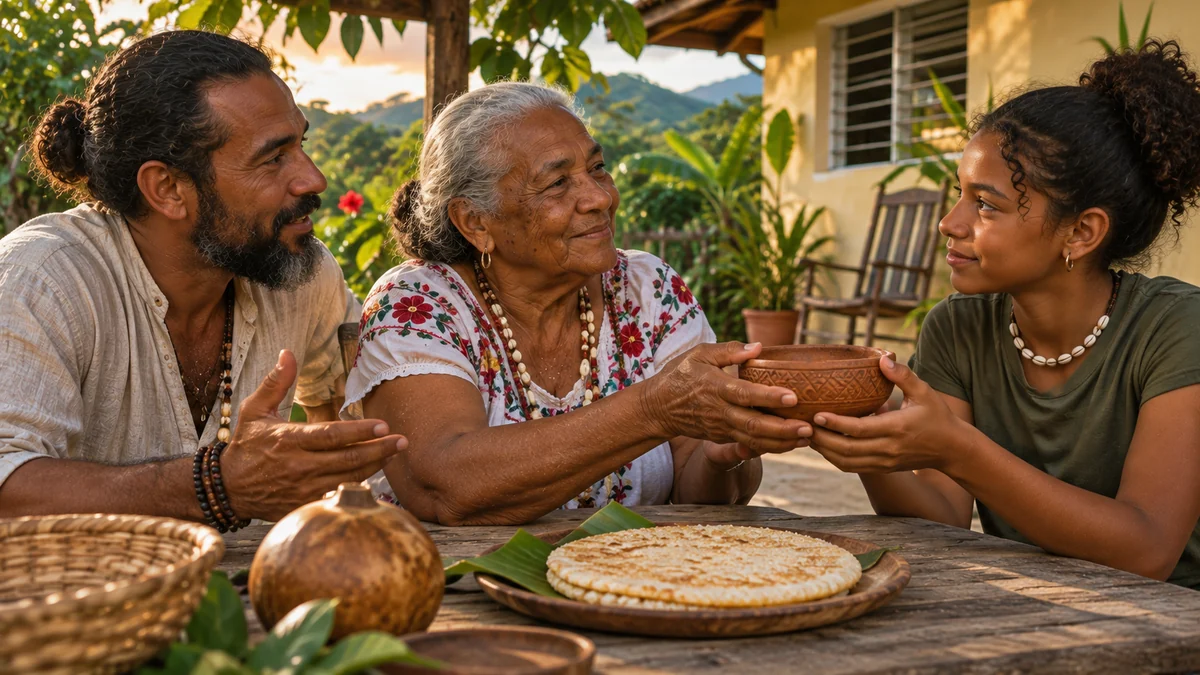
Living Heritage: An artistic interpretation of intergenerational connections in the contemporary Caribbean. The scene evokes survival, the transmission of knowledge, and cultural revitalization; it does not document a particular Taíno family or historical event.
The People Who Were Said to Have Disappeared
Documentary source: Smithsonian exhibition on Taíno heritage and identity (2018–2019)
In 1492, European ships reached Caribbean islands where people had already lived for thousands of years. They had their own settlements, families, political relationships, knowledge of the land and sea, and languages through which they understood and described their world. The arrival of Christopher Columbus marked the beginning of catastrophic change.
Over the following decades, Spanish conquest, enslavement, forced labor, violence, disease, and displacement devastated numerous Indigenous communities. Populations declined dramatically, political structures collapsed, and many family and cultural connections were severed. Later historical narratives often added a further conclusion to this catastrophe: the Taíno had become extinct.
Their artifacts were preserved in museums. Archaeologists studied the remains of their villages. Their names survived in the names of places, rivers, and mountains. Yet the people themselves were frequently portrayed as having vanished entirely. Does that narrative reflect the historical evidence? To answer this question, we must distinguish between several different developments: the destruction of precolonial political communities, population decline, the survival of individuals and their descendants, and the continuation of cultural identity.
These are not the same things. Today, the term Taíno is used for historically connected Indigenous communities of the Caribbean, particularly those of the Greater Antilles and the Bahamas, as well as for contemporary people and communities who identify with that heritage. The term does not, however, imply that every precolonial inhabitant of these regions belonged to one completely unified society. Differences existed before the arrival of Europeans, and new ones emerged over the centuries.
In 2018, the Smithsonian's National Museum of the American Indian opened the exhibition Taíno: Native Heritage and Identity in the Caribbean. Alongside historical heritage, it presented contemporary movements, families, and organizations affirming their Indigenous ancestry and Taíno identity.[1] The exhibition raised an important question: what happens when historical narratives declare a people extinct while their descendants are still living?
The colonial catastrophe is a historical fact. The complete disappearance of every descendant, however, does not automatically follow from it.
Survival After the Catastrophe
The history of the Taíno after 1492 followed no single path. Conditions on Hispaniola were not identical to those in Cuba or Puerto Rico. Spanish authority took hold differently on individual islands, and patterns of settlement, economic activity, and opportunities to escape direct colonial control also varied. Everywhere, however, colonization profoundly transformed Indigenous lives.
Some people were abducted, enslaved, or compelled to labor for colonial masters. Others died from violence and disease. Many communities lost their lands, their leaders, and the ability to maintain their former ways of life. Yet those who survived did not necessarily disappear from Caribbean society.
Four Indigenous Villages in 1556
In a Smithsonian overview of the history of Taíno descendants, researcher Ranald Woodaman describes four Indigenous villages discovered along the coast of Hispaniola in 1556.[2] By then, official colonial records had already created the impression that nearly all the remaining Indigenous population had been counted and incorporated into the colonial system. The existence of these villages reveals how incomplete that picture was.
The evidence does not allow us to calculate reliably the total number of survivors. Nor does it establish that the inhabitants had preserved every precolonial social custom unchanged. It does demonstrate, however, that official records failed to account for every form of Indigenous life.
Different Paths to Survival
Woodaman identifies several ways Indigenous people continued to live after the earliest decades of colonization. Some became part of local economies. In eastern Cuba, historical and archaeological evidence points to a continued Indigenous presence in cattle raising, pottery production, and other occupations. Others moved into areas where direct colonial control was weaker.
In certain places, Indigenous people formed connections with communities of Africans who had escaped enslavement. Elsewhere, families emerged with European, African, and Indigenous ancestors. None of this should be romanticized as a peaceful or idyllic meeting of cultures. Colonial societies were shaped by slavery, inequality, and sexual violence. Mixed ancestry could also emerge under circumstances in which individuals had little or no freedom to choose.
Some Indigenous communities also moved from the Greater Antilles toward the Lesser Antilles and other parts of the Caribbean. Such movements made it harder for later generations to reconstruct individual family histories.
Survival Did Not Mean Remaining Unchanged
This raises one of the central historical questions. Must a community retain the same language, political organization, clothing, and ceremonies for its descendants to count as survivors? Such a standard would exclude many people from their own history precisely because their ancestors were forced to adapt to radically different circumstances. Yet cultural change is not the same as biological disappearance.
At the same time, the survival of descendants does not establish the uninterrupted existence of every precolonial institution or identity. Both distinctions matter.
Colonial rule deprived many communities of the freedom to shape their own development. But not everyone who belonged to those communities disappeared.
When a Person Disappears from a Census
Colonial authorities controlled more than land and labor. They also controlled how people were officially named and classified. At different times, Spanish officials recorded populations using categories associated with ancestry, social standing, legal status, and economic obligations. These included indio, mestizo, and other classifications within the colonial social order. Such labels, however, were not always applied consistently. Nor do they necessarily correspond to present-day understandings of ethnic or cultural belonging.
A person could have Indigenous ancestors without being classified as Indigenous by a particular official. Conversely, an official designation cannot, by itself, reveal someone's complete family history.
What Do Puerto Rico's Records Show?
One important source is the research collection Puerto Rico's Padrones, 1779–1802, prepared by historian Francisco A. Scarano and demographer Katherine J. Curtis.[3] The collection contains 23 annual censuses covering the period from 1779 to 1802; the year 1796 is missing from the series. The records classify the population by sex, age, social standing, and historical categories, including indios. They provide an opportunity to examine changes in colonial population classifications. But caution is essential.
The presence of a category in the dataset does not tell us how many individuals were assigned to it in a particular year. Nor can we infer the actual number of people with Indigenous ancestry from changes within an administrative category without further investigation. Some popular accounts claim that colonial records listed several thousand Indigenous inhabitants toward the end of the eighteenth century, only to record none at the beginning of the nineteenth.
That comparison requires examination of the original figures, their geographical coverage, and the classification rules used in each census. Until those questions are resolved, dramatic numerical contrasts cannot support a definitive conclusion.
Erasure from the Official Narrative
The term paper genocide, used by some writers to describe the administrative or historiographical erasure of Indigenous identity, draws attention to an important problem. When authorities cease to recognize certain groups as Indigenous, the consequences may affect their rights, public representation, and opportunities to preserve their history.
The expression must nevertheless be understood as a political and interpretive designation. It does not, by itself, constitute a legal finding of genocide. Precision is therefore essential when studying colonial records. An official document may tell us how authorities classified people. It does not necessarily reveal how those people understood themselves.
The disappearance of a label from an official record is not proof that every person once classified under that label had disappeared.
The Heritage That Survived in Everyday Life
The survival of cultural heritage cannot be traced solely through old documents. Historical connections may persist in everyday life: in food preparation, knowledge of plants, local names, family stories, and individual words. Caribbean culture, however, is not an unchanged remnant of the precolonial world. It developed over centuries through the interaction of Indigenous, African, European, and other influences.
We must therefore distinguish between the historical roots of a practice and the forms it takes today.
Cassava and Casabe Bread
Documentary source: UNESCO: making and consuming casabe bread (2024)

Cassava, also known as yuca, was an important part of the diet of precolonial Caribbean communities. Knowledge of how to cultivate and process it survived, while also changing across different historical periods. In 2024, UNESCO inscribed the traditional preparation and consumption of cassava bread, known as casabe, on the Representative List of the Intangible Cultural Heritage of Humanity.[4]
The nomination was submitted jointly by Cuba, the Dominican Republic, Haiti, Honduras, and Venezuela. UNESCO emphasizes that knowledge of bread-making is transmitted within families and communities and that the tradition is connected to both Indigenous and African heritage. That distinction matters. Present-day casabe should not be portrayed as an exclusively Taíno food preserved without alteration for five centuries. It is a living cultural practice with ancient roots and diverse contemporary forms.
History does not endure only when everything remains unchanged. Sometimes it survives through adaptation, interaction, and the continued transmission of knowledge.
Words as Traces of the Past
Words that entered other languages through Spanish also bear witness to Indigenous Caribbean heritage. Among them are hamaca, from which the English word hammock derives, and canoa, associated with canoes. Such words provide important evidence of linguistic contact. But the survival of individual words does not establish the uninterrupted existence of an entire historical language.
Precolonial Taíno has not survived as a fully documented community language transmitted continuously from one generation to the next. Contemporary revitalization efforts therefore draw upon surviving vocabulary, historical records, comparisons with related Arawakan languages, and modern linguistic decisions. Anthropologist Sherina Feliciano-Santos has examined how linguistic practices among Taíno activists in Puerto Rico contribute to expressions of belonging and cultural memory.[5]
In discussing these efforts, it is important to distinguish what is historically documented, what has been reconstructed, and what has been newly created. Such distinctions do not diminish the value of contemporary language revitalization. They simply recognize that respect for heritage does not require us to conceal historical interruptions.
Family Memory
Much of the history of people living beyond direct colonial control was never recorded in official documents. Local traditions, family narratives, and oral memories are therefore important sources of knowledge. They should, however, be treated neither as automatically infallible evidence nor as insignificant stories.
Their historical value is best assessed alongside archival, linguistic, archaeological, and other forms of evidence.
Heritage is not always an untouched image of the past. It can also be a connection carried through change and loss.
What Has Ancient DNA Revealed?
Recent research has produced important new scientific evidence about the survival of Indigenous Caribbean ancestry. Ancient DNA allows researchers to compare precolonial individuals with genetic components found in present-day populations more directly than was previously possible. The findings must nevertheless be interpreted carefully. Genetic ancestry and cultural identity are connected, but they are not interchangeable.
The First Major Evidence: 2018
Documentary source: Schroeder et al. (2018): genome of a Lucayan woman
In 2018, Hannes Schroeder and colleagues published an analysis of the approximately 1,000-year-old genome of a woman whose remains were discovered in Preacher's Cave on the Bahamian island of Eleuthera.[6] She belonged to the precolonial Lucayan population of the Bahamas. The researchers identified genetic relationships with present-day Arawakan-speaking populations in northern South America.
Their comparisons also revealed connections between her genome and Indigenous genetic components found among some present-day Caribbean inhabitants. This was a significant finding. It provided evidence that some precolonial ancestral connections had survived into the present. A single ancient genome, however, cannot reconstruct the entire history of all Taíno communities. Nor can it determine the cultural identity of particular people living today.
A Broader Picture: 2020–2021
Documentary source: Fernandes et al. (2020/2021): genetic history of the pre-contact Caribbean
Daniel M. Fernandes and colleagues conducted a much larger study, A Genetic History of the Pre-contact Caribbean.[7] The paper was published online on December 23, 2020, and appeared in the 2021 volume of Nature. The researchers generated genome-wide data from 174 ancient individuals and analyzed them alongside 89 previously published ancient genomes. The new data came from the Bahamas, Hispaniola, Puerto Rico, Curaçao, and Venezuela.
The study revealed a complex precolonial history shaped by migration, population change, and connections between Caribbean islands. Some earlier ancestral lineages were largely replaced by populations associated with the Arawakan-speaking world of northeastern South America. These populations played an important role in the formation of precolonial Caribbean societies during the centuries preceding European arrival.
The researchers also identified the persistence of some of this genetic ancestry among present-day Caribbean populations, particularly in analyzed samples from Puerto Rico and Cuba. This provides important evidence against the idea that all precolonial Indigenous ancestry was completely erased by European conquest.
What Can DNA Actually Tell Us?
Genetic research can reveal ancestral connections between populations and help reconstruct migrations in the past. It cannot, by itself, tell us how a person understood their culture, what language their family spoke, or which community they belong to today. The distinction between mitochondrial DNA and whole-genome analysis is particularly important.
Mitochondrial DNA generally follows a single maternal line. The presence of an Indigenous maternal lineage therefore cannot describe a person's entire ancestry. Whole-genome analysis offers a broader perspective, but its results still depend on the samples, reference populations, and statistical models used. Percentages of Indigenous ancestry must not become a test of who is a "real" Taíno. Identity cannot be reduced to a mathematical calculation.
The analysis of ancient human remains also raises ethical questions: how those remains are handled, how descendant communities are involved, and how the findings are presented to the public.
DNA can help demonstrate that ancestral connections were not completely severed. It cannot, on its own, define the history or identity of a living community.
Who Are the Taíno Today?
Contemporary Taíno identity is diverse. People and organizations connected to Taíno heritage are active in Puerto Rico, the Dominican Republic, Cuba, elsewhere in the Caribbean, and across the diaspora. Some emphasize family ancestry. Others focus on language, cultural practices, spiritual traditions, political organization, or recognition. These priorities may overlap, but they are not identical everywhere.
In 2018, the Smithsonian described a diverse contemporary Taíno movement that had become increasingly visible during the final decades of the twentieth century.[1] The existence of an organization today does not, by itself, establish that it existed in the same form five hundred years ago. Nor does that make the organization insignificant or imply that its members lack genuine historical connections.
Understanding present-day communities also requires listening to people who speak about these questions from personal experience.
Discovering Family Ancestry
Documentary source: Medill Reports (2026): contemporary voices and differing Taíno identities
In a report published on April 7, 2026, journalist Naisha Roy describes how a genetic test shaped Puerto Rican George Acosta's understanding of his family's ancestry.[8] Discovering Indigenous genetic connections gave him a sense of pride. At the same time, he emphasized his family's African ancestry. His experience illustrates how Indigenous heritage can form part of a wider family history rather than exclude its other elements. But personal testimony must be interpreted appropriately. A genetic test may inspire someone to explore their ancestry.
It cannot, by itself, establish membership in a particular community or define a person's entire cultural identity.
Language Revitalization as Living Work
The same report introduces Priscilla Colón, founder of Casa Areyto. Her work focuses on teaching and revitalizing the Taíno language through initiatives that include online courses and educational materials for children. Such activities demonstrate that cultural revival involves more than debating historical documents. It requires the everyday work of organizing, teaching, producing resources, and connecting people.
At the same time, it remains essential to distinguish historically documented Taíno from contemporary reconstructed forms. Both may carry cultural meaning, but they are not historically identical.
Different Understandings of Identity
Roy's report also features Tanya Rodriguez, who helped organize a gathering of Taíno leaders and activists in 2021 but subsequently distanced herself from using Taíno as her own identity. She places greater emphasis on a broader Puerto Rican, or Boricua, identity and has expressed criticism of some contemporary forms of Taíno organizing. Her position does not represent every Puerto Rican. Likewise, the views of an individual Taíno activist cannot represent all contemporary Taíno people. That diversity is precisely what makes careful reporting necessary.
A historically responsible account should not impose a single identity or position upon people whose experiences and beliefs differ.
Identity Is More Than Ancestry
In A Contested Caribbean Indigeneity, anthropologist Sherina Feliciano-Santos examines how contemporary Taíno activists negotiate questions of language, social belonging, and historical identity.[9] Her research demonstrates that identity is shaped by relationships, community practices, historical understandings, and contemporary social circumstances.
We must distinguish between personal identification, recognition within a particular community, cultural heritage, and formal legal recognition. These are not automatically equivalent. Yet their differences do not justify returning to the simplistic claim that the Taíno no longer exist.
The Taíno today are not merely subjects of debate about the past. They are people living in the present, interpreting their heritage in different ways, and helping shape its future.
The Right to Language, Heritage, and Their Own History
Colonization was not only a history of conquering territory and exploiting labor. It was also a history of controlling who could speak, which languages were recognized, how people were named, and who had the authority to write the official account of the past. The concerns of contemporary Taíno communities therefore extend beyond historical reconstruction. They also involve the right to cultural heritage and to a voice in telling their own history.
What Do International Principles Establish?
Documentary source: UN: Declaration on the Rights of Indigenous Peoples (2007)
On September 13, 2007, the United Nations General Assembly adopted the United Nations Declaration on the Rights of Indigenous Peoples.[10] Several articles are especially relevant. Article 13 addresses the right of Indigenous peoples to revitalize, use, develop, and transmit their histories, languages, and oral traditions.
Article 15 affirms that their cultures, histories, and aspirations should be represented appropriately and respectfully in education and public information. Article 31 concerns the right to maintain, control, protect, and develop cultural heritage and traditional knowledge. Article 33 recognizes the right of Indigenous peoples to determine their own identity and membership according to their customs and traditions.
The declaration is not an international treaty that automatically grants a particular legal status to every organization. Legal recognition and the enforcement of specific claims also depend on the relevant legal systems and procedures. Nevertheless, the declaration establishes important international principles concerning the dignity, cultural heritage, and collective rights of Indigenous peoples.
Changing the Museum Narrative

For many years, Indigenous Caribbean heritage was presented primarily through archaeological objects. Stone sculptures, pottery, ornaments, and the remains of settlements are valuable historical sources. But when a museum displays only artifacts without acknowledging people who connect their heritage to them today, it may unintentionally reinforce the impression that the culture has disappeared.
The Smithsonian's 2018–2019 exhibition sought to move beyond that perception by focusing on contemporary communities and diverse forms of Indigenous identity. The traveling exhibition ¡Taíno Vive!, hosted by the Yale Peabody Museum from December 2025 to June 2026, adopted a similar approach.[11] It introduced visitors to Indigenous survival, resistance, and the contemporary Taíno movement. These exhibitions cannot resolve every outstanding historical question. They do, however, signal a shift in how history is presented.
The question is no longer only what people made five hundred years ago. It also matters how people living today understand and relate to that heritage.
Revival Does Not Mean Denying What Colonization Changed
Contemporary cultural revitalization cannot undo historical losses. Some ceremonies were interrupted. Much linguistic knowledge was lost. Certain traditions are known only through the writings of European observers, who may have misunderstood them or presented them through colonial prejudices. Today, some communities therefore reconstruct, adapt, or newly create particular forms of cultural expression.
Historical accuracy requires that these practices not automatically be described as unchanged customs dating back to 1492. But it would be equally unjust to insist that a culture must remain unchanged for five centuries before its contemporary members can claim a connection to it. Such a standard would be especially damaging to people whose ancestors were forced to abandon parts of their language, customs, or public identity.
The right to heritage does not require denying change. It requires that people not be deprived of their history simply because their lives have changed over the centuries.
They Did Not Disappear from History
This series began in 1492. It began with the arrival of Christopher Columbus on islands where people had already lived for many centuries. We then examined what followed. Abductions. Enslavement. Forced labor. Violent rule. Massacres. Epidemics. Displacement and the destruction of communities. We studied the responsibility of colonial authorities, the roles of the Spanish Crown and the Church, and the legal and moral dimensions of conquest.
We investigated the demographic catastrophe and the difficulties involved in establishing its scale. We examined how historical sources inform the debate over genocide, and why documented violence, historical interpretation, and legal assessment must be distinguished. Then we turned to the later history of Columbus's name.
Subsequent generations erected monuments to him, established holidays in his honor, and introduced his image into schools. They transformed a man whose actions were connected to colonial violence into a symbol of civilizational progress and national pride. Meanwhile, the people who suffered under colonization were often denied a voice of their own in public narratives. This final article asks a different question. It no longer asks how Columbus was made into a hero.
It asks what happened to the people whose world his expedition helped open to European conquest. The answer is not simple. Numerous Indigenous communities were destroyed. Their political structures collapsed. Languages and ceremonies were interrupted, knowledge was lost, and families were displaced. Those losses must not be minimized.
Yet historical documents show that Indigenous people survived in different parts of the Caribbean long after the first decades of colonization. Genetic research confirms the persistence of some precolonial ancestral connections. Cultural and linguistic research reveals traces of heritage that continued to change over the centuries.
Contemporary communities and individuals remind us that this history is not merely a matter of archaeological discoveries. People continue to study it, interpret it, revive it, and debate it. They do not all agree. They do not necessarily identify in the same way, use the same names, or share the same understanding of cultural belonging. But the right to speak about one's history does not require complete agreement.
Historical scholarship must not replace the old myth of total extinction with a new myth of an unchanged culture that supposedly survived without loss. Both narratives would erase an essential part of reality. The first would deny the survivors. The second would conceal the violence and upheaval experienced by their ancestors. An honest history must acknowledge both. Destruction and survival. Connections that were broken and connections that endured. The evidence we possess, and the questions that remain unanswered.
Above all, it must recognize that people are not merely the subjects of historical narratives written by others. They have the right to participate in telling their own history.
The history of the Taíno did not begin with Columbus.
When he arrived, their worlds, families, knowledge, and communities already existed. Colonization destroyed many of those worlds. But it does not follow that every person, every descendant, and every connection to the past was erased. The final word of this series, therefore, does not belong to Columbus. It belongs to the question of how we can listen to people whose history has been told without them for far too long.
The Taíno are not merely a chapter from the past. Their history also has a present.
Sources and further reading
- Smithsonian Institution, National Museum of the American Indian. Taíno: Native Heritage and Identity in the Caribbean. Exhibition, New York, July 28, 2018–November 12, 2019 Source
- Ranald Woodaman. “Bringing Taíno Peoples Back Into History.” Smithsonian Magazine, December 28, 2017. Research overview of historical survival and contemporary identity Source
- Francisco A. Scarano and Katherine J. Curtis. Puerto Rico's Padrones, 1779–1802. Inter-university Consortium for Political and Social Research, 2011. Collection of 23 annual censuses; 1796 is missing from the series Source
- UNESCO. Traditional Knowledge and Practices for the Making and Consumption of Cassava Bread. Representative List of the Intangible Cultural Heritage of Humanity, inscribed in 2024, no. 02118 Source
- Sherina Feliciano-Santos. “How Do You Speak Taíno? Indigenous Activism and Linguistic Practices in Puerto Rico.” Journal of Linguistic Anthropology, 27(1), 2017, pp. 4–21 Source
- Hannes Schroeder et al. “Origins and Genetic Legacies of the Caribbean Taino.” Proceedings of the National Academy of Sciences, 115(10), 2018, pp. 2341–2346 Source
- Daniel M. Fernandes et al. “A Genetic History of the Pre-contact Caribbean.” Nature, 590, 2021, pp. 103–110; published online December 23, 2020 Source
- Naisha Roy. “The Sun Is Taíno: Despite Extinction and Erasure Narratives, Puerto Rico Honors Indigenous Heritage.” Medill Reports, Northwestern University, April 7, 2026 Source
- Sherina Feliciano-Santos. A Contested Caribbean Indigeneity: Language, Social Practice, and Identity within Puerto Rican Taíno Activism. Rutgers University Press, 2021 Source
- United Nations General Assembly. United Nations Declaration on the Rights of Indigenous Peoples. Resolution A/RES/61/295, September 13, 2007, especially Articles 13, 15, 31, and 33 Source
- Yale Peabody Museum. ¡Taíno Vive! Caribbean Indigenous Resistance / Resistencia indígena del Caribe. Traveling exhibition, December 2025–June 2026 Source
Research Limitations
Colonial censuses document official classifications that are not necessarily directly comparable with contemporary understandings of identity. The precise numerical comparison between the Puerto Rican censuses of 1787 and 1802 remains unresolved. Genetic evidence supports the persistence of ancestral connections but does not establish membership in contemporary communities. Modern language reconstructions and cultural revitalization differ from directly documented precolonial practices. The formal legal status of contemporary organizations cannot be inferred from self-identification alone