Jesus and Solar Myths: What Do the Parallels Actually Withstand?
Horus, Osiris, Mithras, Dionysus, Attis, and Jesus are often placed on one checklist: virgin birth, December 25, twelve followers, death, and resurrection. Which parallels are actually documented, and which arise only after retrospective pattern-making?
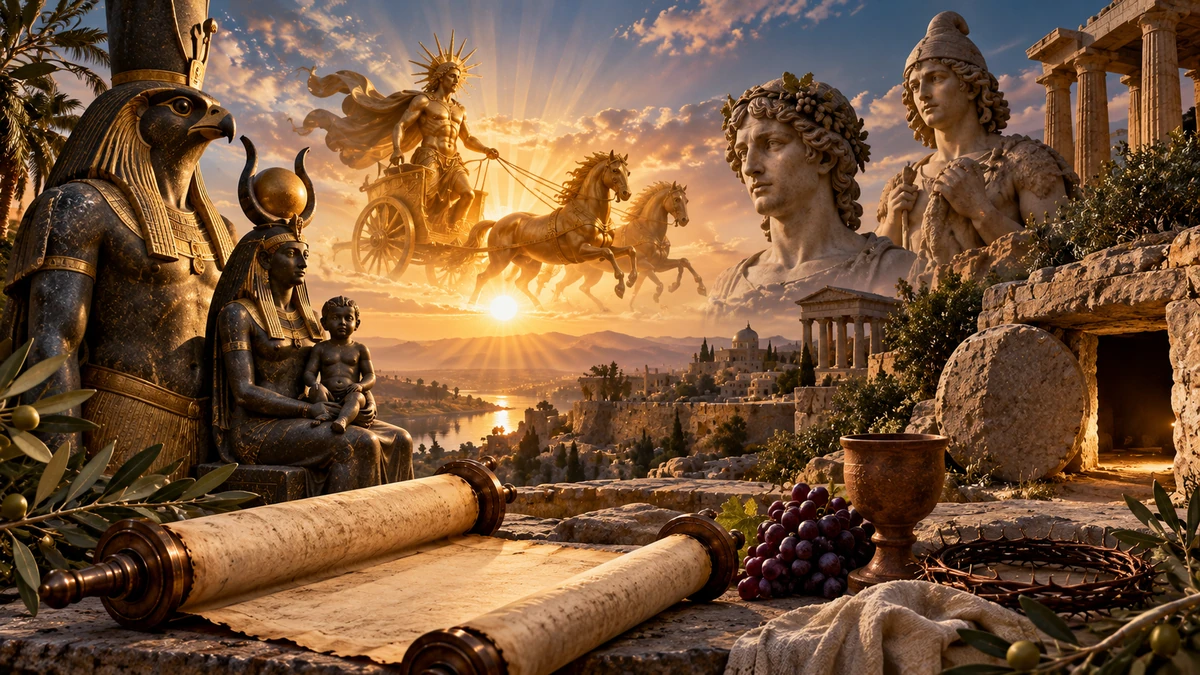
The claim that Jesus is a solar myth appears in several forms. In its weakest form it means only that Christians associated Jesus with light and the Sun. A stronger form argues that the Gospels use older solar motifs. The strongest form claims that Jesus’ story is essentially a rewrite of earlier solar gods such as Horus, Osiris, Mithras, Dionysus, Attis, or Adonis. These are not the same claim and they do not require the same evidence.
Some genuine data are not in dispute. Late-antique Christianity could use solar iconography, compare Christ with the Sun of righteousness, and appropriate the visual language of Sol in the Roman world. Older pagan traditions also contain deities who die, disappear, return, or become associated with renewed life. None of that by itself establishes a single pre-Christian “solar script” from which the Gospel biography was copied.
Popular checklists often merge several very different claims: a December 25 birth, virgin birth, twelve disciples, crucifixion, three days in the grave, and resurrection. When each item is checked against primary or critically controlled sources, the picture becomes much less uniform: some parallels are real and historically interesting, while others are late, loose, or lack an identifiable ancient source.
This article therefore does not ask whether Jesus is “similar” to other religious figures — similarities plainly exist. It asks something stricter: which similarity is directly documented, when is it first documented, and does it justify an inference of literary dependence or common solar origin?
Four Levels of the Claim: From Metaphor to Genealogy
The phrase “solar myth” is useful only if we specify what it means. Level one is direct solar identity: a figure is the Sun or a solar deity in the source. Level two is a well-documented solar association: the figure is not simply the Sun, but historical sources connect it with solar symbolism. Level three is comparative solar interpretation: a scholar notices light, sunrise, death, or return motifs and reads them in solar terms. Level four is genealogy: the claim that a later story actually originated from an earlier solar myth.
The evidentiary threshold rises at each level. A metaphor needs a text or image; historical genealogy requires chronology, plausible contact, sufficiently specific shared elements, and a direction of transmission, not merely a list of similar words.
Similarity begins a comparison. Genealogy requires evidence for a path of transmission.
What Is Documented as Solar in Relation to Jesus?
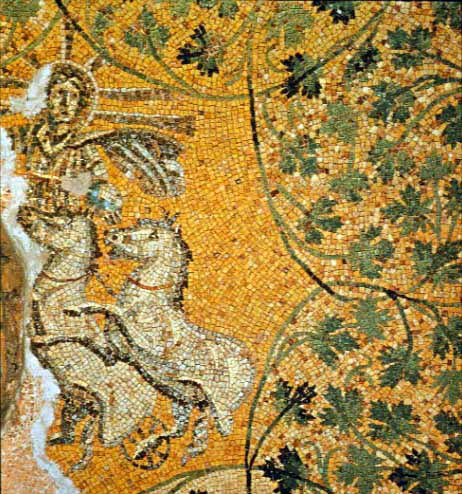
The first result is positive. Christian tradition was not devoid of solar language. Biblical and early Christian texts use light, rising, day, and the Sun as theological metaphors, while late antiquity also gives us artworks in which Christ is represented with the iconography of Sol or the solar charioteer. Recent work on early Christian iconography treats this as a Christian appropriation of Roman visual language, not as something that needs to be denied.
The chronological boundary matters. When third- and fourth-century Christians use solar imagery for Christ, they demonstrate solar reception of Christ. They do not automatically demonstrate that Mark, Matthew, Luke, or Paul constructed the basic story as a rewrite of a sun god.
Symbolic association must also be distinguished from identity. In Roman Mithraism Mithras is closely linked with Sol, yet iconography can depict them as two figures dining together. Religions can employ solar language without a simple equation that “this person is the physical Sun.”
Baseline Control: What Do the Earliest Christian Sources Actually Claim?
Before comparison we must define the Christian target. Matthew and Luke narrate a conception without sexual relations with Joseph and attribute it to the Holy Spirit; the New Testament does not give a date for Jesus’ birth. The Twelve are not merely an unexplained number: Matthew 19:28 and Luke 22:30 explicitly connect them with the twelve tribes of Israel.
Jesus’ death in Christian sources is Roman crucifixion. Resurrection “on the third day” is already part of the early formula in 1 Corinthians 15:3–5, which Paul says he himself received. A proposed older prototype must therefore show more than a generic sequence of death → return; it must show a sufficiently specific pre-Christian pattern corresponding to the actual form of the Christian claim.
This baseline already removes two common shortcuts. December 25 is not a Gospel datum, so a supposed shared birthday with another god cannot explain the formation of Matthew’s or Luke’s infancy narrative. And the Twelve have an explicit Israelite explanation inside the Gospels, so a zodiacal interpretation needs additional evidence beyond the number twelve.
Horus: Mother and Child — Similarity, Difference, and the Question of Influence
Egyptian tradition supplies some genuine points of comparison. Isis with the child Horus is an extremely widespread mother-and-divine-son image. It is a legitimate iconographic comparison with much later Christian art of Mary and Jesus, although similarity of motif by itself does not establish the direction or scale of influence.
The popular checklist, however, usually becomes much stronger: Horus is said to have been born of a virgin on December 25, to have had twelve disciples, to have been crucified, and to have risen after three days. Standard Egyptological summaries describe something else. Isis is the wife of Osiris; after his death she restores his body sufficiently to conceive Horus. This is miraculous or mythological conception, but it is not the same structure as Matthew’s or Luke’s claim about a virgin conceiving through the Holy Spirit.
The standard sources reviewed here likewise do not provide a stable ancient tradition of Horus having “twelve disciples” or being crucified. Egyptian texts and iconography do contain many divine groups, hours of the night, and attendants, so the number twelve appears in wider cosmic symbolism. Turning such a group into “twelve disciples” is an additional interpretive step that requires its own proof.
Horus is a good example of how a genuine iconographic resemblance can become the foundation for additional claims that do not have equally strong sources.
Osiris: Death, Restoration, and a Different Afterlife Framework
It is unfair to dismiss Osiris by saying that he “does not rise at all.” Egyptian myth and ritual genuinely speak of his murder, dismemberment, reassembly, and restoration of life or power. Ptolemaic-Roman iconography can portray scenes of Osiris reviving, and later Greek authors use language of return to life and rebirth.
At the same time, his story is not a simple template for the Gospels. After restoration Osiris does not begin a new public earthly life; he becomes ruler of the dead in the underworld, while Horus assumes royal succession. The Egyptian Khoiak festival also links Osiris’ death and renewal with germinating grain and agricultural regeneration.
Osiris therefore matters greatly to the broader history of ideas about divine death, renewal, and the afterlife. Comparison with Jesus is legitimate. Yet the differences show why the sentence “both died and rose” is not by itself proof of direct literary copying.
Mithras: A Solar and Zodiacal Cult — Parallels and Limits of Comparison
Mithraism matters more than Horus for solar comparison because Roman Mithras genuinely belongs to strongly cosmic, solar, and zodiacal iconography. The tauroctony is often surrounded by zodiac signs, Sol, and Luna, while Mithras is closely associated with Sol. This is a real historical comparison, not a modern invention.
His birth, however, is not a virgin birth. Mithras is normally shown emerging as a young man from a rock; inscriptions can call the rock Petra Genetrix, the Mother Rock. Nor does the cult preserve a Gospel-like narrative corpus of twelve disciples, crucifixion, and resurrection on the third day.
The often-repeated December 25 date is also less secure than it appears. Modern scholarship on Roman Mithraism acknowledges that Mithras’ birth is often assumed to have fallen on December 25 because of the association with Natalis Invicti, while warning that this rests on an assumption, not on an independent Mithraic liturgical calendar.
Mithras therefore demonstrates something more important than the viral checklist: early Christianity really did coexist with a cult saturated in solar and astrological symbolism. That creates a shared cultural environment and the possibility of influence on symbolic language, but not automatic proof that Jesus’ biography is a copy of Mithras’ story.
Dionysus, Attis, and Adonis: Related Motifs, Different Narratives
Older comparative religion, especially after Frazer, grouped diverse Mediterranean and Near Eastern cults into a category of “dying and rising gods.” Later scholarship strongly criticized this category because some cases were reconstructed from late or ambiguous sources and very different stories were collapsed into one type.
Yet the opposite statement — that there were no divine deaths and returns before Christianity — is also too strong. Recent scholarship shows genuine ancient traditions involving Osiris, Dionysus, and some other deities in death, dismemberment, restoration, or return. Their forms, dates, and ritual functions differ greatly.
For Attis, chronology is especially important: explicit testimony to his “resurrection” is late, mainly third- and fourth-century, whereas earlier versions speak of preservation from decay or the continued life of parts of the body. A late Attis therefore cannot simply be projected backward as a source for Paul or Mark.
For Dionysus, traditions of dismemberment and reassembly or return to life do exist. That is a real comparative point, but it is not identical to Roman execution, entombment, and a third-day Easter claim. Good comparison preserves similarity and difference at the same time.
December 25 and Sol Invictus: The Connection Is Real, the Direction of Influence Is Not Settled
The Gospels do not say that Jesus was born on December 25. The date belongs to the later Christian calendar, so it must be studied separately from the formation of the Gospel infancy narratives.
In fourth-century Rome we have evidence on the same date for both Christ’s nativity and Natalis Invicti, the birthday of the Unconquered One. This long supported the explanation that the church simply replaced a pagan solar festival with a Christian one.
Modern calendar history is more cautious. C. P. E. Nothaft’s work emphasizes two serious explanatory traditions: the history-of-religions theory of influence and the calculation theory, according to which Christians could derive the date from internal calculations concerning conception, Passover, and creation. The safest conclusion is therefore that the solar setting, winter solstice, and interreligious influence matter, while the simple formula “the church merely renamed Mithras’ birthday” goes beyond the evidence.
December 25 is a strong question for the history of the Christian festival, not proof for the origin of the Gospel biography of Jesus itself.
The Twelve: An Israelite Framework and Later Zodiacal Interpretations
The number twelve was symbolically productive throughout the ancient Mediterranean and Near East: twelve months, zodiac signs, tribes of Israel, and many groups of twelve. The number by itself therefore cannot establish origin.
With the Gospel Twelve we have an unusual advantage: the text itself explains the symbolism. Jesus promises the followers twelve thrones for the twelve tribes of Israel. This strongly supports the interpretation that the Twelve represent restored Israel.
Later Jewish and Christian interpreters could connect tribes, apostles, months, and zodiac signs. Such associations matter for the history of symbolism — The previous article on the zodiac in the Bible demonstrated that zodiacal reception within Judaism is real. But that does not allow a direct leap to the claim that the group of Twelve originally arose as personifications of the zodiac signs.
What Remains of the Most Famous Parallel Checklist?
| Popular claim | What the sources show | What can currently be said |
|---|---|---|
| “Jesus and Horus were both virgin-born.” | Jesus: Matthew/Luke explicitly narrate virgin conception. Horus: Isis is Osiris’ wife and restores him after death sufficiently to conceive Horus. | The miraculous-birth resemblance is broad; the narrative structures are not the same. |
| “Both were born on December 25.” | The New Testament gives no date for Jesus’ birth; there is no standard Egyptian December 25 birth tradition for Horus. | Not directly supported as an explanation for the origin of the Gospel birth narratives. |
| “Horus/Mithras had 12 disciples.” | Mithraism has strong zodiacal symbolism; Egyptian and Mithraic material contains various groups. But the Gospel Twelve are explicitly linked with the twelve tribes. | Not directly established without a primary source for an equivalent group of disciples. |
| “Mithras was born of a virgin.” | Mithras is iconographically born from a rock, Petra Genetrix. | Surviving Mithraic material presents a different birth motif: emergence from rock. |
| “Mithras was born on December 25.” | The date is often inferred from association with Natalis Invicti, but is not independently established by a Mithraic calendar. | A possible later association, but not an independently attested Mithraic date. |
| “Pagan gods before Jesus never died and returned.” | Osiris, Dionysus, and some others provide genuine ancient traditions of death/renewal; explicit Attis resurrection evidence is late. | Such a blanket denial is too broad; death-and-restoration traditions exist, though they are not identical. |
| “Jesus’ resurrection is simply sunrise after three days.” | Christian sources speak of death, burial, the third day, and appearances; a solar reading is an additional interpretation, not the explicit meaning of the texts. | A possible comparative interpretation, not the explicit meaning of the earliest Christian texts. |
| “Christianity has no solar layer at all.” | Late-antique literature and art genuinely associate Christ with the Sun/Sol. | Late-antique solar reception of Christ is documented. |
The table yields an asymmetric result. Part of the popular checklist collapses under direct checking, especially virgin-born Horus, “virgin-born Mithras,” a universal December 25 birthday, and equivalent groups of twelve disciples. But another part remains important: the ancient world really does contain divine deaths and returns, solar cults, zodiacal symbolism, and later Christian appropriation of solar language.
The largest error therefore works in both directions: apologetic denial of every pagan parallel is too strong, and so is the viral conclusion that any similarity proves Jesus is a copy of the Sun.
What Would Actually Demonstrate Literary Dependence?
To move from comparison to historical explanation we must ask four questions. When is the disputed motif first securely attested? Where is it attested, and was there a route of cultural contact? How specific is the similarity — merely “light,” or a highly unusual sequence of multiple elements? And can we establish a direction of transmission, rather than only a shared environment?
Christianity very likely emerged in a world where Jewish, Greek, Roman, Egyptian, and other symbolic traditions interacted. Complete isolation is therefore implausible. But the passion, the Twelve, the third day, and the infancy narratives also have clear internal Jewish and scriptural contexts that any pagan genealogy must outperform with stronger evidence.
A research-cautious working model is therefore neither “nothing was borrowed” nor “everything was copied.” A better model is layered cultural formation: a Jewish core, Hellenistic-Roman language and environment, later symbolic appropriations, and occasional possible contacts tested case by case.
From Comparison to an Open Question
After the comparison, several layers remain at once. Late-antique Christianity did use solar symbolism for Christ, while the Mediterranean world already contained varied stories about deities, light, death, restoration, and cosmic order. Yet the traditions are not interchangeable: their sources, dates, rituals, and narrative structures differ.
The aim of the comparison is therefore not to declare which religious interpretation “wins,” but to show where motifs genuinely touch, where they diverge, and where the historical path of influence remains an open question. The same evidentiary standard applies to Christian, Egyptian, Mithraic, and other sources.
Solar symbolism is documented where the sources actually show it; genealogy is an additional historical claim that requires chronology, contact, and a traceable path of transmission. Even when those proofs are absent, comparison still has value: it can reveal a shared symbolic language without deciding in advance who copied whom.
When similar motifs appear across different traditions, how much is best explained by historical transmission — and how much by a shared human use of the Sun, light, death, and renewal as symbols?
Sources and further reading
- Bible Gateway — Matthew 1 (NRSVUE) — Primary-text control for the Matthean virgin-conception claim and the absence of a birth date.
- Bible Gateway — Luke 1:27–35 (NRSVUE) — Primary-text control for Luke’s virgin-conception narrative.
- Bible Gateway — Matthew 19:28 and Luke 22:30 (NRSVUE) — Direct textual link between the Twelve and the twelve tribes of Israel.
- Bible Gateway — 1 Corinthians 15:3–8 (NRSVUE) — Early Pauline resurrection formula: death, burial, third day, appearances.
- UCL Digital Egypt — Gods and goddesses in ancient Egypt: creation — Isis restores Osiris sufficiently to conceive Horus; Osiris then rules the underworld.
- The Metropolitan Museum of Art — Statuette of Isis with the infant Horus — Documentary iconographic control for the widespread Isis-and-child-Horus motif and Osiris myth.
- UCL Digital Egypt — Festival of Khoiak — Osiris’ death/revival and its ritual connection with germinating crops.
- Richard C. Miller — “Resurrection in Paganism and the Question of an Empty Tomb in 1 Corinthians 15,” New Testament Studies 63 (2017) — Detailed survey of Osiris, Dionysus, Adonis, Attis and other return-to-life traditions, with chronology caveats.
- Roger Beck — “Mithraism,” Encyclopaedia Iranica — Standard reference for Mithras’ rock birth, tauroctony, Sol relationship and Roman Mithraic iconography.
- Roger Beck — “Ritual, Myth, Doctrine, and Initiation in the Mysteries of Mithras,” Journal of Roman Studies 90 — Notes that a Mithraic December 25 birthday is generally assumed from Natalis Invicti rather than independently demonstrated.
- Journal of Classics Teaching — “Roman Religion in the Classroom: Spotlight on the Mysteries of Mithras” — Accessible scholarly overview of zodiacal and celestial iconography in the tauroctony.
- C. P. E. Nothaft — “The Origins of the Christmas Date: Some Recent Trends in Historical Research,” Church History 81.4 (2012) — Review of History-of-Religions and Calculation theories for December 25.
- C. P. E. Nothaft — “Early Christian Chronology and the Origins of the Christmas Date: In Defense of the Calculation Theory” (2013) — Evidence that early Christian chronological speculation can account for December 25 independently of simple pagan substitution.
- Harvard Theological Review — “Turning to Christ, Communicating with the Roman Gods” (2026) — Recent discussion of Christian appropriation of Sol imagery and the Christ-as-Sol mosaic in a Christian visual context.
- Bryn Mawr Classical Review — review of Tryggve N. D. Mettinger, The Riddle of Resurrection — Useful methodological control: some dying/returning gods existed, but the category hides major differences among myths and rituals.
- Noga Ayali-Darshan — Dying and Rising Gods: The History of a Mythologem in West Asia of the Second Millennium BCE (2024) — Recent reassessment showing limited but real early West Asian evidence for dying-and-rising mythologems.
- Kersey Graves — The World’s Sixteen Crucified Saviors (1875) — Primary witness to the nineteenth-century comparative checklist tradition, including virgin births, December 25 and multiple crucified saviors.
- Gerald Massey — Ancient Egypt, the Light of the World (1907) — Primary reception-history source for later Egyptian/Christian astro-mythic comparison.