The Biography of Satan under Scrutiny: From the Biblical Adversary to the Christian Devil
Kersey Graves argued in the nineteenth century that Satan, hell, and eternal punishment developed historically. What survives modern philology and history of religions — and where does Graves move too quickly from resemblance to pagan origin?
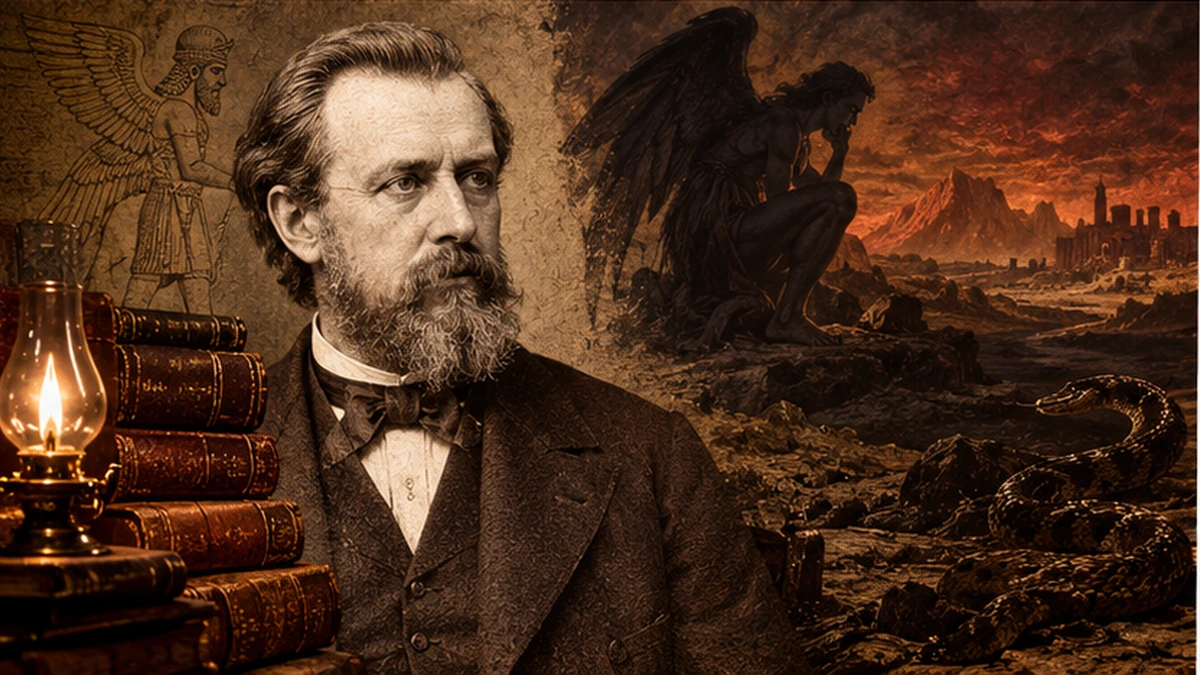
Kersey Graves's The Biography of Satan is a nineteenth-century attempt to explain the history of Satan, the Devil, hell, and eternal punishment as developments in religious ideas rather than as an unchanged doctrine equally present throughout the Bible. Its basic intuition is recognizable to modern historians of religion: the figure of Satan does indeed change across the Hebrew Bible, Second Temple Judaism, and early Christianity.
Graves, however, often adds a much stronger conclusion to this valid observation: he treats many developed Christian ideas about the Devil and post-mortem punishment as direct imports from older 'pagan' or 'Oriental' religions. This is where the evidential problem begins. Similarity between motifs does not by itself tell us whether we are looking at direct borrowing, a shared cultural environment, independent development, or later reinterpretation of older biblical language.
The book is therefore most useful as an early freethought experiment in comparative religious history. At its best it forces the reader to distinguish the Hebrew satan from the later Christian Devil, Sheol from later hell, and Isaiah's 'morning star' from the later proper name Lucifer. At its weakest it collapses chronology and moves too quickly from resemblance to origin.
This article therefore does not ask whether Graves was 'for' or 'against' Christianity. It asks something more testable: which of his historical and linguistic claims remain useful, which require correction, and which are too speculative to serve as evidence in THY-REALITY?
The book, the author and the core claims
Which edition are we auditing? The edition specified by the user is Kersey Graves, The Biography of Satan, 4th edition, Research Associates School Times Publications, 2000, ISBN 0948390689 / 9780948390685, about 165 pages. It is a modern reprint of an older work, not a modern scholarly monograph.
Its bibliographic history is somewhat confusing because some modern retail descriptions give 1879 or 1880 as the first publication. Older catalogues and antiquarian records, however, trace the work to 1865; a Chicago copy from 1880 is already marked “Twelfth Edition.” For THY-REALITY the safest formulation is therefore that the work originated in the mid-nineteenth century, no later than 1865, and was repeatedly reprinted and rearranged thereafter.
Who was Kersey Graves — and why does that matter for reading him? Graves (1813–1883) was an American reform writer associated with Quaker backgrounds, abolitionism, freethought, spiritualism, and popular comparative religion. A local Wayne County biographical tradition describes him as a teacher, lecturer, anti-slavery advocate, and author who became dissatisfied early with “popular theology.”
That does not invalidate his work, but it places it correctly. The Biography of Satan is not a product of modern Assyriology, Iranian studies, Hebrew philology, or textual criticism. It emerged in a period when European and American comparativists often constructed large genealogies of ideas from translations, secondary summaries, and broad similarities. Every Gravesian “origin” therefore requires a fresh chronological and philological audit.
What does the book actually argue? The fourth-edition table of contents shows that Graves is not writing only about Satan as a person. The book is simultaneously a history of evil, the Devil, Sheol, hell, Gehenna, Tartarus, eternal punishment, the lake of fire, the abyss, demons, the “war in heaven,” and alleged pre-Christian parallels.
| Gravesian cluster | Basic claim | What the audit must test |
|---|---|---|
| Hebrew Bible | the developed Devil and endless hell are not original teachings there | texts of satan, Sheol, Job, Zechariah, Chronicles |
| “Oriental” origin | the Christian Devil and punishment were borrowed from older religions | chronology, cultural contact, direction of influence |
| Infernal vocabulary | abyss, fire, brimstone, Gehenna, Tartarus have pre-Christian roots | whether analogy is enough to establish direct borrowing |
| Astral motifs | some infernal and satanic motifs derive from celestial mythology | whether concrete textual bridges exist |
| Moral critique | eternal punishment is harmful and priest-maintained | this is a normative argument, not merely historical evidence |

From *satan* to Satan: development within the Hebrew Bible
First rule: Satan has no single “biography” Modern scholarship supports Graves’s basic intuition but uses a different model. In Hebrew texts satan often means an adversary or accuser; later Judaism develops figures such as Belial, Mastema, Satan, and demonic forces; New Testament writings present Satan as a more consistent cosmic opponent; later Christian tradition then fuses the Eden serpent, Isaiah’s morning star, fallen angels, and Revelation into a single story.
“Biography of Satan” is therefore useful only as a history of the formation of a character. No single ancient document gives one continuous life story of the same figure from Genesis to later church tradition.
Hebrew *satan*: name or function? Graves correctly senses that the older Hebrew material differs from the later Devil. The Hebrew root ś-ṭ-n means to oppose or act as an adversary. In Job, ha-satan — “the accuser/adversary” — appears as a heavenly being within God’s court, not as an independent evil god opposing God.
This is one of Graves’s strongest points. Yet the statement “Satan does not exist in the Old Testament” would be too strong: the vocabulary and heavenly accuser do exist, while the figure’s function, degree of personification, and relationship to evil develop over time.
The serpent in Eden is not called Satan in Genesis Genesis 3 describes the serpent as a crafty animal created by God. The text does not call it satan, the Devil, or a fallen angel. Identification of the serpent with Satan belongs to later interpretive development, consolidated in Jewish and especially Christian readings.
Here Graves points to a real problem of retrospective reading: later Christian imagery is often projected back into Genesis as though it had been explicit from the start. Yet this does not require the conclusion that the later identification is necessarily a “fraud”; a history of interpretation may reread an older symbol through later texts, provided it does not confuse that rereading with the original sense of Genesis.
Job, Zechariah, and 1 Chronicles: development is visible inside the Bible Job and Zechariah present a heavenly accuser/adversary operating within divine authority. Especially striking is the comparison between 2 Samuel 24:1 and 1 Chronicles 21:1: in the earlier narrative David is incited to the census by YHWH’s anger, while Chronicles introduces satan. This is serious inner-biblical evidence for development in the way responsibility for evil or temptation is distributed.
Development, however, does not by itself identify a single external source. The change may reflect internal theological reasoning, Persian-period cultural contact, new apocalyptic patterns, or a combination of these factors.
Sheol, Gehenna and the history of hell
Does the Old Testament teach an “endless hell”? Graves offers an important corrective to popular reading: the earlier Hebrew Bible does not contain the fully developed later Christian system in which an individual soul goes after death to eternal fiery punishment. Earlier conceptions revolve around death, burial, and Sheol, while later texts develop more differentiated ideas of judgment, resurrection, and the destinies of righteous and wicked.
This does not mean, however, that the Hebrew Bible has no concept of an afterlife or punishment. Modern studies of Sheol show a layered picture: grave, underworld, poetic personification of death, and in some passages morally inflected destiny. Graves is strongest when denying the presence of a later systematic hell, not when denying post-mortem ideas altogether.
*Sheol* is not simply a synonym for “grave” Graves notes that older English translations render the same Hebrew Sheol as “grave,” “hell,” or “pit,” which can create theological confusion. That is a legitimate translation observation. His own correction, however, can go too far when he reduces Sheol almost entirely to the physical grave.
Modern philology distinguishes at least two overlapping senses: the concrete domain of death/burial and a mythologized underworld of the dead. It is therefore often safest to leave Sheol untranslated and determine its sense from each context.
Gehenna, Tophet, and the Valley of Hinnom: a real historical trajectory exists here Graves is right that Gehenna was not originally the name of a metaphysical underworld. The term derives from Ge Hinnom, the Valley of Hinnom near Jerusalem, associated in biblical tradition with Topheth, fire, judgment, and condemned cultic practices. In later Jewish usage the geographic name develops into a term for eschatological punishment.
This is a more persuasive example of historical development than Graves’s distant mythological analogies. Yet there is still no single moment when a “pagan valley” was simply renamed as Christian hell. It is a multi-stage Jewish and then Christian semantic history.
Lucifer: a later name, not the original meaning of Isaiah 14
Isaiah 14:12, in its immediate context, belongs to a taunt against the king of Babylon. The Hebrew helel ben-shahar uses the imagery of the brilliant morning star/Venus; Latin lucifer means “light-bringer/morning star.” Only later Christian interpretation solidified the term as Satan’s proper name before his fall.
If Graves argues that “Lucifer” is not originally Satan’s biblical personal name, that correction is basically sound. Caution is required with his further astral reconstruction: the astral metaphor in Isaiah is real, but it does not by itself generate the whole later Satanology.
Persian influence and the limit of comparative genealogy
Was the Christian Devil “imported from Persia”? This is one of the most important places where modern scholarship requires more caution than Graves. The Zoroastrian and Iranian environment is a serious candidate for influence on some Jewish eschatological, angelological, and dualistic ideas in the Second Temple period. Encyclopaedia Iranica and the Cambridge History of Judaism treat such influence as a genuine research question.
But “influence” is not the same as “copying Ahriman into Satan.” Dating Zoroastrian texts is difficult, many developed Iranian formulations survive only in later sources, and Jewish Satan never simply becomes an equal, uncreated anti-god. Henry Ansgar Kelly therefore explicitly notes that a simple Zoroastrian genealogy of Satan has limited support today and is better kept at the level of possibility or partial influence.
Jews lived for long periods in a Persian cultural environment.. Strong.
Dualistic and eschatological motifs intensify in later Judaism.. Strong.
Some motifs have Iranian parallels.. Strong to moderate, depending on the motif.
Satan is a direct copy of Ahriman.. Too weak / too linear.
Political Persia is not the same thing as Zoroastrian theology Jason Silverman’s work on Zechariah 3 points to another important possibility: some features of the heavenly accuser may be explained through Persian imperial administrative culture, not necessarily through direct transfer of Zoroastrian demonology. This is a good example of why Graves’s phrase “Oriental origin” hides too many different mechanisms.
Cultural influence may be political, legal, linguistic, ritual, literary, or theological. Evidence for one level is not automatically evidence for another.
A “pagan analogue” is not automatically an ancestor Graves frequently gathers Egyptian, Greek, Persian, Indian, and other figures with negative, serpentine, fiery, or underworld traits and places them in a genealogy of the Christian Devil. Comparative method is useful, but it requires three controls: chronology, contact, and specificity.
Chronology. Is the alleged source actually earlier than the Jewish/Christian motif?
Contact. Is there a historical channel through which the motif could have travelled?
Specificity. Is the resemblance distinctive enough, or is it a universal motif such as fire, serpent, darkness, or underworld?
Without these three steps a comparison remains interesting, but it is not proof of genealogy.
Astral, fiery and demonic motifs: similarity is not a single origin
“Hell was first in the skies”: the astral reconstruction is the book’s weakest zone Across several chapters Graves connects hell, dragons, the woman clothed with the sun, war in heaven, and other motifs with astronomical or zodiacal conceptions. Individual ancient texts certainly use astral language; Revelation 12 is explicitly cosmic, Isaiah 14 uses the morning star, and ancient religions frequently project divine conflict into the heavens.
But this does not establish a general rule that hell and the Devil were originally astronomical phenomena. Here Graves often does precisely what THY-REALITY seeks to avoid: converting iconographic or verbal resemblance into historical origin without enough intermediate witnesses.
Abyss, lake of fire, and brimstone: motifs have histories, not one source Graves rightly noticed that Revelation’s language belongs to a wider ancient world of fire, underworld, divine judgment, and chaos imagery. Modern studies, however, show multiple pathways. The “lake of fire,” for example, has no close direct equivalent in the Hebrew Bible; Egyptian fire imagery and Jewish traditions of fiery punishment exist, while the precise “lake of fire” complex is especially characteristic of the Apocalypse of John.
Historically it is therefore better to speak of an intertextual and cultural reservoir of motifs than of one demonstrable pagan source.
Demons and exorcism: similarity is even less likely to prove one origin Graves includes “casting out devils” among the phenomena said to reveal older pagan roots. Demons, illness, protective rituals, and exorcistic practices are indeed much older than Christianity and widespread across the Near East and Mediterranean.
But their very breadth makes direct origin harder to prove. Christian exorcism emerges within Jewish and Greco-Roman worlds where multiple demonological traditions already overlap. “Older than Christianity” is a useful historical correction; “therefore Christianity copied it from this specific religion” requires additional evidence.
Evil and eternal punishment: historical and moral arguments
“God, not the Devil, is the author of evil”: the translation must be unpacked Graves collects passages in which God causes disaster, punishment, or destruction and sets them against later theology that assigns much moral evil to the Devil. That contrast is historically important. But the English word evil in older translations frequently renders Hebrew terms that can also mean calamity, disaster, or ruin rather than moral evil in a philosophical sense.
THY-REALITY must therefore check the Hebrew term, genre, and context in each such citation. Development in theodicy is real; the slogan “the Bible says God is the moral author of evil” is not precise enough.
Eternal punishment: historical and moral arguments are not the same Graves’s book is polemically directed against endless punishment. His question — how and when eternal punishment developed — is historical. His judgment that the doctrine is morally harmful is philosophical and ethical.
Both levels are legitimate, but this article keeps them separate. Historical evidence may show that a doctrine developed; by itself it does not decide whether that doctrine is theologically true or morally acceptable.
The biggest methodological problem: chains of similarity
Graves often works through long lists: similar gods, similar serpents, similar fires, similar names, similar stories. The problem is not collecting parallels but moving from “A resembles B” to “B derives from A.”
A modern audit requires at least: dating both motifs, identifying the earliest textual witnesses, establishing a geographic channel of contact, demonstrating semantic continuity, and explaining differences. If a theory counts similarities while ignoring differences, it becomes an unfalsifiable pattern hunt.
What Graves got right, where he goes too far, and what survives review
What did Graves get surprisingly right? Later Christian Satan is not simply identical with Job’s *ha-satan*.. Well supported.
The serpent in Genesis is not explicitly called Satan there.. Textually clear.
“Lucifer” in Isaiah 14 was not originally Satan’s personal name.. Philologically well supported.
Sheol is not identical with later Christian hell.. Well supported, provided Sheol is not reduced to “grave” alone.
The image of Satan and post-mortem punishment develops historically.. A central finding of modern history of religions.
Second Temple Judaism is a crucial transitional period.. Highly important and still relevant.
Where does Graves go too far? “Oriental origin” as one explanation for almost everything. collapses different cultures, periods, and mechanisms into one direction
direct equation Ahriman → Satan. possible influence is not identity or copying
Sheol = only the grave. ignores underworld/mythological senses
astral origin of hell and the Devil. too few independent textual bridges
similar image = historical borrowing. chronology, contact, and specificity are missing
later Christian doctrine = priestly invention. a claim about motive exceeds the evidence unless separately documented
Comparison of Graves’s key claims
| Claim | Status | Safe THY-REALITY formulation |
|---|---|---|
| The developed Devil is absent from the oldest Hebrew layers. | STRONG | The figure develops; satan initially often denotes a function/adversary. |
| The Eden serpent = Satan already in Genesis. | NO | That is a later interpretive identification. |
| Lucifer is Satan’s original name. | NO | Isaiah 14 uses morning-star imagery in a taunt against the Babylonian king. |
| Sheol = Christian hell. | NO | The concepts overlap and develop historically; they are not synonyms. |
| Persian influence on Jewish eschatology is possible. | YES, WITH CAUTION | Influence is a serious research question; direct genealogy must be proven motif by motif. |
| Satan is a copy of Ahriman. | TOO WEAK | Not established as a simple linear borrowing. |
| Fiery punishment and demonic motifs have pre-Christian parallels. | YES | Parallel does not establish one origin or copying. |
| Christian hell is wholly a priestly invention. | UNCONTROLLED | This polemical account of motive and institutions requires independent historical evidence. |
How should THY-REALITY use Graves?
As a historical document of freethought. YES — it shows how nineteenth-century critics attacked hell doctrine and compared religions.
As a generator of questions. YES — especially Satan/ha-satan, Lucifer, Sheol, Gehenna, and development of punishment.
As a bibliography of ancient religions. ONLY WITH RECHECKING — older references must be reidentified in modern editions.
As proof of direct pagan origin. NOT BY ITSELF — an independent modern source is required.
As final authority for Hebrew/Greek translation. NO — check modern lexica and critical editions.
As proof of institutional motives. NO WITHOUT ADDITIONAL SOURCES.
The practical rule is therefore: let Graves open the question; let modern primary and scholarly sources decide how much of the answer survives.
Conclusion: good questions, overly broad genealogies
The Biography of Satan is not a reliable modern handbook to the history of Satan, but it is historically interesting and at several crucial points surprisingly perceptive. Graves correctly breaks the assumption that the later Christian Devil exists in identical form from the opening pages of the Hebrew Bible. He also rightly exposes translation traps around Sheol, the later identification of Lucifer with Satan, and the fact that fiery punishment, demons, and underworld imagery have long pre-Christian histories.
His problem is the method of origins. Where a modern historian might say “here we have development, a parallel, or possible influence,” Graves often says “this was taken from that.” His evidence frequently cannot carry that additional step.
For THY-REALITY the book is therefore most useful as a generator of testable questions and a historical example of early comparative criticism of religion. Individual insights can be retained when they survive independent audit; the large linear genealogies must remain hypotheses until chronology, texts, and channels of contact support them.
Sources and further reading
- eCampus — The Biography of Satan (ISBN 9780948390685) — Bibliographic control for the user-specified 2000 Research Associates School Times edition; 4th ed., 165 pages; detailed table of contents.
- AbeBooks — The Biography of Satan, ISBN 0948390689 — Independent edition metadata: Research Associates School Times Publications, 2000, 4th edition, 165 pages.
- Weiser Antiquarian — 1880 “Twelfth Edition” — Antiquarian description of an 1880 Chicago copy already marked Twelfth Edition; states the work was apparently first published in 1865.
- Open Library — The Biography of Satan — Catalogues the work as first published in 1865 and provides metadata for the 1924 fourth edition.
- Google Books — The Biography of Satan, P. Eckler 1924 — Full-view bibliographic control and searchable vocabulary for the 1924 fourth edition.
- IAPSOP — Who Was Kersey Graves — Historical-biographical reconstruction with citations to contemporary newspapers and Wayne County sources; useful for Graves’s reform, Quaker, spiritualist, and freethought context.
- Henry Ansgar Kelly — Satan: A Biography (Cambridge) — Modern history of the Satan figure; discusses Hebrew satan/diabolos and cautions that simple Zoroastrian derivation has limited scholarly support.
- Elaine Pagels — The Social History of Satan, Harvard Theological Review — Classic scholarly account of the development of Satan in late Second Temple Jewish and early Christian social worlds.
- Archie T. Wright — Satan and the Problem of Evil — Recent scholarly synthesis tracing Satan from an accuser/functionary to a chief antagonist in Second Temple and early Christian traditions.
- Warren Zev Harvey — Questions on the Book of Job — Peer-reviewed discussion noting that Hebrew satan generally means accuser/adversary and that Job’s satan is a heavenly being among the sons of God.
- Matthew Suriano — A History of Death in the Hebrew Bible / Sheol — Oxford study distinguishing Sheol as realm of the dead and as tomb/death imagery rather than reducing it to later Christian hell.
- Humanities & Social Sciences Communications — Hebrew Bible afterlife concepts — Modern study mapping the evolution and coexistence of Hebrew Bible concepts of Sheol, death, judgment and resurrection.
- Encyclopaedia Iranica — Eschatology: Zoroastrian influence — Authoritative overview: Iranian influence on Second Temple eschatology is plausible/significant in some reconstructions, but attribution is debated and textual chronology complicates proof.
- Shaul Shaked — Iranian influence on Judaism, Cambridge History of Judaism — Major scholarly treatment of the method and evidence for Iranian influence in late Second Temple Judaism.
- Jason M. Silverman — Vetting the Priest in Zechariah 3 — Argues that Zechariah’s satan may reflect Achaemenid imperial administrative structures; demonstrates that Persian influence need not mean direct Zoroastrian demonological borrowing.
- New Testament Studies — The Apocalypse of John and Graeco-Roman Revelatory Magic — Useful control for the lake-of-fire motif: fiery punishment has older parallels, while the specific “lake of fire” complex is especially characteristic of Revelation.
- University of Iowa Bible & Archaeology — Is the Snake in the Garden Satan? — Academic public-facing explanation that Genesis 3 does not identify its serpent as Satan and that the identification develops later.
- Jewish Encyclopedia — Lucifer — Historical philological control for Isaiah 14: the morning-star image is applied to the king of Babylon; “Lucifer” is the Latin/translation tradition, later read as Satan.