Jesus as a New Moses, a New Elijah, and a New Israel
The Gospels narrate Jesus through older scriptural patterns: Matthew draws especially densely on Moses, exodus, and Israel, while Luke develops Elijah and Elisha motifs. Typology, however, is neither historical proof nor proof of invention.
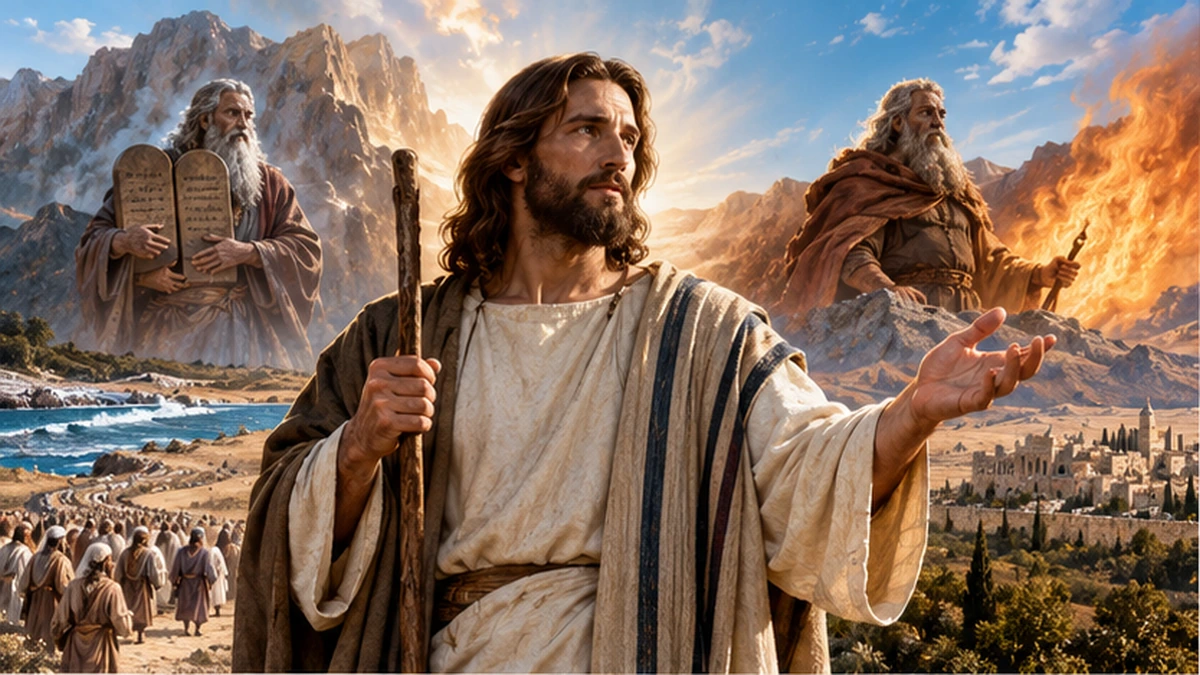
The labels “new Moses,” “new Elijah,” and “new Israel” are not three titles that the Gospels simply place on Jesus’ lips. They are modern interpretive shorthand for a network of quotations, allusions, and narrative patterns through which the evangelists set Jesus’ story beside older scriptural stories.
The strongest case is Matthew. His Jesus goes to Egypt and comes out, is identified as God’s Son, undergoes testing in the wilderness while quoting Deuteronomy, and then teaches on a mountain. This creates recognizable links with Israel in the exodus and with Moses, but not every parallel is equally strong and not every detail is presented by Matthew as a direct prediction.
The Elijah pattern works differently. Luke repeatedly shapes scenes that recall Elijah and Elisha, especially at Nazareth and in the raising of a widow’s son. At the same time, the Synoptics connect the expected return of Elijah very clearly with John the Baptist. “Jesus = new Elijah” therefore describes part of the literary picture, not a uniform identification across the Gospels.
The central methodological boundary is simple: literary construction from earlier texts is not the same thing as proof that the narrated event did not happen. It tells us primarily how an evangelist interprets and tells an event. The reverse is equally true: a strong typological connection does not by itself prove the historicity of a scene. This article therefore separates textual parallel, interpretation, and historical conclusion.
What typology means — and what it does not mean
Biblical and early Christian writers often use earlier events as patterns through which later events are understood. Such reading can compare persons, places, or sequences without claiming that they are identical. In Matthew, Mark, and Luke, Moses, Elijah, the exodus, the wilderness, the mountain, and Israel’s prophets belong to a shared symbolic vocabulary of the Jewish scriptural world.
It is therefore essential to distinguish a quotation (the evangelist explicitly cites Scripture), an allusion (language or scene evokes an older text), and a larger typological reading reconstructed by an interpreter. The farther we move from an explicit citation, the more caution the conclusion requires.
The four Gospels do not use these patterns in the same way
| Pattern | Mark | Matthew | Luke | John |
|---|---|---|---|---|
| Moses | The Transfiguration contains strong Sinai motifs; “listen to him” recalls Deut 18:15. | The densest network: Egypt, wilderness, Deuteronomy, mountain, Torah, and Transfiguration. | Moses matters in the Transfiguration and salvation history, but less as an organizing pattern for Jesus’ life. | Moses is a major comparative figure: law through Moses / grace and truth through Jesus; manna, the wilderness serpent, and other exodus imagery. |
| Elijah / Elisha | Elijah appears in expectation and at the Transfiguration; John the Baptist is interpreted in an Elijah framework. | Similar to Mark; Matthew explicitly links John with Elijah. | The most pronounced narrative reuse: Nazareth (Elijah and Elisha), the widow’s son at Nain, and fire from heaven as a rejected Elijah model. | John the Baptist denies that he is Elijah; Elijah typology for Jesus is much less prominent. |
| Israel / exodus | Wilderness, the Twelve, and restoration motifs appear, but without Matthew’s Hosea 11:1 quotation. | The strongest recapitulative network: Son from Egypt, wilderness, the Twelve, and “the twelve tribes of Israel.” | Strong emphasis on Israel’s restoration, Jerusalem, and the Twelve; Jesus need not be read as replacing Israel. | Exodus imagery is strong but developed through different symbols: lamb, manna/bread of life, Moses, and signs. |
The table shows why one Gospel’s strategy should not be turned into a universal formula for the whole New Testament. Matthew’s patterning is especially dense, Luke constructs prophetic continuity differently, and John develops its own symbolic network.
New Moses and new Israel: Matthew’s concentrated network
Herod and Pharaoh: the resemblance is clear, but Matthew never writes an equals sign Matthew 2 tells of a ruler who fears a new king and orders the killing of boys; Joseph escapes with the child and later returns after the dangerous ruler dies. A reader familiar with Exodus 1–4 can scarcely miss echoes of Pharaoh’s order against Hebrew boys and Moses’ flight and return. The connection becomes denser in Matt 2:20: Joseph is told that those seeking the child’s life are dead, closely echoing Exod 4:19, where Moses is told that the men seeking his life are dead.
But the parallel is not complete. Matthew’s Jesus is not drawn from the Nile, Joseph is not Moses, and Herod is never called a “new Pharaoh.” The safest conclusion is that Matthew’s infancy narrative sounds deliberately exodus-like and Mosaic, not that every detail directly reproduces Moses’ biography.
“Out of Egypt I called my son”: in Hosea the son is Israel Matthew 2:15 explicitly uses Hosea 11:1. Yet in Hosea’s original context the line is not a prediction of a future messiah: it looks backward to God calling Israel, his son, out of Egypt. This is one of the most important controls in the entire audit.
Matthew therefore does not use Hosea as a simple modern-style prediction. The text is reapplied to Jesus’ story. This is the principal basis for speaking of Jesus as representative or recapitulated Israel: the story of one “Son” is narrated through the story of the collective “son,” Israel. “New Israel,” however, is an interpretive label rather than Matthew’s own title.
Baptism, forty days, and Deuteronomy: the tightest “Israel” sequence After the baptism Jesus is declared Son and then enters the wilderness for forty days. In Matthew 4 he answers the three temptations with Deut 8:3, 6:16, and 6:13. All three passages stand within Deuteronomy’s reflection on Israel’s wilderness life, testing, and covenant loyalty.
The reading “Jesus retraces Israel’s path but remains faithful” therefore has a strong textual basis. The parallel depends not merely on the number forty but on the combination of sonship, wilderness, and responses drawn specifically from the part of Torah that interprets Israel’s wilderness experience.
Mountain and Torah: why is “new Moses” such a strong label in Matthew? Matthew 5 introduces Jesus’ major discourse by having him ascend a mountain. He then discusses the law, affirms it, and interprets it with striking authority. This naturally evokes Moses at Sinai, making “new Moses” one of the oldest and most influential readings of Matthew’s Christology.
Yet Matthew does not portray Jesus as simply discarding Moses: Matt 5:17–20 explicitly rejects the idea that he came to abolish the law and the prophets. The debate is whether the antitheses in Matt 5 intensify, authoritatively interpret, or in some cases transform Mosaic law. Modern scholarship does not agree on every detail.
The popular idea that Matthew’s five major discourses intentionally correspond to five new books of Moses is possible but less secure than the direct mountain and exodus connections. Five discourse units are visible through repeated closing formulas; their precise relation to the Pentateuch remains an interpretation.
The Transfiguration: Moses and Elijah stand beside Jesus, not simply erased At the Transfiguration in Mark 9, Matthew 17, and Luke 9, Moses and Elijah appear. Mountain, cloud, voice, and Jesus’ transformed appearance create a dense network of Sinai and theophanic motifs. In Mark the voice tells the disciples to listen to Jesus; this can also be heard against Deut 18:15, where Israel is told to listen to the prophet like Moses.
But the scene has no single uncontested meaning. Scholars disagree over why Moses and Elijah are the two figures: law and prophets, eschatological figures, recipients of Sinai theophanies, or some combination. The Transfiguration is therefore strong evidence that the Gospels place Jesus in direct relation to Moses and Elijah, but not a simple proof of one exclusive typological equation.
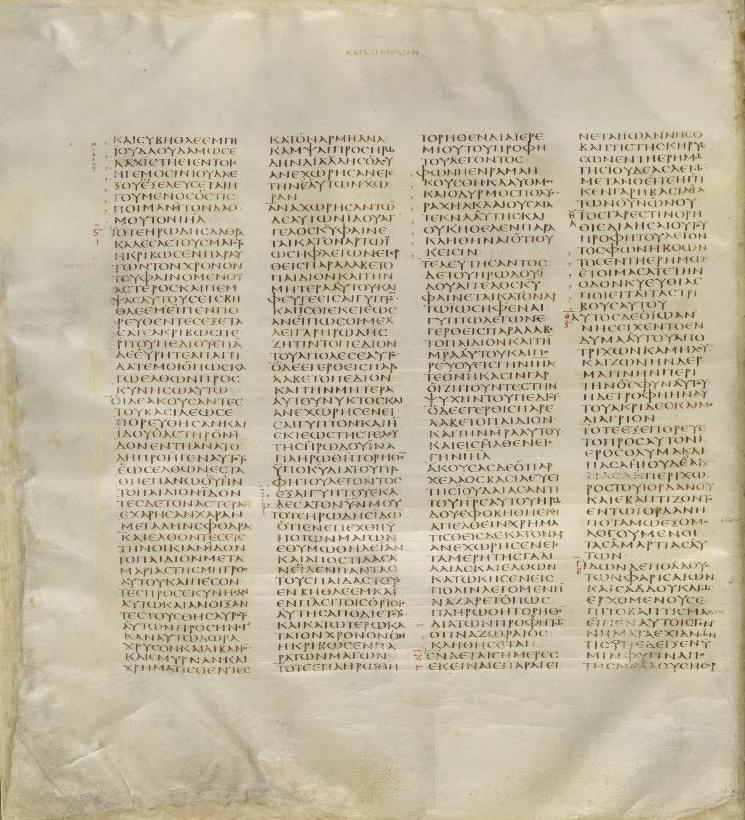
The Elijah pattern: John the Baptist, Luke and the limits of the equation
John the Baptist is the major complication for “Jesus = new Elijah” Malachi 4:5 expects Elijah before the great day of the Lord. In the Synoptic tradition John the Baptist is the figure most explicitly placed in this role: Luke 1:17 says he will go before the Lord “with the spirit and power of Elijah,” Matthew 11:14 identifies John as the Elijah “who is to come,” and Matt 17:10–13 again interprets the Elijah expectation through John.
It is therefore inaccurate to speak as though the Gospels simply transfer Elijah’s identity to Jesus. More precisely: John carries the explicit eschatological Elijah role, while Jesus in some narratives takes on Elijah- and Elisha-like features as prophet, wonder-worker, and raiser of the dead.
Luke 4: Elijah and Elisha are keys to Jesus’ program At Nazareth, after reading Isaiah, Jesus recalls Elijah being sent to the widow at Zarephath and Elisha healing Naaman the Syrian (Luke 4:25–27). These names are not incidental: both examples concern divine action across expected boundaries and help frame Luke’s themes of prophetic mission, rejection of a prophet at home, and the wider reach of divine mercy.
The scene therefore does more than say that Jesus is “another Elijah.” Jesus places himself within a prophetic sequence, uses it as an interpretive key for his own mission, and also exceeds any one predecessor.
Nain: Luke’s raising of a widow’s son nearly speaks the language of 1 Kings 17 Luke 7:11–17 is one of the strongest cases. Jesus meets a widow whose only son has died, raises him, and “gives him to his mother.” The verbal and narrative resemblance to Elijah’s raising of a widow’s son in 1 Kings 17:17–24 is dense enough that scholars treat it as deliberate literary imitation or transformation of the earlier scene.
The crowd’s response matters too: people say that a great prophet has risen among them. Here the Elijah frame is considerably stronger than many looser associations, though Luke still does not give Jesus the formal title “new Elijah.”
Fire from heaven: Luke does not merely repeat the old pattern—he corrects it When a Samaritan village refuses Jesus, James and John ask whether they should command fire from heaven to destroy it (Luke 9:54). The wording clearly recalls 2 Kings 1, where Elijah calls down fire on the king’s men. Some later manuscripts even add “as Elijah did,” but that gloss is not part of the best-supported early text.
Jesus rejects the proposal. This is a crucial counterexample: an evangelist can invoke a scriptural pattern not only to copy it. Typology can include contrast and ethical redirection.
The Twelve and the restoration of Israel
Jesus’ choice of twelve followers has a hard-to-miss connection in a Jewish setting with the twelve tribes of Israel. Matthew 19:28 states it explicitly: in the renewal the Twelve will sit on twelve thrones judging the twelve tribes of Israel; a parallel tradition appears in Luke 22:28–30.
This is a reason to use “new Israel” carefully. Matthew can narratively recapitulate Jesus through Israel’s story without necessarily claiming that ethnic Israel has been abolished or replaced. Recent scholarship therefore distinguishes “Jesus as representative Israel” from the thesis that Jesus or the church becomes a replacement “true Israel.”
The strongest parallels: strength of evidence and limit of inference
| Gospel motif | Earlier pattern | Strength of link | What we may conclude |
|---|---|---|---|
| Matt 2:15 — Son from Egypt | Hos 11:1; Exod 4:22 | Very strong: explicit quotation. | Matthew consciously applies Israel’s exodus language to Jesus; Hosea 11:1 itself is not a future messianic prediction. |
| Matt 4 — forty days and three Deuteronomy replies | Israel’s wilderness; Deut 6–8 | Very strong combination of motif and quotations. | Jesus is narrated as the faithful Son in a situation recalling Israel’s testing. |
| Matt 5 — teacher on a mountain | Moses/Sinai | Strong but typological. | “New Moses” fits Matthew’s literary portrait; the precise relation of Jesus’ teaching to Torah requires separate analysis. |
| Mark 9 / Matt 17 / Luke 9 — Transfiguration | Moses and Elijah; Sinai/Horeb | The figures are explicit; their meaning is multivalent. | The Gospels place Jesus over or in a special relation to Moses and Elijah; no single reason for their presence is proven. |
| Luke 7 — widow’s son | 1 Kings 17 | Very strong verbal and narrative resemblance. | Luke deliberately activates Elijah-like prophetic memory. |
| Luke 9 — fire from heaven | 2 Kings 1 | Strong allusion. | Jesus rejects militant use of an Elijah precedent; similarity does not mean imitation in every respect. |
| Matt 19:28 / Luke 22:30 — twelve tribes | restoration of Israel | Explicit connection. | The Twelve symbolize a role in Israel’s restoration; this alone does not establish replacement theology. |
This kind of matrix is more useful than looking for a hidden code because it forces every proposed link to state how direct it is and what it actually demonstrates.
Does literary construction mean the story was invented?
No. If Luke shapes the Nain scene with language from 1 Kings 17, or Matthew frames Jesus’ infancy through exodus imagery, we learn something important about the evangelist’s interpretation. We do not automatically learn whether the scene had a historical core, how much of it predates the evangelist, or which details were literarily sharpened.
The opposite leap is equally invalid: scriptural patterning does not itself prove that events happened exactly as narrated. Historical questions require additional criteria—age and independence of traditions, multiple attestation, contextual plausibility, external evidence, and redactional analysis.
What can we reasonably say after this review?
Very well supported: the Gospels consciously use Israel’s Scriptures to shape Jesus’ identity; Matthew in particular connects Jesus densely with exodus, Israel, and Moses; Luke uses clear Elijah-Elisha patterns; and the Transfiguration directly places Moses and Elijah beside Jesus.
Well supported but interpretive: “new Moses” is an apt label for an important part of Matthew’s portrait; Jesus in Matt 2–4 recapitulates key parts of Israel’s story; Luke 7 deliberately reshapes 1 Kings 17. “New Israel” is less secure if it is made to mean replacement of Israel, since Matthew and Luke retain strong restoration language involving Israel and the twelve tribes.
Too strong: claiming that every Gospel episode exists only because it has an Old Testament precedent; that literary resemblance by itself proves invention; or that Moses, Elijah, and Israel are three equally strong typologies in all four Gospels.
The most precise formulation is therefore: the evangelists present Jesus as the climax and rereading of Israel’s story through several older patterns; Matthew deploys Moses and Israel most densely, Luke develops Elijah/Elisha especially strongly, and all three Synoptics bring Moses and Elijah together at the Transfiguration with Jesus as the central figure. That is a literary conclusion. Historical questions must then be tested separately.
Sources and further reading
- Exodus 1–4, NRSVUE — Pharaoh’s order, Moses’ escape and return, Israel as God’s firstborn son
- Exodus 19–24; 34, NRSVUE — Sinai, covenant, mountain, cloud, Moses and reflected glory
- Deuteronomy 6–8; 18:15, NRSVUE — wilderness testing and the prophet like Moses
- 1 Kings 17–19, NRSVUE — Elijah, widow’s son, and Horeb theophany
- 2 Kings 1–2, NRSVUE — fire from heaven and Elijah’s departure
- Hosea 11, NRSVUE — Israel as the son called out of Egypt
- Malachi 4:5–6, NRSVUE — expectation of Elijah before the day of the Lord
- Matthew 1–7, NRSVUE — infancy, Egypt, baptism, wilderness, Deuteronomy quotations, Sermon on the Mount
- Matthew 11:14; 17; 19:28, NRSVUE — John as Elijah, Transfiguration, and the twelve tribes
- Mark 9:2–13, NRSVUE — Transfiguration, Moses, Elijah, and the Elijah discussion
- Luke 1:17; 4:16–30; 7:11–17; 9:28–56; 22:28–30, NRSVUE — Elijah language, Nain, Transfiguration, fire from heaven, and twelve tribes
- John 1; 3:14; 6, NRSVUE — Moses comparison, wilderness serpent, manna/bread imagery
- Oxford Handbook of the Synoptic Gospels, “Israel’s Scriptures” — comparative survey of scriptural use, including new Moses and Elijah motifs
- C. F. D. Moule, The Origin of Christology, “The fulfilment theme in the New Testament” — Hosea 11:1 originally refers to Israel and the exodus, not a future prediction
- Steve Moyise, “Hosea in the New Testament,” The Oxford Handbook of Hosea — quotation, allusion, and reuse of Hosea
- Jennifer M. Matheny, “Hosea 11 and Metaphors of Identity…” — Hosea 11, Israel/Ephraim, and exodus identity
- The Role and Meaning of the “Son of God” Title in Matthew’s Gospel, New Testament Studies — Matthew 2:15 and the limits of a full Israel-Jesus equation
- The New Moses and the Wisdom of God: A Convergence of Themes in Matthew 11:25–30, Horizons — Mosaic typology in Matthew
- The Enigma of the Antitheses, New Testament Studies — Matthew 5:17–48, Torah, and the debated “new Moses/new Torah” reading
- Jeannine K. Brown, “Direct Engagement of the Reader in Matthew’s Discourses,” New Testament Studies — Matthew’s five major discourse units
- Caleb T. Friedeman, “Moses, Elijah, and Jesus’ Divine Glory (Mark 9.2–8),” New Testament Studies — Transfiguration, Sinai motifs, Moses and Elijah
- Thomas Louis Brodie, “Luke 7.11–17 as an Imitatio of 1 Kings 17.17–24,” New Testament Studies — literary relation between Nain and Elijah’s widow narrative
- “Elijah, John, and Jesus in the Gospel of Luke,” New Testament Studies — differentiation and overlap of Elijah motifs in Luke
- Jan Dochhorn, “Die Verschonung des samaritanischen Dorfes (Lk 9.54–55),” New Testament Studies — Luke’s critical reuse of the Elijah fire tradition
- Isaac W. Oliver, Luke’s Jewish Eschatology: The National Restoration of Israel in Luke-Acts — Israel’s restoration and the twelve tribes in Luke-Acts
- Nicholas J. Schaser, A Ransom for Israel: Jesus and Jewish Salvation in Matthew (SBL Press, 2025) — critique of replacement-oriented “new Israel” readings
- Israel and the Individual in Matthew and Midrash: Reassessing “True Israel,” Religions 12 (2021) — Jesus-Israel recapitulation without replacement theology