Jesus’ Birth under Scrutiny: The Genealogies, Herod, and Quirinius
Matthew and Luke agree on Bethlehem and a Davidic connection, yet tell different infancy stories, provide different genealogies, and use chronological anchors that are difficult to fit into one historical timeline.
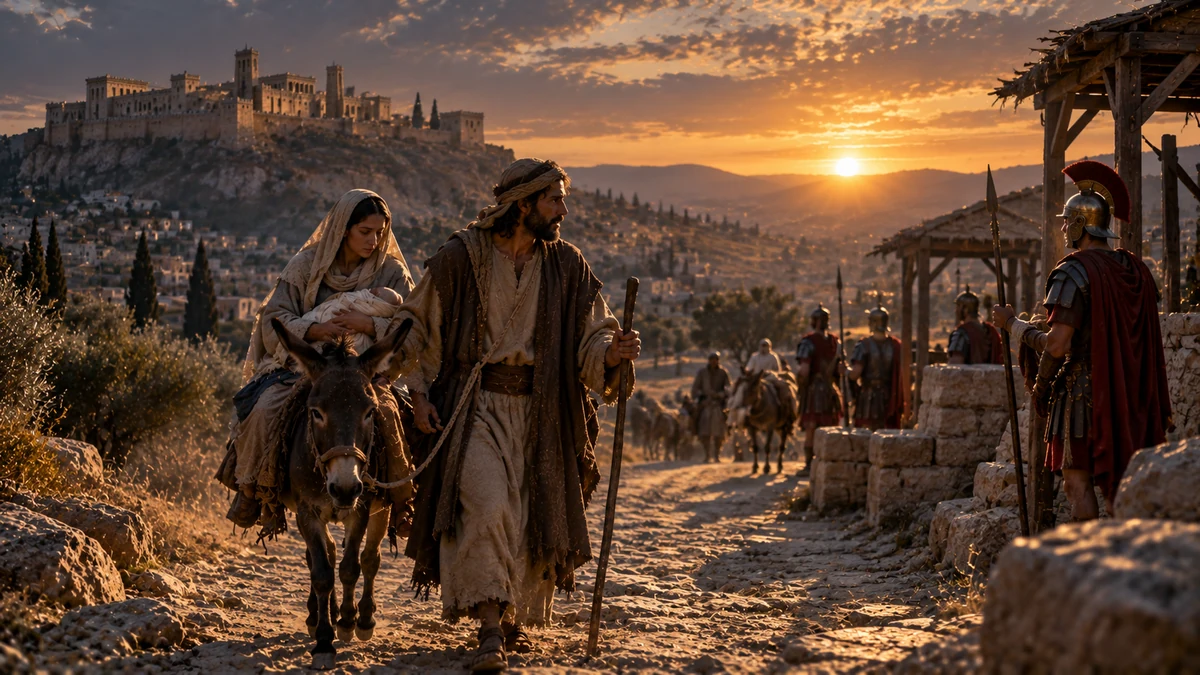
Only Matthew and Luke narrate Jesus' birth in the New Testament. Mark begins with the adult Jesus and John with the Logos; therefore the details about genealogies, Bethlehem, Herod, the census, magi, shepherds, Egypt, and the Jerusalem temple come from two later and substantially different narrative complexes.
The comparison should therefore not begin with “which evangelist is right?” but with three separate levels: what each text actually claims; where Matthew and Luke agree or diverge; and which claims can be checked against external historical evidence.
Both Gospels place the birth in Bethlehem, connect Jesus with David's house, and describe conception before ordinary marital intercourse. Yet they reach those shared points through different stories: Matthew is structured around Herod, the magi, danger, and Egypt; Luke around Nazareth, Augustus' registration, Quirinius, shepherds, and the temple.
The largest historical tension is chronological. Matthew, and Luke 1 as well, place the setting under Herod the Great, who died in 4 BCE in the standard chronology; Luke 2 links the birth to the census under Publius Sulpicius Quirinius, securely documented after Judaea was annexed to direct Roman administration in 6 CE. This article tests what can be reconciled, what remains open, and where the texts simply do not yield an easy chronology.
Two birth narratives: shared core, different route
The first task is to separate absence from contradiction. Matthew's failure to mention shepherds and Luke's failure to mention magi is not by itself a conflict. Tension begins where two narrative arcs require different locations, relationships, or dates.
| Question | Matthew 1–2 | Luke 1–2 |
|---|---|---|
| Family starting point | Before the birth, Matthew does not explicitly say where Joseph and Mary had been living; Jesus is born in Bethlehem. | Joseph and Mary are presented in Nazareth; the registration takes them to Bethlehem. |
| Why Bethlehem? | Birth in Bethlehem is stated as a fact and explicitly connected to Micah's prophecy. | Joseph goes to David's city for registration because he belongs to David's house. |
| Visitors | Magi from the east, guided by the star. | Shepherds informed of the birth by angels. |
| Main political figure | Herod the Great; later his son Archelaus. | Augustus and Quirinius; Herod already appears in Luke 1:5. |
| After the birth | Herod's threat, flight to Egypt, then return; settlement in Nazareth because of Archelaus. | Circumcision, presentation in the temple, then return to Nazareth. |
| Egypt / massacre | Yes, Matthew only. | Not mentioned. |
| Jerusalem temple after birth | Not mentioned. | Simeon and Anna; the family visits the temple. |
The table does not prove that the stories cannot be combined into a single harmony, but it shows that neither evangelist is simply telling an abbreviated version of the other. Each has its own literary arc, scriptural emphases, and family geography.
The genealogies: structure and key differences
Matthew's genealogy is deliberately shaped into three groups of fourteen Matthew 1 traces the line from Abraham through David and Solomon to Joseph and explicitly arranges it into three groups of fourteen generations. The list is therefore not a neutral civil register; its architecture carries theological and literary meaning.
Compared with Old Testament royal lists, Matthew omits some generations, including kings between Joram and Uzziah. This is an important control: ancient genealogies could use fathering language for broader dynastic succession and could be selective. Matthew's “fourteen + fourteen + fourteen” should therefore not be converted into a precise modern genealogical chronology.
Luke's genealogy runs in the opposite direction and follows a different Davidic branch Luke 3 places the genealogy only after Jesus' baptism. It runs backward from Jesus through Joseph to David, Abraham, Adam, and God. Its scope is therefore more universal than Matthew's opening from Abraham.
The decisive difference comes after David: Matthew follows Solomon, Luke Nathan, another son of David. Immediately before Joseph the lists also disagree: Matthew names Joseph's father Jacob, Luke Heli. This is a genuine textual difference, not merely an omitted detail.
| Feature | Matthew 1 | Luke 3 |
|---|---|---|
| Location in Gospel | Before the birth narrative. | After the baptism, before the temptation. |
| Direction | Abraham → Jesus. | Jesus → Adam → God. |
| Davidic branch | David → Solomon. | David → Nathan. |
| Joseph's father | Jacob. | Heli. |
| Form | Three highlighted groups of 14. | A longer continuous reverse chain. |
| Main emphasis | Abraham, David, royal/messianic line, exile. | Davidic connection expanded to all humanity through Adam. |
| Mary's genealogy? | The text does not give one; the line reaches Joseph, Mary's husband. | The text says Jesus was “as was supposed, the son of Joseph, son of Heli ...”; Mary is not named as a genealogical link. |
The genealogies side by side: where do they actually diverge? The popular proposal that Matthew gives Joseph's genealogy while Luke gives Mary's is therefore not stated directly by Luke. It is a later harmonization. This does not rule out early traditions of Mary's Davidic descent; it means only that Luke's genealogy itself does not straightforwardly demonstrate that claim.
Why trace through Joseph if both Gospels reject ordinary biological paternity? Both Gospels use Joseph as a Davidic-dynastic link while narrating a conception in which Joseph is not the ordinary biological father. To a modern genealogical reader this creates tension, but in ancient legal and dynastic contexts fatherhood was not solely a genetic category.
Matthew emphasizes Joseph's act of naming the child; Luke calls Jesus “as was supposed” Joseph's son. The genealogies can therefore function as legal, familial, and messianic identification, not as modern DNA pedigrees. That still does not explain why the concrete names and Davidic branches differ.
The earliest harmonization: Julius Africanus and levirate marriage
Already in the early third century Julius Africanus tried to reconcile the lists through levirate marriage: Jacob and Heli were said to be half-brothers, making Joseph the natural son of one and the legal son of the other. Eusebius later preserved this explanation.
The proposal is historically important because it shows that early Christians noticed the discrepancy rather than overlooking it. But Africanus requires an additional family history not supplied by the Gospels and not independently verifiable. It is therefore best classified as an ancient harmonization, not a demonstrated reconstruction of Joseph's family.
Herod as a historical anchor
Matthew 2 explicitly places the birth “in the time of King Herod,” while Luke 1:5 begins the Baptist's story likewise under “Herod, king of Judea.” Both infancy traditions in their final form therefore situate events in the Herodian period.
Josephus describes Herod's death after a lunar eclipse and before Passover; the standard chronology places it in 4 BCE. Minority chronologies exist, but 4 BCE remains the normal historical baseline. If the Herodian framework is correct, Jesus' birth must precede that date; the texts themselves do not establish an exact year.

Quirinius and the census: problem, solutions and limits
Quirinius' census is well documented—and that is exactly why it creates a problem Josephus reports that Quirinius came to Syria and Judaea when Judaea was brought under direct provincial administration after Archelaus was removed, and conducted an assessment of property. The event is conventionally dated to 6/7 CE and provoked the movement of Judas the Galilean.
Acts 5:37 also remembers Judas the Galilean “at the time of the census,” confirming that this registration was a memorable event in early Christian memory. The Oxford Classical Dictionary places Quirinius as Syrian legate in 6 CE and notes that attempts to prove an earlier Syrian governorship have not produced secure epigraphic evidence.
Compared with Herod's death in 4 BCE, this produces a gap of roughly a decade. That is the central chronological problem in Luke 1–2, not a trivial detail.
| Proposed solution | What it tries to explain | Main evidentiary limit |
|---|---|---|
| Luke 2:2 means a census “before” Quirinius | Reads Greek prōtē comparatively: a registration before Quirinius' census. | The grammatical proposal has defenders but is not the standard or undisputed reading. |
| Quirinius held an earlier authority/office in Syria | Allows a Quirinian registration during Herod's lifetime. | Known inscriptions and Quirinius' career do not securely demonstrate a second Syrian governorship. |
| Herod's kingdom conducted a local registration under Augustus | Preserves an early date and allows census activity in a client kingdom. | Client kingdoms could conduct censuses, but there is no independent evidence for this specific registration. |
| Luke connected the later famous census with an earlier birth tradition | Explains the decade-long mismatch without positing a lost census. | Historically economical, but it means Luke made a chronological error or merged two traditions. |
Was there another, earlier census? The main solutions and their limits A fair pregled virov cannot declare the first three proposals impossible; neither can it present them as established history. At present, the Quirinian census of 6/7 CE is directly better documented than a hypothetical earlier registration that would solve the nativity chronology.
Did Roman censuses send people to the city of a remote ancestor? Rome conducted many kinds of censuses, tax registrations, and local enrollments, and client kingdoms were not unfamiliar with such procedures. Luke 2, however, gives a highly specific reason for Joseph's journey: he travels from Nazareth to Bethlehem because he belongs to the house and lineage of David.
There are examples in which people had to return to their home or registration district for census purposes, but there is no clear Roman rule requiring inhabitants of the empire to register in the city of an ancestor who lived roughly a millennium earlier. The historical question is therefore not whether Rome used censuses—it did—but whether we know the particular mechanism Luke's journey to Bethlehem requires.
Bethlehem, Herod and Egypt: tradition and literary explanation
Bethlehem: shared tradition or literary connection to David? Matthew and Luke agree that Jesus was born in Bethlehem, an important shared point. Yet double attestation within two infancy narratives does not by itself tell us whether this is two independent historical memories, a shared tradition, or a theologically shaped connection with David's city.
Matthew explicitly connects Bethlehem with Micah; Luke does not quote Micah but repeatedly emphasizes David's city and Joseph's Davidic ancestry. Jesus' association with Nazareth is extremely strong across the wider Gospel tradition. A historian can therefore say that Bethlehem is an early canonical birth tradition, but cannot prove the birthplace from that agreement alone.
Herod's massacre and the flight to Egypt: what does lack of external confirmation mean? The killing of Bethlehem's children and the flight to Egypt occur only in Matthew. Josephus, who reports Herod's brutality at length, does not mention the episode. That silence is relevant, but an argument from silence is not the same as a demonstrated refutation: Bethlehem was small and the potential number of victims would have been limited.
The safest formulation is therefore double-sided: the massacre lacks independent ancient corroboration; at the same time Herod's documented violence toward perceived rivals does not make such an act inherently impossible. The specific event remains less historically secure than the general fact of Herodian repression.
What can we claim at different levels of confidence?
Very well supported: Matthew and Luke contain different infancy narratives and different genealogies; both connect Jesus with David and Bethlehem; their genealogies diverge after David and name different fathers for Joseph; Quirinius' Judaean census in 6/7 CE is historically well documented.
Well supported but not absolute: the standard Herodian chronology places his death in 4 BCE, which makes a straightforward reading of Luke 1–2 chronologically tense. Proposals for an earlier Quirinian role or a lost earlier census exist but do not enjoy the same direct evidence.
Open: Jesus' exact birth year and birthplace, the historical status of individual episodes in Matthew 2, and the precise origin of the two genealogies. Literary and theological shaping does not by itself prove that no historical core exists; religious meaning likewise cannot substitute for historical evidence.
The central methodological rule is therefore the same as in the previous pregled virovs: harmonization is a permitted possibility, not proof; discrepancy is a historical problem, not by itself proof that the whole narrative was invented.
Sources and further reading
- Matthew 1–2, NRSVUE — genealogy, birth, magi, Herod, Egypt, Nazareth
- Luke 1–3, NRSVUE — Herod setting, census, Bethlehem, temple, genealogy
- Luke 3, NRSVUE — Joseph as son of Heli; genealogy through Nathan to Adam
- Acts 5:37, NRSVUE — Judas the Galilean in the days of the census
- Flavius Josephus, Antiquities of the Jews XVII — Herod's final illness, lunar eclipse, death and succession
- Flavius Josephus, Antiquities of the Jews XVIII — Quirinius' assessment after annexation of Judaea; Judas the Galilean
- Oxford Classical Dictionary, “Sulpicius Quirinius, Publius” — legate of Syria in CE 6 and assessment of Judaea; limits of earlier-governorship theories
- Alden A. Mosshammer, “Evidence for the Chronology of Jesus,” The Easter Computus and the Origins of the Christian Era — Herod/Quirinius chronological problem
- Leroy A. Huizenga, “Bethlehem and the Census,” The Oxford Handbook of Christmas — discussion of Luke 2 and the proposal to read the census as before Quirinius
- John Thorley, “The Nativity Census: What Does Luke Actually Say?”, Greece & Rome — historical and grammatical discussion of Luke 2:1–2
- Craig A. Evans, Matthew, Cambridge University Press — Matthew 1 genealogy and three groups of fourteen
- W. D. Davies / New Testament Studies discussion, “The Genealogies of Jesus” — divergence of Matthew and Luke and limits of Mary-genealogy harmonization
- Yifat Monnickendam, “Biblical Law in Greco-Roman Attire” — Matthew/Luke genealogies and Julius Africanus' levirate harmonization
- Julius Africanus, Epistle to Aristides — early Christian levirate explanation of Jacob/Heli and Joseph
- Eusebius, Church History I — preservation of Africanus' genealogy harmonization
- M. David Litwa, “Genealogy,” How the Gospels Became History — ancient genealogical conventions, omissions and double paternity
- Andrew J. Patton, “Transmission of the Genealogy of Jesus in Greek New Testament Manuscripts,” JTS 77 (2026) — manuscript formatting and textual variation in Luke's genealogy
- New Testament Studies, “The Four (Five) Women and other Annotations in Matthew's Genealogy” — literary shaping and omitted royal generations
- Franz Cumont, “The Population of Syria,” Journal of Roman Studies — Quirinian census evidence and Q. Aemilius Secundus inscription
- Stephen C. Carlson, “The Accommodations of Joseph and Mary in Bethlehem: κατάλυμα in Luke 2.7,” NTS — census compliance and Bethlehem accommodation context
- Bible Odyssey, “How Does the New Testament Relate to History?” — historical method and the Herod/Quirinius problem in Luke
- M. Bockmuehl, “The Son of David and his Mother,” Journal of Theological Studies — Davidic descent traditions and later association with Mary
- Oxford Academic, Jesus' chronology chapter — the conventional 4 BCE Herodian boundary and later Quirinian census