Early Christianity: From the Jesus Movement to Diverse Churches and Canon
Early Christianity did not begin as a finished institution. From a Jewish Jesus movement, disputes over Gentiles, leadership, teaching, texts and authority produced multiple churches, a canon and later orthodoxy.
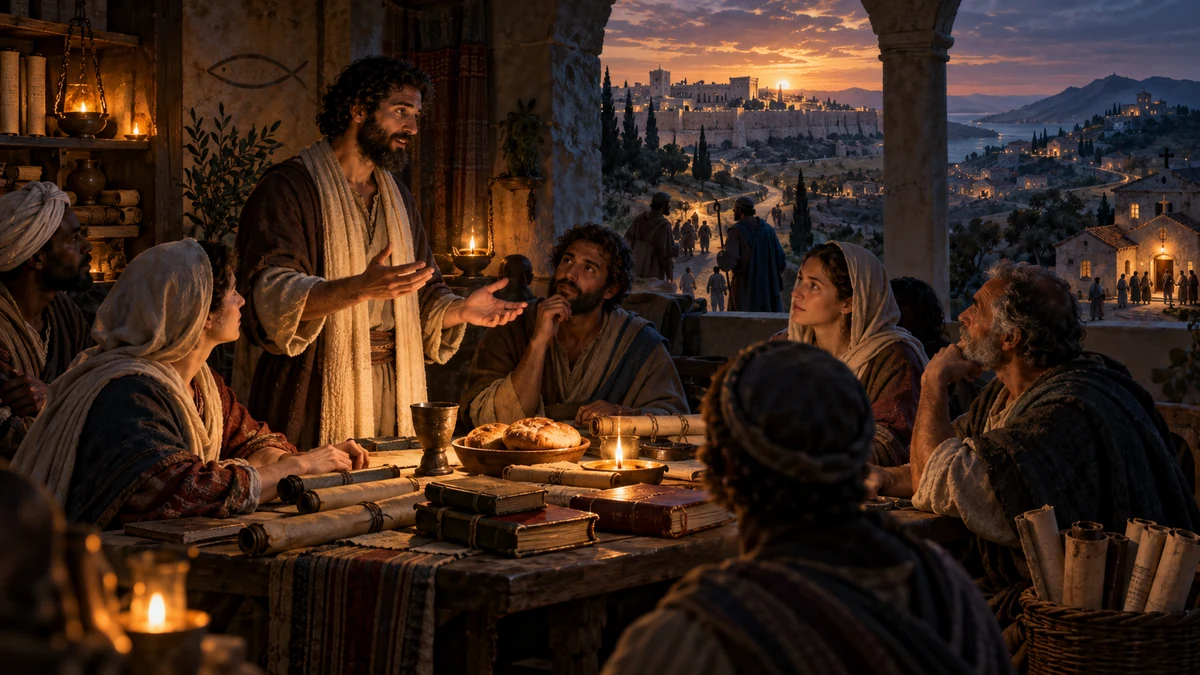
Early Christianity is often narrated backward from later churches, creeds and the biblical canon, as if the final form had already existed in the first decades after Jesus. The sources present a different picture. The Jesus movement began within Second Temple Judaism and, within a few generations, expanded through the Greco-Roman world, producing communities with different practices, leaders, texts and answers to the question of who Jesus was and what his death and resurrection meant.
this article therefore does not search for one idealized 'original Church' from which all later differences were merely deviations. Nor does it accept the opposite romantic story in which every group later excluded must therefore have been older, more authentic or more true. Under the project's symmetric-skepticism rule, both official ecclesiastical retrospectives and alternative reconstructions are historical claims to be tested against the earliest texts, manuscripts and material evidence.
The decisive historical change was not one conspiracy or one council. It was a long process: a Jewish messianic movement received increasing numbers of Gentiles; local household assemblies formed wider networks; some interpretations of Jesus gained greater institutional power while others remained marginal or disappeared; some writings acquired greater authority; episcopal structures hardened; and imperial patronage in the fourth century dramatically changed the relationship between faith and political power.
The historical success of a church form does not by itself prove its metaphysical truth. But the defeat or suppression of a rival does not prove that the rival was right either. History can show who spoke, who prevailed, who was excluded and how a canon formed; the question of spiritual truth requires another level of judgment.
The Jesus movement begins as a Jewish messianic movement
The earliest traces of the movement do not show a new religion suddenly appearing alongside Judaism. Jesus, his first disciples, James, Peter and Paul are Jews, and their language is saturated with Israel's scriptures, Messiah, resurrection, the kingdom of God and the question of Torah. The Cambridge History of Christianity emphasizes that Jesus and his first disciples were Jews and that Jewish Christians remained significant for centuries.
The Jerusalem community carried particular weight, and James is associated with its authority in the earliest sources. Yet even in the first decades we should not imagine complete theological uniformity. Paul's letters, our earliest surviving Christian writings, reveal serious disputes over circumcision, table fellowship and the obligations of Gentiles toward Torah.
This matters for later institutional narratives. If the first century is described as if it already possessed a finished Catholic, Orthodox or Protestant structure, a later identity has been projected backward into an age when basic questions were still open.
Paul and the Gentile question: the first great rupture was not abstract theology
Expansion among Gentiles is one of the decisive facts of the early movement. In Galatians Paul describes meetings and conflicts with other leaders concerning his mission among the uncircumcised; Cambridge scholarship places the status of Gentiles and their obligations to Torah at the center of the earliest Christian disputes.
Acts later narrates a Jerusalem agreement, but Paul's own testimony shows that practical tensions did not disappear. The Antioch incident, in which Paul criticizes Peter over table fellowship with Gentiles, is valuable precisely because it demonstrates that early authority did not mean the absence of conflict.
A historical transformation of enormous consequence emerges here. A movement that begins as a Jewish messianic expectation becomes capable of receiving people without requiring full entry into the Jewish ethnic-legal community. This is not a single decision but a process of negotiation, dispute and new interpretation of inherited tradition.
The first churches were networks of communities, not one central administration
The earliest Christian assemblies commonly met in houses and other private spaces. Paul's letters know apostles, prophets, teachers, coworkers, hosts of household assemblies and other roles, but they do not yet display one universal administrative scheme for every city. Oxford research on early church order likewise cautions that ritual authority in the first and second centuries was not everywhere concentrated in identical offices.
Women also matter. In the earliest sources they appear as coworkers, hosts, prophets, deacons or holders of other leadership roles. This does not mean that the ancient world was egalitarian; it does mean that later, more restrictive institutional patterns should not simply be projected onto the first generation.
In this period 'church' therefore often means a local assembly of people rather than a monumental building or centralized institution. Organization develops, but not everywhere at the same speed or along the same path.

The earliest documents already display different emphases and conflicts
Paul's letters witness factions and disputes about food, sexuality, charismatic gifts, resurrection and the relation to Mosaic law. The Gospels are not four copies of one book: they share a central story about Jesus while narrating it with different emphases, chronologies and theological languages. Diversity therefore does not begin only with the 'heresies' of the second century.
This does not mean that every difference was equally large or that there was no early common core. Convictions about Jesus' special role, his death, experiences of his resurrection or appearances, and expectation of divine action linked very different communities. History must see continuity and conflict at the same time.
The weakest method would allow later official terminology to decide in advance who was 'orthodox' from the beginning and who was 'heretical'. Those categories are historically important, but they are also outcomes of struggles over the boundaries of community.
More gospels do not mean that all are equally early or equally reliable
More narratives, sayings collections, gospels, apocalypses and apostolic writings circulated in the first centuries than are now contained in the New Testament. Discoveries such as the Nag Hammadi library made this fact widely known. But non-canonical status does not by itself show that a work was deliberately hidden, earlier than the canonical Gospels or historically more reliable.
The reverse is also true: canonical status does not prove that a text is the earliest or lacks an editorial history. The criteria remain those of “How Do Sacred Texts Form? Oral Tradition, Redaction and Canon”: dating, manuscript tradition, literary dependence, historical context, external attestation and explanatory power.
By the middle and late second century a collection of four Gospels becomes increasingly recognizable. Irenaeus around 180 explicitly defends the fourfold Gospel of Matthew, Mark, Luke and John, while modern research indicates use of that fourfold collection developing before him.
Marcion, Valentinians and 'Gnosticism': real plurality without romanticizing it
The second century makes Christian plurality still more visible. Marcion in Rome argues for a radical distinction between the creator of the Jewish scriptures and the good God revealed through Jesus, and forms his own collection of a Gospel and Pauline letters. Valentinians develop different cosmologies and accounts of salvation. Jewish-Christian communities retain stronger attachment to Torah. The Montanist movement emphasizes continuing prophecy and charismatic authority.
The word 'Gnosticism' requires caution. The Oxford Classical Dictionary notes that the diversity of groups modern scholars place under that label is so great that some scholars use the collective category only reluctantly. this article therefore does not construct a single secret 'Gnostic church' destroyed in one act by one centralized institution.
Yet neither should we minimize the fact that later victorious currents actively defined the limits of acceptable teaching, rejected competitors and branded their writings dangerous. Institutional history includes a real struggle over authority to define the meaning of tradition.
Bishop, succession and 'true tradition' become answers to plurality
As communities multiply and differences become more visible, the need for standards of authority also grows. Ignatius of Antioch in the early second century strongly stresses the roles of bishop, presbyters and deacons. But the intensity of his appeal itself indicates that such organization was not automatically and identically established everywhere.
Irenaeus later connects his argument against rival teachings to public apostolic tradition, episcopal succession and a rule of faith. This was an intellectual and institutional answer to a real problem: if many groups appeal to Jesus and the apostles, who can demonstrate reliable continuity?
From the perspective of power this is a turning point. Structure can preserve memory, community and accountability; at the same time, concentration of the right to interpret creates the possibility that institutional continuity becomes a substitute for testing an argument. this article therefore treats succession as a historical criterion of authority, not an automatic proof of theological truth.
Persecution was real, but not a continuous three-century war of the state against Christians
Martyrs are not a later invention. Nero's violence in Rome, Pliny's interrogation of Christians in Bithynia and later imperial persecutions are historical realities. But the popular picture of three centuries of one continuous, empire-wide hunt for Christians is too simple.
Modern scholarship stresses that before the third century persecutions were often local, intermittent and dependent on circumstances. The third century saw broader imperial measures, especially under Decius and later Diocletian, yet even then experience varied greatly by place and time.
Memory of martyrdom nevertheless became a powerful source of identity and moral authority. An institution that had once stood before state coercion then faced a new question after Constantine: what happens when the same religion gains access to state power?
Constantine and Nicaea: the end of marginality, not the moment an emperor 'invented Christianity'
Constantine's support is a watershed, but it must be described precisely. Christianity did not overnight become the empire's sole official religion under him. The great era of persecution ended, the church gained legal standing, property, imperial patronage and political weight, and bishops entered an entirely new relationship with power.
The Council of Nicaea in 325 dealt above all with the dispute over the relationship of Father and Son, adopted a creed and promulgated twenty disciplinary canons. It did not choose the twenty-seven books of the New Testament. Nor did the Nicene formula immediately end theological dispute; the decades after the council were filled with further conflicts, exiles and shifting imperial alliances.
This matters for a critique of systems. Once political power begins funding, privileging and arbitrating within a religious institution, the boundary between protecting a community and using religion for political unity becomes dangerously thin. Yet it is equally poor history to reduce three centuries of Christian development to Constantine's political project.
Canon and 'orthodoxy' form gradually — historical victory is not the same as proof of truth
The New Testament did not arise from one vote. By the second century the four Gospels and a substantial collection of Pauline letters were highly influential, while the status of other books remained disputed. Eusebius in the early fourth century still distinguishes acknowledged, disputed and rejected writings. Athanasius's thirty-ninth Festal Letter of 367 is the first surviving document to list exactly the same twenty-seven books contained in today's New Testament.
The process is at once spiritual, literary and institutional. Communities select books used in worship, connect them with apostolic tradition and employ them for teaching; bishops and synods gradually reinforce boundaries. Canon is therefore neither a purely spontaneous mystical gift nor merely a cynical political list. It is the historical result of long reception, conflict and institutional decision-making.
The Natural Law conclusion is simple: power can determine which book may be publicly authorized or which group receives institutional recognition, but decree cannot manufacture truth. The reverse also holds: a banned text is not true merely because it was banned. Our task is to remove the privilege of status and examine claims by evidence, meaning and moral coherence—not by who retained the institutional seal centuries later.

Sources and further reading
- Cambridge — The Early Christians / Jewish origins: Jesus was a Jewish preacher and his first followers lived in Jewish contexts; differentiation from Judaism was gradual.
- Cambridge History of Christianity — Gentile Christianity: the movement began with a Galilean Jewish Jesus and early disputes centered on Gentile inclusion and Torah.
- Cambridge History of Christianity — Social and ecclesial life: earliest Christian communities developed rapidly in diverse forms and the process was not unilinear.
- Cambridge — Galatians / Gentiles and the Law: Gentile inclusion and Torah observance were foundational early disputes.
- Cambridge, New Testament Studies — Jerusalem decrees and Antioch incident: early Jesus-believers disputed the status of Gentiles and table fellowship.
- Cambridge History of Ancient Christianity — Paul and diverse champions: Pauline letters show serious identity conflicts already in the 40s–50s CE.
- Oxford Classical Dictionary — early Christian churches: earliest Christians met in private houses; dedicated church buildings developed gradually.
- Oxford Handbook — ritual and emerging church hierarchy: early ritual authority was not uniformly concentrated in identical offices.
- Oxford — Women, Ministry, and Church Order: women appear as coworkers, missionaries and house-church leaders in early Christianity while institutional patterns changed over time.
- Oxford Handbook — leadership roles and early Christian communities: evidence includes women as apostles, prophets, teachers, deacons and other leaders, with substantial regional variation.
- Oxford JTS — ordering Gospel textuality: Irenaeus around 180 CE presents Matthew, Mark, Luke and John as a unified fourfold Gospel.
- Oxford JTS — four-Gospel canon in Epistula Apostolorum: evidence for a four-Gospel collection predates Irenaeus and may reach the mid-second century.
- Oxford — Connecting Gospels: by the late second century a canonical boundary increasingly privileged four Gospels while other Jesus texts moved to the margins.
- Oxford Classical Dictionary — Gnosticism: the category covers highly diverse groups and is methodologically contested in modern scholarship.
- Oxford — Marcion and his Critics: Marcion developed a rival scriptural and theological program in second-century Rome and founded a lasting ecclesial movement.
- Oxford — Ignatius of Antioch: early-second-century letters illustrate the growing authority of bishops, Eucharistic order, conflicts over teaching and martyrdom.
- Cambridge History of Christianity — pre-Constantinian institutions: household communities developed into increasingly interlinked structures; diversity remained substantial.
- Cambridge — early-Christian persecution: before the third century persecution was often localized, sporadic and non-uniform rather than a continuous empire-wide policy.
- Cambridge History of Christianity — Constantine and the peace of the church: imperial hostility shifted to patronage, but Christianity did not become the official religion of the empire under Constantine.
- Cambridge Companion to Nicaea — the Creed: Nicaea centered on the theological controversy over the Son and produced a creed with a complex later reception.
- Cambridge Companion to Nicaea — Twenty Canons: Nicaea promulgated twenty disciplinary canons concerning clergy, sacraments and ecclesiastical jurisdiction, not a list of New Testament books.
- Cambridge Companion to Nicaea — aftermath: Nicene decisions did not instantly end the controversy; imperial and ecclesiastical alignments shifted repeatedly after 325.
- Oxford — Development of the Christian Biblical Canon: New Testament canon formation proceeded in stages through the reception of Gospels, Pauline letters, Catholic Epistles, Acts and Revelation.
- Cambridge / Harvard Theological Review — Athanasius Festal Letter 39: the 367 CE letter is the earliest surviving document listing precisely the twenty-seven books of the later New Testament canon.
- Cambridge — Parting of the ways: Jewish and Christian differentiation was a long process; early Christian beliefs and practices remained shaped by diverse Jewish traditions.