Jesus and Barabbas: An Echo of Yom Kippur or a Later Interpretation?
The Barabbas scene may be more than a historical episode: does Matthew reshape the older two-goat rite of Leviticus 16 into a new Passion narrative that preserves the core pattern of two figures and two opposite fates?
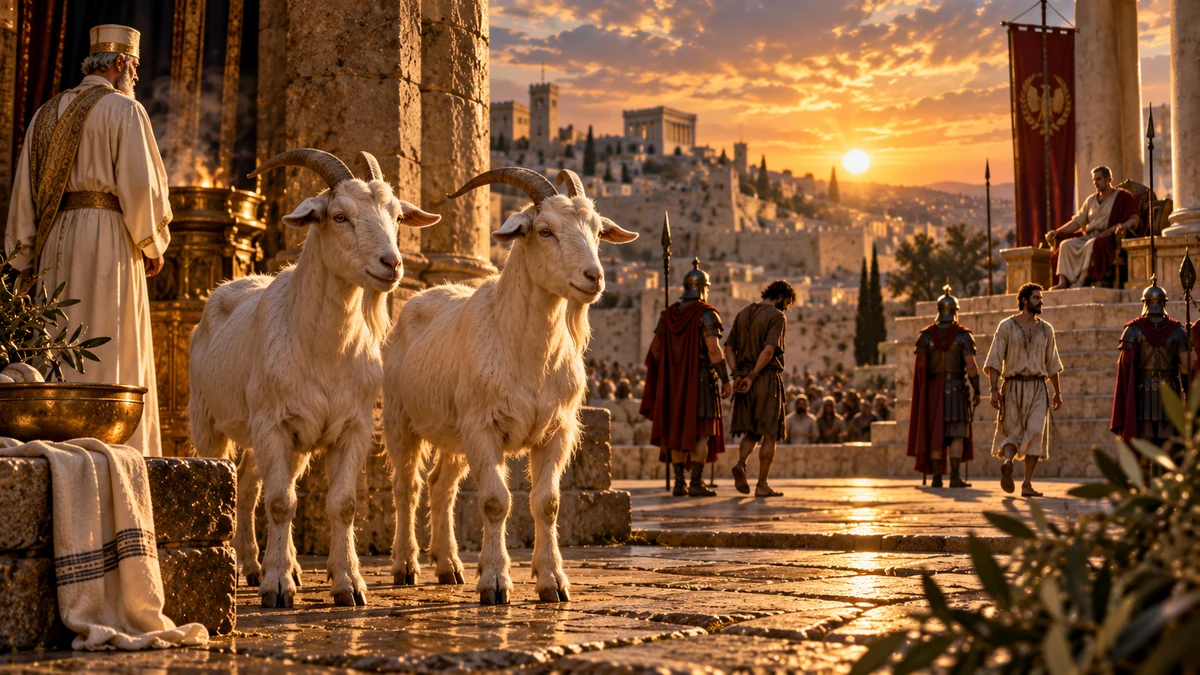
The Barabbas scene can be read on two levels at once. On the surface it is a judicial-political story: Jesus and the prisoner Barabbas stand before Pilate, the crowd demands the release of one, and the other goes to death. At a deeper literary level, however, a different question appears: was the scene shaped so that an older scriptural pattern could sound again inside a new story?
The closest candidate is the Yom Kippur rite of Leviticus 16. There too, two comparable subjects are placed before the community; a choice and separation follow; one goes to death, while the other remains alive and is removed from the community. Later Mishnah even stresses that the two goats should ideally resemble one another. In some important manuscripts of Matthew, the contrast becomes sharper still: Barabbas is called Jesus Barabbas, so the reader may face two men named Jesus with opposite fates.
Such a correspondence does not require a one-to-one match. Intertextual allusion can preserve a deep narrative structure while changing festival, characters, setting, and ritual mechanism. The central question is therefore not simply “is Barabbas the scapegoat?” but: does Matthew retell an older scriptural pattern without merely copying it?
The article therefore separates three levels: what the Gospels and Leviticus 16 directly say, what Matthew’s wider use of Israel’s Scriptures makes plausible, and where interpretive reconstruction begins. The historicity of Barabbas and of a Passover amnesty remains an important control, but no longer the sole center of the inquiry.
Intertextuality: when a new story speaks with an older text
The New Testament often uses Israel’s Scriptures without a direct quotation. Allusion, typology, and retelling can work without an “it is written” formula. Modern Gospel scholarship therefore speaks of a scriptural “generative milieu”: older texts contribute not only isolated sentences but also images, characters, and narrative structures.
To assess a proposed allusion, it is useful to ask whether the older text was available to the author, how substantial the resemblance is, whether the motif recurs in the same writer, whether it coheres with the writer’s themes, whether the connection is historically plausible, and whether it actually illuminates the new passage. Richard B. Hays systematized such questions through criteria such as availability, volume, recurrence, thematic coherence, historical plausibility, history of interpretation, and satisfaction.
These criteria do not prove an allusion mathematically. They help distinguish a chance resemblance from a connection that becomes cumulatively plausible.
Yom Kippur in Leviticus 16: a pattern of two and two fates
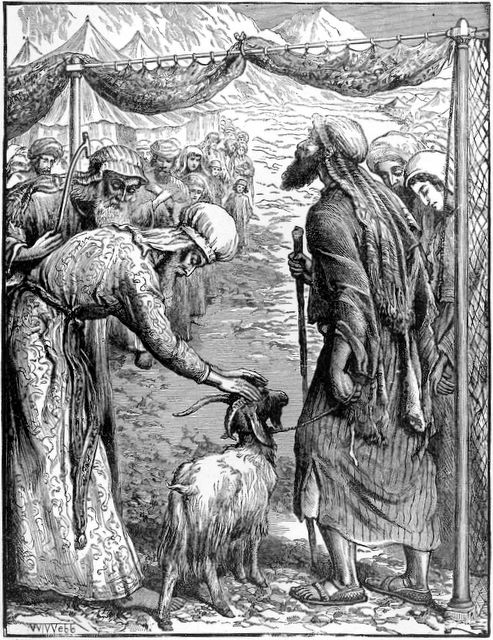
Leviticus 16 describes the purification of sanctuary and people. The high priest places two goats before the LORD and casts lots over them: one is “for the LORD” and becomes a purification offering; the other is “for Azazel,” remains alive, receives the confessed iniquities of Israel, and is sent into the wilderness.
The later Mishnah Yoma 6:1 emphasizes the pairing even further: ideally the goats should match in appearance, height, and value and be purchased together. Only the lot assigns their different roles. This detail matters for comparison with Barabbas because the ritual does not merely involve two unrelated subjects; it first places a pair in parallel and then divides them.
Yet the ritual is not a story of one innocent and one guilty goat. Both belong to the same rite of purgation, but with different functions: one is slaughtered, the other symbolically carries iniquity away from the community. Any Christian or literary analogy must therefore avoid importing a later moral opposition that the Levitical rite itself does not contain.
The Gospel narrative: one basic scene, different redactions
The core plot is shared by all four canonical Gospels: Barabbas is a prisoner, the crowd demands his release, and Jesus remains on the path to crucifixion. The details, however, are not identical. Mark associates Barabbas with insurgents who committed murder in an uprising; Matthew calls him a notorious prisoner; Luke likewise links him to an insurrection in the city and murder; John uses a term rendered variously as bandit or insurrectionist.
The explanation of the release is also not entirely uniform. Mark and Matthew speak of a custom by which the governor released one prisoner at the festival. John has Pilate ask whether, according to “your custom,” he should release the king of the Jews. Luke narrates the demand for Barabbas's release, but Luke 23:17 — the sentence explicitly explaining a festival obligation to release a prisoner — is absent from many early and important manuscripts and is widely treated as a later harmonization with Mark and Matthew.
At this first level it is therefore safer to speak of a shared tradition with different redactional forms than of four fully identical historical reports.
Does the core narrative pattern survive?
| Element | Yom Kippur — Lev 16 / Mishnah | Jesus and Barabbas | What can currently be said |
|---|---|---|---|
| Two candidates | two goats are presented together and ideally resemble one another | Jesus and Barabbas stand before Pilate; in part of Matthew's tradition both are named Jesus | the structural resemblance is real and especially striking with the ‘Jesus Barabbas’ reading |
| Choice | a sacred lot determines the assignments | Pilate offers a choice and the crowd demands Barabbas | both scenes divide a pair, but the mechanism and actors differ |
| One dies | the goat for the LORD is slaughtered as a purification offering | Jesus is handed over for crucifixion | the functional similarity matters; intertextuality does not require the Gospel to label the scene explicitly as an enactment of Leviticus 16 |
| One remains alive | the goat for Azazel remains alive and carries confessed sins into the wilderness | Barabbas is released | release is similar, but Barabbas receives no confessed sins and is not sent into the wilderness |
| Calendar | Yom Kippur, tenth day of the seventh month | the Passion is set around Passover | this is a major calendrical and liturgical difference; any link would be literary, not the same ritual |
| Purpose | purification of sanctuary and community | judicial/political decision concerning prisoners | theological linkage is a possible interpretation, not direct identity of events |
The central issue is not whether every detail matches. If perfect correspondence were required, the normal operation of allusion and typology would be missed. More relevant is whether the core remains: two comparable subjects → public choice or separation → one goes to death → one remains alive → the scene is tied to guilt, blood, and the fate of a community.
At this level the resemblance is concentrated enough to make intertextual reading worth serious investigation. The differences — Passover rather than Yom Kippur, Pilate rather than the high priest, a crowd’s demand rather than lots, and no wilderness — prevent us from calling it a simple rewriting of the ritual.
‘Jesus Barabbas’: when the pair becomes sharper
In Matthew 27:16–17, part of the manuscript tradition reads not simply “Barabbas” but “Jesus Barabbas.” After reviewing external and internal text-critical arguments, Robert E. Moses supports the possibility that the longer form is earlier, while warning that this does not automatically reconstruct a historical man whose full name was Jesus Barabbas.
The variant matters literarily regardless of the final text-critical decision. Matthew's Pilate may thus ask which “Jesus” should be released: Jesus Barabbas or Jesus called the Messiah. The contrast shifts from a choice between two persons to a choice between two bearers of the same common name who receive opposite narrative fates.
This still does not prove Yom Kippur. It does, however, increase the reason to take the literary structure seriously rather than treating Barabbas as an incidental historical footnote.
If this variant is early, the “volume” of the possible echo increases: the two poles of the choice are no longer simply two prisoners but two men named Jesus set in narrative opposition. That does not prove typology, but it makes the structure less easily dismissed as accidental.
Matthew and scriptural patterns: the wider context of allusion
The hypothesis becomes more significant if this is not an isolated example of Matthew’s dialogue with Israel’s Scriptures. Matthew is densely woven with direct quotations, fulfillment formulas, and subtler scriptural echoes. It is therefore historically and literarily plausible that Passion scenes too are shaped through older legal, ritual, and narrative models.
Matthew adds a scene absent from the other Gospels: Pilate washes his hands before the crowd and declares himself innocent of Jesus' blood. This action recalls another biblical rite more directly than Yom Kippur — Deuteronomy 21, where elders in the case of an unsolved killing wash their hands over a slain heifer and declare that their hands did not shed the blood.
Caution is still necessary. Handwashing as a symbol of cleansing and innocence is not confined to a single Jewish text. Yet the fact that Matthew's Passion narrative can draw on several scriptural legal and ritual images strengthens the broader question: is the final scene only a record of events, or also a theologically shaped narrative that reads events through the language of Israel's Scriptures?
Hans M. Moscicke in 2020 treated Matthew 27:15–26 systematically as a Matthean Day of Atonement typology. His solution to every detail is not the only possible one and itself raises further questions, but the hypothesis clearly belongs within serious academic debate rather than only popular comparative literature.
The historical amnesty as a control, not the sole center
The largest historical difficulty is the so-called privilegium paschale — a regular custom in which the Roman governor supposedly released a prisoner chosen by the crowd at Passover. For first-century Judea, no independent document has yet been found that clearly establishes such an annual practice. Jennifer K. Berenson Maclean therefore stresses that the lack of external attestation is one reason some scholars understand the scene as a literary construction.
Absence of attestation, however, is not proof that an individual release could never have occurred. Roman authorities knew pardons and pragmatic political gestures, and the Barabbas release appears in multiple Gospel traditions. Some scholars therefore allow for a historical core — an individual release — even if the Gospel explanation of a recurring festival custom is harder to verify.
Josephus's external portraits of Pilate show a governor capable of threatening crowds and using violence, but also of retreating when confronted with determined collective resistance. Such a portrait neither confirms the Gospel episode nor permits an easy claim about what Pilate would “never” have done.
Even if an individual release proved historically plausible, that would not rule out intertextual shaping of the story. Conversely, even a strong typology would not prove Barabbas to be a literary invention. Historical memory and literary formation can overlap.
Name, guilt, and the limits of symbolic reading
The name Barabbas is commonly connected with Aramaic bar Abba — “son of the father” or “son of Abba.” Because abba is a word for father and can also occur in personal or honorific naming, the etymology is not an unambiguous theological code. The popular contrast “Jesus, Son of the Father, versus Jesus Barabbas, son of father” is therefore literarily attractive, but the name by itself cannot prove that the character was invented as a symbol.
The same restraint applies to theories that Jesus of Nazareth and Barabbas were originally one person or two versions of the same event. Such hypotheses have a genuine history in scholarship and deserve mention, but they go beyond what can safely be inferred from the textual variant alone. Possibility must be distinguished from reconstruction.
Matthew's scene also contains the sentence “his blood be on us and on our children” (Matt 27:25), which has had a long and often destructive reception history. Later Christian interpretation used it to support collective Jewish guilt, even though the narrative concerns a particular crowd in a particular conflict, not biological or perpetual guilt of all Jews.
This matters for the Yom Kippur comparison as well. If ritual purification becomes an interpretive key, attention can shift from ethnic blame toward a literary theology of transfer, sacrifice, release, and innocent blood. But that too is interpretation and cannot erase the political and historical setting of a Roman execution.
An objective comparison must therefore hold three levels together: Roman authority, intra-Jewish conflict within the narrative, and later Christian theological reception. None should become a warrant for collective accusation beyond the historical scene.
What the intertextual hypothesis explains — and what it does not
The hypothesis helps explain why the scene is built around a pair with opposite fates, why the Matthean “Jesus Barabbas” variant is so literarily potent, and why the same passage accumulates themes of blood, innocence, transferred guilt, and ritual language.
It does not automatically explain the origin of every element or settle the historical question. It does not show that every detail derives from Leviticus 16, that Barabbas never existed, or that Matthew consciously “hid” a ritual beneath a historical story. The safest formulation is that Matthew 27 permits and at several points supports a reading through the Yom Kippur pattern, while the degree of authorial intentionality and the exact mechanism of development remain open.
What remains open?
If intertextuality is understood as reuse of an older pattern rather than sentence-by-sentence copying, the comparison between Leviticus 16 and Matthew 27 becomes substantially stronger. The central motif is similar enough that the possibility of allusion should not be dismissed as mere coincidence; the differences are large enough that a demonstrated direct rewriting would also go beyond the evidence.
Perhaps the most interesting question therefore lies at the boundary between history and literature: if a new narrative preserves the structure of an older rite while changing the people, festival, and circumstances, are we seeing deliberate allusion, typological retelling, or the way an early community understood a new event through an older sacred text?
Sources and further reading
- Bible Gateway — Mark 15:6–15 (NRSVUE) — Primary text for the Barabbas release, insurrection, murder, and festival custom in Mark.
- Bible Gateway — Matthew 27:15–26 (NRSVUE) — Primary text for Barabbas, Pilate’s choice, handwashing, and Matthean crowd scene.
- Bible Gateway — Luke 23:13–25 (NRSVUE) — Primary text for Luke’s Barabbas narrative.
- Bible Gateway — Luke 23:17 (NABRE/NIV) — Text-critical note that the explicit festival-release verse is absent from many early and important manuscripts.
- Bible Gateway — John 18:38–40 (NRSVUE) — Primary text for John’s version of the custom and Barabbas.
- Sefaria — Leviticus 16:7–10, 20–22 — Primary text for the two goats, lots for the LORD and Azazel, sacrifice, confession, and sending away.
- Sefaria — Mishnah Yoma 6:1 — Later Jewish ritual tradition preferring the two Yom Kippur goats to match in appearance, height, value, and acquisition.
- Jennifer K. Berenson Maclean — “Barabbas, the Scapegoat Ritual, and the Development of the Passion Narrative,” Harvard Theological Review 100.3 (2007), 309–334 — Major scholarly development of the scapegoat comparison and the problem of the Passover-release custom.
- Robert E. Moses — “Jesus Barabbas, a Nominal Messiah? Text and History in Matthew 27.16–17,” New Testament Studies 58.1 (2012), 43–56 — Argues for the originality of the longer ‘Jesus Barabbas’ reading while warning against overhistorical deduction from it.
- Stevan L. Davies — “Who is called Bar Abbas?” New Testament Studies 27.2 (1981), 260–262 — Documents an alternative scholarly hypothesis identifying Jesus and Bar-Abba and shows the history of debate.
- New Testament Studies — “Dating the Death of Jesus: Memory and the Religious Imagination” — Notes the early tradition of Barabbas release while treating the historicity of the amnesty as disputed and discussing Passover timing problems.
- Josephus, Antiquities 18.55–62 via Perseus — Primary ancient account of Pilate’s standards and aqueduct conflicts, useful for controlling reconstructions of Pilate’s political behavior.
- Josephus, Jewish War 2.169–177 via Perseus — Parallel primary account of Pilate’s confrontation with Jewish petitioners.
- Bible Gateway — Deuteronomy 21:1–9 (NRSVUE) — Primary scriptural control for the handwashing declaration of innocence after an unresolved killing.
- Ryan D. Wettlaufer — “A Second Glance at Matthew 27.24,” New Testament Studies 53.3 (2007), 344–358 — Text-critical study of Pilate’s declaration of innocence in Matthew 27:24.
- Catherine Sider Hamilton — The Death of Jesus in Matthew (Cambridge University Press) — Treats Matthew 27:25 as a major interpretive crux with a long history of anti-Jewish reception.
- Timothy B. Cargal — “‘His Blood be Upon Us and Upon our Children’: A Matthean Double Entendre?” New Testament Studies 37.1 (1991), 101–112 — Survey of interpretation and caution against making Matthew’s crowd equivalent to the entire Jewish people.
- Hans M. Moscicke — “Jesus, Barabbas, and the Crowd as Figures in Matthew’s Day of Atonement Typology (Matthew 27:15–26),” Journal of Biblical Literature 139.1 (2020), 125–153 — Direct scholarly defense of a Matthean Yom Kippur typology, while acknowledging and addressing difficulties in the comparison.
- Richard B. Hays — Echoes of Scripture in the Letters of Paul — Classic formulation of seven criteria for evaluating scriptural echoes: availability, volume, recurrence, thematic coherence, historical plausibility, history of interpretation, and satisfaction.
- Richard B. Hays and Christopher Blumhofer — “The Scriptural Matrix of the Gospels,” in The Cambridge Companion to the Gospels — Describes Israel’s Scriptures as the generative milieu within which Gospel narratives acquire meaning.