Full Spectrum Dominance — F. William Engdahl: How the Book Interprets Global Military and Political Supremacy
How does Engdahl connect Joint Vision 2020, NATO, bases, color revolutions, missile defense and the post-9/11 order into one model of American power?

The phrase “Full Spectrum Dominance” did not originate with F. William Engdahl. The U.S. Joint Vision 2020 used it in 2000 as a central term for future military capability across the full range of operations.
In his 2009 book of the same name, Engdahl expands that military concept into a broader geopolitical model. He links bases, NATO, Russia and China, information superiority, color revolutions, missile defense, energy and the post-9/11 security order.
The article therefore does not turn every sentence in the book into a separate verdict. Its purpose is to show how Engdahl constructs the argument, which events he connects and which official documents form the background to his interpretation.
The central distinction remains visible throughout: an official document shows what an institution actually wrote or did; Engdahl’s interpretation shows how the author connects those elements into a unified theory of global supremacy.
The book and a term Engdahl did not invent
F. William Engdahl published Full Spectrum Dominance: Totalitarian Democracy in the New World Order in 2009. His starting point is a phrase he did not invent: the U.S. Joint Vision 2020 placed “full spectrum dominance” at the centre of its vision for future joint forces. The official document defines it as the ability of U.S. forces, alone or with partners, to defeat any adversary and control any situation across the full range of military operations.
Engdahl makes a much broader interpretive move. In his account, the phrase describes not merely operational military superiority but the logic of post-Cold War American global strategy: military force, bases, information superiority, communications, geopolitical alignments, energy corridors, political influence and the prevention of a rival capable of constraining U.S. predominance. The article therefore separates the official military concept from Engdahl’s expanded geopolitical reading.
After the Cold War: peace or competition by other means?
Engdahl’s central thesis is that the dissolution of the Soviet Union did not end geopolitical competition. Instead, the period in which the United States remained the sole global military superpower allegedly created an opportunity to consolidate a position that future competitors could not challenge. Russia and China therefore appear throughout the book as long-term centres of power around which much of U.S. strategic attention revolves.
This is the lens through which Engdahl reads events from the Balkans to the Caucasus and Central Asia. NATO enlargement, access to bases, pipelines, energy corridors and political change in the former Soviet space become pieces of one geopolitical picture. NATO’s official account presents enlargement as voluntary integration of new democracies and a contribution to European security; Engdahl reads the same process primarily through balance-of-power logic and strategic movement toward Russia. The article keeps event and interpretation distinct.

Color revolutions: political change inside the broader spectrum
One of the book’s most characteristic arguments concerns the so-called color revolutions. Engdahl treats Serbia in 2000, Georgia in 2003 and Ukraine in 2004 not simply as spontaneous domestic protest movements but as examples of a newer form of geopolitical competition in which civil-society funding, polling, political consulting, nonviolent mobilization, media and communications technology can help produce political change without a conventional invasion.
Western support to opposition and democracy organizations is not something Engdahl invented. The Washington Post documented extensive U.S. financing, consulting, training and logistical support to the Serbian opposition against Milošević, while USAID and the National Endowment for Democracy publicly recorded democracy and civil-society assistance. Engdahl’s additional step is to interpret these documented connections as a civilian application of Full Spectrum Dominance. That linkage is his analytical thesis.
China and the “weaponization of human rights”
The book then shifts toward China. Engdahl argues that strategy is not confined to tanks, aircraft and missiles; human-rights language, NGOs, media campaigns, ethnic questions and support for opposition networks can also function as tools of geopolitical pressure. Tibet, Myanmar and Darfur appear in the book as examples where he sees moral discourse intersecting with wider strategic goals.
The article does not claim that every humanitarian or human-rights organization is a geopolitical instrument. It explains Engdahl’s logic: when a major power funds political and civil-society programs in a country it also treats as a strategic competitor, normative goals and geopolitical interests may coexist. Engdahl tends to interpret that overlap primarily through power politics; other approaches give more weight to independent normative motives. Understanding the book requires seeing the argument in the form he actually makes it.
The “empire of bases” and the expansion of reach
For Engdahl, the global network of U.S. military bases is the material infrastructure of Full Spectrum Dominance. Bases are not merely logistical points in his analysis; they enable rapid force projection, political presence, access to strategic corridors and intervention far from U.S. territory. The book therefore links military geography with energy routes and control of key areas of Eurasia.
Joint Vision 2020 itself emphasizes global power projection, overseas presence and freedom to operate across space, sea, land, air and information. NATO also expanded after the Cold War: Czechia, Hungary and Poland joined in 1999, followed by seven more states in 2004. Engdahl reads these developments as components of a single strategy of encirclement and dominance; official institutions describe them in terms of alliance, deterrence, collective security and voluntary enlargement. The article does not collapse those descriptions into one another.
Missile defense, space and the nuclear dimension
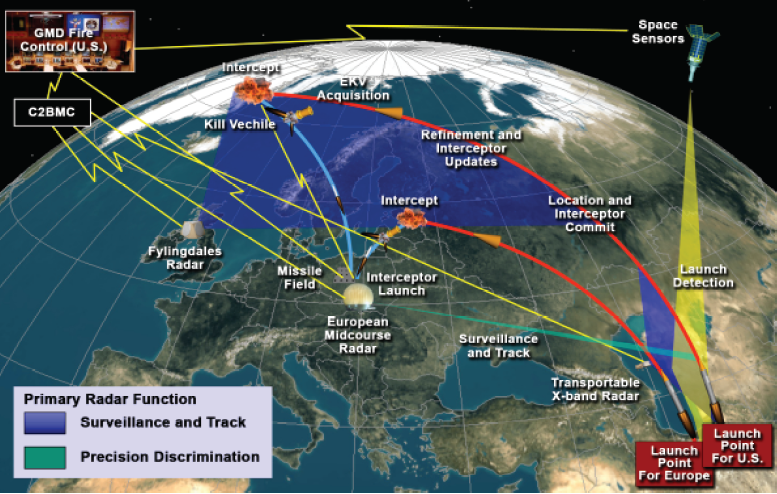
A substantial part of Engdahl’s book concerns missile defense, the military use of space and nuclear strategy. He argues that systems presented as defensive can also affect strategic balance because effective missile defense changes the calculation of deterrence. He pays particular attention to U.S. plans for interceptors in Poland and a radar in the Czech Republic and to Russia’s reaction to those projects.
The 2008 U.S.–Poland agreement did provide for an American interceptor facility, while the official U.S. explanation was protection of Europe and the United States from longer-range missile threats from the Middle East. Engdahl places the project in a broader nuclear balance with Russia and reads the shield as an element of potential strategic superiority. He treats space and information capabilities similarly: not as isolated technologies, but as components of an integrated architecture intended to reduce an opponent’s capacity to respond.
September 11, the War on Terror and the “permanent war state”
Engdahl treats September 11, 2001 as a turning point after which an existing strategic direction gained far wider political room to operate. The Patriot Act, the wars in Afghanistan and Iraq, expanded surveillance and the doctrine of anticipatory or preemptive action form part of his account of a new period in which the enemy became global, diffuse and potentially permanent.
Primary documents establish important parts of that context: the Patriot Act was approved on 26 October 2001 and expanded investigative and counterterrorism authorities; the 2002 National Security Strategy explicitly stated that the United States could act preemptively against emerging threats. Engdahl turns this context into his broader thesis of a “permanent war state”—a system in which continuing danger sustains military readiness, security institutions and the political legitimacy of global force projection.
What Engdahl ultimately means by Full Spectrum Dominance
Taken as a whole, “Full Spectrum Dominance” means far more in Engdahl’s book than it does in Joint Vision 2020. He connects conventional forces, nuclear weapons, space, information superiority, bases, missile defense, NATO, support for political change, human-rights discourse, propaganda, economics and energy into one model of U.S. hegemony. That is the book’s central thesis and the reason for its subtitle, Totalitarian Democracy in the New World Order.
The key discipline is therefore straightforward. Primary documents show that Full Spectrum Dominance, global power projection, information superiority and many of the programs discussed in the book are not invented phrases. Engdahl’s additional move is to connect diverse policies into one coherent long-term strategy. The article neither conceals that move nor presents it as an officially acknowledged interpretation. Its purpose is to explain how the book sees the world, which events it connects, and why its framework has influenced debates about post-Cold War American power.
Sources and further reading
- F. William Engdahl, Full Spectrum Dominance — Google Books, 2009 edition
- F. William Engdahl, Full Spectrum Dominance — Google Books, 2011 edition
- WorldCat — Full spectrum dominance, 2009
- U.S. Joint Chiefs of Staff — Joint Vision 2020, GovInfo
- American Forces Press Service / DVIDS — Joint Vision 2020 Emphasizes Full-spectrum Dominance
- NATO — Member countries / post-Cold War enlargement history
- NATO — Seven new members join NATO, 29 March 2004
- NATO — Bucharest 2008 open-door decisions on Ukraine and Georgia
- U.S. State Department — Ballistic Missile Defense Agreement with Poland, 2008
- U.S. State Department — text of U.S.–Poland missile-defense agreement
- White House archive — National Security Strategy, 2002
- White House archive — 2002 preemption language
- GovInfo — USA PATRIOT Act, Public Law 107-56
- Washington Post — U.S. Advice Guided Milosevic Opposition, 11 Dec 2000
- USAID Office of Transition Initiatives — Serbia/Montenegro program report
- National Endowment for Democracy — 2002 Annual Report, Serbia/Otpor grants
- NATO — Poland and NATO historical account
- NATO — Membership Action Plan