September 11, 2001: Investigations, Intelligence Gaps, and Open Questions
The article separates three 9/11 questions — the hijackings, foreknowledge, and collapse mechanisms — and consolidates the strongest technical, intelligence, and support-network evidence without turning anomalies into unproven conclusions.
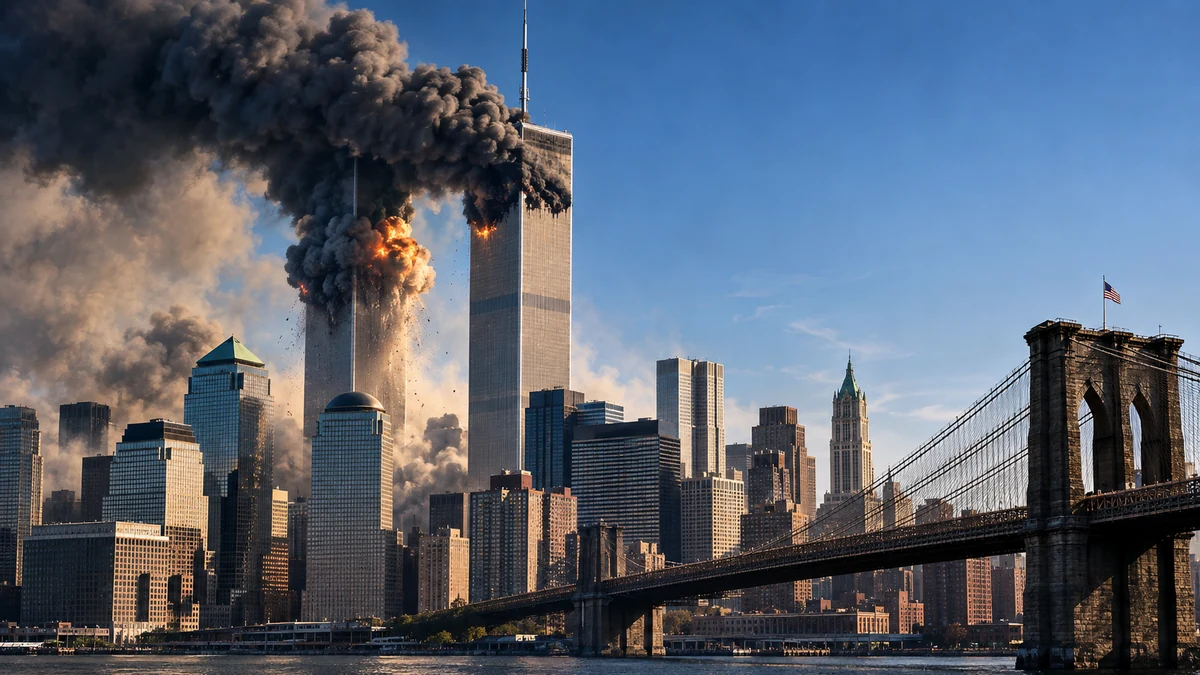
September 11, 2001 raises three different questions that should not be collapsed into one: who organized the hijackings, who may have possessed enough advance information to prevent or exploit the attack, and what physically caused the complete collapse of three high-rise buildings. Evidence for one proposition is not automatically evidence for the other two.
This article therefore does not assume that an institutional explanation is correct simply because it is official. Reports by NIST, the 9/11 Commission, the FBI, CIA, inspectors general, and courts are important parts of the evidentiary record, but they are evaluated by their sources, methods, scope, later corrections, and by which alternative explanations they actually tested.
At the same time, the article avoids the opposite error. An accumulation of anomalies is a reason to investigate further, not a mathematical proof of a single plan. The strongest evidence comes from concrete intersections: information about specific future hijackers, documented assistance, telephone and financial records, physical exhibits, forensic signatures, and verifiable timelines.
The result is an open reconstruction. Some anomalies often dismissed as myths are real; others are weaker than commonly portrayed; and later declassifications materially changed the early public picture. The question is not whether one must choose between an “official story” and one alternative theory, but how far each evidentiary line actually reaches and which link is still missing.
Three questions, three evidentiary chains
The 9/11 Commission reconstructed the multi-year development of al-Qaeda’s “planes operation,” Khalid Sheikh Mohammed’s role, the selection of hijackers, flight training, and financial flows. It estimated the operation cost roughly $400,000–$500,000 and concluded that most financing came through al-Qaeda. That is a strong operational record concerning the hijackings.
It does not automatically answer the other two questions. Someone outside the operational cell could have known more than was later acknowledged; agencies could have possessed fragments they failed to connect in time; and the physical mechanism of each building collapse can be tested separately. This article therefore treats each proposition through its own evidentiary chain.
What the public investigative record attributes to al-Qaeda
The published Commission record links the nineteen hijackers to al-Qaeda and KSM to the planning of the operation. The Commission’s financial investigation found that funds moved through ordinary banking and cash channels and said it found no credible evidence that a person in the United States or a foreign government provided substantial financing to the hijackers.
That conclusion should be taken seriously without being stretched beyond its scope. A demonstrated al-Qaeda operational role does not by itself exclude additional foreknowledge, logistical assistance by people who did not know the full plot, concealment of institutional failures, or a different technical mechanism for a particular collapse. Those are separate claims.
Towers 1 and 2: NIST’s mechanism and the modeling boundary
NIST concluded that the aircraft impacts damaged structural systems and dislodged fireproofing, while the ensuing fires weakened floors and columns until global collapse initiation. In NIST’s reconstruction, failure began in the impact-and-fire zones and progressed downward; NIST reported no corroborating evidence of explosive demolition.
A public methodological boundary matters: NIST modeled in detail the period from aircraft impact to collapse initiation, not the entire subsequent destruction of both towers at the same numerical level of detail. NIST regarded the later collapse as inevitable once global failure began; critics argue that this leaves the later dynamics less directly tested. That distinction does not establish an alternative mechanism, but it defines what the model itself demonstrated.
WTC 7: free fall and a competing structural reconstruction
WTC 7 was not struck by an aircraft. It sustained debris damage, burned uncontrolled for hours, and collapsed at about 5:20 p.m. NIST attributed the failure to thermal expansion, failure around Column 79, and cascading internal failures. A distinctive feature is that NIST acknowledged roughly 2.25 seconds of gravitational acceleration, or free fall, in the exterior descent; in its explanation, that phase occurred only after internal support had already been lost.
A University of Alaska Fairbanks study led by J. Leroy Hulsey reached the opposite structural conclusion: its model found that fire could not produce the observed collapse and that reproducing the motion required near-simultaneous failure of multiple supports. The project was funded by Architects & Engineers for 9/11 Truth, which is relevant to provenance and potential interest; the study itself does not identify an explosive, perpetrator, or operational plan. WTC 7 therefore remains a serious technical dispute, not standalone proof of controlled demolition.
Physical evidence: testimony, red-gray chips, and unusual steel damage
Firefighters, police officers, employees, and other witnesses described bangs, flashes, and events they interpreted as explosions. Those statements are part of the historical record, but the word “explosion” does not identify a cause: possibilities include explosives, fuel, electrical equipment, pressure events, or structural failure. The testimony is strongest when it can be matched in time and location to independent evidence.
Harrit and colleagues reported red-gray chips in dust samples in 2009 and interpreted them as unreacted energetic thermitic material. Another analysis of comparable chips found a composition consistent with epoxy, iron oxide, and kaolin. The published thermitic interpretation therefore remains part of the evidentiary record, but not a settled chemical demonstration of thermite at the WTC.
FEMA documented unusual high-temperature oxidation and sulfidation, intergranular penetration, and an Fe–O–S eutectic associated with localized liquefaction and thinning in recovered steel. FEMA called the phenomenon unusual and recommended further study; it did not conclude that thermate caused it. NIST later stated explicitly that tower steel was not tested for explosive or thermite/thermate residues. The absence of such testing does not prove explosives, but it means chemical residue testing was not part of NIST’s exclusion of that alternative.

Silverstein, BBC, and put options: three anomalies with different limits
Larry Silverstein did not buy the WTC land in July 2001; his group obtained a 99-year lease, and property insurance was required by the lease. Roughly $3.5 billion in coverage per occurrence and the later dispute over whether the two aircraft impacts constituted one or two occurrences are real. So are his absence that morning for a dermatology appointment and the later “pull it” remark concerning WTC 7. None of those facts alone proves foreknowledge or a demolition order, but neither are they pure internet inventions.
BBC did report WTC 7 as having collapsed while the building was still standing and visible behind its correspondent. The error can be traced to a Reuters report in an environment where emergency personnel already expected that the building might collapse. The premature report is a documented anomaly; without additional evidence it does not distinguish between a pre-scripted narrative and a mistaken report in a chaotic information flow.
Unusually large put-option trades in United and American Airlines before the attacks were also real. The Commission’s investigation concluded, in a prominent example, that 95 percent of the UAL puts on September 6 were tied to one U.S.-registered investment adviser and found no demonstrable connection to al-Qaeda or advance knowledge. The anomaly was investigated and received an explanation, though the public report does not reproduce the complete regulatory file.
Pre-attack warnings: from strategic danger to specific names
CIA’s September 11, 2026 declassification released 71 President’s Daily Brief products. Titles from 1998 include Reports That Bin Ladin is Planning Attacks Inside the US and Bin Ladin Preparing To Hijack US Aircraft and Other Attacks. This substantially strengthens the evidence that attacks inside the United States and hijacking U.S. aircraft were subjects of strategic warning years before 2001.
The trail is stronger still when it reaches specific people. The Justice Department Inspector General found that CIA knew in January 2000 that al-Mihdhar had a multiple-entry U.S. visa and was associated with the Kuala Lumpur gathering of al-Qaeda operatives, and by March knew that al-Hazmi had traveled to Los Angeles. Critical information did not reach the FBI in time. The OIG identified at least five lost opportunities in which the FBI could have learned more or developed further leads.
The same OIG found no evidence that the FBI or another Intelligence Community member possessed specific intelligence about the full September 11 plot. The public record therefore establishes serious and repeated failures in the flow of concrete information; it does not by itself prove that information was deliberately withheld to protect the attack.
San Diego: documented assistance and a reopened support-network inquiry
When al-Hazmi and al-Mihdhar reached California, the story moves from general warning into a documented network of contacts. Omar al-Bayoumi met them in Los Angeles on February 1, 2000, after visiting the Saudi consulate, and then helped them secure housing in San Diego, complete rental paperwork, and open a bank account. The Commission could not determine whether the first meeting was accidental or arranged.
The future hijackers later lived for months in the home of an active FBI informational asset without the FBI recognizing who they were. Bayoumi himself had already been the subject of a preliminary FBI inquiry that closed in 1999. These are verifiable intersections between future hijackers, people who assisted them, and the pre-existing U.S. investigative apparatus.
The FBI reopened the issue through Operation Encore in 2007. Its May 2021 closing document confirms years of investigation into Bayoumi, Fahad al-Thumairy, and Musaed al-Jarrah and whether they knowingly aided the hijackers. The FBI and prosecutors ultimately concluded there was insufficient evidence to prosecute them for knowing participation in the attack. That is an important boundary: assistance and contacts are documented; knowledge and intent were not proven to the standard required for criminal prosecution.

Phones, money, and evidence provenance in San Diego
The declassified Joint Inquiry material described the documentary evidence that Bayoumi assisted the hijackers as strong. A later FBI record temporally links a $1,558 cashier’s check for the first rent, an equal cash deposit into Bayoumi’s account, and al-Mihdhar’s opening of an account with $9,900 within seven minutes. That strongly supports an immediate cash reimbursement explanation without automatically identifying the source or purpose of the cash.
FBI analysis of telephone toll records documented 67 contacts between numbers associated with Bayoumi and al-Thumairy and 11 contacts between Bayoumi’s mobile phone and a line subscribed to the Saudi consulate in the period around al-Hazmi and al-Mihdhar’s arrival. This establishes calls between numbers; their content and purpose are unknown.
FBI documents also record unusual financial timing, including a large increase in Bayoumi’s Dallah/AVCO allowance in spring 2000. The timing is relevant, but no public record reviewed here directly identifies the increase as payment for assisting the hijackers. This is why the article distinguishes the underlying record, FBI analysis of that record, witness testimony, and investigative inference.
Bayoumi’s British exhibits: the sketch, Washington, and a fragmented evidence path
British police seized a substantial body of documents, videos, and computer material after Bayoumi’s arrest in September 2001. An October 2001 FBI memorandum says copies of seized exhibits were provided to the U.S. side while also acknowledging that many videos, disks, and pieces of correspondence still awaited review or translation. Possession of evidence is not the same as analysis or distribution to the right investigators.
Among the later-highlighted exhibits is an airplane sketch with an equation for horizon geometry. The equation itself is standard and does not prove attack planning; FBI investigators only later developed operational interpretations of additional numbers and the drawing. In 2025 the court considered the exhibit as part of a broader jurisdictional record, not as standalone proof of intent.
Another exhibit is an approximately hour-long 1999 Washington video. It contains government sites, comments about Congress and security, as well as ordinary tourist imagery; the transcript includes a reference to a “plan.” Plaintiffs’ experts interpreted the video as surveillance, but Judge Daniels did not hold that the recording itself proved “casing.” The recipient, any tasking, and a direct connection to the attack planners remain missing.
The evidentiary path was uneven: the sketch’s specialist analysis is publicly documented only in 2012, while civil plaintiffs obtained additional Metropolitan Police material in 2022–2023, including a fuller Washington recording. That legitimately limits claims that every early public assessment rested on the entire body of material now known; by itself it does not prove deliberate suppression.
Bayoumi and Anwar al-Awlaki: acquaintance is documented, meaning remains disputed
Later British video evidence matters in part because of Anwar al-Awlaki. Bayoumi denied in a 2021 deposition that he had personally met him, while a 1998 recording shows the two together. The public litigation record also describes Awlaki contact information in Bayoumi’s address materials and additional shared social settings. On the narrow question of acquaintance, physical evidence carries more weight than the later categorical denial.
Paintball footage and gatherings involving visiting Saudi religious officials add context to the network, but they do not establish that a particular paintball event was operational terrorist training for September 11. The proper boundary is straightforward: acquaintance and repeated contacts are documented; purpose and linkage to the specific plot are not.
Awlaki, future hijackers, and Dar al-Hijrah
Awlaki enters the story not only through Bayoumi. Witness and FBI records place him in the same environment as al-Hazmi and al-Mihdhar in San Diego. Commission notes also document four calls between numbers associated with Awlaki and Bayoumi on the day Bayoumi helped the pair secure housing; the records do not establish who spoke or what was discussed.
After Awlaki moved to Virginia, al-Hazmi and Hani Hanjour appeared at his new mosque, Dar al-Hijrah. Eyad al-Rababah then helped them with housing and transportation. Some FBI agents suspected Awlaki may have directed Rababah to assist them; the Commission wrote that it shared the suspicion but could not prove it.
A further telephone trace comes from Hamburg: a 2002 FBI record says a number associated with Dar al-Hijrah was found in German-seized material connected to Essabar and Binalshibh; a later Commission appendix described it as Awlaki’s phone number. Because the underlying German seizure record is not publicly available for verification, the two formulations are not treated as identical. A stored contact number is also not proof that a call occurred.
Rababah’s logistics chain: assistance is established, higher direction is not
Rababah’s assistance is time-stamped and administratively traceable. In May 2001 he drove al-Hazmi, Hanjour, and two other future hijackers among Virginia, Connecticut, and New Jersey and helped them obtain lodging. Fairfield Inn telephone records contain 75 local calls, including calls to flight schools and real-estate offices; these are business records, not later witness memory.
Rababah also told the FBI that another person called him, said there were now “four” and that they wanted to see him, and that some of what he did for the group was requested by another person. Identities are partly redacted in the public record. Later FBI analysis therefore left as an explicit investigative gap the question of who, if anyone, directed Rababah and how much he knew about the hijackers’ activities.
That is more precise than either extreme. Rababah was not merely an incidental passerby with no verifiable role, but the public record also does not establish a higher command chain or his knowledge of the attack plan.
NORAD, Vigilant Guardian, and confusion between exercise and real event
The Vigilant Guardian exercise was underway on September 11. The public record confirms that some personnel initially checked whether incoming information was real-world or part of the exercise and that early FAA/NORAD timelines were later revised. That matters for understanding confusion, communication, and response speed.
The fact that an exercise occurred that morning does not by itself prove complicity. Such a claim would require a documented order, a deliberately created procedural obstacle, or communications showing that the exercise was used to facilitate the attack. The public record reviewed here does not establish that chain.
Two Israeli counterintelligence leads that should not be conflated
The so-called Israeli art students story and the case of five Israelis associated with Urban Moving Systems are separate leads. Internal DEA material recorded roughly 130 incidents in more than 40 cities involving young Israelis presenting themselves as art students at DEA and other federal or military locations; DEA examined the possibility of organized intelligence collection. The public record does not establish their involvement in the September 11 attacks.
Five Israelis in New Jersey were detained after the attacks, questioned, and later deported. Later reporting, citing anonymous former U.S. intelligence officials, alleged intelligence ties for some and the possibility that Urban Moving Systems served as cover; Israel denied spying, and the same reporting did not say the five had advance knowledge of the attacks. This is therefore a counterintelligence lead, not a direct link to the hijackers or the collapse mechanism.
PNAC, Northwoods, and post-9/11 policy
PNAC’s Rebuilding America’s Defenses did use language about transformation being slow absent a “catastrophic and catalyzing event — like a new Pearl Harbor.” Operation Northwoods, from 1962, is an authentic Joint Chiefs document containing proposals for staged incidents that could help justify war against Cuba.
Both matter as historical context. Northwoods demonstrates that false-flag concepts were in fact put on paper at the highest military level; PNAC demonstrates that geopolitical ambitions and thinking about a catalytic shock existed before September 11. Neither document is, by itself, an operational plan for the 2001 attacks.
September 11 was followed by the Patriot Act, the Afghanistan war, the preventive-war doctrine, and later Iraq. The attacks proved extraordinarily useful to already existing policy agendas. But benefiting from an event and using an event are not, by themselves, evidence of causing it.
What was actually planned in advance
Several circumstances later cited in 9/11 debates were not spontaneous coincidences: Silverstein’s lease and insurance arrangements were completed before the attacks; Vigilant Guardian was a scheduled exercise; PNAC and other strategic programs predated the event; intelligence services had warned for years about Bin Ladin, attacks inside the United States, and aircraft hijacking; and in the al-Mihdhar/al-Hazmi case, specific personal information already existed.
That does not mean all these things were planned as part of the attack. It does mean they should not be erased by the single word “coincidence.” Each requires a separate question: what was its documented prehistory, who possessed the relevant information, and is there an actual link to the operational core of the attack?
When the documented elements are assembled into a combined pattern
If every anomaly is treated in complete isolation, a specific explanation can usually be offered: BBC received bad information, Silverstein had a medical appointment, the exercise was routine, suspicious options trades had an innocent buyer, and intelligence fragments were lost through bureaucratic failure. Some of those explanations are well supported and belong in the record.
But the availability of a separate explanation for each element is not the same as explaining the combined pattern. The public record contains real intersections: specific future hijackers in pre-attack intelligence files; their residence with an FBI source; documented assistance in San Diego; telephone and financial records; repeated Bayoumi-Awlaki contacts; later logistical assistance in Virginia; physical exhibits seized early but analyzed unevenly; and technical questions where official and alternative reconstructions diverge.
A cumulative approach therefore justifies further inquiry, not an automatic conclusion of one hidden operation. The strongest next step is not collecting more associations but finding connecting evidence: communications, orders, financial flows with demonstrated purpose, access chains, forensic signatures, or archival documents that actually join two currently separate lines.
The open question: what is established and what is still missing
It is established or well documented that WTC 7 experienced a free-fall phase; that a serious professional dispute exists over its structural reconstruction; that FEMA documented unusual high-temperature damage in some recovered steel; that NIST did not chemically test tower steel for explosive or thermitic residues; that BBC prematurely reported WTC 7’s collapse; that multiple strategic warnings existed before the attacks; and that U.S. agencies possessed specific information about al-Mihdhar and al-Hazmi before September 11.
Also documented are contacts and assistance in San Diego, telephone and financial traces, Bayoumi’s acquaintance with Awlaki, Rababah’s later logistical assistance, and a fragmented path for part of the British evidence. Operation Encore nevertheless did not develop enough evidence to criminally prosecute Bayoumi, al-Thumairy, or al-Jarrah for knowing participation in the attack. Civil litigation against Saudi Arabia cleared an important jurisdictional hurdle in 2025, but that was not a final finding of liability.
What remains publicly missing is a direct operational chain. For intentional demolition, there is no public evidence showing procurement, access to critical structural elements, placement, initiation, and command. For foreknowledge and support networks, there is no public document proving a complete command chain between additional actors and the operational planners. The absence of a public chain is not proof that none existed; it is the boundary of what can responsibly be stated as proven today.
The article therefore remains an open investigative reconstruction rather than a verdict. It does not accept institutional explanations by authority alone, but neither does it turn documented contact into proof of intent without the missing evidentiary step. That boundary is precisely why September 11 remains a live historical and research question.

Sources and further reading
- National Institute of Standards and Technology (NIST). FAQs — WTC Towers Investigation (updated 2021).
- NIST. FAQs — WTC 7 Investigation (updated 2021).
- NIST. About the World Trade Center Disaster Investigation.
- NIST. Assessment of Structural Steel From the World Trade Center Towers, Part I (2006).
- NIST. Status of Data Collection Efforts for the WTC Investigation (2004).
- NIST. FEMA 403 Appendix C — Limited Metallurgical Examination (2002).
- NIST. Steel Inventory and Identification, NCSTAR 1-3B.
- NIST. Key Findings of June 2004 Progress Report — recovered WTC steel.
- University of Alaska Fairbanks. A Structural Reevaluation of the Collapse of World Trade Center 7 (2020).
- Harrit, N. H., et al. Active Thermitic Material Discovered in Dust from the 9/11 WTC Catastrophe. Open Chemical Physics Journal 2 (2009): 7–31.
- Millette, J. Analysis of Red/Gray Chips in WTC Dust — Progress Report (2012).
- New York Court of Appeals. Matter of New York Times Co. v City of New York Fire Department, 4 NY3d 477 (2005).
- New York Courts. New York Times Co. v New York Fire Dept., oral-history litigation record.
- World Trade Center Properties, LLC v. Hartford Fire Insurance Co., 345 F.3d 154 (2d Cir. 2003).
- Aegis Insurance Services v. 7 World Trade Center Company, S.D.N.Y. (2009) — lease and insurance background.
- Port Authority of New York & New Jersey. Consolidated Financial Statements 2012, Note K — WTC leases and insurance recoveries.
- Engineering News-Record. World Trade Center’s Rebuilders Find Opportunity in the Face of Tragedy — Silverstein dermatologist account.
- PBS FRONTLINE. Ground Zero — The Stakeholders: WTC lease and rebuilding obligations.
- PBS. America Rebuilds: A Year at Ground Zero (2002) — documentary source of the Silverstein “pull it” statement; Library of Congress catalog record.
- Silverstein Properties statement on “pull it,” reproduced in U.S. State Department counter-misinformation archive (2005).
- BBC Trust. Editorial Standards Committee Bulletin, Jan. 2017 — complaint concerning WTC 7/free-fall coverage.
- Full Fact. Error in BBC reporting doesn’t mean 9/11 was scripted (2021), documenting premature WTC 7 report and Reuters explanation.
- BBC Trust. Service Review / complaints concerning The Conspiracy Files and WTC 7 (2012).
- National Commission on Terrorist Attacks Upon the United States. The 9/11 Commission Report — Executive Summary.
- 9/11 Commission Report, Chapter 5 — A Money Trail?
- 9/11 Commission Report, Chapter 8 — “The System Was Blinking Red.”
- 9/11 Commission Report, Chapter 11 — Foresight and Hindsight.
- 9/11 Commission Report — Notes, including securities-trading investigation.
- 9/11 Commission. Terrorist Financing Staff Monograph (2004).
- 9/11 Commission Hearing, March 31, 2003 — testimony raising pre-attack put-option questions.
- 9/11 Commission Hearing, April 13, 2004 — Phoenix Memo, Moussaoui, and threat reporting.
- CIA. 71 Declassified 9/11-related President’s Daily Brief products (Sept. 11, 2026).
- CIA. CIA Releases President’s Daily Briefs in Commemoration of the 25th Anniversary of 9/11 (Sept. 11, 2026).
- CIA. “Bin Ladin Determined To Strike in US,” President’s Daily Brief, Aug. 6, 2001 (via National Security Archive).
- CIA. Declassified Documents Related to 9/11 Attacks — OIG and internal responses (2015 release).
- U.S. Senate Select Committee on Intelligence. Joint Inquiry into Intelligence Community Activities Before and After 9/11 (2002).
- U.S. Department of Transportation OIG. Results of OIG Investigation of 9/11 Commission Staff Referral (Aug. 31, 2006).
- Washington Post. 9/11 Panel Suspected Deception by Pentagon (Aug. 2, 2006).
- Washington Post. No Intent to Mislead Panel Found in Aviation Officials’ 9/11 Errors (Sept. 1, 2006).
- Salon. The Israeli “Art Student” Mystery (May 7, 2002), reporting on the June 2001 DEA security memo.
- The Forward. Spy Rumors Fly on Gusts of Truth (March 15, 2002) — Urban Moving Systems counterintelligence reporting.
- The Forward. FBI Probe Defuses Israeli Spying Rumors (March 15, 2002) — official denials and investigation context.
- National Archives. 9/11 Commission Records and FBI/agency source holdings.
- National Archives. 2026 Presidential Records release notice referencing Israeli Art Students and Urban Moving Systems records.
- Project for the New American Century. Rebuilding America’s Defenses: Strategy, Forces and Resources for a New Century (Sept. 2000), archived transcription.
- National Security Archive. Joint Chiefs of Staff, “Justification for US Military Intervention in Cuba” / Operation Northwoods, March 13, 1962.
- George W. Bush White House Archives. The National Security Strategy of the United States of America (Sept. 2002).
- GovInfo. H.R. 3162 — USA PATRIOT Act of 2001, introduced Oct. 23, 2001.
- U.S. House of Representatives History, Art & Archives. House Passes the USA PATRIOT Act.
- 9/11 Commission. Staff Statements and Monographs index.
- GovInfo. Official U.S. Government edition of the 9/11 Commission Report.
- NIST. World Trade Center Investigation portal and reports.
- George W. Bush Presidential Library / National Archives. FOIA 2025-0218-F Finding Aid — Records on Internal White House Records Regarding “Israeli Art Students,” “Urban Moving Systems,” and Other Particular Terms (2026).
- U.S. Department of Justice, Office of the Inspector General. A Review of the FBI’s Handling of Intelligence Information Related to the September 11 Attacks, Chapter Five: Two September 11 Hijackers — Khalid al-Mihdhar and Nawaf al-Hazmi (released publicly 2006).
- CIA Office of Inspector General. OIG Report on CIA Accountability With Respect to the 9/11 Attacks (June 2005; declassified release).
- National Commission on Terrorist Attacks Upon the United States. The 9/11 Commission Report, Chapter 7 — The Attack Looms (San Diego / Bayoumi / Thumairy material).
- Federal Bureau of Investigation. Operation Encore Closing Electronic Communication — To administratively close case (May 27, 2021), released under Executive Order 14040.
- Federal Bureau of Investigation. Addendum to Operation Encore Closing Electronic Communication (September 8, 2021), released under Executive Order 14040.
- U.S. District Court, Southern District of New York. In re Terrorist Attacks on September 11, 2001, 03 MDL 1570, Document 11182, Memorandum Decision and Order denying KSA renewed motion to dismiss for lack of jurisdiction (August 28, 2025).
- U.S. District Court, Southern District of New York. In re Terrorist Attacks on September 11, 2001 — order staying proceedings involving KSA pending interlocutory appeal (November 5, 2025).
- Reuters. Trump says he will consider request to release more 9/11 records concerning possible Saudi ties (September 13, 2026).
- U.S. Congress, Joint Inquiry into Intelligence Community Activities Before and After the Terrorist Attacks of September 11, 2001. Declassified Part Four / “28 Pages” (declassified July 2016), including Bayoumi, Bassnan and Saudi-government-related leads.
- Federal Bureau of Investigation. San Diego to New York electronic communication, September 29, 2005 — Bayoumi / Thumairy / Saudi Consulate telephone analysis, released under Executive Order 14040.
- Federal Bureau of Investigation. Operation Encore working document / Counterterrorism communication, September 28, 2010 — phone, logistics and support-network analysis, released under Executive Order 14040.
- Federal Bureau of Investigation. Operation Encore joint case progress / closing communication, March 21, 2013 — support/logistics and advance-team investigative assessments, released under Executive Order 14040.
- Federal Bureau of Investigation. ENCORE Investigation Update, Review and Analysis: Interview (November 2015), Electronic Communication dated April 4, 2016.
- Federal Bureau of Investigation. Records concerning Omar al-Bayoumi / Dallah AVCO salary and allowance history, released in Executive Order 14040 Release Update Part 03.
- Federal Bureau of Investigation. “Connections to the Attacks of September 11, 2001,” Electronic Communication dated July 23, 2021; historical summary concerning Saudi-government-affiliated persons and entities; document expressly states it is not an intelligence assessment.
- Saudi Press Agency. Statement from the Embassy of the Kingdom of Saudi Arabia in the United States regarding release of classified September 11 documents (September 8, 2021).
- Federal Bureau of Investigation. New York to Counterterrorism electronic communication, August 12, 2009 — Operation Encore / Omar al-Bayoumi; bank, rental, employment and transaction-record synthesis, released under Executive Order 14040.
- Federal Bureau of Investigation. Operation Encore electronic communication, February 18, 2010 — chronology derived from telephone and banking records, released under Executive Order 14040.
- U.S. District Court, Southern District of New York. In re Terrorist Attacks on September 11, 2001, 523 F. Supp. 3d 478 (S.D.N.Y. 2021) — discovery ruling describing FBI production and location of underlying telephone, bank and financial business records.
- Federal Bureau of Investigation. Operation Encore electronic communication, April 5, 2012 — analysis of handwritten airplane/horizon equation seized from Omar al-Bayoumi’s United Kingdom residence; released under Executive Order 14040.
- Andrew T. Young, San Diego State University. “Distance to the Horizon” — geometric derivation of the horizon-distance relation from the Pythagorean theorem.
- National Transportation Safety Board. Flight Path Study — American Airlines Flight 77, February 19, 2002.
- U.S. District Court, Southern District of New York. In re Terrorist Attacks on September 11, 2001, Memorandum Decision and Order, ECF No. 11180 (August 28, 2025) — review of December 11, 2024 expert-evidence rulings, including Barry Schiff and Douglas Moss.
- U.S. District Court, Southern District of New York, Magistrate Judge Sarah Netburn. In re Terrorist Attacks on September 11, 2001, Opinion & Order, ECF No. 10615 (December 11, 2024) — Daubert rulings on aviation experts Barry Schiff and Douglas Moss; public case-text mirror.
- U.S. District Court, Southern District of New York. Plaintiffs’ Averment of Facts and Evidence in Support of Claims Against the Kingdom of Saudi Arabia and Dallah Avco, corrected public filing (January 2024; public version filed August 2, 2024) — cited for MPS exhibit provenance, Bayoumi deposition excerpts, Awlaki contact records, January 1998 embrace footage, paintball-video allegations/exhibit references, Washington-video transcript, and the May 2002 MPS return receipt. Treated as a party filing whose underlying exhibit references are distinguished from the plaintiffs’ inferences.
- ProPublica, Tim Golden. “At Least Two Saudi Officials May Have Deliberately Assisted 9/11 Hijackers, New Evidence Suggests” (September 11, 2024) — litigation context, Saudi tourist-video position and provenance reporting concerning British materials.
- CBS News / 60 Minutes. “Investigators for 9/11 families examine video taken by man with ties to Saudi intelligence referencing a ‘plan’” (June 20, 2024) — public reporting of former FBI officials’ interpretations; treated in R238 as attributed expert opinion, not a court finding.
- Federal Bureau of Investigation. Counterterrorism memorandum dated October 11, 2001, reporting New Scotland Yard transfer of copies of recovered Bayoumi exhibits, computer mirror images, and continuing review/translation work; released under Executive Order 14040.
- U.S. District Court, Southern District of New York, Magistrate Judge Sarah Netburn. In re Terrorist Attacks on September 11, 2001, Order dated August 12, 2024 — procedural history of June 2021 UK assistance request and March 2022 / December 2023 Metropolitan Police Service productions.
- ProPublica, Tim Golden. “25 Years After 9/11, Questions About the FBI’s Pursuit of Saudi Suspects in the Case Have Only Grown” (September 10, 2026) — investigative reconstruction of the 2001 evidence transfer, limited tape review, 2012 Encore London review, Bayoumi’s network with Saudi religious officials and Awlaki, and later evidence-access gaps; treated as secondary reporting where complete underlying logs are not public.
- BBC News, Jane McMullen. “New videos of man in 9/11 lawsuit reveal links to extremists and Saudi state” (September 7, 2026; clarification September 14, 2026) — reporting on newly public Bayoumi videos, the Awlaki embrace, paintball footage, Saudi response, evidence handling, and material reportedly not seen by the 9/11 Commission; treated as later investigative reporting rather than a primary custody log.
- National Security Archive. FBI follow-up interviews with Anwar al-Awlaki, September 17 and 19, 2001 — FD-302 records documenting his recognition of Nawaf al-Hazmi, acknowledged San Diego association, and claimed lack of remembered substantive conversations.
- National Security Archive. FBI memorandum, December 1, 2006 — request to interview Anwar al-Awlaki in Yemen; records known San Diego contacts with al-Hazmi/al-Mihdhar, possible Virginia contacts with al-Hazmi/Hanjour, and states the exact relationship remained unclear.
- Federal Bureau of Investigation. New York electronic communication, July 25, 2007 — retrospective Awlaki investigative history, including 1999 opening as an investigative subject, San Diego hijacker contacts, possible Virginia contacts, and the assessment that his exact relationship with the hijackers remained unclear; released under Executive Order 14040.
- Federal Bureau of Investigation. Newark to Counterterrorism, PENTTBOM investigative summary (June 3, 2002), citing Bonn serial 858; records a telephone number associated with Dar al-Hijrah among material tied to Zakariya Essabar and Ramzi Binalshibh.
- National Commission on Terrorist Attacks Upon the United States. Terrorist Travel Staff Monograph, Appendices — Anwar Nasser Aulaqi entry; states that Aulaqi’s telephone number was found when police searched Ramzi Binalshibh’s Hamburg apartment.
- National Commission on Terrorist Attacks Upon the United States. The 9/11 Commission Report — Notes to Chapter 7; sources the Dar al-Hijrah/Rababah chronology, changed first-meeting account, and FBI suspicion of possible Awlaki tasking.
- Federal Bureau of Investigation. Executive Order 14040 release 2(d), Part 1 — Eyad al-Rababah FD-302 (March 17, 2013) and Communications Exploitation of Target Number (March 30, 2016); records uncertainty over imam identification and preserves the unresolved question of who, if anyone, directed Rababah to assist the hijackers.
- Federal Bureau of Investigation. Working Draft Chronology of Events for Hijackers and Associates (Nov. 14, 2003 version), May 8, 2001 Hani Hanjour entry — hotel records and witness evidence place Hanjour, al-Hazmi, Moqed, and al-Ghamdi at the Fairfield Inn and record 75 local calls, many to flight schools and real-estate agencies.
- Federal Bureau of Investigation. 9/11 FBI Report, February 2004 — records the May 8 Virginia-to-Connecticut trip, the group’s May 10 departure from the Fairfield Inn without Rababah’s knowledge, the unknown May 10–16 lodging interval, and the later South Hackensack/Paterson lodging chronology.