From Global Cooling to Warming: What Did the Media and Science Actually Say?
The 1970s were neither an era of unanimous scientific fear of a new ice age nor a time when cooling was never taken seriously. The archive shows a real cooling trend, aerosol scenarios, dramatic media headlines and, at the same time, a long-established scientific line of CO₂ warming.

In the 1970s, articles about global cooling really did exist. Some scientists genuinely investigated whether the recent temperature decline might continue, and both TIME and Newsweek published stories that could leave readers with the impression that a colder era was approaching. It would therefore be dishonest to rewrite the history as though cooling had never been discussed.
But the opposite extreme is also wrong. A review of the peer-reviewed literature from the period does not show a scientific consensus on an imminent ice age. Cooling papers were published between 1965 and 1979, but papers anticipating warming from rising CO₂ were more numerous. In the same decade that Newsweek wrote about a ‘cooling world,’ Wallace Broecker asked in Science whether the planet was on the brink of pronounced global warming.
The more interesting story is a competition between two real physical effects. Aerosols and particles can reflect sunlight and cool the surface; greenhouse gases reduce outgoing heat and warm the climate system. Scientists of the 1970s were not choosing between one real and one imaginary mechanism. They were trying to estimate which influence would dominate, how emissions would evolve and how reliable the available observations were.
The article therefore examines four separate questions: what was actually measured, what the scientific literature published, what mass media emphasized, and what happens to public judgement when uncertainty is translated into fear. Only by separating these layers can we see why the story of a ‘switch from an ice age to global warming’ is partly true yet misleading in its most common form. The article also draws a clear ethical boundary: warning about risk is legitimate; presenting the worst-case scenario as though it were nearly certain is not neutral information.
First separate three histories: the temperature record, scientific literature and the media story
When someone today produces a headline or clipping from the 1970s, it is often treated as proof of ‘what science said at the time.’ A newspaper headline, a peer-reviewed paper and an instrumental temperature record are not the same kind of evidence. The first shows what editors chose to feature, the second what a researcher argued professionally, and the third what the observations then allowed scientists to see.
This distinction is not a way to dismiss inconvenient old forecasts. It lets us acknowledge that some scientists genuinely warned about cooling without turning those papers into a consensus that did not exist. The same applies to journalism: highly visible cooling stories were real, but the media did not speak with one voice either.
| Level | What is historically verifiable | Common mistake |
|---|---|---|
| Measurements | The mid-20th century included a period of stagnation or cooling, stronger in early Northern Hemisphere analyses. | Turning a regional or short-term trend into a universal forecast. |
| Peer-reviewed science | Aerosol-cooling scenarios and CO₂-warming papers both existed. | Treating one or several papers as the consensus of an entire field. |
| Mass media | TIME, Newsweek and others published stories about cooling and food risks. | Equating a media headline with the formal position of the scientific community. |
| Current assessment | Greenhouse gases warm; aerosols predominantly cool; net human influence is warming. | Projecting today’s knowledge backward as though genuine 1970s uncertainty never existed. |
1940–1970: the cooling was not invented, but the early record was not truly global
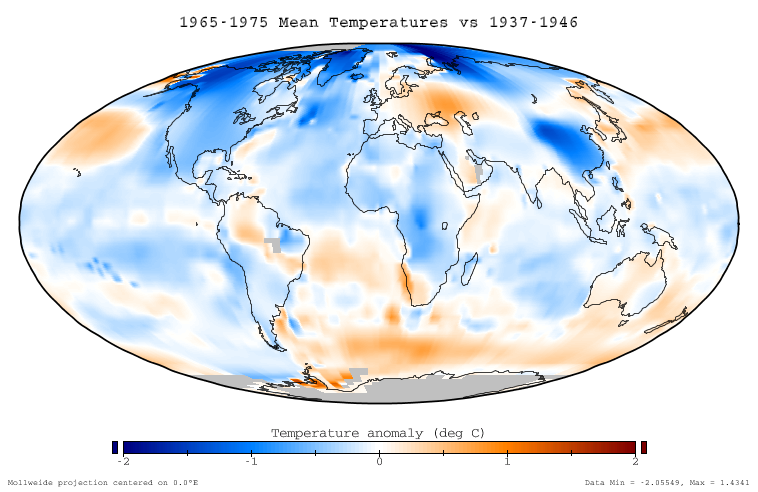
Part of the global-cooling story grew from a genuine observation. Early analyses showed temperatures falling after the warmer decades of the first half of the twentieth century. NASA’s historical review notes that important early series were concentrated mainly between 20° and 90° north, where Murray Mitchell found roughly 0.3°C of cooling from around 1940 to 1970.
Later, when a more global temperature record was assembled, the picture changed. Hansen’s team estimated in 1981 that post-1940 global cooling was much smaller, around 0.1°C, while the longer trend from the late nineteenth century through the late 1970s was already net warming. This is not a case of measurements being ‘rewritten’; broader geographic coverage changed the estimate of the planet as a whole.
The historical phrase ‘global cooling’ can therefore mislead if read with today’s meaning of global. The signal was real enough to demand explanation, but its magnitude, spatial pattern and duration were known much less well than they are today.
Aerosols: a real cooling mechanism that does not have to be denied to understand warming
The strongest scientific basis for cooling scenarios was not newspaper ice-age imagery but aerosols. Sulfate particles and some other aerosols reflect incoming sunlight, alter clouds and can create a net negative radiative forcing. The mechanism remains part of standard climate physics; the IPCC assesses that other human influences, principally aerosols, have masked part of greenhouse-gas warming.
Rasool and Schneider calculated in 1971 that a fourfold increase in global background aerosol concentration could, in their model, lower surface temperature by roughly 3.5 K and, if sustained, could be sufficient to trigger ice-age conditions. The paper is real and should not be waved away. But it was a scenario of very large aerosol increases, not a measurement of the future or proof that such an emissions pathway would occur.
There was no uniform view of the net aerosol effect even then. A 1970 NOAA technical memorandum challenged some earlier cooling interpretations and found that certain tropospheric aerosols could warm or cool depending on optical properties and surface conditions. That disagreement shows how incomplete knowledge of aerosol distribution, absorption, scattering and cloud effects still was.
The greenhouse direction did not begin in the 1980s: Arrhenius, Callendar, Revelle, Keeling and Manabe
The story that science first chose cooling and only later ‘invented’ warming fails on chronology. Svante Arrhenius quantitatively examined the effect of atmospheric CO₂ on temperature in 1896. Guy Stewart Callendar linked fossil-fuel combustion, rising CO₂ and observed warming in 1938 and calculated a positive temperature effect from additional carbon dioxide.
Revelle and Suess warned in 1957 that rapidly increasing fossil-fuel combustion amounted to a large geophysical experiment. Keeling then used precision measurements to show seasonal cycling and a persistent rise in atmospheric CO₂. In 1967 Manabe and Wetherald’s radiative-convective model estimated roughly 2°C of warming for doubled CO₂ under the relative-humidity assumptions of their model.
All of this predates the most frequently cited cooling stories in popular magazines. Climate science of the 1970s was therefore not a linear sequence of ‘cold, then warm,’ but simultaneous work on multiple forcings whose relative strength and future development were still poorly constrained.
1971: what the Rasool–Schneider paper actually claimed
The Rasool–Schneider paper matters precisely because it can be read without caricature. The authors calculated that adding CO₂ warmed the surface, although their model produced diminishing additional warming at higher concentrations. Their aerosol calculation produced a stronger cooling response and warned of major temperature decline if global particle concentrations rose several-fold.
Two statements are therefore true at once. The paper gave scientific legitimacy to a strong cooling scenario and formed part of the real history from which media stories emerged. At the same time, it did not claim that this trajectory was certain; the result depended on assumed aerosol growth and on simplified treatment of aerosol radiative behaviour.
Stephen Schneider later became one of the best-known researchers of anthropogenic warming. That trajectory is not evidence of opportunism; it is a useful example of a scientific assessment changing as observations, models and understanding of aerosols, clouds and the carbon cycle improved.

1974–1975: the media cooling wave was real
In June 1974, TIME published ‘Another Ice Age?’ describing several decades of cooler conditions and concern over unusual weather. Yet the article was more cautious than later screenshots often suggest: it framed the situation as suspicion and possibility and acknowledged that scientists did not know the direction and causes well enough.
In April 1975, Newsweek published Peter Gwynne’s much more dramatic ‘The Cooling World.’ It warned of ominous signs, possible declines in food production and broad agreement among meteorologists about a continuing cooling trend. The article later became an iconic exhibit in the claim that ‘science once predicted an ice age.’
Gwynne’s 2014 retrospective is revealing. He did not say the story had been invented from nothing; he said there was a real group of climatologists with genuine scientific reasons to consider cooling. He also acknowledged that the piece was overconfident and failed to present the full scientific picture. That is the fairest way to read the clipping: evidence of a real media and scientific strand, not a map of the entire discipline.
What about the New York Times and other media? They did not speak with one voice either
In May 1975, the New York Times ran a story about the possibility of major cooling and the well-documented Northern Hemisphere decline. Yet the opening also stressed that scientists were confident mainly that climate was changing, while its direction and cause remained matters of deep debate.
Only months later, the same newspaper ran another piece by the same reporter describing new journal papers that challenged the cold-period interpretation. This matters because the media story itself was not one-directional. Ice-age headlines were more memorable than pieces about uncertainty, aerosols, CO₂ and competing explanations.
Historical analysis should therefore distinguish the visibility of an idea from its dominance. Cooling was vivid, photographically powerful and politically dramatic because it invoked harvest failure and ice ages; that does not mean it represented most of the specialist literature.
Fear sells: from the headlines of 1975 to today’s attention economy
The analysis does not stop at the mild observation that some headlines were ‘dramatic.’ When a news outlet knows that the specialist picture is uncertain yet selects the most frightening scenario and presents it as the dominant or nearly certain future, that is manipulative communication. The problem is not warning about danger. The problem is collapsing the difference between probability and possibility, scenario and forecast, and the full state of evidence versus the fragment most likely to capture attention.
This boundary is not invented for this article. The Society of Professional Journalists’ Code of Ethics requires accuracy and context, specifically warns against misleading or oversimplifying when promoting and summarizing stories, and cautions against pandering to lurid curiosity. The historical problem with The Cooling World is therefore not that Newsweek covered a real cooling strand in science; it is that a divided and uncertain research landscape was communicated with more confidence than the full literature justified.
The mechanism did not disappear with 1970s magazine covers. Today’s online environment contains a measurable incentive for negativity: in a large set of randomized headline experiments, each additional negative word in an average-length headline increased click-through rates by about 2.3%. This does not prove that ‘all media deliberately frighten people today,’ but it does demonstrate an economic and behavioural pressure that rewards fear, conflict and catastrophic framing with attention.
The historical lesson is therefore directly contemporary. If an outlet selects an extreme scenario, conceals material uncertainty or turns a possibility into an impression of near-certainty, that practice deserves criticism whether the subject is cooling, warming, an epidemic, war, technology or something else. A real danger does not create a licence for a false degree of certainty. The more serious the risk, the stronger the duty to communicate uncertainty honestly.
Within the natural-law framework used by THY-REALITY, the objection goes deeper. In Aquinas, the human person as a rational being is naturally directed toward knowledge of truth and social life. The article draws a normative conclusion from that framework: deliberately bypassing rational judgement through exaggerated fear acts against the dignity of human reason and free judgement. This is the portal’s philosophical assessment, not an empirical claim of climate science, and it is therefore stated separately and explicitly.
The contemporary crisis of trust in news has many causes and cannot fairly be attributed to sensationalism alone. Yet the Reuters Institute reports that across 47 markets only about 40% say they trust most news most of the time. That is another reason journalism should not confuse informing people with behavioural engineering for clicks, ratings or political effect. The long-term cost of exaggeration is not only a false impression about one topic; it is the erosion of trust even when a later warning is real and urgent.
The 1965–1979 literature review: seven cooling, forty-four warming and twenty neutral papers
Peterson, Connolley and Fleck reviewed peer-reviewed literature from 1965–1979 that addressed the direction of future temperature change. Their classification identified 7 cooling papers, 44 warming papers and 20 papers with no clear directional prediction. Any historical classification involves judgement at the margins, but the ratio is difficult to reconcile with the claim that cooling was the scientific consensus.
Those counts do not mean that ‘97 percent of scientists’ in 1970 already agreed with every conclusion of modern climate assessments. Climate science was institutionally, observationally and computationally younger. The narrower point is that the specific claim ‘most published climate research predicted global cooling’ is poorly supported.
Nor should the forty-four warming papers be treated as proof that every early warming projection was accurate. Models, sensitivities, time horizons and forcings differed substantially. The review tells us about the balance of published directions, not the precision of every forecast.
1975: in the same year as Newsweek, Broecker forecast pronounced warming
In August 1975, only months after Newsweek, Wallace Broecker published ‘Climatic Change: Are We on the Brink of a Pronounced Global Warming?’ in Science. He accepted that a cooling trend existed at the time, but argued that natural cooling would bottom out within roughly a decade and that exponentially rising CO₂ would then become dominant.
Broecker’s forecast was not flawless; he later discussed how some of its success came from incorrectly estimated natural variability. But the direction is historically important. Global warming was not a late reaction to the collapse of an ice-age scare. It was an active scientific hypothesis at the same moment that the best-known cooling headlines were appearing.
That simultaneity disappears when history is told only through magazine covers. Science rarely has one headline; during transitional periods it contains competing models that observations gradually discriminate among.
The 1975 National Academy report: a research program, not a declaration of an imminent ice age
The U.S. National Academy of Sciences report Understanding Climatic Change: A Program for Action is often invoked in modern debates. It did take climate variability and potential social consequences seriously. But its central message was not a confident ice-age forecast; it was lack of knowledge and a call for systematic national observations, data analysis and modelling.
The report emphasized the need to predict future changes whether natural or human-induced. That language matters. The central institutional concern in 1975 was uncertainty in the climate system, not a unified belief in one direction.
A reader who extracts only graphs of past cooling or discussions of ice ages can produce a very different impression from a reader who examines the recommendations as a whole. This is the same documentary problem seen with old newspaper clippings: context determines what a source actually proves.
The 1979 Charney Report: why the balance shifted toward CO₂
By the end of the decade, evidence from rising CO₂, radiative physics and independent models had become strong enough for the U.S. National Academy to commission a focused assessment. The Charney Report compared the available models and concluded that there was no reason to expect climatic changes from continued CO₂ growth to be negligible.
The report estimated equilibrium warming from doubled CO₂ in a range of roughly 1.5–4.5°C, with a central estimate near 3°C. The uncertainty was broad but the sign of the effect was clear. The debate therefore shifted from whether greenhouse warming could become important toward how large it would be and how quickly it would emerge.
This was not a sudden ideological reversal. It was the result of decades of work from Arrhenius and Callendar through Revelle, Keeling and Manabe to increasingly capable models and broader global observations.
Why mid-century cooling still matters in modern climate science
Modern climate physics does not require mid-20th-century cooling to disappear from history. The IPCC assesses that greenhouse gases have caused more warming than appears in the net temperature response because other human influences — principally aerosols — offset part of that warming. In AR6, well-mixed greenhouse gases make a positive contribution larger than net human warming, while aerosols and some other influences contribute cooling.
In that sense the intuitive conflict of the 1970s survived: CO₂ warms, aerosols cool. What changed were the measurements of amounts, optical properties, emissions trends, spatial distribution and climate response. As particulate pollution controls reduced aerosol emissions in many industrialized regions, part of the regional masking effect weakened, while long-lived CO₂ continued to accumulate globally.
It is therefore misleading to say that ‘cooling physics was disproved.’ What failed was the expectation that future aerosol growth would be sufficiently large and persistent to overpower the growing greenhouse effect globally.
What actually changed: data, geographic coverage, models and the emissions pathway
Four shifts were decisive. First, temperature records became more global and reduced the disproportionate weight of Northern Hemisphere cooling. Second, the Keeling CO₂ record grew from a short series into a multi-decade trend. Third, radiative-convective and later three-dimensional models allowed different forcings to be tested more explicitly. Fourth, real-world emissions did not follow the most extreme aerosol-growth scenarios.
Science therefore changed in an ordinary rather than theatrical way: hypotheses acquired more data, some assumptions proved too strong, and other signals became clearer. The fact that old assessments carried wider uncertainty is not an argument against science; it describes how knowledge develops.
The history is still a useful warning against overconfidence. Modern projections retain uncertainty intervals and scenarios. The difference is that the basic mechanisms and global observing systems are much more constrained, not that uncertainty has vanished.
Evidence matrix: what is confirmed, partial, or historically exaggerated
| Claim | Assessment | Why |
|---|---|---|
| ‘Nobody in the 1970s talked about global cooling.’ | False | Real peer-reviewed cooling scenarios and prominent media stories existed. |
| ‘The scientific consensus of the 1970s predicted a new ice age.’ | Not supported | The literature review finds far more warming than cooling papers; the 1975 NAS report stresses uncertainty and research. |
| ‘Newsweek’s The Cooling World is a fake or later internet myth.’ | False | It was a real April 28, 1975 article; its author later described how it was written. |
| ‘Aerosols can cool climate.’ | Confirmed | The mechanism remains part of modern climate physics and IPCC attribution. |
| ‘Because aerosols cool, the CO₂ greenhouse effect is not real.’ | False | They are distinct forcings with opposite signs and both are measurable. |
| ‘CO₂ warming appeared only after the cooling scare.’ | False | Arrhenius, Callendar, Revelle, Keeling and Manabe all predate the famous cooling media stories. |
| ‘Science simply swapped cooling for warming.’ | Over-simplified | Cooling and warming hypotheses coexisted; evidence shifted with observations, models and emissions. |
| ‘Modern science has no uncertainty left.’ | False | Uncertainty remains in sensitivity, regional outcomes, aerosols and future emissions even though the sign of net human influence is far better constrained. |
Conclusion: bad history of science begins when one newspaper clipping becomes an entire decade
If the 1970s are reduced to Newsweek, the result is a story in which science confidently predicted an ice age and then reversed course. If cooling papers are erased, the opposite mythology appears: a perfectly linear march toward today’s conclusions. Neither survives contact with the source record.
The more interesting reality is that researchers were looking at a real mid-century cooling signal, investigating a real aerosol mechanism and simultaneously building an increasingly strong case for CO₂ warming. Media outlets amplified some cooling scenarios more dramatically than the full literature justified, but they did not invent those scenarios from nothing.
The best lesson is therefore neither ‘scientists were wrong once, so we know nothing’ nor ‘old articles do not matter.’ It is methodological: always ask whether a claim comes from a measurement, a model scenario, a peer-reviewed literature balance, an institutional assessment or a media headline — and whether we are moving legitimately from one level to another.
There is also a second lesson that should not be softened: media manipulation through fear is wrong even when it begins with a real problem. When uncertainty becomes certainty, possibility becomes inevitability, and the worst-case scenario becomes the headline that overwhelms the full range of evidence, the audience is not given better knowledge but a more strongly directed emotional response.
The article therefore does not advocate distrust of science or of media as categories. It argues for something more demanding: scientists, institutions and journalists should show what is known, what is not known, how probable a scenario is, and where value or political judgement begins. Without that boundary, the public is no longer treated as a community of reasoning persons but as an audience to be moved by a sufficiently strong stimulus.
Sources and further reading
- Peterson, T. C., Connolley, W. M., & Fleck, J. (2008). The Myth of the 1970s Global Cooling Scientific Consensus. Bulletin of the American Meteorological Society, 89(9), 1325–1338. Survey of peer-reviewed climate literature from 1965–1979.
- TIME (1974). Another Ice Age? Contemporary popular-media report on recent cooling and competing explanations.
- Gwynne, P. (1975). The Cooling World. Newsweek, April 28, 1975. Contemporary media article reproduced in the U.S. congressional record and other archives.
- Gwynne, P. (2014). Stop Citing My 1975 ‘Global Cooling’ Article. First-person retrospective on what the Newsweek story represented and where it overstated the evidence.
- National Research Council (1975). Understanding Climatic Change: A Program for Action. National Academy of Sciences. Contemporary assessment emphasizing uncertainty and the need for a national climate research program.
- Rasool, S. I., & Schneider, S. H. (1971). Atmospheric Carbon Dioxide and Aerosols: Effects of Large Increases on Global Climate. Science, 173(3992), 138–141. Peer-reviewed aerosol-cooling scenario.
- Broecker, W. S. (1975). Climatic Change: Are We on the Brink of a Pronounced Global Warming? Science, 189(4201), 460–463. Peer-reviewed prediction that CO2 warming would overtake the contemporary cooling trend.
- National Research Council (1979). Carbon Dioxide and Climate: A Scientific Assessment (Charney Report). First landmark U.S. National Academies assessment of CO2 climate sensitivity.
- Arrhenius, S. (1896). On the Influence of Carbonic Acid in the Air upon the Temperature of the Ground. Philosophical Magazine. Public-domain historical paper.
- Callendar, G. S. (1938). The Artificial Production of Carbon Dioxide and Its Influence on Temperature. Quarterly Journal of the Royal Meteorological Society, 64, 223–240.
- Revelle, R., & Suess, H. E. (1957). Carbon Dioxide Exchange Between Atmosphere and Ocean and the Question of an Increase of Atmospheric CO2 during the Past Decades. Tellus.
- Keeling, C. D. (1960). The Concentration and Isotopic Abundances of Carbon Dioxide in the Atmosphere. Tellus, 12, 200–203. Early direct evidence of rising atmospheric CO2.
- Manabe, S., & Wetherald, R. T. (1967). Thermal Equilibrium of the Atmosphere with a Given Distribution of Relative Humidity. Journal of the Atmospheric Sciences, 24, 241–259. Radiative-convective estimate of warming from doubled CO2.
- NASA GISS — Earth’s Temperature Tracker. Historical account of the 1940–1970 cooling interval, early Northern Hemisphere records, aerosols and subsequent global measurements.
- NASA GISS — Background of the GISTEMP Analysis. History of early global temperature reconstruction and the finding that post-1940 global cooling was smaller than Northern Hemisphere estimates suggested.
- NASA JPL — What’s in a Name? Historical discussion of ‘inadvertent climate modification,’ aerosol cooling, greenhouse warming and the 1979 Charney Report.
- NASA GISS — Wallace Broecker and GISS. Historical context for Broecker’s 1975 warming paper and later global-temperature research.
- NASA GISS (1981 historical summary) — History of GISTEMP. Documents the early global analysis showing modest mid-century cooling and net twentieth-century warming.
- IPCC (2021). AR6 Working Group I Summary for Policymakers. Attribution assessment separating greenhouse-gas warming from aerosol and other human cooling effects.
- IPCC (2023). Climate Change 2023: Synthesis Report. Current synthesis of observed warming and its causes.
- National Academies (2025). Building the Foundation of Climate Science. Historical overview of the 1979 Charney Report, early models and observational limitations.
- NOAA repository (1970). The effect of atmospheric aerosol on climate with special reference to surface temperature. Contemporary example of disagreement over whether aerosols necessarily implied net cooling.
- Science News (2008). Cooling climate ‘consensus’ of 1970s never was. Contemporary reporting on Peterson et al.’s literature review and contrasting 1975 newspaper headlines.
- Scientific American (2014). How the ‘Global Cooling’ Story Came to Be. Interview/history of Peter Gwynne’s Newsweek piece and the real scientific strand behind it.
- National Geographic (2009). Ice, Ice Baby: When Fact-Checking Is Not Fact-Checking. Contextual reconstruction of 1975 New York Times coverage showing explicit uncertainty about direction.
- Keeling, C. D. (1958). The concentration and isotopic abundances of atmospheric carbon dioxide in rural areas. Geochimica et Cosmochimica Acta, 13, 322–334.
- Scripps CO2 Program — Scientific Literature. Primary publication index for Keeling’s early atmospheric CO2 measurements.
- Society of Professional Journalists (2014; current online edition). SPJ Code of Ethics. Requires accuracy, context, avoidance of distortion, minimization of harm and accountability; explicitly warns against oversimplification and pandering to lurid curiosity.
- Robertson, C. E., Pröllochs, N., Schwarzenegger, K., Pärnamets, P., Van Bavel, J. J., & Feuerriegel, S. (2023). Negativity drives online news consumption. Nature Human Behaviour, 7, 812–822. Randomized headline experiments showing that negative words causally increase click-through rates.
- Reuters Institute for the Study of Journalism (2025). These newsrooms are trying to boost trust through transparency. Reports that only 40% across 47 markets say they trust most news most of the time, documenting a contemporary trust problem without assigning it to one single cause.
- Thomas Aquinas, Summa Theologiae I–II, q. 94, a. 2. Primary natural-law text connecting human practical reason with the inclination to know truth and to live in society; used here as a philosophical framework, not as empirical media evidence.